KLab
Game Co.85 documents
Documents
Financial18 pages
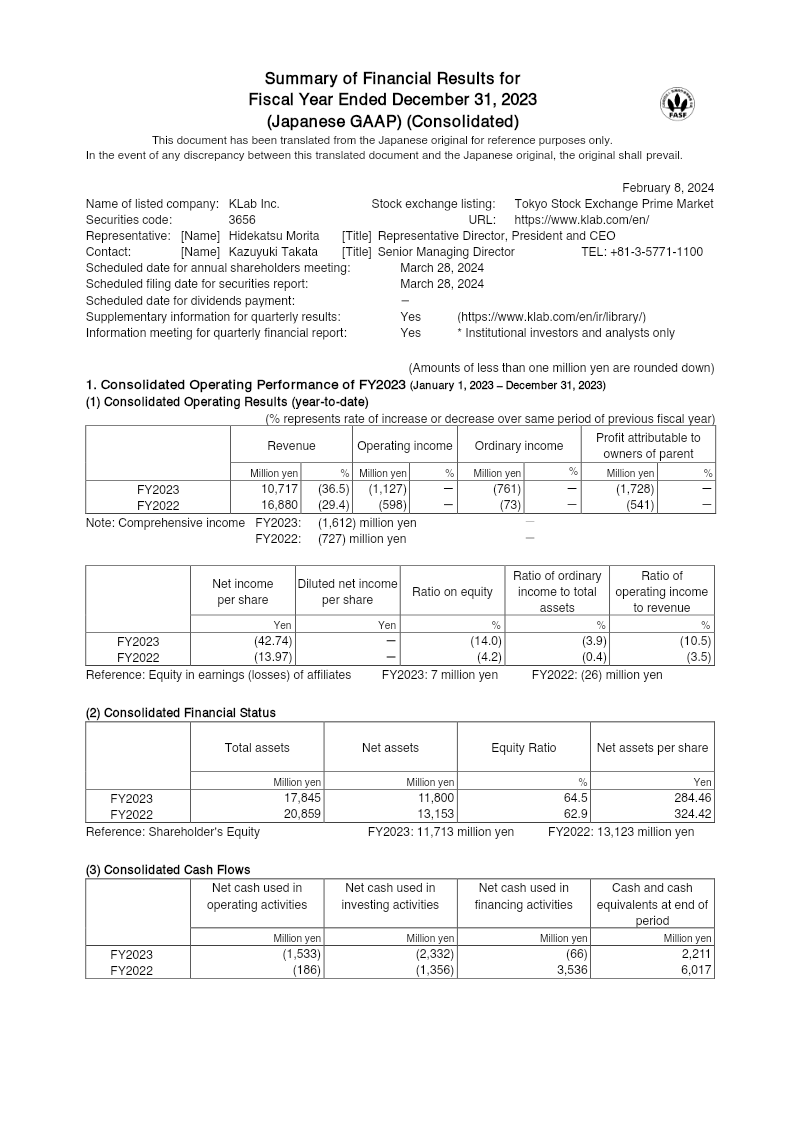
Summary of Financial Results for Fiscal Year Ended December 31, 2023
The fiscal year ended December 31, 2023, marked a period of significant financial contraction and strategic transition for the organization. Consolidated revenue fell 36.5% year-over-year to ¥10.7 billion, primarily driven by a sharp decline in income from paid users within the core game business. This downturn, exacerbated by the weakening performance of established titles such as Captain Tsubasa: Dream Team, resulted in an operating loss of ¥1.1 billion and a net loss attributable to owners of the parent of ¥1.73 billion. An extraordinary impairment loss of approximately ¥841 million on software assets further pressured the bottom line, leading to a net loss per share of 42.74 yen.
Liquidity and asset management reflected heavy reinvestment despite the operational downturn. Cash and equivalents decreased by ¥3.8 billion to end the year at ¥2.21 billion, a result of negative operating cash flow and substantial capital expenditures. Specifically, investment in intangible fixed assets reached ¥2.82 billion, with "software in progress" rising to ¥5.8 billion. This spending underscores a pivot toward major upcoming projects, most notably the high-stakes development of EA SPORTS FC™ TACTICAL. Despite these outflows, the company maintained a relatively stable equity ratio of 64.5%, supported by steady advertising revenue from its casual gaming subsidiary, GlobalGear.
Strategic shifts characterized the end of the period, including the elevation of the blockchain-related business to a reportable segment and the subsequent post-period transfer of shares in the subsidiary BLOCKSMITH&Co. Due to the inherent volatility of the mobile gaming market and the high degree of uncertainty surrounding the performance of its largest-ever development project, no financial forecast has been provided for the 2024 fiscal year. The current trajectory indicates a heavy reliance on upcoming releases to offset the diminishing returns of the existing portfolio and to stabilize the company’s long-term financial position.
- Consolidated revenue dropped 36.5% year-over-year to ¥10.7 billion, resulting in an operating loss of ¥1.1 billion and a net loss of ¥1.73 billion.
- The company recorded a net loss per share of 42.74 yen, impacted by an extraordinary impairment loss of ¥841 million on software assets.
- Cash and equivalents declined by ¥3.8 billion to ¥2.21 billion, driven by negative operating cash flow and ¥2.82 billion in intangible asset investments.
- Development spending is heavily concentrated on upcoming projects, with 'software in progress' rising to ¥5.8 billion, specifically for EA SPORTS FC™ TACTICAL.
- The company declined to provide a 2024 financial forecast, citing market volatility and uncertainty regarding the performance of its major development pipeline.
+1
KLabFeb 2024
Financial9 pages
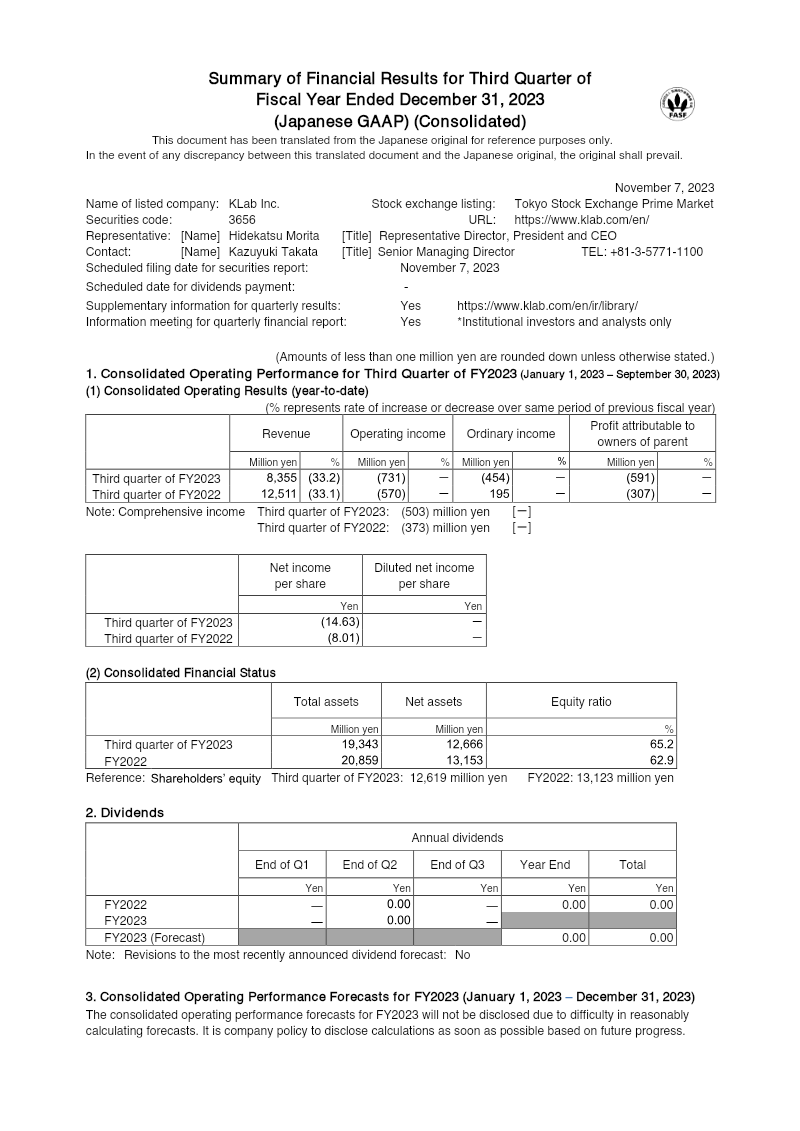
Summary of Financial Results for Third Quarter of Fiscal Year Ended December 31, 2023
This financial summary details the consolidated operating performance of KLab Inc. for the first nine months of the fiscal year ended December 31, 2023. The data reflects a significant downturn in financial performance compared to the same period in 2022. Revenue fell by 33.2% to 8,355 million yen, while the company reported an operating loss of 731 million yen and a net loss attributable to owners of the parent of 591 million yen. These results represent a deepening of losses from the previous year, where the company recorded an operating loss of 570 million yen and a net loss of 307 million yen.
The scope of the report covers the company’s primary Game Business and its "Other" segment, which transitioned from research and consulting in 2022 to blockchain-related ventures in 2023. The Game Business remains the primary revenue driver but saw a sharp decline in income from paid users, dropping from 10.8 billion yen in 2022 to 6.4 billion yen in 2023. Despite the overall revenue decline, the "Other" segment showed growth, with revenue increasing from 316 million yen to 583 million yen and shifting from a segment loss to a profit of 291 million yen.
Financial stability remains relatively steady with an equity ratio of 65.2%, up from 62.9% at the end of 2022, though total assets decreased from 20.8 billion yen to 19.3 billion yen. Notable balance sheet changes include a significant increase in software and software in progress, totaling over 6 billion yen, suggesting ongoing development investments. Due to the volatility of the mobile gaming market, the company has declined to provide a consolidated operating performance forecast for the remainder of the fiscal year, citing the difficulty of making reasonable calculations. The methodology follows Japanese GAAP consolidated standards.
- KLab Inc. reported a 33.2% year-over-year revenue decline to 8,355 million yen for the first nine months of 2023, resulting in an operating loss of 731 million yen.
- The core Game Business experienced a sharp contraction in paid user income, which fell from 10.8 billion yen in 2022 to 6.4 billion yen in 2023.
- The company's 'Other' segment, now focused on blockchain ventures, grew revenue to 583 million yen and shifted from a loss to a 291 million yen profit.
- Net loss attributable to owners of the parent widened to 591 million yen for the nine-month period, compared to a 307 million yen loss in the same period of 2022.
- KLab declined to provide a consolidated operating performance forecast for the remainder of the fiscal year, citing high volatility in the mobile gaming market.
+1
KLabNov 2023
Financial18 pages
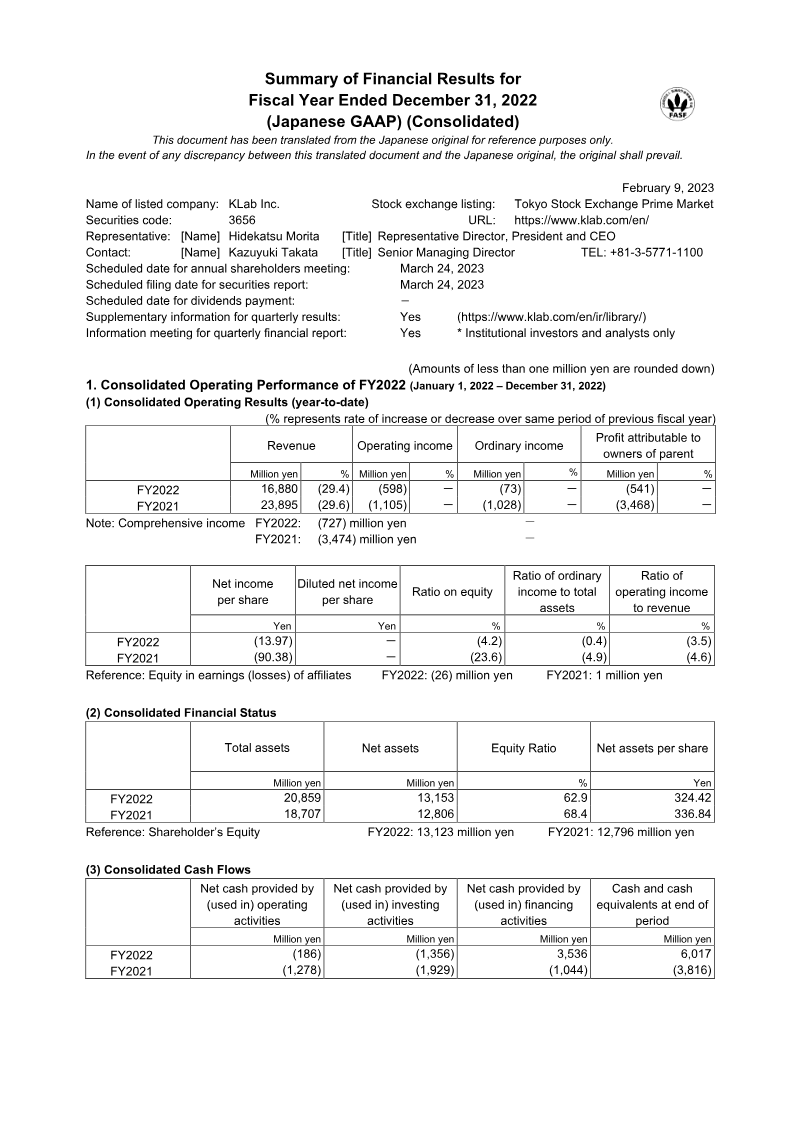
Summary of Financial Results for Fiscal Year Ended December 31, 2022 (Japanese GAAP)
KLab Inc. experienced a transitional fiscal year ending December 31, 2022, characterized by a strategic contraction in revenue alongside a significant narrowing of net losses. Total revenue declined 29.4% year-over-year to 16.88 billion yen, a downturn primarily attributed to the withdrawal of underperforming titles and sluggish sales for Captain Tsubasa: Dream Team. However, aggressive cost-cutting measures and the sustained performance of BLEACH Brave Souls allowed the company to reduce its operating loss from 1.1 billion yen to 598 million yen. Net loss attributable to owners improved substantially from 3.47 billion yen in 2021 to 541.9 million yen in 2022, bolstered by foreign exchange gains and reduced operating expenses.
The financial position of the group was stabilized through active financing, resulting in an increase in cash and cash equivalents to 6.02 billion yen. This liquidity was largely driven by 3.54 billion yen in financing activities, including the acquisition of long-term debt and the exercise of stock options, which offset negative operating and investing cash flows. While the equity ratio declined to 62.9% and net assets per share saw a slight reduction to 324.42 yen, the net loss per share narrowed significantly from 90.38 yen to 13.97 yen. The adoption of new revenue recognition standards also impacted the figures, contributing a minor decrease in reported game business revenue.
Looking forward, the company has withheld specific performance forecasts for the 2023 fiscal year due to high market volatility and the inherent difficulty in predicting hit-driven mobile gaming cycles. Growth strategies are currently centered on high-profile collaborations, specifically a co-developed title with Electronic Arts, and a planned expansion into the blockchain entertainment sector. These initiatives aim to diversify revenue streams and leverage intellectual property to return the group to profitability following this period of structural consolidation.
- KLab Inc. reported a 29.4% year-over-year revenue decline to 16.88 billion yen for the fiscal year ending December 31, 2022, driven by the withdrawal of underperforming titles and weak sales for Captain Tsubasa: Dream Team.
- Net loss attributable to owners improved significantly to 541.9 million yen in 2022, down from 3.47 billion yen in 2021, aided by reduced operating expenses and foreign exchange gains.
- Operating losses narrowed to 598 million yen from 1.1 billion yen in the previous year, supported by aggressive cost-cutting measures and the sustained performance of BLEACH Brave Souls.
- Cash and cash equivalents increased to 6.02 billion yen, bolstered by 3.54 billion yen in financing activities, including long-term debt acquisition and the exercise of stock options.
- The company withheld 2023 financial forecasts due to market volatility and the unpredictable nature of hit-driven mobile gaming cycles.
+1
KLabFeb 2023
Financial9 pages
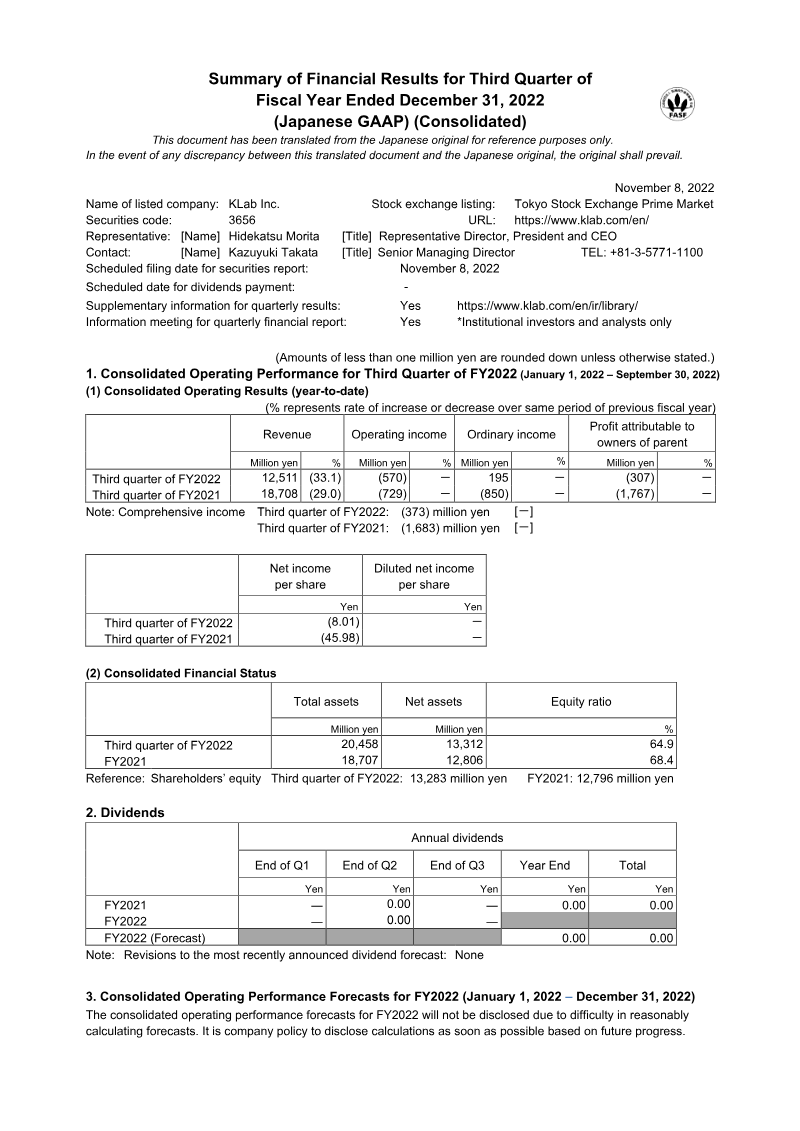
Summary of Financial Results for Third Quarter of Fiscal Year Ended December 31, 2022
The financial results for KLab Inc. during the first nine months of the fiscal year ended December 31, 2022, reveal a period of significant contraction in revenue alongside narrowing operational losses. Total revenue reached 12.5 billion yen, representing a 33.1% decrease compared to the 18.7 billion yen reported during the same period in 2021. Despite this decline, the company managed to reduce its operating loss from 729 million yen in the previous year to 570 million yen. Notably, the company achieved a positive ordinary income of 195 million yen, a recovery from an 850 million yen loss in 2021, largely bolstered by 628 million yen in foreign exchange gains.
The scope of these results covers the consolidated performance of the Japanese entity and its subsidiaries from January 1 to September 30, 2022. The primary industry segment is the Game Business, which accounted for 12.1 billion yen of total revenue, while the Research & Consulting and other businesses contributed approximately 316 million yen. Geographically, the report focuses on the Japanese market under Japanese GAAP. A significant methodology change occurred during this period with the adoption of the Accounting Standard for Revenue Recognition. This shift altered how the company recognizes income from in-game currency and licenses, resulting in a 65 million yen decrease in reported revenue for the period compared to previous accounting methods.
The consolidated financial status shows total assets increasing to 20.4 billion yen, up from 18.7 billion yen at the end of 2021, supported by a rise in cash and deposits. However, the company reported a net loss attributable to owners of the parent of 307 million yen, though this was a substantial improvement over the 1.7 billion yen loss recorded in the prior year. Due to the inherent volatility of the mobile gaming market, the company has declined to provide specific consolidated performance forecasts for the remainder of the fiscal year.
- KLab Inc. reported 12.5 billion yen in revenue for the first nine months of 2022, a 33.1% decline compared to the 18.7 billion yen recorded in the same period of 2021.
- Operating losses narrowed to 570 million yen from 729 million yen in the prior year, while net loss attributable to owners of the parent improved to 307 million yen from 1.7 billion yen.
- The company achieved a positive ordinary income of 195 million yen, a significant recovery from an 850 million yen loss in 2021, largely driven by 628 million yen in foreign exchange gains.
- The Game Business remains the primary revenue driver, contributing 12.1 billion yen of the total 12.5 billion yen revenue generated between January 1 and September 30, 2022.
- Adoption of the new Accounting Standard for Revenue Recognition regarding in-game currency and licenses resulted in a 65 million yen decrease in reported revenue for the period.
+1
KLabNov 2022
Financial10 pages
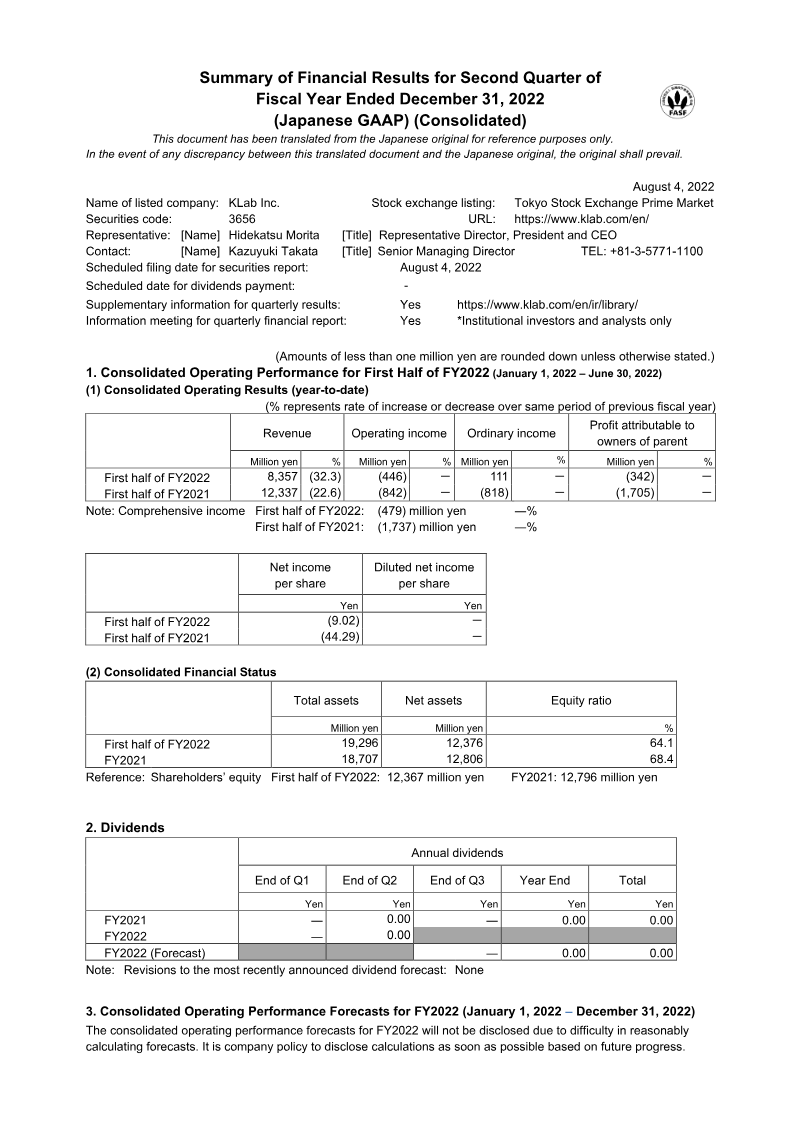
Summary of Financial Results for Second Quarter of Fiscal Year Ended December 31, 2022
KLab Inc. reports consolidated financial results for the first half of fiscal year 2022, covering the period from January 1 to June 30, 2022. The primary purpose of the disclosure is to provide a comprehensive overview of the company’s financial health, operating performance, and strategic adjustments under Japanese GAAP. The scope focuses on the Japanese mobile gaming market and related research and consulting segments.
Financial data indicates a challenging period characterized by a significant decline in revenue, which fell 32.3% year-over-year to 8,357 million yen. Despite this contraction, the company narrowed its operating loss to 446 million yen compared to a loss of 842 million yen in the same period of the previous year. Ordinary income turned positive at 111 million yen, largely bolstered by 465 million yen in foreign exchange gains. However, the company recorded a net loss attributable to owners of the parent of 342 million yen, impacted by extraordinary losses including a 410 million yen impairment loss on software within the Game Business segment.
Methodologically, the results reflect the first-time application of the Accounting Standard for Revenue Recognition. This change shifted revenue recognition for in-game currency from the time of exchange to an estimated period of use, resulting in a 53 million yen decrease in reported revenue for the period. The consolidated balance sheet shows total assets of 19,296 million yen and a solid equity ratio of 64.1%.
Looking ahead, the company maintains a policy of non-disclosure regarding full-year forecasts due to the volatility of the mobile gaming industry. Significant subsequent events include the issuance of the 18th Stock Acquisition Rights to Morgan Stanley MUFG Securities to procure approximately 5.1 billion yen and the establishment of a 4 billion yen credit line with MUFG Bank to ensure future liquidity and financial stability.
- KLab Inc. reported a 32.3% year-over-year revenue decline to 8,357 million yen for the first half of 2022.
- The company recorded a net loss of 342 million yen, driven by a 410 million yen impairment loss on software within its Game Business segment.
- Operating losses narrowed to 446 million yen from 842 million yen in the prior-year period, while ordinary income reached 111 million yen, supported by 465 million yen in foreign exchange gains.
- To bolster liquidity, the company secured approximately 5.1 billion yen through the issuance of stock acquisition rights to Morgan Stanley MUFG Securities and established a 4 billion yen credit line with MUFG Bank.
- The adoption of new revenue recognition standards for in-game currency reduced reported revenue by 53 million yen for the period.
+1
KLabAug 2022
Financial18 pages
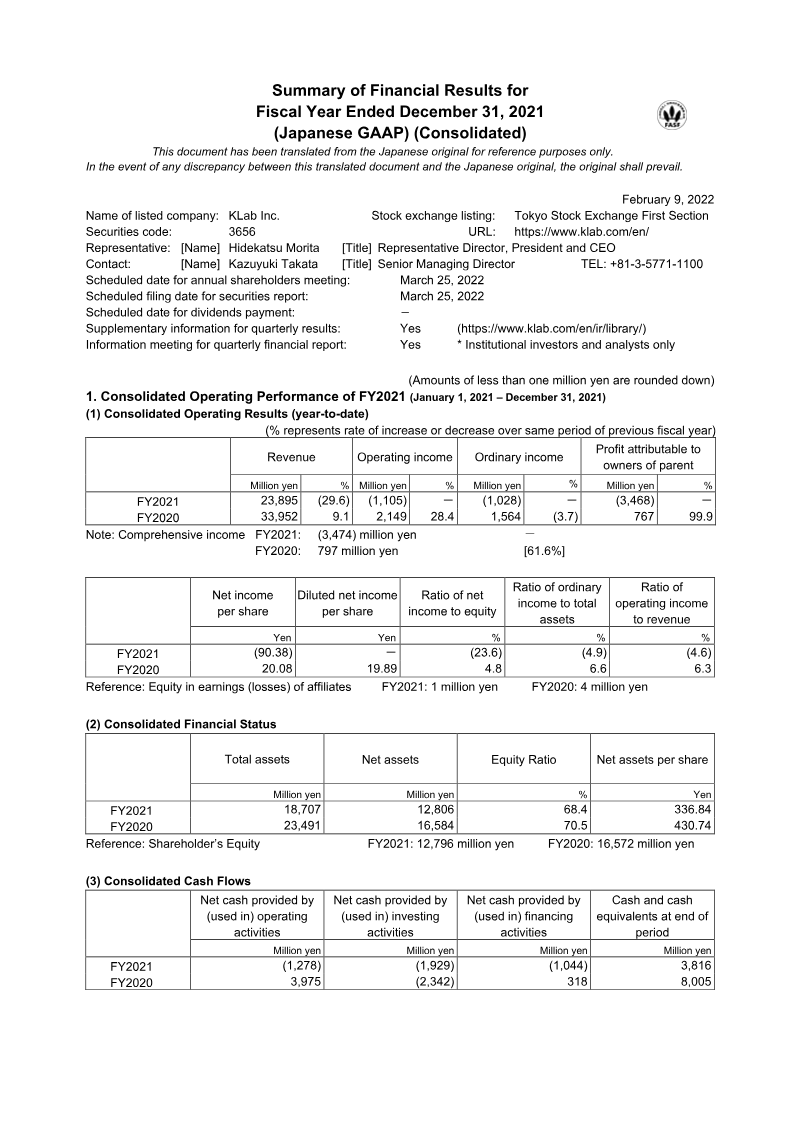
Summary of Financial Results for Fiscal Year Ended December 31, 2021 (Japanese GAAP)
KLab Inc. experienced a significant financial downturn during the fiscal year ended December 31, 2021, characterized by a sharp transition from profitability to substantial losses. Revenue fell by 29.6% to ¥23.9 billion, down from ¥33.9 billion the previous year. This decline was primarily driven by the underperformance of existing titles, most notably Love Live! School Idol Festival ALL STARS, which faced intensified market competition. The company shifted from a ¥2.1 billion operating profit in 2020 to a ¥1.1 billion operating loss, while the net loss attributable to owners reached ¥3.47 billion. This volatility resulted in a net loss of ¥90.38 per share, a stark reversal from the ¥20.08 per share profit recorded in the prior fiscal year.
The core Game Business segment saw its profit margin erode by over 60%, ending at ¥2.57 billion. Financial stability was further impacted by ¥1.68 billion in extraordinary impairment losses on software assets and negative operating cash flows. Consequently, total net assets decreased from ¥16.58 billion to ¥12.81 billion, and cash and cash equivalents plummeted by ¥4.19 billion to end the period at ¥3.82 billion. These figures reflect both the high costs of intangible asset development and the diminishing returns from the current mobile gaming portfolio within the Japanese market.
Looking forward, the outlook remains cautious as earnings forecasts for 2022 have been withheld. This decision stems from high levels of market volatility and uncertainty regarding the release schedule of a major collaborative project with Electronic Arts. While the company continues to focus on its game business, the depletion of cash reserves and the significant drop in net assets per share highlight a period of contraction and strategic transition. Management remains focused on navigating these headwinds through upcoming pipeline developments, though the immediate financial impact of these initiatives remains difficult to quantify.
- KLab Inc. swung from a ¥2.1 billion operating profit in 2020 to a ¥1.1 billion operating loss in 2021, with net losses reaching ¥3.47 billion.
- Annual revenue declined by 29.6% to ¥23.9 billion, largely due to the underperformance of existing titles like 'Love Live! School Idol Festival ALL STARS' amid increased market competition.
- The company's cash and cash equivalents dropped by ¥4.19 billion to ¥3.82 billion, while total net assets decreased from ¥16.58 billion to ¥12.81 billion.
- Profit margins in the core Game Business segment eroded by over 60%, falling to ¥2.57 billion.
- Financial results were further impacted by ¥1.68 billion in extraordinary impairment losses on software assets.
+2
KLabFeb 2022
Financial8 pages
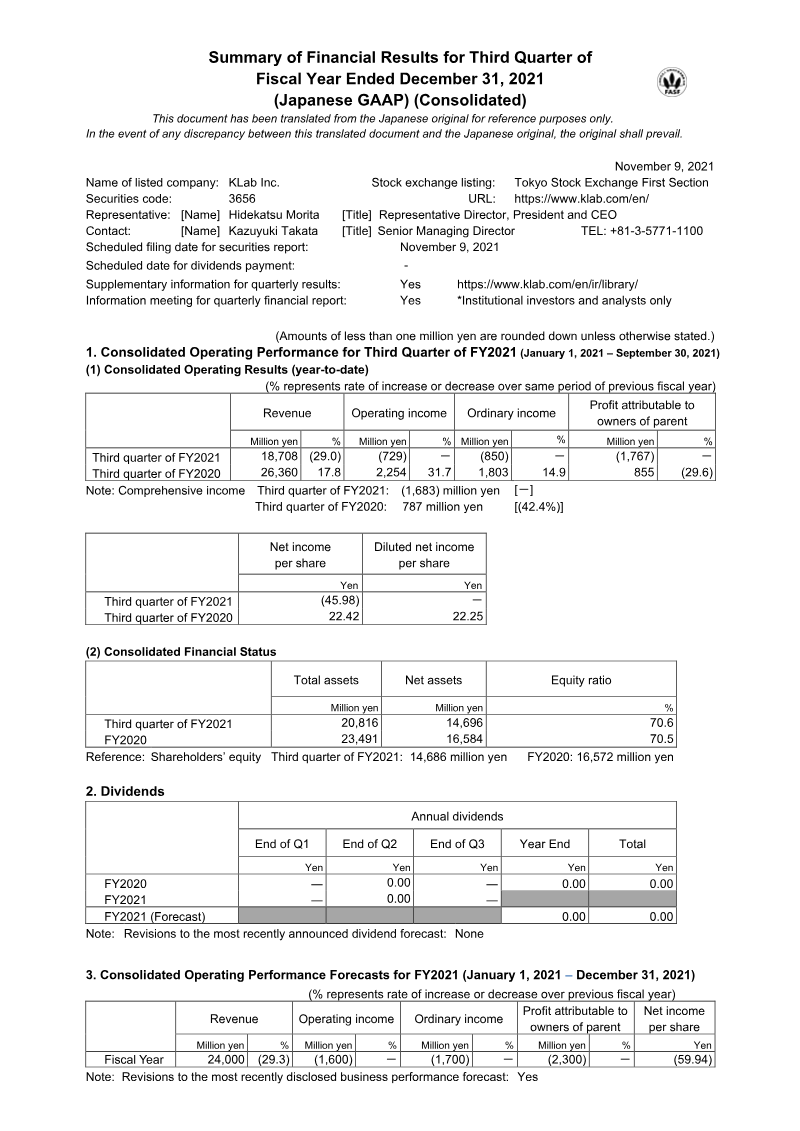
Summary of Financial Results for Third Quarter of Fiscal Year Ended December 31, 2021
KLab Inc. reported a significant downturn in financial performance for the first nine months of the fiscal year ended December 31, 2021. Consolidated revenue fell by 29.0% year-over-year to 18.7 billion yen, resulting in an operating loss of 729 million yen and a net loss attributable to owners of the parent of 1.76 billion yen. This represents a sharp reversal from the same period in 2020, which saw 26.3 billion yen in revenue and 855 million yen in profit.
The decline is primarily attributed to the core Game Business segment, where revenue dropped from 26.1 billion yen to 18.4 billion yen. Profitability was further impacted by a substantial increase in extraordinary losses, specifically impairment losses, which rose from 498 million yen in the previous year to 1.54 billion yen. While selling, general, and administrative expenses were reduced by approximately 25% to 2.7 billion yen, these savings were insufficient to offset the contraction in gross profit.
Geographically focused on the Japanese market but operating globally, the company’s balance sheet shows total assets decreased to 20.8 billion yen from 23.4 billion yen at the end of 2020. Despite the losses, the equity ratio remained stable at 70.6%. The full-year forecast for 2021 anticipates continued challenges, with projected annual revenue of 24.0 billion yen and a net loss of 2.3 billion yen. No dividends were paid or forecasted for the fiscal year. The results were prepared under Japanese GAAP and include data from January 1 to September 30, 2021.
- KLab Inc. reported a 29.0% year-over-year revenue decline to 18.7 billion yen for the first nine months of 2021, resulting in a net loss of 1.76 billion yen.
- The core Game Business segment drove the downturn, with segment revenue falling from 26.1 billion yen in 2020 to 18.4 billion yen in 2021.
- Profitability was severely impacted by a surge in impairment losses, which tripled year-over-year from 498 million yen to 1.54 billion yen.
- Despite a 25% reduction in selling, general, and administrative expenses to 2.7 billion yen, the company could not offset the contraction in gross profit.
- The company projects a full-year net loss of 2.3 billion yen for 2021 and has confirmed that no dividends will be paid for the fiscal year.
+1
KLabNov 2021
Financial8 pages
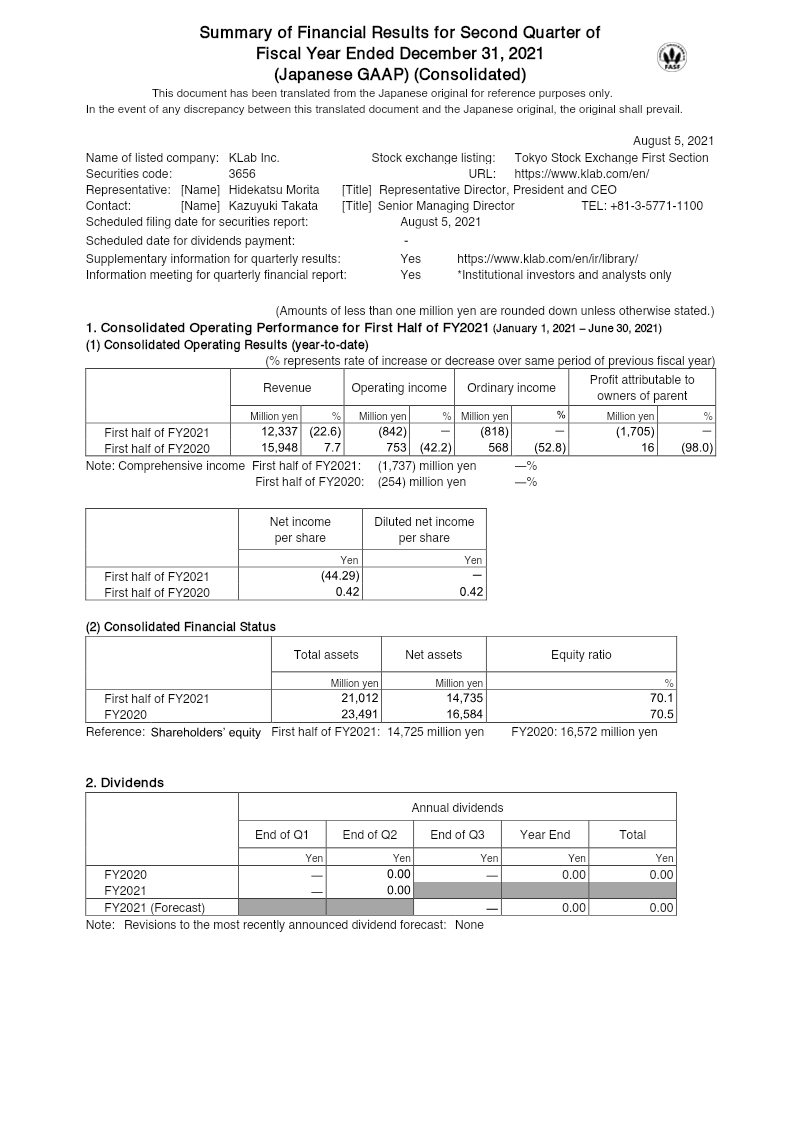
Consolidated Financial Results for the Second Quarter of the Fiscal Year Ending December 31, 2021: Japanese GAAP
KLab Inc. reported a significant downturn in financial performance for the first half of the fiscal year ending December 31, 2021. Revenue fell by 22.6% year-over-year to 12.3 billion yen, resulting in an operating loss of 842 million yen and a net loss attributable to owners of the parent of 1.7 billion yen. This represents a sharp reversal from the same period in 2020, which saw a modest profit. The decline was primarily driven by a contraction in the core game business, where revenue dropped from 15.8 billion yen to 12.1 billion yen.
The financial results were further impacted by substantial extraordinary losses, specifically a 1.54 billion yen impairment loss. This follows a previous impairment of goodwill in the research and consulting segment during the prior year. Consequently, the company’s total assets decreased from 23.5 billion yen at the end of 2020 to 21.0 billion yen by June 30, 2021. Despite these losses, the company maintained a stable equity ratio of 70.1%.
Geographically focused on the Japanese market and listed on the Tokyo Stock Exchange, the company revised its full-year forecasts to reflect ongoing volatility. Projections for the fiscal year end suggest a wide range of potential outcomes, with revenue expected between 27 billion and 32 billion yen and net results ranging from a 1.3 billion yen loss to a 200 million yen profit. No dividends were paid or forecasted for the period. The data was prepared in accordance with Japanese GAAP and covers the consolidated performance of the parent company and its subsidiaries.
- KLab Inc. reported a 22.6% year-over-year revenue decline to 12.3 billion yen for the first half of 2021, resulting in an operating loss of 842 million yen and a net loss of 1.7 billion yen.
- The core game business experienced a significant contraction, with revenue falling from 15.8 billion yen in the first half of 2020 to 12.1 billion yen in the same period of 2021.
- Financial performance was further impacted by a 1.54 billion yen impairment loss, contributing to a reduction in total assets from 23.5 billion yen at the end of 2020 to 21.0 billion yen by June 30, 2021.
- The company revised its full-year fiscal projections to a wide range, forecasting revenue between 27 billion and 32 billion yen and net results ranging from a 1.3 billion yen loss to a 200 million yen profit.
- Despite the reported losses, KLab Inc. maintained a stable equity ratio of 70.1% as of June 30, 2021.
+1
KLabAug 2021
Financial9 pages
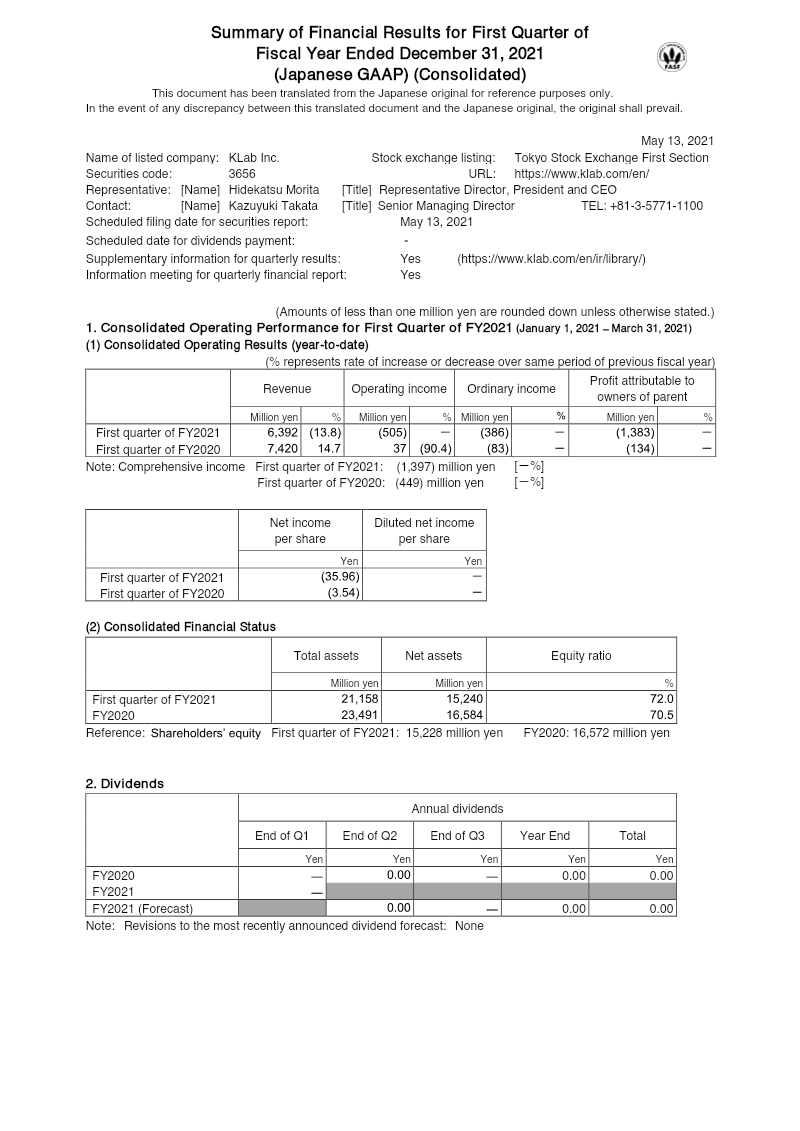
Consolidated Financial Results for the First Quarter of the Fiscal Year Ending December 31, 2021
KLab Inc. reported a significant downturn in financial performance for the first quarter of the fiscal year ending December 31, 2021. Revenue fell 13.8% year-over-year to 6.39 billion yen, resulting in an operating loss of 505 million yen compared to a small profit in the previous year. The company’s bottom line was further impacted by a substantial extraordinary loss of 1.54 billion yen due to impairment losses on software within the Game Business segment. Consequently, the loss attributable to owners of the parent widened to 1.38 billion yen, or 35.96 yen per share.
The report covers the Japanese mobile gaming market for the three-month period from January 1 to March 31, 2021. Despite the quarterly losses, the company maintained a solid equity ratio of 72.0%, though total assets decreased from 23.4 billion yen to 21.1 billion yen. Management revised its full-year forecasts to reflect a range of potential outcomes, projecting annual revenue between 27 billion and 32 billion yen, with results potentially varying from a net loss of 1.3 billion yen to a modest profit of 200 million yen.
Strategic shifts highlighted include an aggressive expansion into the casual gaming sector to achieve sustainable mid-to-long-term growth. This strategy was underscored by the subsequent acquisition of GlobalGear Co., Ltd. in April 2021, a developer known for high-volume title releases and hit games with over 10 million downloads. Additionally, the board authorized a share repurchase program of up to 900,000 shares to improve capital efficiency and shareholder value. These results were prepared in accordance with Japanese GAAP and reflect consolidated performance across the company's core gaming and research segments.
- KLab Inc. reported a Q1 2021 net loss of 1.38 billion yen, driven by a 13.8% year-over-year revenue decline to 6.39 billion yen and an operating loss of 505 million yen.
- The company recorded a 1.54 billion yen extraordinary loss due to software impairments within its Game Business segment.
- Management revised its full-year 2021 outlook, projecting annual revenue between 27 billion and 32 billion yen with a potential net result ranging from a 1.3 billion yen loss to a 200 million yen profit.
- To pivot toward sustainable growth, KLab acquired casual game developer GlobalGear Co., Ltd. in April 2021, targeting high-volume title production.
- Despite the quarterly losses, the company maintained a solid equity ratio of 72.0%, though total assets declined from 23.4 billion yen to 21.1 billion yen.
+2
KLabMay 2021
Financial17 pages
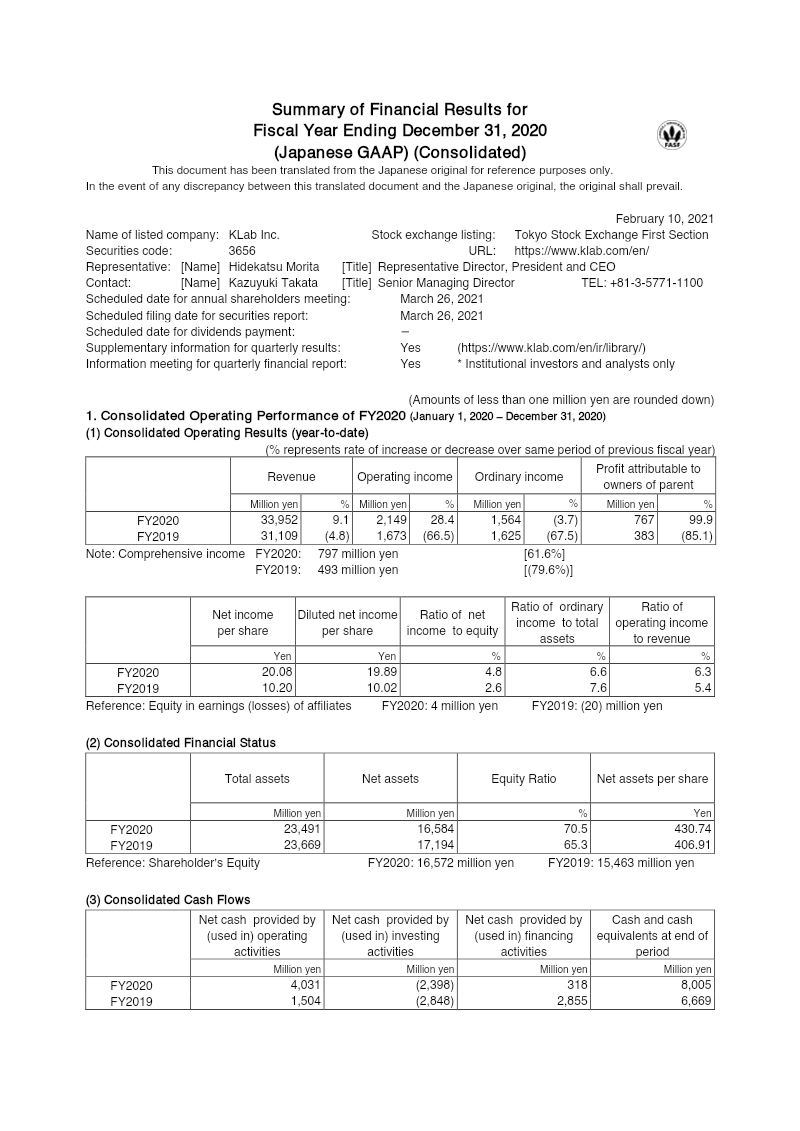
Summary of Financial Results for Fiscal Year Ending December 31, 2020 (Japanese GAAP) (Consolidated)
KLab Inc. achieved a resilient financial performance for the fiscal year ending December 31, 2020, characterized by a 9.1% year-on-year revenue increase to 33.95 billion yen. This growth was primarily driven by the sustained success of core intellectual properties within the Game Business segment, including titles such as BLEACH Brave Souls, Captain Tsubasa: Dream Team, and Love Live! School Idol Festival ALL STARS. Strategic expansions into the Steam platform and broader Asian markets allowed legacy titles to reach significant milestones, such as 50 million downloads, while the implementation of subscription models and in-game advertising further diversified the revenue base.
Profitability metrics showed significant improvement, with operating income rising 28.4% to 2.15 billion yen. This increase was largely facilitated by a reduction in selling, general, and administrative expenses, specifically through optimized public relations and promotional spending. Net income attributable to owners of the parent doubled year-over-year to 767 million yen, effectively increasing earnings per share from 10.20 yen to 20.08 yen. These gains occurred despite external pressures, including a substantial foreign exchange loss of 670.8 million yen and costs associated with goodwill amortization.
The company concluded the fiscal year with a strengthened liquidity position, reporting 8.01 billion yen in cash and equivalents. This financial stability was supported by robust operating cash flows of 3.98 billion yen and successful financing activities. Despite the global economic volatility introduced by the COVID-19 pandemic, the transition to telecommuting and multi-platform development strategies ensured operational continuity. Looking forward, revenue for the 2021 fiscal year is projected to remain stable between 33 and 35 billion yen, reflecting a conservative yet steady outlook for the Japanese and international mobile gaming markets.
- KLab Inc. grew annual revenue by 9.1% year-on-year to 33.95 billion yen for the fiscal year ending December 31, 2020.
- Operating income increased by 28.4% to 2.15 billion yen, driven primarily by optimized marketing and promotional spending.
- Net income attributable to owners of the parent doubled year-over-year to 767 million yen, resulting in earnings per share rising from 10.20 yen to 20.08 yen.
- Revenue growth was anchored by core titles including BLEACH Brave Souls, Captain Tsubasa: Dream Team, and Love Live! School Idol Festival ALL STARS.
- The company ended the fiscal year with 8.01 billion yen in cash and equivalents, supported by 3.98 billion yen in operating cash flows.
+1
KLabFeb 2021
Financial8 pages
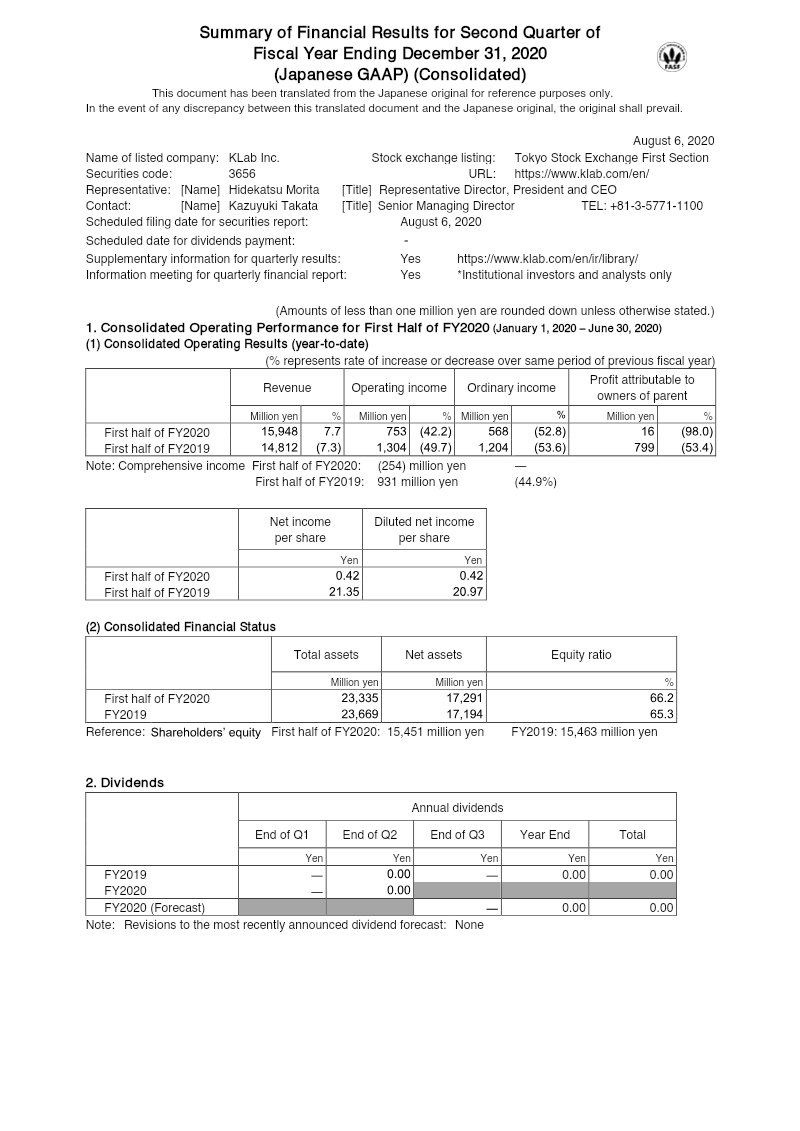
Consolidated Financial Results for the First Half of Fiscal Year 2020
KLab Inc. reported consolidated financial results for the first half of fiscal year 2020, covering the period from January 1 to June 30, 2020. The data reveals a divergence between top-line growth and bottom-line profitability. Revenue increased by 7.7% year-over-year to 15.9 billion yen, driven primarily by the core Game Business segment, which accounted for 15.8 billion yen of total turnover. Despite this growth, operating income fell by 42.2% to 753 million yen, and profit attributable to owners of the parent plummeted by 98% to just 16 million yen.
The sharp decline in profitability is attributed to rising costs and significant non-operating and extraordinary items. The cost of sales rose from 10.9 billion yen to 12.8 billion yen, while ordinary income was pressured by 243 million yen in foreign exchange losses. Furthermore, the company recorded a substantial extraordinary impairment loss of 498.8 million yen related to goodwill in its Research and Consulting Business, after determining that the segment lacked its initially anticipated profitability.
Geographically focused on the Japanese market but with international exposure, the company maintained a stable equity ratio of 66.2% with total assets valued at 23.3 billion yen. Looking ahead, the full-year forecast for 2020 suggests significant volatility, with revenue projected between 33 billion and 36 billion yen. While the company anticipates a potential recovery in net income, the wide forecast range reflects ongoing uncertainty in the operating environment. No dividends were paid during the period, consistent with previous fiscal cycles.
- KLab Inc. reported a 98% year-over-year decline in profit attributable to owners of the parent, falling to 16 million yen for the first half of 2020.
- Operating income dropped by 42.2% to 753 million yen, despite a 7.7% increase in total revenue to 15.9 billion yen.
- The company recorded a 498.8 million yen extraordinary impairment loss on goodwill within its Research and Consulting Business due to underperformance.
- Cost of sales rose significantly from 10.9 billion yen to 12.8 billion yen, while foreign exchange losses further pressured ordinary income by 243 million yen.
- The core Game Business segment remains the primary revenue driver, accounting for 15.8 billion yen of the total 15.9 billion yen turnover.
+2
KLabAug 2020
Financial17 pages
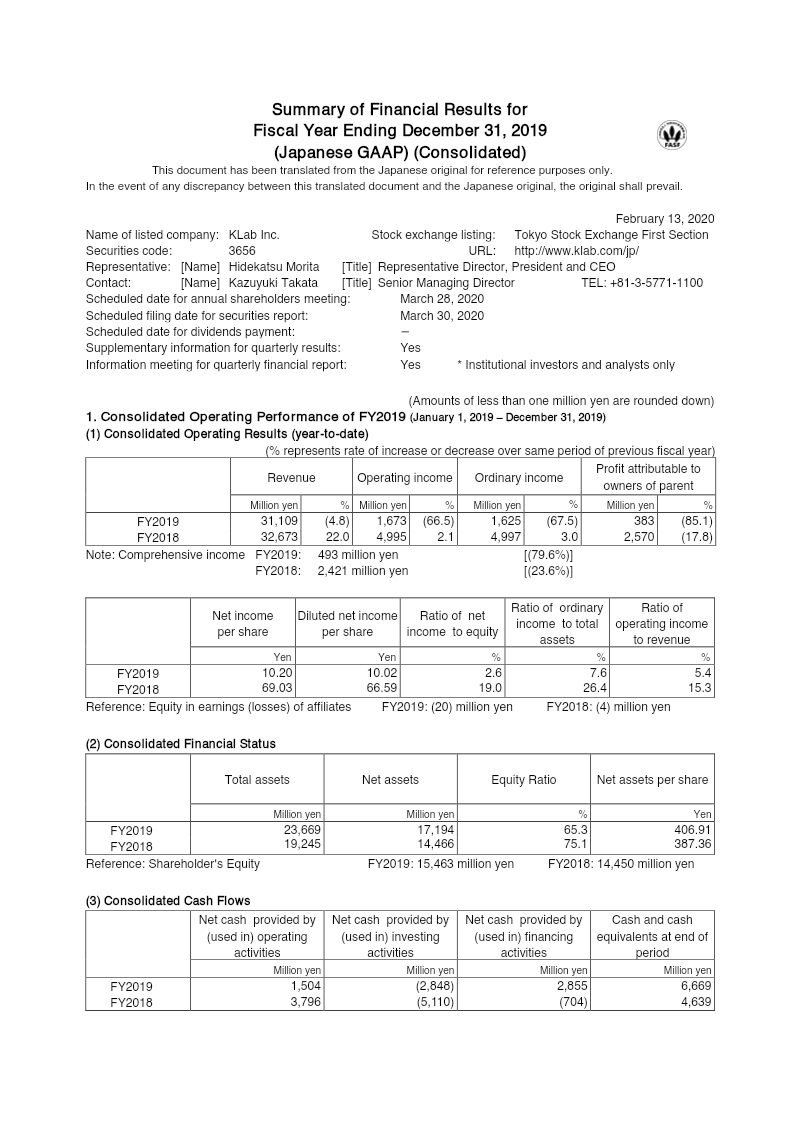
Summary of Financial Results for Fiscal Year Ending December 31, 2019 (Japanese GAAP) (Consolidated)
The fiscal year ending December 31, 2019, was characterized by a contraction in profitability for KLab Inc. despite the continued global strength of its core intellectual properties. Total revenue declined by 4.8% to 31.1 billion yen, while net profit experienced a sharp 85.1% drop, falling to 383 million yen. This downturn was primarily driven by rising labor costs, increased depreciation, and a substantial 1.3 billion yen impairment loss associated with the title Magatsu Wahrheit. While established games such as Captain Tsubasa: Dream Team and BLEACH Brave Souls maintained strong international performance, the natural decline of older titles and high operational expenses significantly compressed operating income from 5.0 billion yen to 1.7 billion yen.
The Game Business remains the central pillar of the organization, accounting for nearly 99% of total revenue. Despite the decline in net income per share from 69.03 yen to 10.20 yen, the corporate balance sheet showed resilience. Total assets grew to 23.6 billion yen, and net assets increased to 17.2 billion yen, supported by higher retained earnings and the strategic acquisition of 2.3 billion yen in long-term debt. This influx of capital helped stabilize cash and equivalents at 6.7 billion yen, providing a buffer against the year’s reduced operating cash flows.
Looking toward the 2020 fiscal year, revenue is projected to recover to a range between 35 and 40 billion yen. This forecast reflects an aggressive growth strategy dependent on the successful lifecycle management of existing titles and the performance of new releases. While the 2019 results highlight the volatility inherent in the mobile gaming sector and the impact of high development costs on margins, the expansion of software assets and a strengthened capital base suggest a focus on long-term scaling within the Japanese and global markets.
- KLab Inc. experienced a significant profitability contraction in fiscal year 2019, with net profit falling 85.1% to 383 million yen and operating income dropping from 5.0 billion yen to 1.7 billion yen.
- Total revenue for the year declined by 4.8% to 31.1 billion yen, primarily due to the natural lifecycle decline of older titles and high operational expenses.
- A substantial 1.3 billion yen impairment loss related to the title 'Magatsu Wahrheit' significantly impacted the company's bottom line.
- The Game Business remains the company's primary revenue driver, accounting for nearly 99% of total revenue, with 'Captain Tsubasa: Dream Team' and 'BLEACH Brave Souls' serving as key international performers.
- Despite reduced operating cash flows, the company maintained a resilient balance sheet with total assets growing to 23.6 billion yen and cash and equivalents stabilized at 6.7 billion yen through 2.3 billion yen in new long-term debt.
+1
KLabFeb 2020