Updated Mar 21, 2026 by KLab
Financial
Published by KLab
Summary of Financial Results for Fiscal Year Ending December 31, 2019 (Japanese GAAP) (Consolidated) This document has been translated from the Japanese original for reference purposes only. In the event of any discrepancy between this translated document and the Japanese original, the original shall prevail. Name of listed company: KLab Inc.
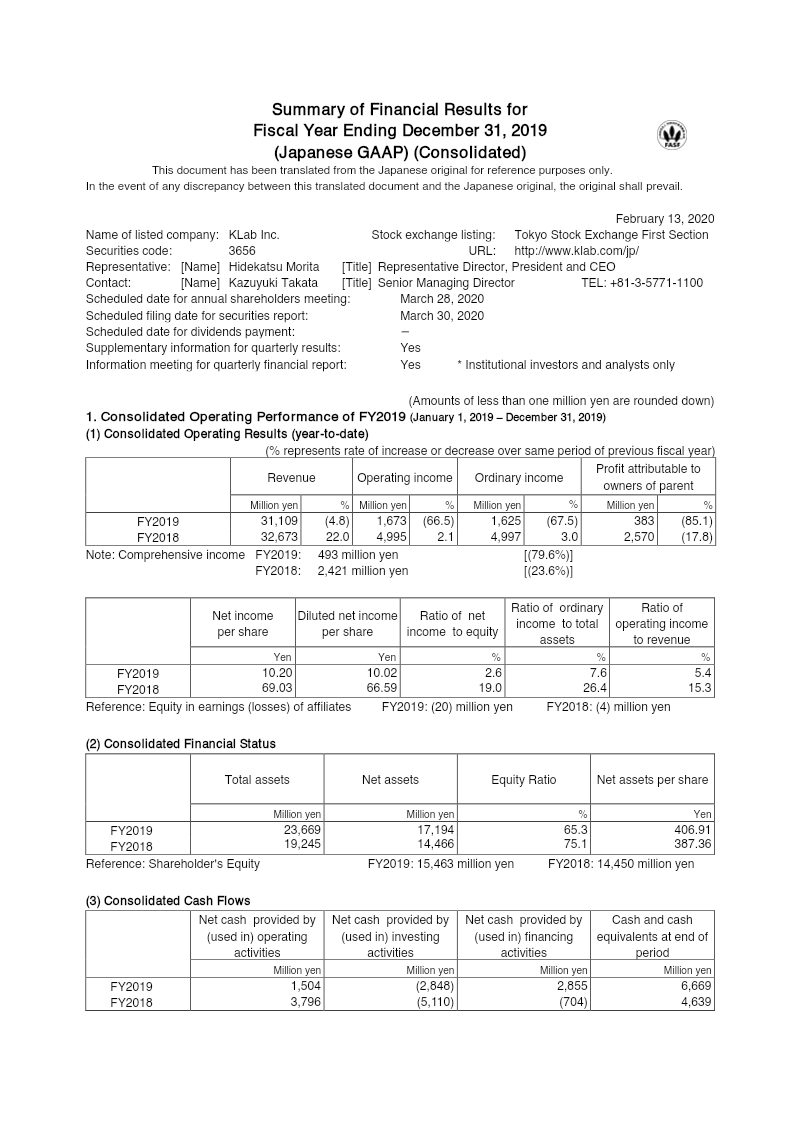
Summary of Financial Results for Fiscal Year Ending December 31, 2019 (Japanese GAAP) (Consolidated) This document has been translated from the Japanese original for reference purposes only. In the event of any discrepancy between this translated document and the Japanese original, the original shall prevail. February 13, 2020 Name of listed company: KLab Inc. Stock exchange listing: Tokyo Stock Exchange First Section Securities code: 3656 URL: http://www.klab.com/jp/ Representative: [Name] Hidekatsu Morita [Title] Representative Director, President and CEO Contact: [Name] Kazuyuki Takata [Title] Senior Managing Director TEL: +81-3-5771-1100 Scheduled date for annual shareholders meeting: March 28, 2020 Scheduled filing date for securities report: March 30, 2020 Scheduled date for dividends payment: - Supplementary information for quarterly results: Yes Information meeting for quarterly financial report: Yes * Institutional investors and analysts only (Amounts of less than one million yen are rounded down) 1. Consolidated Operating Performance of FY2019 (January 1, 2019 – December 31, 2019) (1) Consolidated Operating Results (year-to-date) (% represents rate of increase or decrease over same period of previous fiscal year) Revenue Operating income Ordinary income Profit attributable to owners of parent Million yen % Million yen % Million yen % Million yen % FY2019 31,109 (4.8) 1,673 (66.5) 1,625 (67.5) 383 (85.1) FY2018 32,673 22.0 4,995 2.1 4,997 3.0 2,570 (17.8) Note: Comprehensive income FY2019: 493 million yen [(79.6%)] FY2018: 2,421 million yen [(23.6%)]
fit attributable to owners of parent Million yen % Million yen % Million yen % Million yen % FY2019 31,109 (4.8) 1,673 (66.5) 1,625 (67.5) 383 (85.1) FY2018 32,673 22.0 4,995 2.1 4,997 3.0 2,570 (17.8) Note: Comprehensive income FY2019: 493 million yen [(79.6%)] FY2018: 2,421 million yen [(23.6%)] Net income Diluted net income Ratio of net Ratio of ordinary Ratio of per share per share income to equity income to total operating income assets to revenue Yen Yen % % % FY2019 10.20 10.02 2.6 7.6 5.4 FY2018 69.03 66.59 19.0 26.4 15.3 Reference: Equity in earnings (losses) of affiliates FY2019: (20) million yen FY2018: (4) million yen (2) Consolidated Financial Status Total assets Net assets Equity Ratio Net assets per share Million yen Million yen % Yen FY2019 23,669 17,194 65.3 406.91 FY2018 19,245 14,466 75.1 387.36 Reference: Shareholder’s Equity FY2019: 15,463 million yen FY2018: 14,450 million yen (3) Consolidated Cash Flows Net cash provided by Net cash provided by Net cash provided by Cash and cash (used in) operating (used in) investing (used in) financing equivalents at end of activities activities activities period Million yen Million yen Million yen Million yen FY2019 1,504 (2,848) 2,855 6,669 FY2018 3,796 (5,110) (704) 4,639
2. Dividends Annual dividends Total Dividend Ratio of amount of payout dividends to End of Q1 End of Q2 End of Q3 Year end Total dividends ratio net assets (Total) (Consolidated) (Consolidated) Yen Yen Yen Yen Yen Million Yen % % FY2018 - 0.00 - 0.00 0.00 - - - FY2019 - 0.00 - 0.00 0.00 - - - FY2020 - 0.00 - 0.00 0.00 - (Forecast) 3. Consolidated Operating Performance Forecasts for FY2020 (January 1, 2020 – December 31, 2020) (% represents rate of increase or decrease over same period of previous fiscal year) Revenue Operating income Ordinary income Profit attributable to Net income owners of parent per share Million yen % Million yen % Million yen % Million yen % Yen Fiscal Year ~40,000 28.6 3,000 79.3 3,000 84.6 2,100 447.1 55.26 35,000 ~12.5 ~1,000 ~-40.3 ~1,000 ~-38.5 ~750 ~95.4 ~19.74 The consolidated operating performance forecasts for FY2020 are shown in a range format. For more information on performance forecasts, please refer to “1. Qualitative Information on Management Performance; (4) Forecasts and Various Factors in the Future” on page 3 of Supporting Information. ■ Explanatory Notes (1) Changes to major subsidiaries during the period: None (Changes to specified subsidiaries accompanying changes in scope of consolidation) (2) Changes to accounting policies, estimates, and restatements ① Changes to accounting revision of accounting standards: None ② Changes other than ①: None ③ Changes to accounting estimates: None ④ Restatements: None
hanges to specified subsidiaries accompanying changes in scope of consolidation) (2) Changes to accounting policies, estimates, and restatements ① Changes to accounting revision of accounting standards: None ② Changes other than ①: None ③ Changes to accounting estimates: None ④ Restatements: None (3) Number of outstanding shares (common shares) ① Period end outstanding shares FY2019 38,171,900 shares FY2018 37,696,200 shares (including treasury shares) ② Period end treasury shares FY2019 170,000 shares FY2018 390,500 shares ③ Average outstanding shares FY2019 37,647,099 shares FY2018 37,227,934 shares during the period [Reference] Summary of Non-Consolidated Operating Performance 1. Non-Consolidated Operating Performance for FY2019 (January 1, 2019 – December 31, 2019) (1) Non-Consolidated Operating Results (% represents rate of increase or decrease over same period of previous fiscal year) Revenue Operating Income Ordinary income Net income Million yen % Million yen % Million yen % Million yen % FY2019 30,802 (4.9) 1,766 (64.9) 2,029 (60.7) 1,191 (56.7) FY2018 32,395 21.7 5,028 1.6 5,164 6.5 2,749 (5.7) Net income Diluted net income per share per share Yen Yen FY2019 31.65 31.10 FY2018 73.85 71.23
(2) Non-Consolidated Financial Status Total assets Net assets Equity ratio Net assets per share Million yen Million yen % Yen FY2019 22,427 15,980 71.2 420.16 FY2018 19,212 14,206 73.9 380.42 Reference: Shareholder’s Equity FY2019: 15,966 million yen FY2018: 14,191 million yen * The summary of financial results are not subject to audit procedures.
Supporting Information INDEX 1. Qualitative Information on Management Performance 2 (1) Analysis of Operating Results 2 (2) Analysis of Financial Status 2 (3) Analysis of Cash Flows 2 (4) Forecasts and Various Factors in the Future 3 2. Rationale Behind the Choice of Accounting Standards 3 3. Consolidated Financial Statements 4 (1) Consolidated Balance Sheets 4 (2) Consolidated Statements of Income and Comprehensive Income 6 (3) Consolidated Statements of Changes in Equity 8 (4) Consolidated Statements of Cash Flows 10 (5) Notes Related to Consolidated Financial Statements 12 (Notes Related to Ongoing Concern Assumptions) 12 (Segment information) 12 (Per Share Data) 14 (Significant Subsequent Events) 14
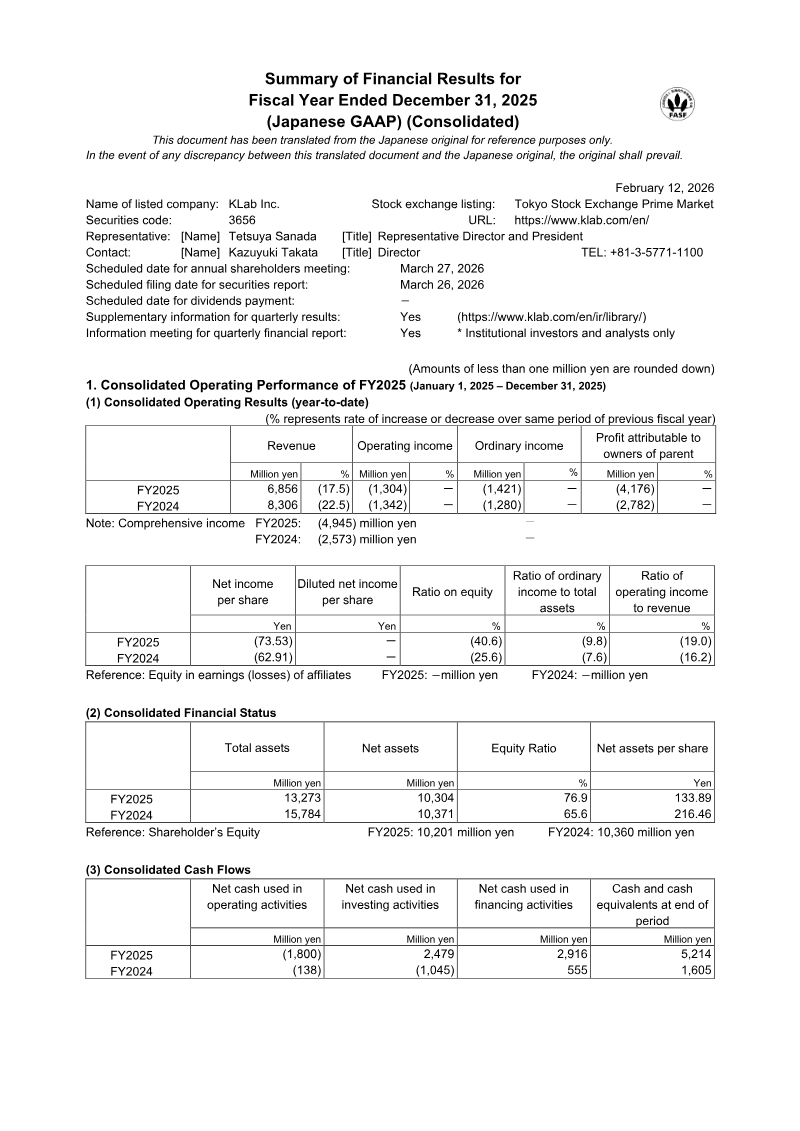
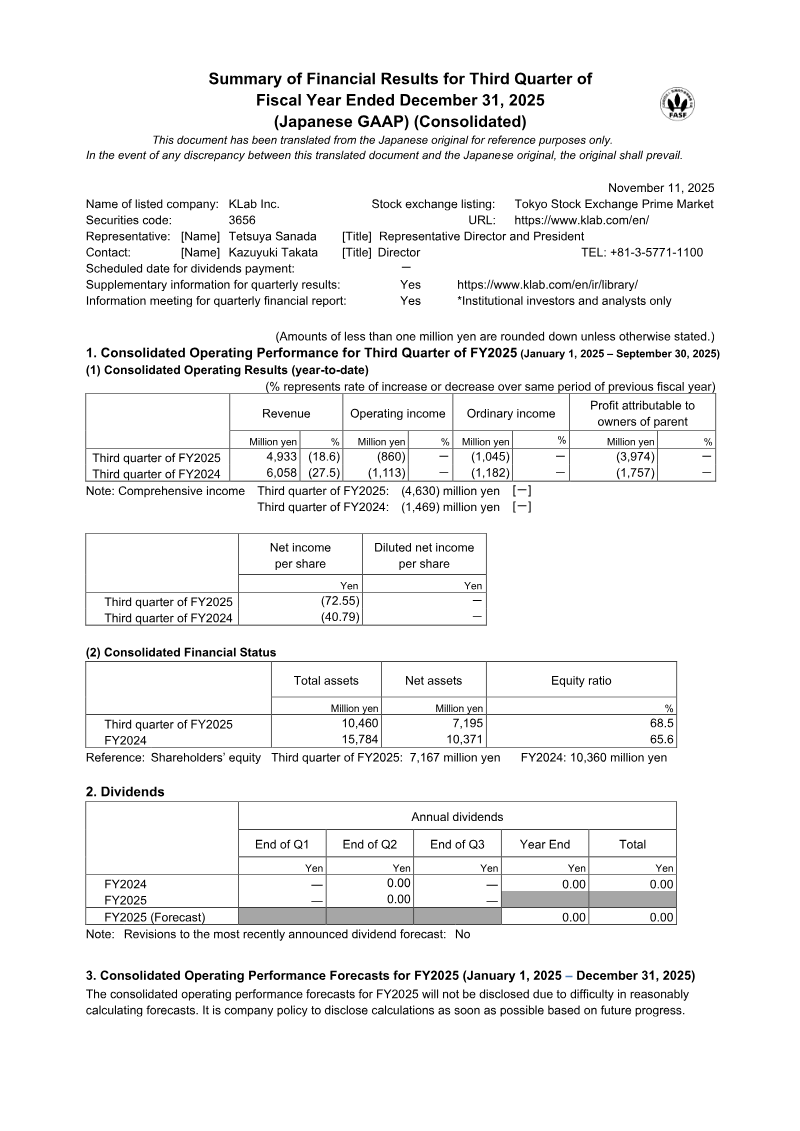
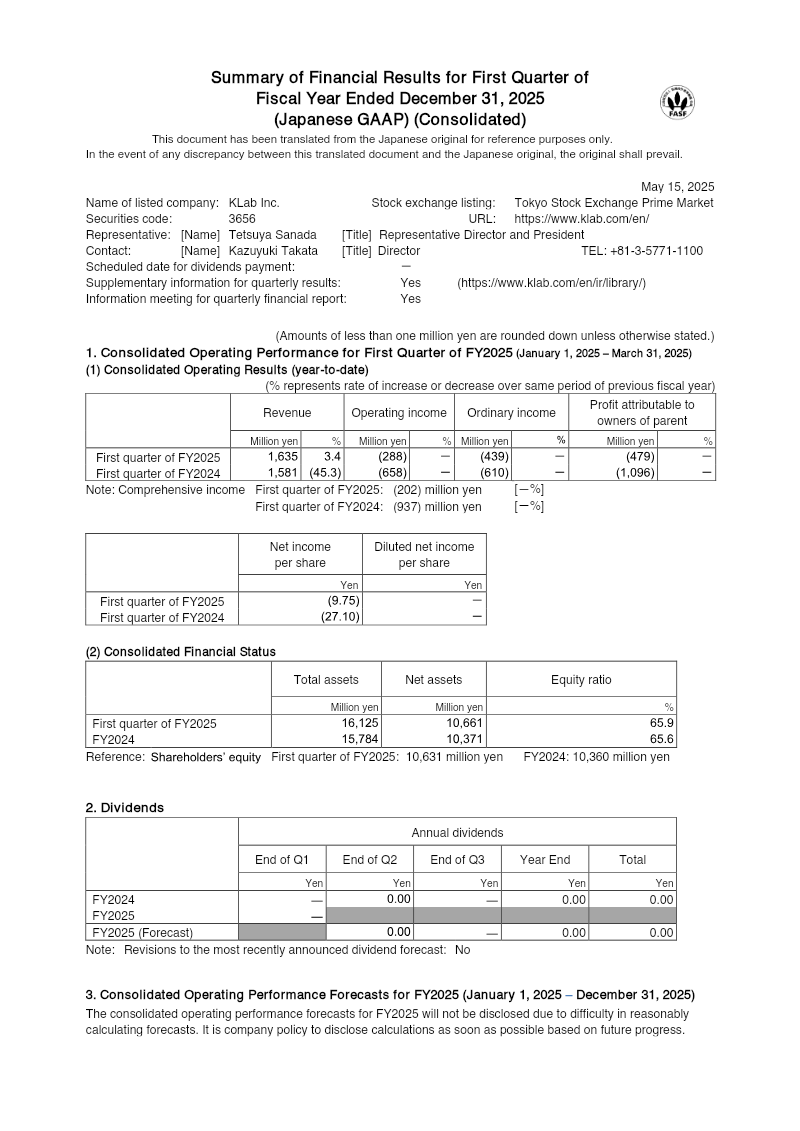
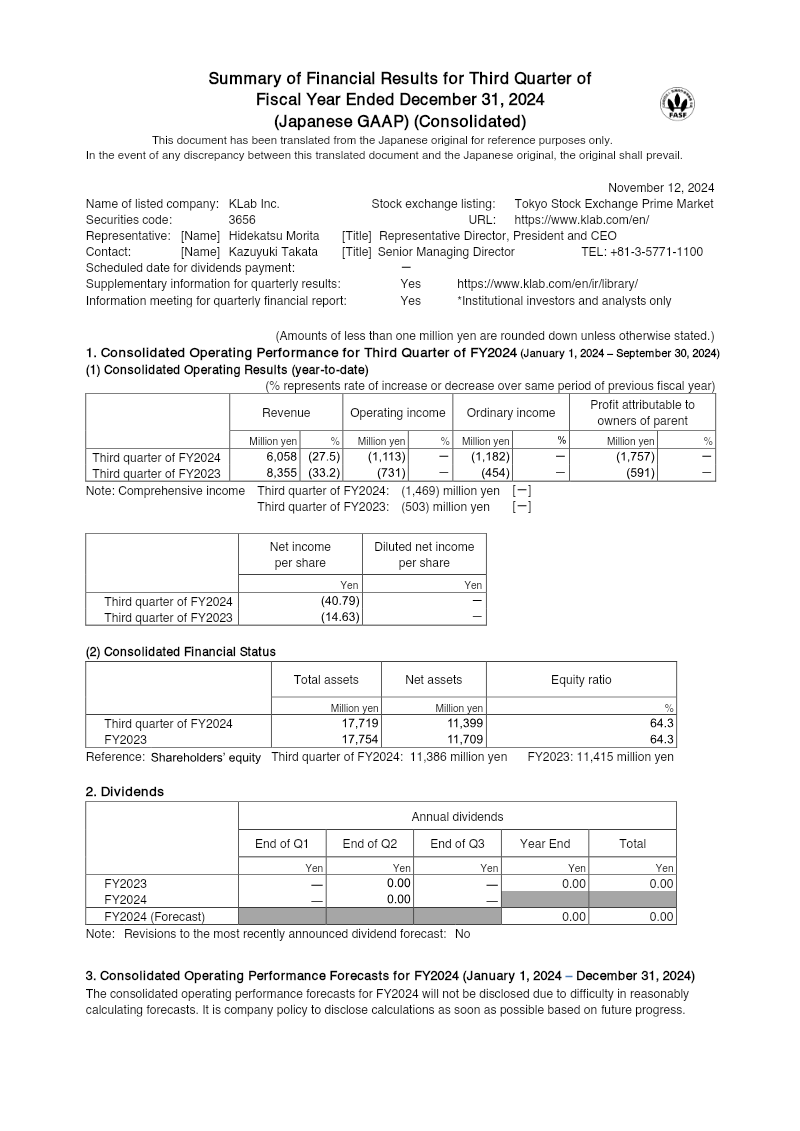
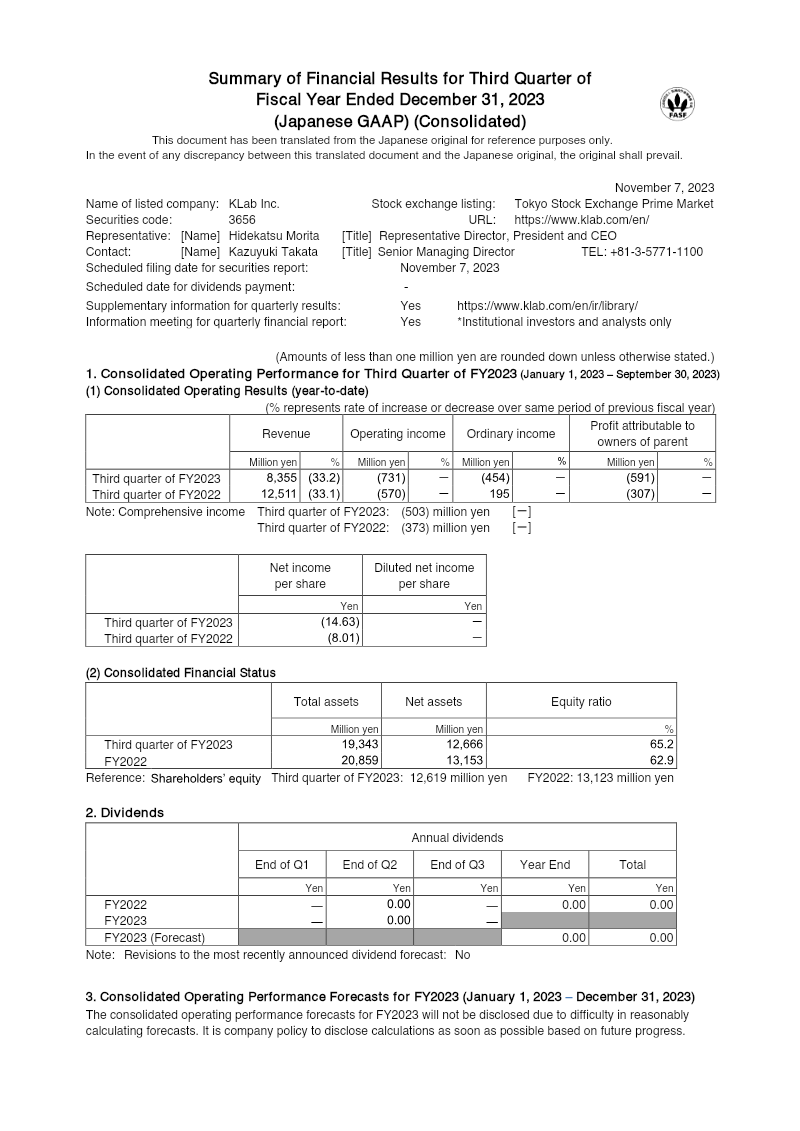
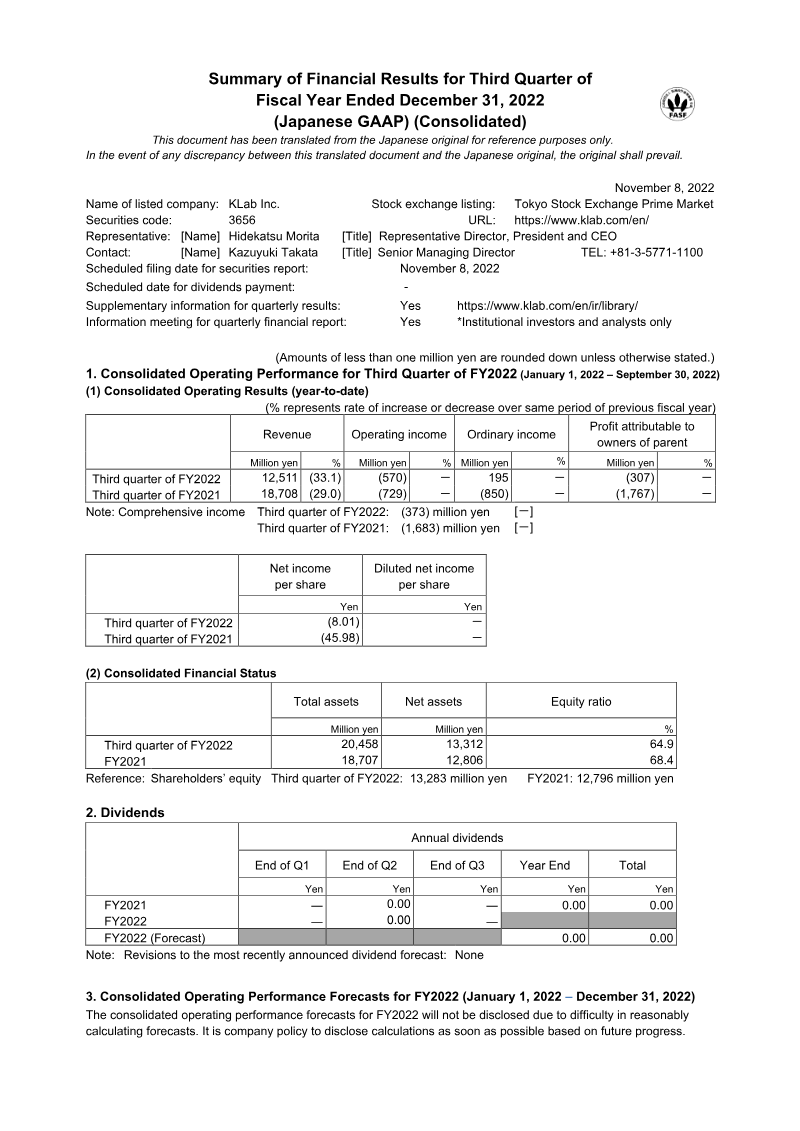
KLab Inc. experienced a significant downturn during the third quarter of fiscal year 2025, characterized by an 18.6% year-over-year revenue decline to ¥4.93 billion. This contraction was primarily driven by weakening performance in established titles such as Captain Tsubasa: Dream Team and a general decrease in income from paid users within the game business. Despite aggressive cost-cutting measures and a ¥1.57 billion gain from the sale of investment securities, the company recorded a substantial net loss of ¥3.97 billion. This loss was largely precipitated by a massive ¥4.42 billion impairment charge on software assets related to EA SPORTS FC™ TACTICAL and a reduction in goodwill following the divestment of GlobalGear Co. Ltd. The financial strain resulted in a decrease of over ¥3.1 billion in total net assets, though the company mitigated some impact by raising approximately ¥719 million through the exercise of stock acquisition rights. While four consecutive years of operating deficits have prompted scrutiny regarding the company’s status as a going concern, management asserts that no material uncertainty exists. This confidence is based on steady progress with major intellectual properties, including Dragon Quest and My Hero Academia, alongside a strategic pivot toward generative AI and blockchain ventures to diversify future revenue streams. Operating within the Japanese market during a period of rapid industry volatility, the company has withheld future performance forecasts. The current strategy focuses on maintaining liquidity through strict cost controls and asset sales while transitioning the business model to leverage emerging technologies. Despite the current net losses and the impairment of software in progress, the segment profit of ¥592 million suggests that core operations remain functional as the group attempts to stabilize its capital position and return to long-term profitability.
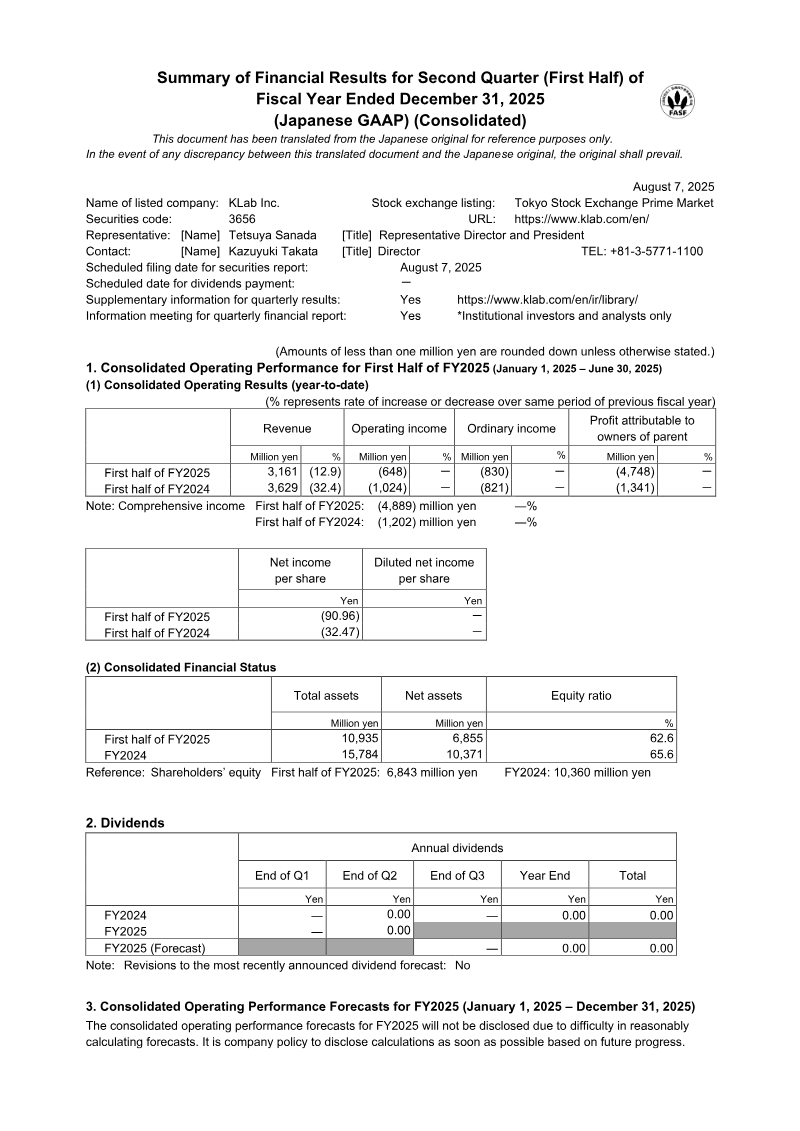
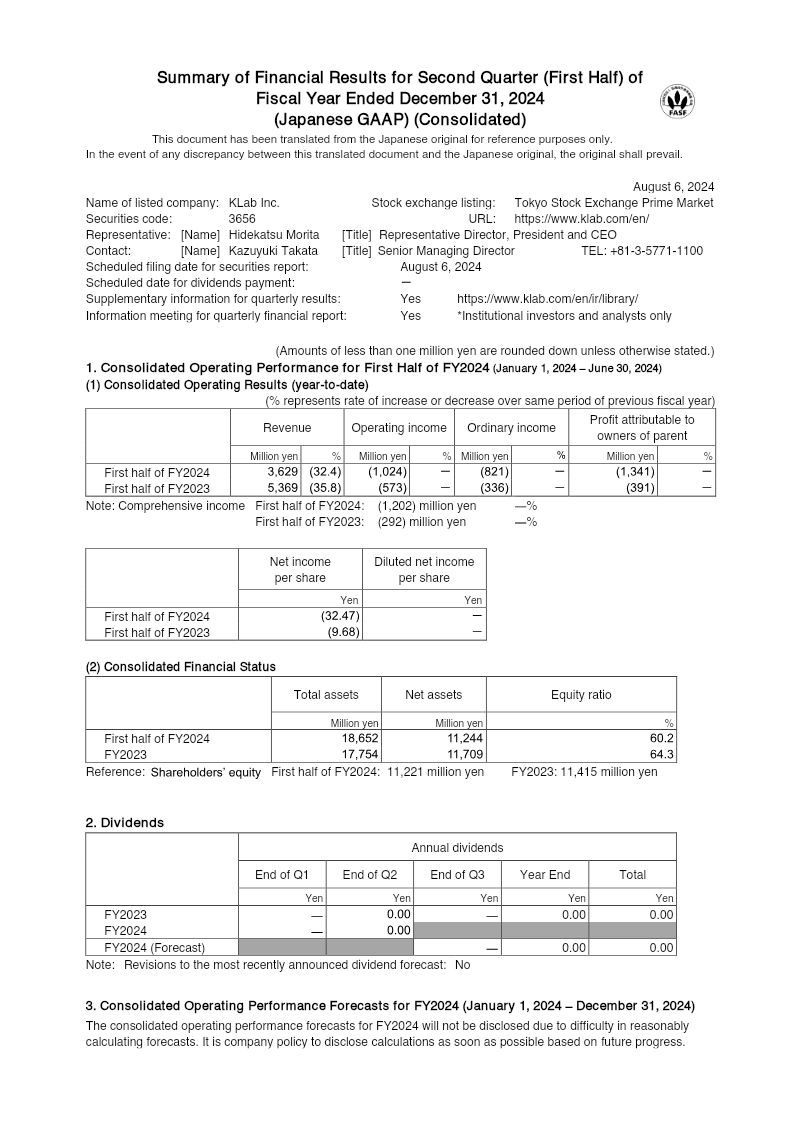
KLab Inc. experienced a challenging first half of the fiscal year ending December 31, 2025, characterized by a 12.9% year-over-year revenue decline to 3,161 million yen and a substantial net loss of 4,748 million yen. This loss was primarily driven by a 4.43 billion yen impairment on software in progress, which contributed to a sharp reduction in total assets from 15.7 billion yen to 10.9 billion yen. Despite these pressures, the game business segment achieved a profit of 313 million yen, and operating losses showed slight improvement compared to the previous year. Due to ongoing volatility and the difficulty of projecting future performance, no full-year forecast has been provided, and interim dividends have been suspended. To stabilize its financial position and pivot its corporate strategy, the firm executed several capital-raising and restructuring initiatives. These included the sale of the subsidiary GlobalGear for 1.1 billion yen and the issuance of new stock acquisition rights. These rights are tied to rigorous performance hurdles, requiring the company to achieve over 1,000 million yen in non-game revenue and a market capitalization exceeding 10 billion yen before they can be exercised. These measures are designed to incentivize a recovery in market value and diversify revenue streams beyond traditional mobile gaming. Management remains focused on achieving profitability through aggressive cost-cutting, workforce optimization, and a refined development pipeline. While the company has faced four consecutive years of operating deficits and delays in the release of EA SPORTS FC™ TACTICAL, it maintains that there is no material uncertainty regarding its status as a going concern. Future growth is predicated on the successful launch of new projects, including a My Hero Academia title and an expansion into the hybrid casual gaming market. This strategic shift aims to balance the high-risk nature of major game development with more sustainable, diversified business operations.
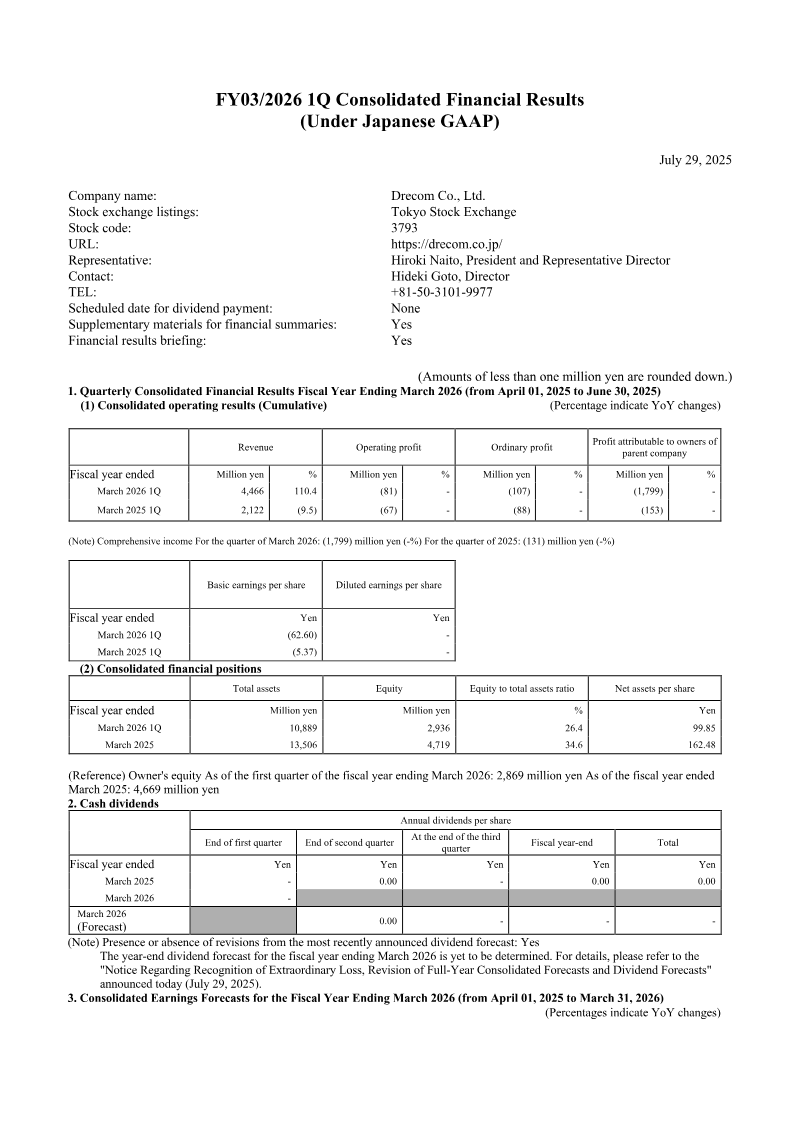
Drecom Co., Ltd. reported its consolidated financial results for the first quarter of the fiscal year ending March 2026, covering the period from April 1, 2025, to June 30, 2025. The company’s primary mission centers on global entertainment expansion through the integration of intellectual property and technology. The financial results reflect a period of significant revenue growth offset by substantial impairment losses, leading to a net loss for the quarter. Total revenue for the first quarter reached 4,466 million yen, representing a 110.4% increase compared to the same period in the previous year. This growth was largely driven by the performance of the mobile game title Wizardry Variants Daphne. Despite this revenue surge, the company recorded an operating loss of 81 million yen and an ordinary loss of 107 million yen. A major factor in the quarterly performance was an extraordinary impairment loss of 1,563 million yen, attributed to the reassessment of future earnings for a mobile game title released in the previous fiscal year that performed below expectations. Consequently, the quarterly net loss attributable to owners of the parent company totaled 1,799 million yen. The company operates across two primary segments: the Game Business and the Content Business. The Game Business generated 4,327 million yen in sales, though segment profit declined by 51.6% due to increased variable and fixed costs associated with new title releases. The Content Business, which focuses on publishing and merchandise, saw revenue rise to 155 million yen, with a reduced segment loss of 204 million yen as the company continues to invest in new business areas. Following these results, the company has revised its full-year consolidated earnings forecasts for the fiscal year ending March 2026.
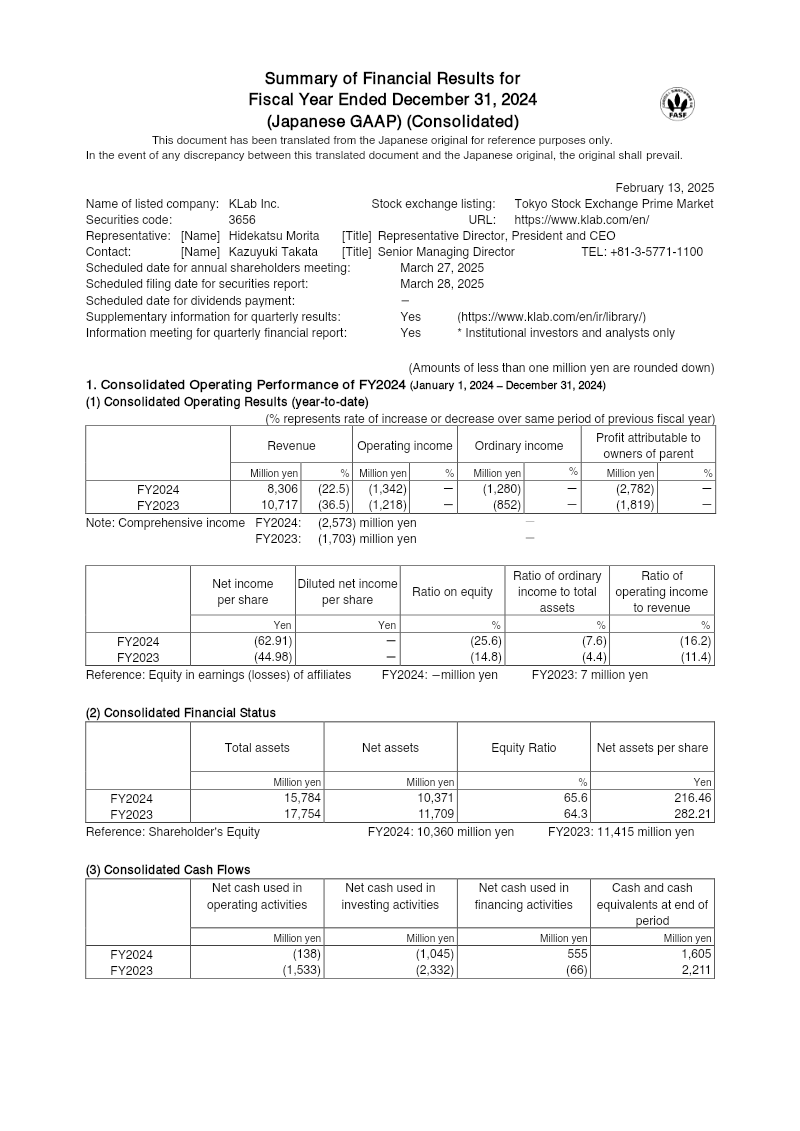
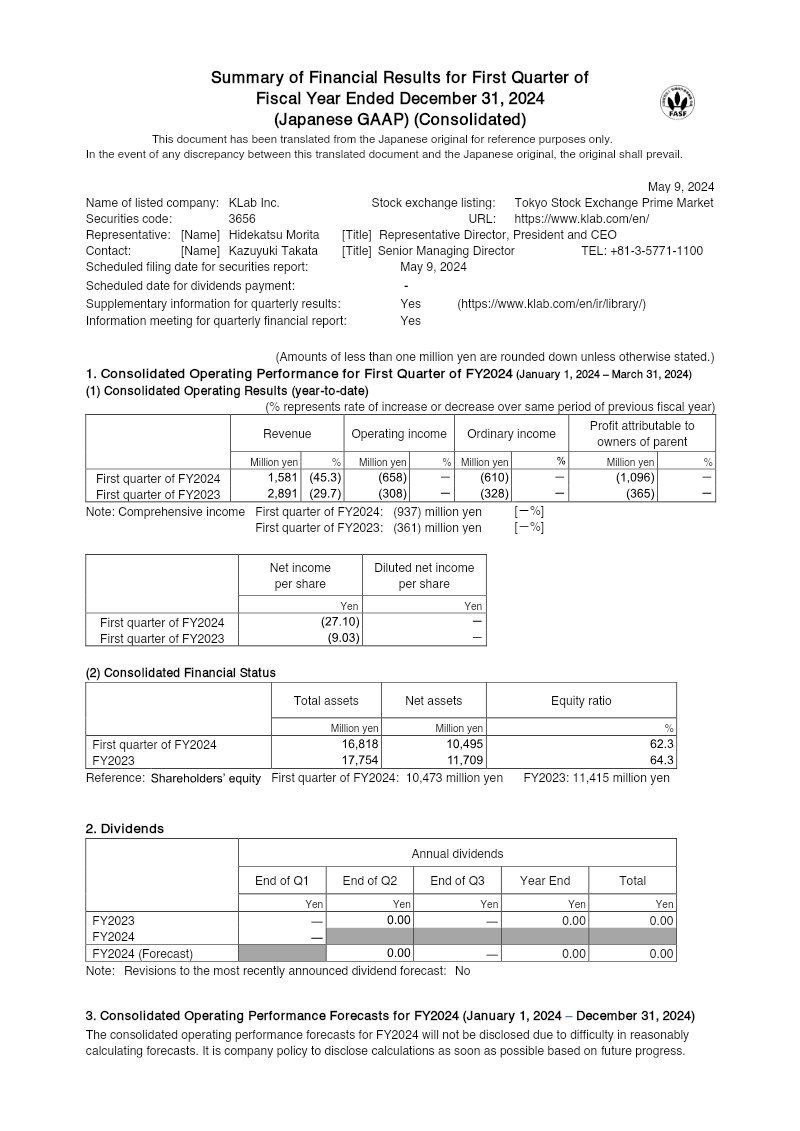
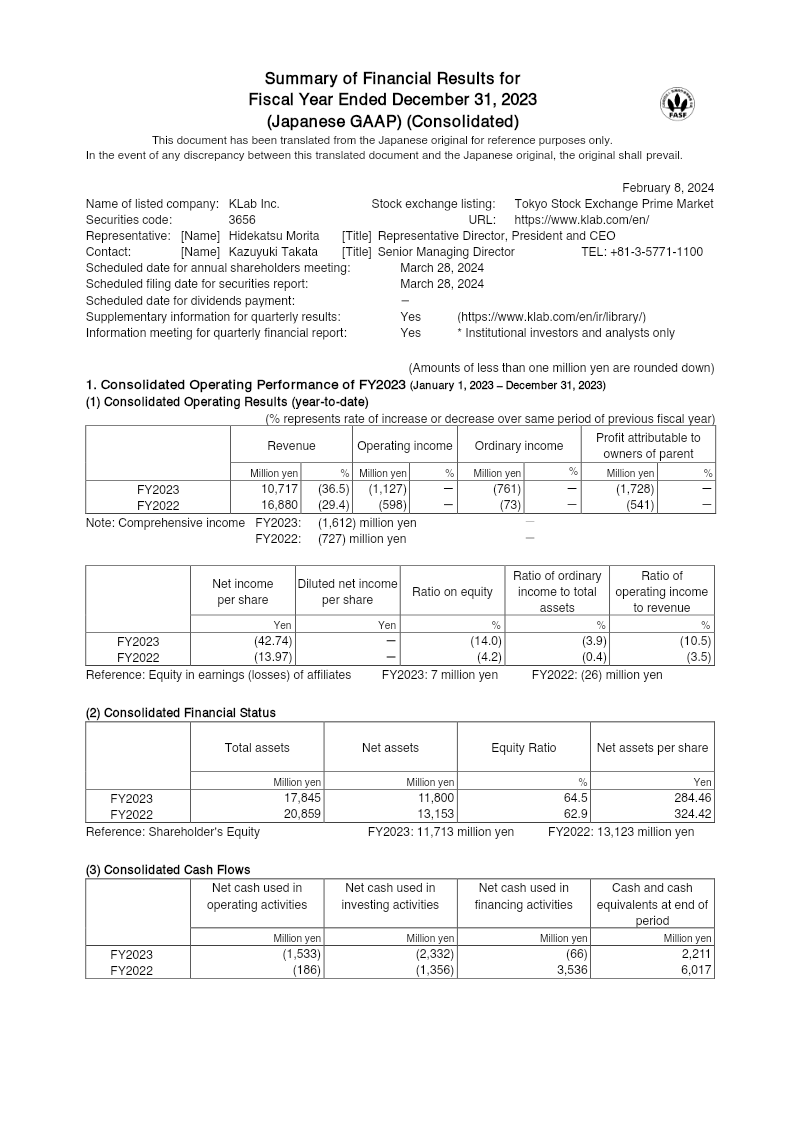
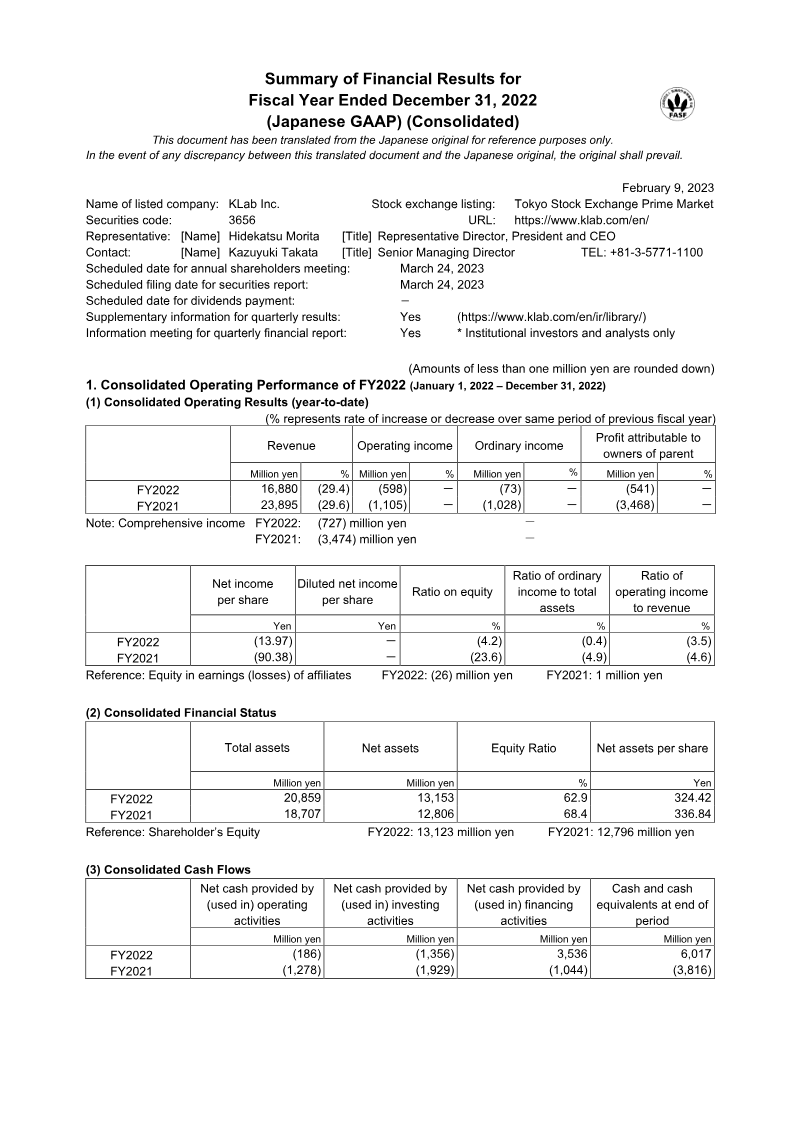
KLab Inc. experienced a significant financial downturn during the fiscal year ended December 31, 2024, characterized by a 22.5% year-over-year revenue decline to 8.3 billion yen. This contraction led to a net loss of 2.78 billion yen, a substantial increase from the 1.82 billion yen loss recorded in the previous year. The downturn was primarily driven by a reduced portfolio of active titles and the delayed global launch of EA SPORTS FC™ TACTICAL due to retention challenges. While established titles like Captain Tsubasa: Dream Team and BLEACH Brave Souls remained stable, the company faced 1.14 billion yen in extraordinary losses, including significant software impairments and valuation losses on investment securities. The company’s financial position weakened as it marked its fourth consecutive year of operating deficits, resulting in a breach of financial covenants and a 2.8 billion yen decrease in retained earnings. Total net assets fell to 10.37 billion yen, while cash equivalents dropped to 1.61 billion yen. In response to these challenges, the business narrowed its strategic focus to the core Game Business segment, effectively deconsolidating its blockchain-related operations through the partial sale of BLOCKSMITH&Co. Despite the fiscal strain, investment in software in progress increased by 1.4 billion yen to support three major global IP projects, including a title based on the My Hero Academia franchise. To address concerns regarding its status as a going concern, the company secured approximately 2.8 billion yen in funding through third-party allotments and unsecured bonds in early 2025. Management has implemented rigorous cost controls and personnel restructuring to mitigate ongoing losses. However, due to the complexity and scale of its lead development projects, no earnings forecast has been provided for the 2025 fiscal year. The company remains reliant on the successful launch of its upcoming pipeline to stabilize its long-term financial health and recover from its current liquidity constraints.