KLab
Game Co.85 documents
Documents
Financial9 pages
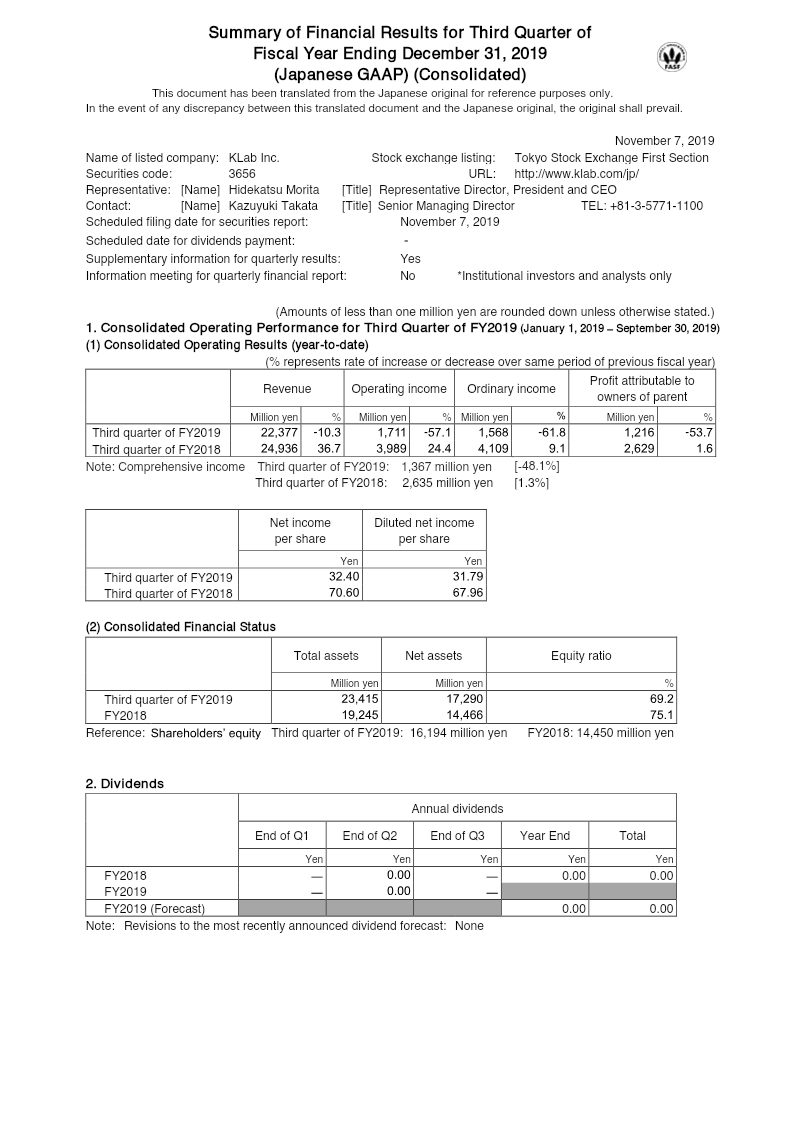
Consolidated Financial Results for the Third Quarter of the Fiscal Year Ending December 31, 2019
This financial report details the consolidated operating performance of KLab Inc. for the first nine months of fiscal year 2019, covering the period from January 1 to September 30, 2019. The data reveals a period of contraction for the Japanese mobile gaming company, with revenue declining 10.3% year-over-year to 22.37 billion yen. The downturn was primarily driven by diminishing returns from established titles such as Love Live! School Idol Festival and Captain Tsubasa: Dream Team. While new releases like Magatsu Wahrheit and Love Live! School Idol Festival ALL STARS contributed new revenue streams, they were insufficient to offset the decline of legacy products.
Profitability metrics saw a more significant decline during this period. Operating income fell by 57.1% to 1.71 billion yen, while profit attributable to owners of the parent dropped 53.7% to 1.21 billion yen. This compression was caused by a combination of lower top-line revenue and rising costs of sales, which increased by 1.0% due to higher labor, outsourcing, and depreciation expenses associated with new game development. Conversely, selling, general, and administrative expenses decreased by 10.3%, largely due to reduced advertising spend.
The financial status remains stable with an equity ratio of 69.2% and total assets of 23.4 billion yen, an increase driven by higher accounts receivable and software assets. Looking forward, the company revised its full-year 2019 forecasts to a definite figure rather than a range, projecting total revenue of 31.5 billion yen and operating income of 1.75 billion yen. The methodology follows Japanese GAAP, and the scope includes the core game business alongside smaller segments in research, consulting, and venture capital.
- KLab Inc. experienced a 10.3% year-over-year revenue decline to 22.37 billion yen for the first nine months of 2019, driven by underperforming legacy titles like Love Live! School Idol Festival and Captain Tsubasa: Dream Team.
- Operating income plummeted 57.1% to 1.71 billion yen, while profit attributable to owners of the parent fell 53.7% to 1.21 billion yen.
- Profitability was compressed by a 1.0% increase in cost of sales, attributed to rising labor, outsourcing, and depreciation expenses linked to new game development.
- New releases such as Magatsu Wahrheit and Love Live! School Idol Festival ALL STARS failed to generate sufficient revenue to offset the decline of the company's established product portfolio.
- The company revised its full-year 2019 outlook to a fixed projection of 31.5 billion yen in revenue and 1.75 billion yen in operating income.
+1
KLabNov 2019
Financial8 pages
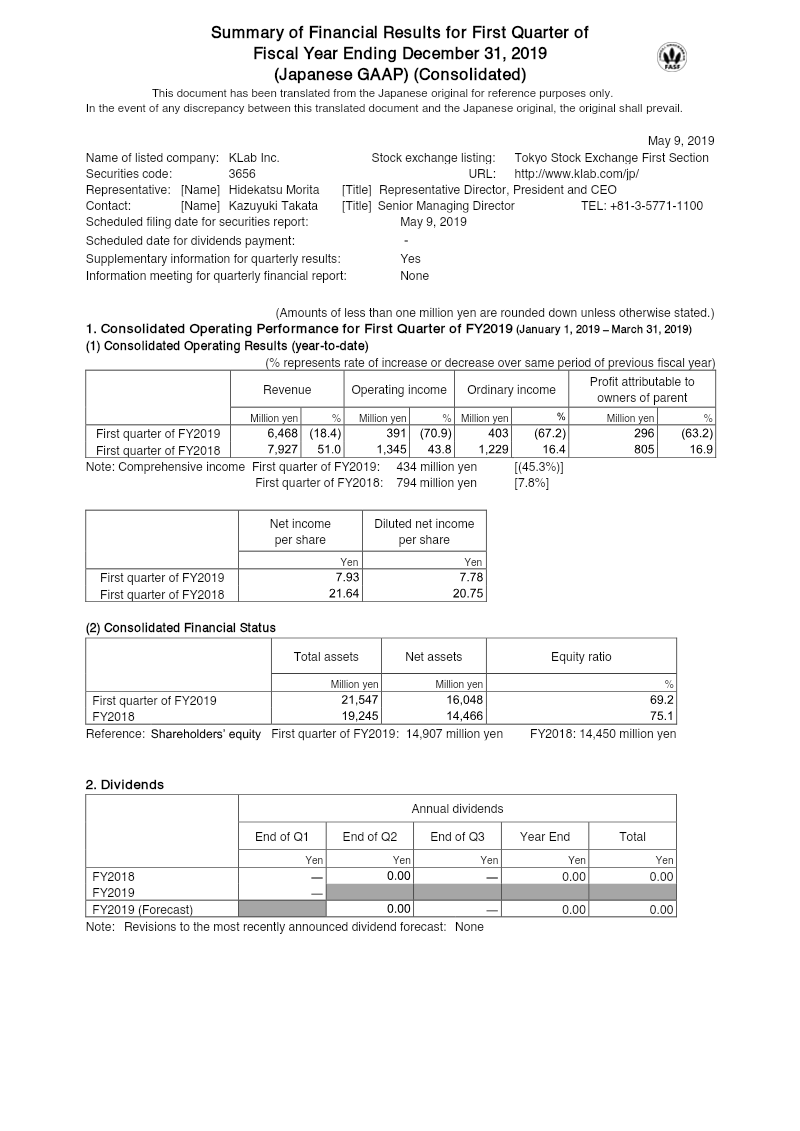
Consolidated Financial Results for the First Quarter of the Fiscal Year Ending December 31, 2019
KLab Inc. reported a significant decline in financial performance for the first quarter of the fiscal year ending December 31, 2019, covering the period from January 1 to March 31, 2019. Consolidated revenue fell 18.4% year-over-year to 6.47 billion yen, primarily driven by declining revenue from the title Love Live! School Idol Festival. This contraction in the top line led to sharper decreases in profitability: operating income dropped 70.9% to 391 million yen, and profit attributable to owners of the parent fell 63.2% to 296 million yen.
The company’s cost of sales and selling, general, and administrative expenses also decreased by 8.3% and 5.2% respectively, largely due to lower royalties, commissions, and reduced advertising spend. Despite the drop in quarterly earnings, total assets increased by 2.3 billion yen to 21.5 billion yen, fueled by higher operating investment securities and software in progress. Net assets rose to 16.0 billion yen, influenced by the inclusion of non-controlling interests from a newly consolidated subsidiary.
Geographically focused on the Japanese market with global reach through its mobile titles, KLab’s operations are divided between its core Game Business and Other Businesses, which now includes a venture capital segment following the consolidation of KVP Inc. and its associated funds. Looking ahead, the company maintains a range-based forecast for the full fiscal year 2019, projecting revenue between 32 billion and 40 billion yen. Management noted that while financial forecasting has become more accurate, the inherent volatility of new game success remains a critical factor in achieving these targets.
- KLab Inc. reported a significant Q1 2019 downturn, with consolidated revenue falling 18.4% year-over-year to 6.47 billion yen.
- Profitability suffered sharper declines than revenue, as operating income dropped 70.9% to 391 million yen and net profit fell 63.2% to 296 million yen.
- The primary driver for the revenue contraction was the declining performance of the mobile title Love Live! School Idol Festival.
- Despite lower earnings, total assets grew by 2.3 billion yen to 21.5 billion yen, driven by increases in operating investment securities and software in progress.
- KLab maintains a full-year 2019 revenue forecast between 32 billion and 40 billion yen, though management cited the inherent volatility of new game success as a primary risk factor.
+1
KLabMay 2019
Financial18 pages
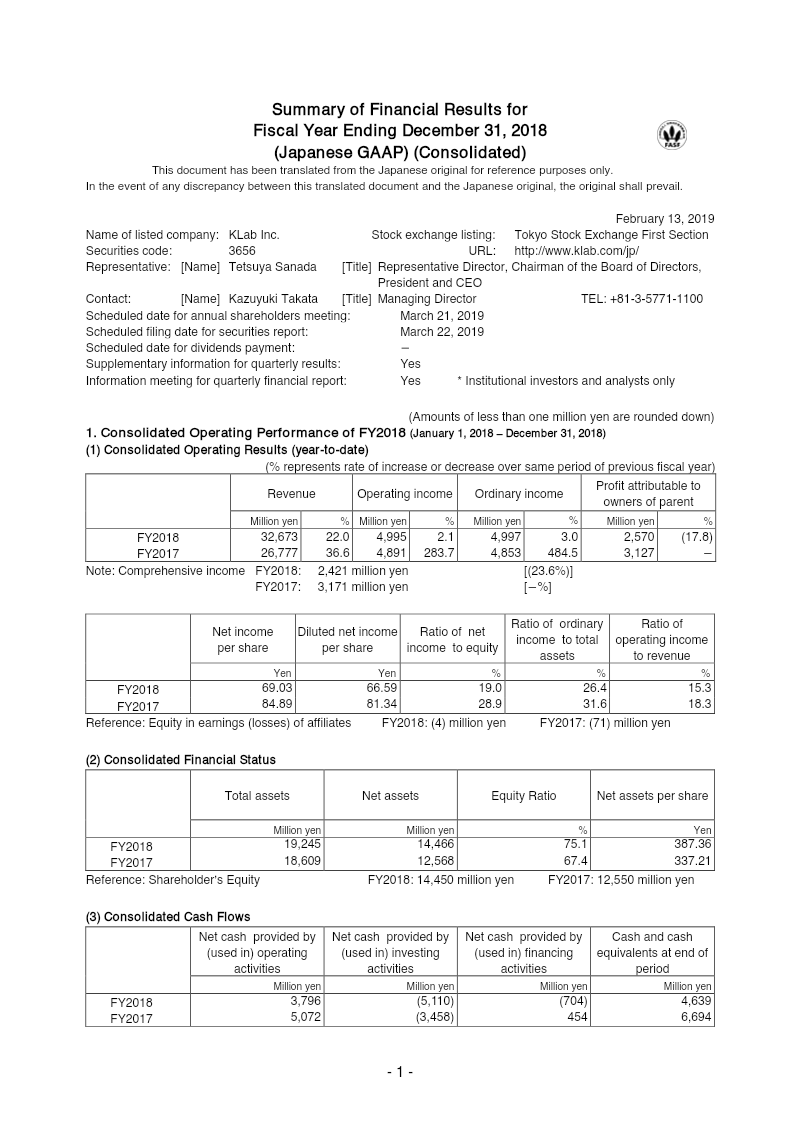
Summary of Financial Results for Fiscal Year Ending December 31, 2018 (Japanese GAAP) (Consolidated)
KLab Inc. achieved record-high consolidated revenue of 32.67 billion yen for the fiscal year ending December 31, 2018, representing a 22.0% year-over-year increase. This growth was primarily driven by the strong performance of key titles within the Game Business segment, specifically BLEACH Brave Souls and Captain Tsubasa: Dream Team. While operating profit rose to 4.99 billion yen, profit attributable to owners fell 17.8% to 2.57 billion yen. This divergence between top-line growth and net profitability resulted from rising royalty payments, increased promotional expenditures, and a 958 million yen extraordinary loss stemming from software impairment and asset disposal, including costs related to the title Lapis Re:LiGHTs.
The financial position remains stable, characterized by an equity ratio that improved to 75.1% and total assets valued at 19.2 billion yen. Despite the increase in total net assets to 14.47 billion yen—supported by higher retained earnings and the issuance of new shares—cash and cash equivalents decreased by approximately 2.06 billion yen. This reduction was largely attributed to higher income tax payments and intensified investment in intangible fixed assets. Consequently, net income per share declined from 84.89 yen to 69.03 yen, and the company elected not to issue a dividend for the fiscal year.
Looking toward the 2019 fiscal year, projections for revenue are set within a range of 32 billion to 40 billion yen. This forecast reflects a cautious outlook where future performance is heavily contingent upon the successful launch and monetization of new titles. While the Game Business remains the sole reportable segment and the primary engine of growth, the transition from record revenue to lower net income highlights the impact of rising operational costs and strategic asset write-downs on the bottom line.
- KLab Inc. achieved record-high consolidated revenue of 32.67 billion yen in 2018, a 22.0% year-over-year increase driven by the success of BLEACH Brave Souls and Captain Tsubasa: Dream Team.
- Profit attributable to owners fell 17.8% to 2.57 billion yen due to rising royalty payments, increased promotional spending, and a 958 million yen extraordinary loss from software impairment and asset disposal.
- The company reported an operating profit of 4.99 billion yen, while net income per share declined from 84.89 yen to 69.03 yen.
- KLab maintained a stable financial position with an equity ratio of 75.1% and total assets of 19.2 billion yen, though cash and cash equivalents decreased by 2.06 billion yen due to tax payments and investments in intangible assets.
- The company elected not to issue a dividend for the 2018 fiscal year.
+1
KLabFeb 2019
Financial12 pages
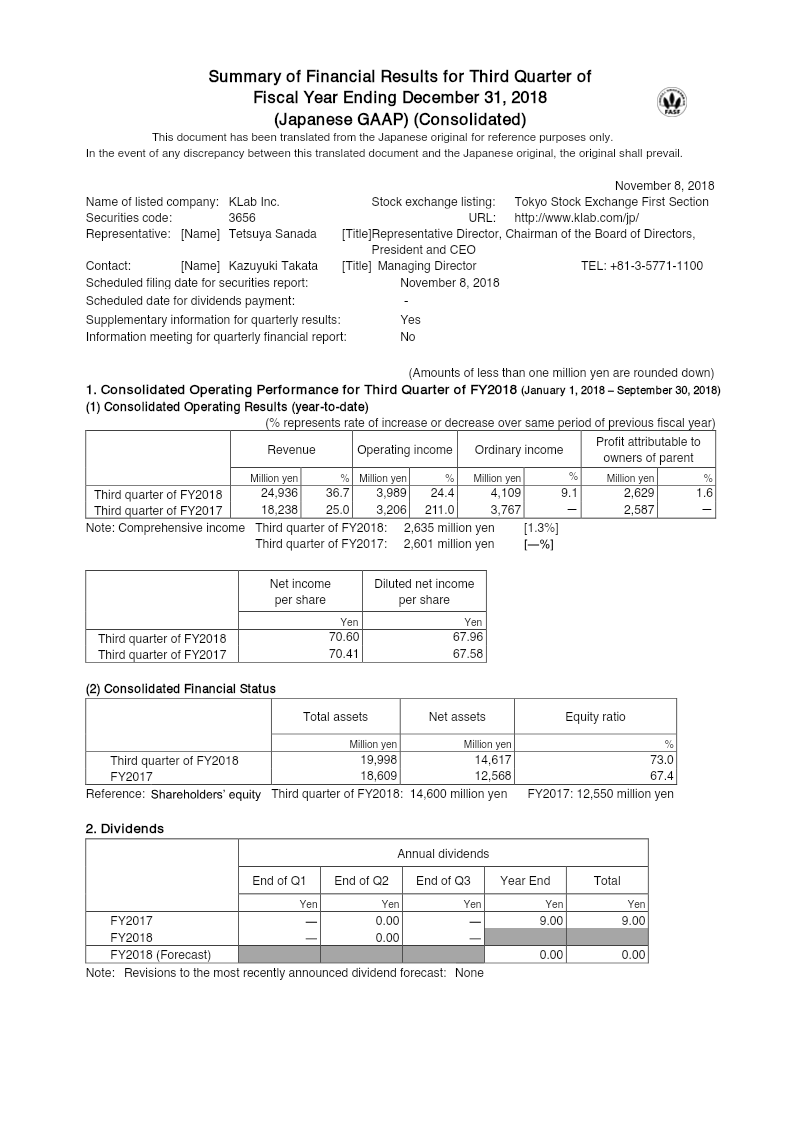
Summary of Financial Results for Third Quarter of Fiscal Year Ending December 31, 2018 (Japanese GAAP)
KLab Inc. reported significant growth in its consolidated financial results for the first nine months of the fiscal year ending December 31, 2018. Revenue reached 24.9 billion yen, a 36.7% increase over the same period in 2017. This growth was primarily driven by the strong performance of Captain Tsubasa: Dream Team, anniversary campaigns for BLEACH Brave Souls, and the successful August 2018 launch of YU☆YU☆HAKUSHO 100% Maji Battle. Operating income rose 24.4% to 3.9 billion yen, while profit attributable to owners of the parent saw a modest increase of 1.6% to 2.6 billion yen.
The financial position remains stable with total assets of 19.9 billion yen and an equity ratio of 73.0%. While current assets decreased due to lower cash holdings, non-current assets rose significantly, driven by a 3.4 billion yen investment in software in progress. Expenditures also increased, with cost of sales rising 42.6% due to higher royalties and commissions, and selling, general, and administrative expenses increasing 27.8% following higher advertising spend.
Geographically focused on the Japanese market with global reach through its mobile titles, KLab revised its full-year 2018 forecasts to 31.5 billion yen in revenue and 4.0 billion yen in operating income. While revenue is expected to grow 17.6% year-over-year, the company anticipates a decline in annual profits compared to 2017, citing the volatility of new title success. The methodology follows Japanese GAAP, and the results include segment data for the core Game Business and secondary research and consulting operations. Notable corporate actions during the period included the retirement of 870,000 shares of treasury stock and the implementation of an employee stock ownership plan.
- KLab Inc. reported revenue of 24.9 billion yen for the first nine months of 2018, marking a 36.7% year-over-year increase driven by titles like Captain Tsubasa: Dream Team, BLEACH Brave Souls, and YU☆YU☆HAKUSHO 100% Maji Battle.
- Operating income grew 24.4% to 3.9 billion yen, while profit attributable to owners of the parent rose by a more modest 1.6% to 2.6 billion yen.
- Full-year 2018 forecasts were revised to 31.5 billion yen in revenue and 4.0 billion yen in operating income, with the company projecting a year-over-year decline in annual profits due to the volatility of new game launches.
- Operating costs rose significantly, with cost of sales increasing 42.6% due to higher royalties and commissions, and SG&A expenses rising 27.8% as a result of increased advertising spend.
- The company maintains a stable financial position with total assets of 19.9 billion yen and an equity ratio of 73.0%, supported by a 3.4 billion yen investment in software in progress.
+1
KLabNov 2018
Financial11 pages
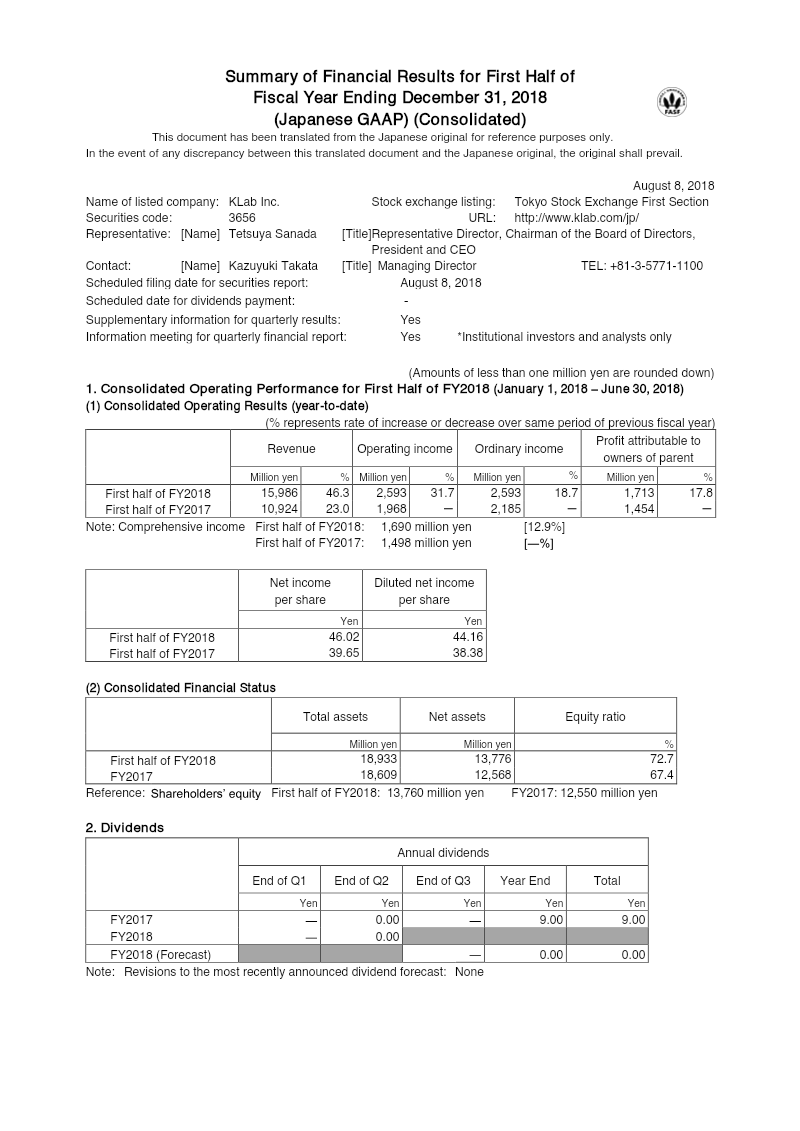
Summary of Financial Results for First Half of Fiscal Year Ending December 31, 2018
KLab Inc. reported significant growth in its consolidated financial results for the first half of the fiscal year ending December 31, 2018, covering the period from January 1 to June 30, 2018. Revenue reached 15.98 billion yen, a 46.3% increase over the same period in 2017. This growth was primarily driven by the strong performance of the mobile title Captain Tsubasa: Dream Team, which launched in Japan in mid-2017. Operating income rose 31.7% to 2.59 billion yen, while profit attributable to owners of the parent increased 17.8% to 1.71 billion yen.
The expansion in revenue was accompanied by a 51.3% rise in cost of sales, totaling 10.62 billion yen, largely due to higher platform commissions and royalties. Selling, general, and administrative expenses also grew by 43.2% to 2.76 billion yen, fueled by increased advertising spend. Despite these costs, the company maintained a strong financial position with an equity ratio of 72.7%, up from 67.4% at the end of 2017. Total assets stood at 18.93 billion yen, with a notable increase in non-current assets driven by software in progress.
The geographic focus remains primarily on the Japanese market, though the company operates globally within the mobile gaming segment. Looking ahead, KLab provided a range-based forecast for the full fiscal year 2018, projecting revenue between 30.0 billion and 33.0 billion yen. While revenue is expected to grow year-over-year, the company anticipates a potential decline in annual operating income, forecasted between 2.75 billion and 4.25 billion yen, citing the inherent volatility and impact of new game title success on financial performance. Methodology for these results follows Japanese GAAP, with specific updates to accounting policies regarding stock acquisition rights and tax expense calculations.
- KLab Inc. reported 15.98 billion yen in revenue for H1 2018, representing a 46.3% increase year-over-year driven primarily by the mobile title Captain Tsubasa: Dream Team.
- Operating income grew 31.7% to 2.59 billion yen, while profit attributable to owners of the parent rose 17.8% to 1.71 billion yen.
- The company projects full-year 2018 revenue between 30.0 billion and 33.0 billion yen, though it anticipates a potential decline in annual operating income, forecasted between 2.75 billion and 4.25 billion yen.
- Operating costs rose significantly, with cost of sales increasing 51.3% to 10.62 billion yen due to higher royalties and platform commissions, alongside a 43.2% increase in SG&A expenses.
- KLab maintained a strong balance sheet with an equity ratio of 72.7% as of June 30, 2018, up from 67.4% at the end of 2017.
+1
KLabAug 2018
Financial12 pages
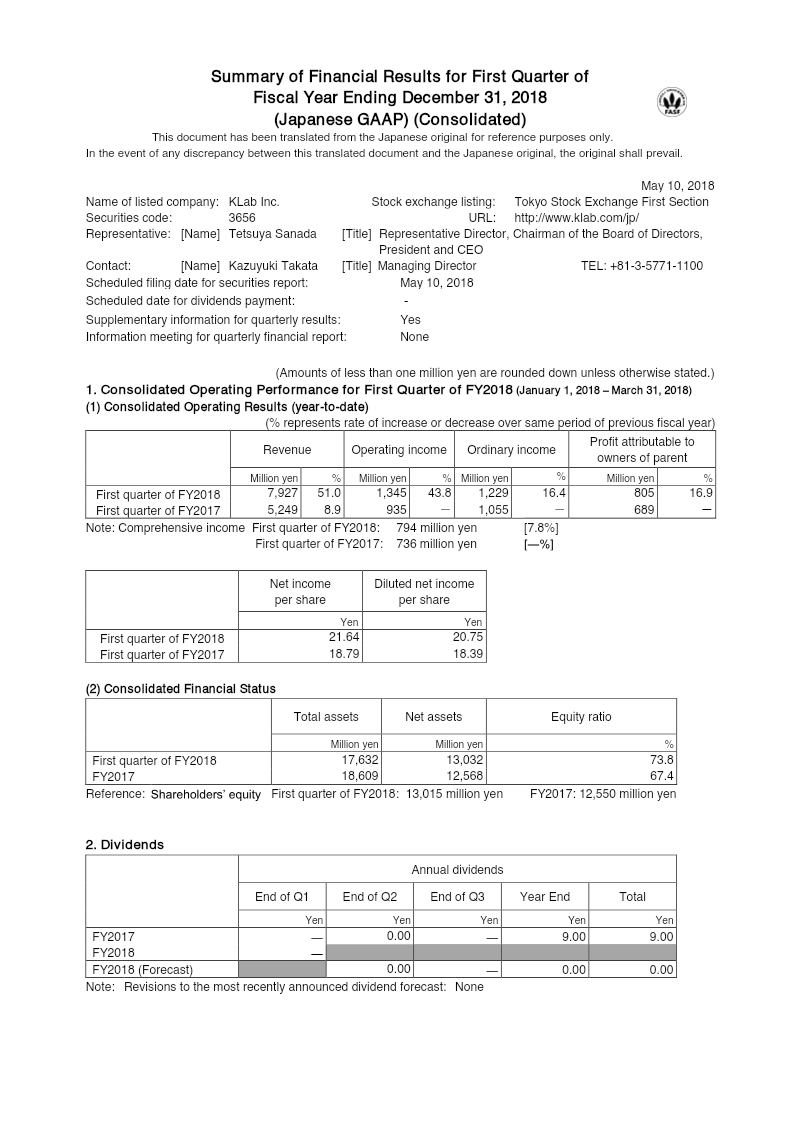
Summary of Financial Results for First Quarter of Fiscal Year Ending December 31, 2018
KLab Inc. reported significant growth in its consolidated financial results for the first quarter of the fiscal year ending December 31, 2018. Covering the period from January 1 to March 31, 2018, the data reveals a 51.0% year-over-year increase in revenue, reaching 7.92 billion yen. This growth was primarily driven by the strong performance of mobile titles including Captain Tsubasa: Dream Team, Utano☆Princesama Shining Live, and Bleach: Brave Souls.
Operating income rose 43.8% to 1.34 billion yen, while profit attributable to owners of the parent increased 16.9% to 805 million yen. These gains were achieved despite rising costs of sales, which grew 51.8% due to higher royalties, commissions, and outsourcing expenses related to game development. Non-operating expenses were impacted by 159 million yen in foreign exchange losses resulting from the re-evaluation of foreign currency receivables.
The financial status remains stable with an equity ratio of 73.8%, up from 67.4% at the end of 2017. Total assets decreased slightly to 17.6 billion yen, largely due to a reduction in cash and deposits, while non-current assets rose following increased investment in software in progress. Subsequent to the quarter's end, the company executed a share buyback of 261,100 shares for approximately 499 million yen to improve capital efficiency.
Looking ahead, KLab maintains a range-based forecast for the full fiscal year 2018, projecting revenue between 33.5 billion and 38.5 billion yen. This methodology accounts for the inherent volatility in the success of new game titles. The company anticipates operating income to fall within the range of 3.75 billion to 6.25 billion yen, reflecting a neutral to positive outlook depending on market trends and the performance of the existing mobile gaming portfolio.
- KLab Inc. reported a 51.0% year-over-year revenue increase to 7.92 billion yen for Q1 2018, driven by the strong performance of mobile titles including Captain Tsubasa: Dream Team, Utano☆Princesama Shining Live, and Bleach: Brave Souls.
- Operating income grew 43.8% to 1.34 billion yen, while profit attributable to owners of the parent rose 16.9% to 805 million yen.
- The company maintains a full-year 2018 revenue forecast of 33.5 billion to 38.5 billion yen and an operating income forecast of 3.75 billion to 6.25 billion yen, accounting for potential volatility in new game performance.
- Costs of sales increased by 51.8% due to higher royalties, commissions, and outsourcing expenses, while non-operating expenses included 159 million yen in foreign exchange losses.
- The company's equity ratio improved to 73.8% in Q1 2018, up from 67.4% at the end of 2017.
+2
KLabMay 2018
Financial19 pages
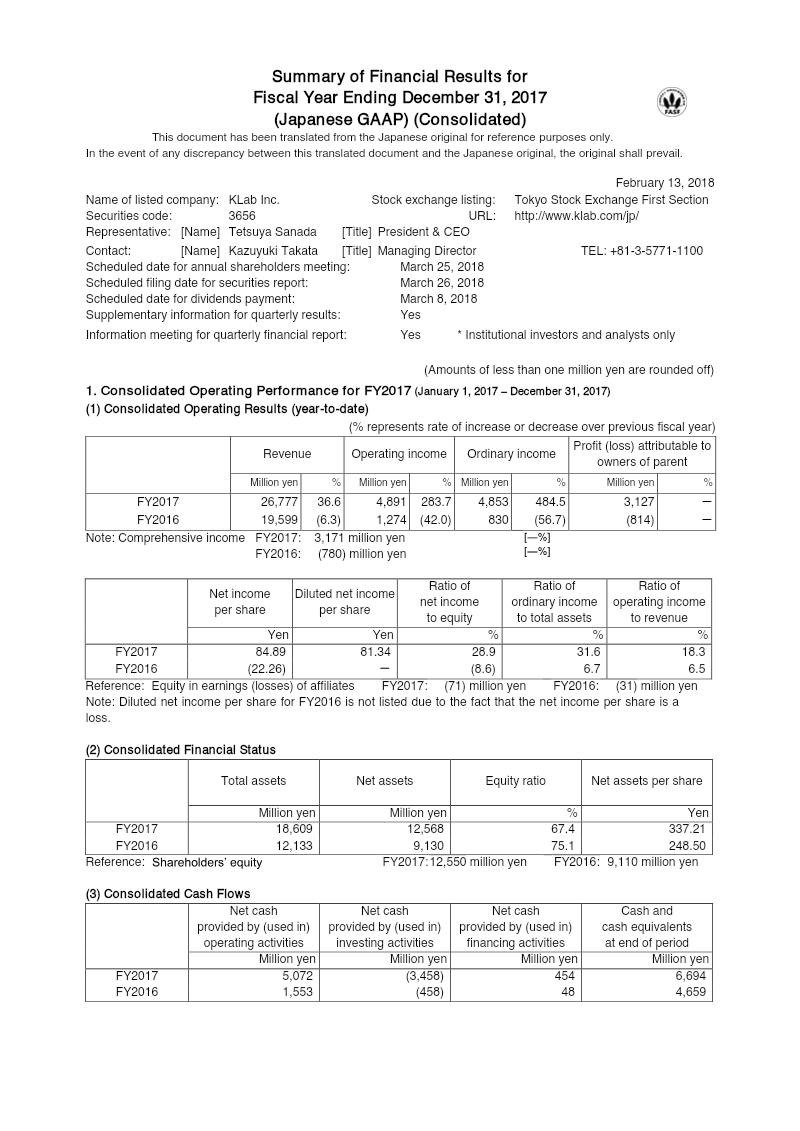
Summary of Financial Results for Fiscal Year Ending December 31, 2017
KLab Inc. achieved record-high financial performance for the fiscal year ending December 31, 2017, marking a significant recovery from the previous year’s losses. Revenue increased by 36.6% to 26.8 billion yen, while operating income experienced a dramatic surge of 283.7%, reaching 4.9 billion yen. This growth was almost entirely concentrated within the Game Business segment, which accounted for 99.3% of total outside sales. The primary drivers of this success were the sustained popularity of established titles such as Love Live! School Idol Festival and Bleach: Brave Souls, alongside the high-performing launch of Captain Tsubasa: Dream Team.
The fiscal year concluded with a net income of 3.13 billion yen, a stark contrast to the 845.6 million yen net loss reported in 2016. This turnaround resulted in a net income per share of 84.89 yen and a strengthened net asset position of 12.57 billion yen. Financial reporting for the period included specific accounting treatments for share calculations, where certain subscription rights were excluded from diluted net income per share due to their non-dilutive nature, and shares held in trusts were categorized as treasury shares for income calculation purposes.
Looking ahead to the fiscal year ending December 31, 2018, projections indicate continued upward momentum. The company issued a range-based forecast anticipating revenue growth to reach as high as 38.5 billion yen. This outlook reflects a strategic focus on leveraging existing intellectual properties and maintaining the operational efficiency that characterized the 2017 fiscal period. No significant subsequent events were reported following the close of the fiscal year, suggesting a stable transition into the next reporting cycle.
- KLab Inc. achieved record-high financial performance in fiscal year 2017, with revenue rising 36.6% to 26.8 billion yen and operating income surging 283.7% to 4.9 billion yen.
- The company successfully reversed a 2016 net loss of 845.6 million yen, reporting a net income of 3.13 billion yen for the fiscal year ending December 31, 2017.
- The Game Business segment was the primary driver of financial success, accounting for 99.3% of the company's total outside sales.
- Growth was fueled by the sustained popularity of Love Live! School Idol Festival and Bleach: Brave Souls, alongside the successful launch of Captain Tsubasa: Dream Team.
- KLab Inc. projects continued growth for the fiscal year ending December 31, 2018, with revenue forecasts reaching as high as 38.5 billion yen.
+1
KLabFeb 2018
Financial12 pages
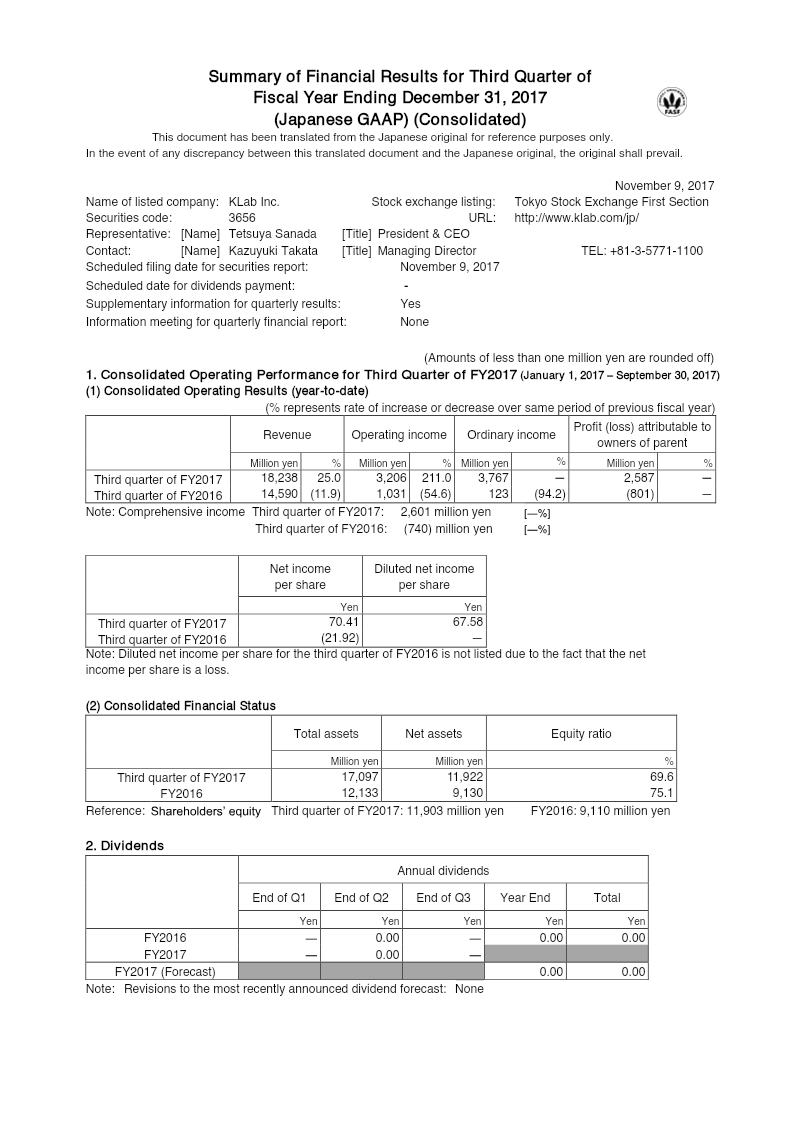
Summary of Financial Results for Third Quarter of Fiscal Year Ending December 31, 2017
KLab Inc. reported significant financial growth for the first nine months of fiscal year 2017, ending September 30, 2017. Consolidated revenue reached 18.2 billion yen, a 25% increase over the same period in 2016. This growth was primarily driven by the sustained performance of Bleach: Brave Souls and the successful Japanese launches of Captain Tsubasa: Tatakae Dream Team and Utano☆Princesama Shining Live. Operating income saw a dramatic rise of 211%, reaching 3.2 billion yen, while profit attributable to owners of the parent turned positive at 2.5 billion yen, compared to a loss in the previous year.
The financial position of the company strengthened during this period, with total assets increasing to 17.1 billion yen. This expansion was supported by higher cash reserves, trade accounts receivable, and a significant rise in intangible assets, including goodwill following the acquisition of ABASEA Inc. and its subsidiary Spicemart Inc. While cost of sales and advertising expenses increased in line with higher revenues and new product launches, the company also benefited from over 500 million yen in foreign exchange gains.
Geographically focused on the Japanese market for its primary 2017 releases, KLab’s methodology follows Japanese GAAP consolidated reporting. Based on favorable year-to-date trends, the company issued an upward revision for its full-year 2017 forecast. It now projects annual revenue of 26 billion yen and operating income of 4.3 billion yen. This shift from range-based to single-figure forecasting reflects management's increased confidence in the stability of its current financial trajectory and the success rate of its mobile gaming portfolio.
- KLab Inc. reported 18.2 billion yen in revenue for the first nine months of 2017, a 25% year-over-year increase.
- Operating income surged 211% to 3.2 billion yen, while net profit reached 2.5 billion yen, reversing a loss from the same period in 2016.
- Growth was primarily driven by the performance of Bleach: Brave Souls and the Japanese launches of Captain Tsubasa: Tatakae Dream Team and Utano☆Princesama Shining Live.
- Management issued an upward revision for full-year 2017, now projecting 26 billion yen in revenue and 4.3 billion yen in operating income.
- Total assets grew to 17.1 billion yen, bolstered by increased cash reserves and intangible assets acquired through the purchase of ABASEA Inc. and Spicemart Inc.
+1
KLabNov 2017
Financial2 pages
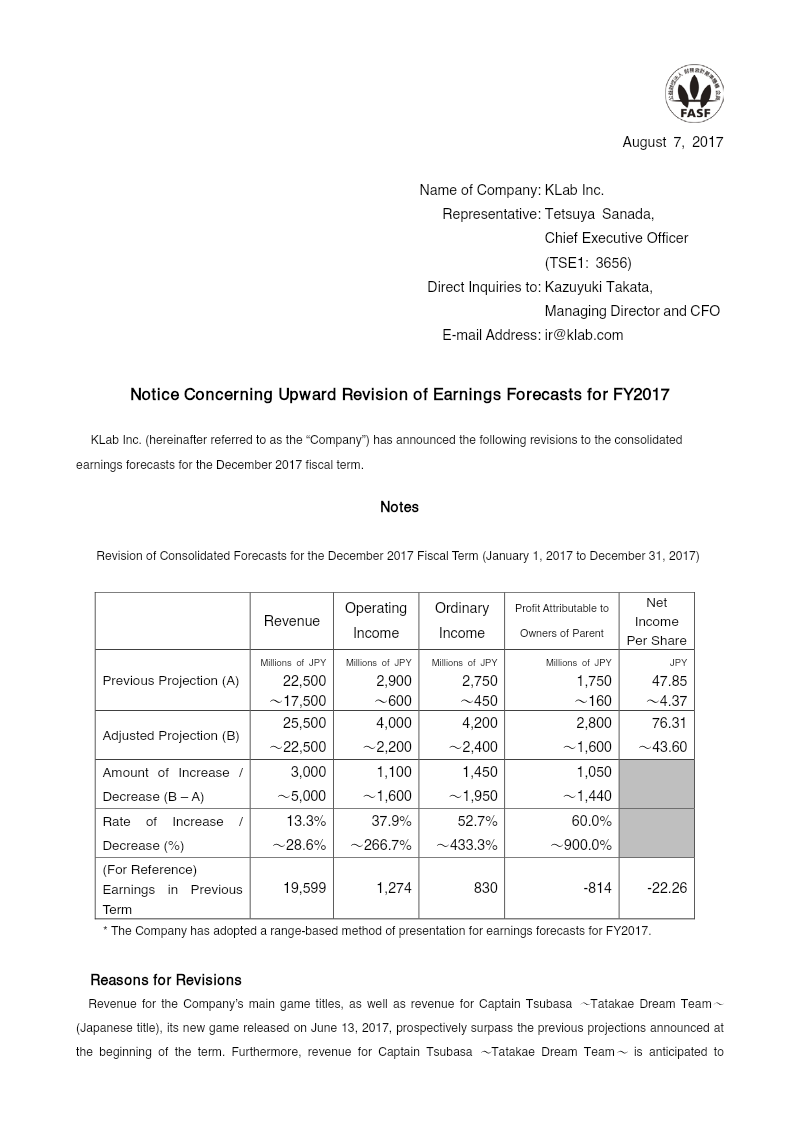
Notice Concerning Upward Revision of Earnings Forecasts for FY2017
KLab Inc. has issued an upward revision of its consolidated earnings forecasts for the fiscal year ending December 31, 2017, reflecting a significant improvement in financial performance compared to initial projections. The revised outlook covers the full twelve-month period beginning January 1, 2017, and focuses on the Japanese mobile gaming market and the company’s international operations. This adjustment follows a period of stronger-than-anticipated revenue generation from core legacy titles and the successful launch of Captain Tsubasa: Tatakae Dream Team, which debuted in Japan on June 13, 2017.
The updated financial targets indicate a substantial increase across all primary metrics. Revenue projections have been raised to a range of 22.5 billion to 25.5 billion JPY, representing a 13.3% to 28.6% increase over previous estimates. Operating income is now expected to fall between 2.2 billion and 4.0 billion JPY, while ordinary profit is forecasted between 2.4 billion and 4.2 billion JPY. Net income attributable to owners of the parent is projected to reach as high as 2.8 billion JPY, a sharp contrast to the net loss of 814 million JPY recorded in the previous fiscal year.
The primary driver for this optimistic outlook is the sustained momentum of the Captain Tsubasa title, which is expected to maintain its performance levels throughout the second half of the fiscal year. Despite the positive revisions, the company maintains a range-based forecasting methodology. This approach accounts for the inherent volatility and difficulty in predicting the precise financial impact of upcoming titles that have not yet been released. The revised figures suggest a robust recovery for the firm, characterized by triple-digit percentage growth in profit margins at the lower end of the forecast range compared to initial expectations.
- KLab Inc. has significantly revised its FY2017 revenue forecast upward to a range of 22.5 billion to 25.5 billion JPY, marking a 13.3% to 28.6% increase over previous estimates.
- The company projects a strong financial turnaround with net income reaching up to 2.8 billion JPY, contrasting sharply with the 814 million JPY net loss recorded in the previous fiscal year.
- The successful June 13, 2017, launch of 'Captain Tsubasa: Tatakae Dream Team' and the sustained performance of legacy titles are the primary drivers for the improved financial outlook.
- Operating income for FY2017 is now forecasted to reach between 2.2 billion and 4.0 billion JPY, with ordinary profit projected between 2.4 billion and 4.2 billion JPY.
- KLab continues to utilize range-based forecasting to account for market volatility and the unpredictable financial impact of upcoming, unreleased titles.
+1
KLabAug 2017
Financial13 pages
Summary of Financial Results for First Half of Fiscal Year Ending December 31, 2017
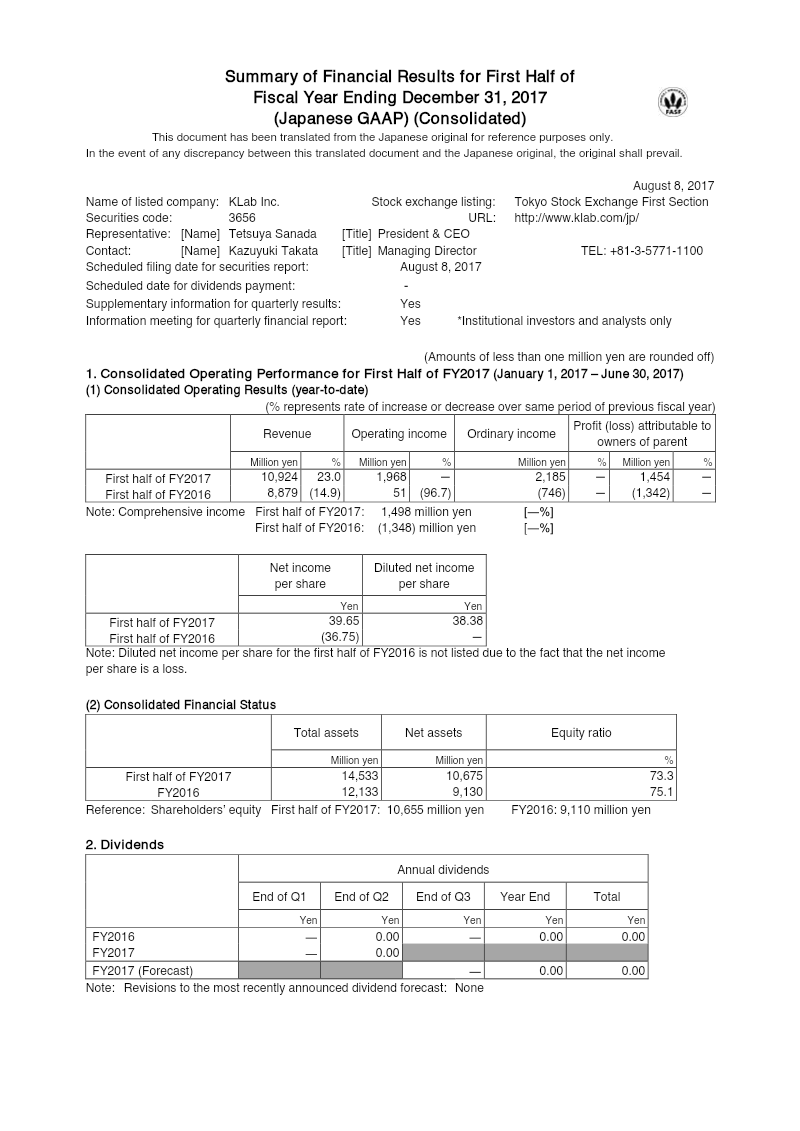
This financial summary details the consolidated operating performance of KLab Inc. for the first half of the fiscal year ending December 31, 2017. Covering the period from January 1 to June 30, 2017, the findings reveal a significant financial turnaround compared to the same period in 2016. Revenue rose 23.0% to 10.9 billion yen, driven by the stable performance of core titles and the successful June launch of Captain Tsubasa: Tatakae Dream Team.
The transition from a net loss of 1.3 billion yen in the previous year to a profit of 1.45 billion yen highlights improved operational efficiency. Operating income reached 1.96 billion yen, a stark contrast to the 51 million yen reported in 2016. This growth was supported by a 6.6% reduction in selling, general, and administrative expenses—primarily through lower advertising and outsourcing costs—and a 175 million yen foreign exchange gain. The company’s financial position remains robust, with total assets increasing to 14.5 billion yen and an equity ratio of 73.3%.
Strategic developments noted include the July 2017 acquisition of ABASEA Inc. and its subsidiary Spicemart Inc. for 1 billion yen. This move aims to enhance KLab’s data analysis and consulting capabilities within the competitive mobile gaming markets of Japan and China. Methodologically, the report utilizes Japanese GAAP and introduces a range-based forecasting model for the full fiscal year. Management revised its annual guidance upward, projecting revenue between 22.5 and 25.5 billion yen and ordinary income between 2.4 and 4.2 billion yen, reflecting confidence in current market trends and the success rate of new game titles.
- KLab Inc. achieved a significant financial turnaround in H1 2017, moving from a 1.3 billion yen net loss in 2016 to a 1.45 billion yen profit.
- Revenue grew 23.0% year-over-year to 10.9 billion yen, bolstered by stable core title performance and the June 2017 launch of Captain Tsubasa: Tatakae Dream Team.
- Operating income surged to 1.96 billion yen compared to 51 million yen in the same period of 2016, aided by a 6.6% reduction in selling, general, and administrative expenses.
- Management revised full-year guidance upward, projecting revenue between 22.5 and 25.5 billion yen and ordinary income between 2.4 and 4.2 billion yen.
- KLab acquired ABASEA Inc. and its subsidiary Spicemart Inc. for 1 billion yen in July 2017 to strengthen data analysis and consulting capabilities in the Japanese and Chinese mobile gaming markets.
+2
KLabAug 2017
Financial11 pages
Summary of Financial Results for First Quarter of Fiscal Year Ending December 31, 2017: Japanese GAAP
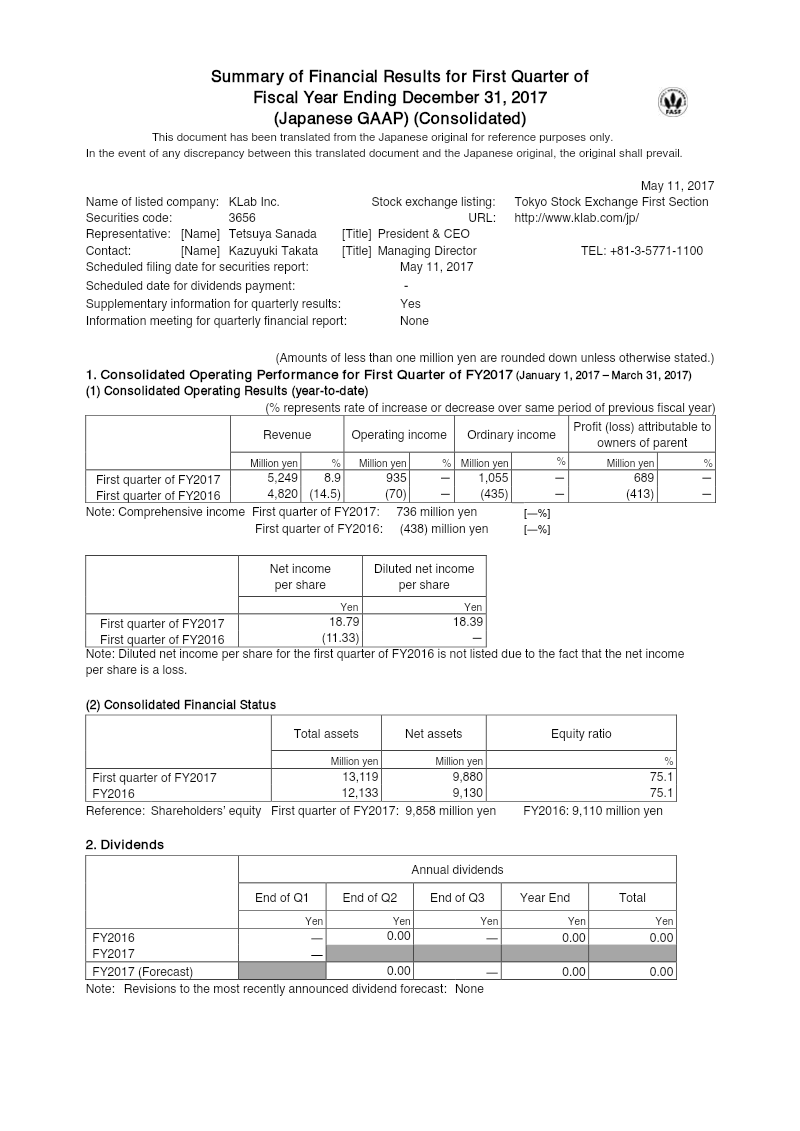
KLab Inc. reported a significant financial turnaround in its consolidated operating results for the first quarter of the fiscal year ending December 31, 2017. Covering the period from January 1 to March 31, 2017, the data reveals a return to profitability compared to the same period in the previous year. Revenue reached 5.25 billion yen, an 8.9% year-over-year increase, while operating income surged to 935 million yen, reversing a 70 million yen loss from the first quarter of 2016. Profit attributable to owners of the parent reached 689 million yen, compared to a 413 million yen loss in the prior year.
The primary drivers for this growth were the strong performances of the mobile game titles Love Live! School Idol Festival and Bleach: Brave Souls. Financial efficiency improved as the cost of sales decreased by 5.4% and selling, general, and administrative expenses dropped by 30.9%, largely due to reduced event-related costs and lower advertising expenditures. Additionally, the company benefited from 101 million yen in foreign exchange gains. The balance sheet remained stable with an equity ratio of 75.1% and total assets increasing to 13.1 billion yen, driven by higher trade accounts receivable and software in progress.
Looking ahead, the company has transitioned to a range-based forecasting method to provide investors with a more comprehensive long-term perspective. For the full fiscal year 2017, revenue is projected to fall between 17.5 billion and 22.5 billion yen, with operating income forecasted between 600 million and 2.9 billion yen. These projections account for the inherent volatility in the success rates of new game titles. No dividends were paid for the quarter, and the forecast for year-end dividends remains at zero yen.
- KLab Inc. achieved a financial turnaround in Q1 2017, reporting 5.25 billion yen in revenue—an 8.9% year-over-year increase—and 935 million yen in operating income compared to a 70 million yen loss in Q1 2016.
- Profit attributable to owners of the parent reached 689 million yen for the quarter, reversing the 413 million yen loss recorded in the same period of the previous year.
- Growth was primarily driven by the strong performance of mobile game titles 'Love Live! School Idol Festival' and 'Bleach: Brave Souls'.
- Operational efficiency improved significantly as the cost of sales decreased by 5.4% and selling, general, and administrative expenses dropped by 30.9% due to reduced advertising and event costs.
- The company maintains a stable balance sheet with an equity ratio of 75.1% and total assets of 13.1 billion yen, supported by a 101 million yen foreign exchange gain.
+1
KLabMay 2017
Financial2 pages
Notice Concerning Non-Operating Income Recorded for Fourth Quarter FY2016 and Revision of Earnings Forecasts for FY2016
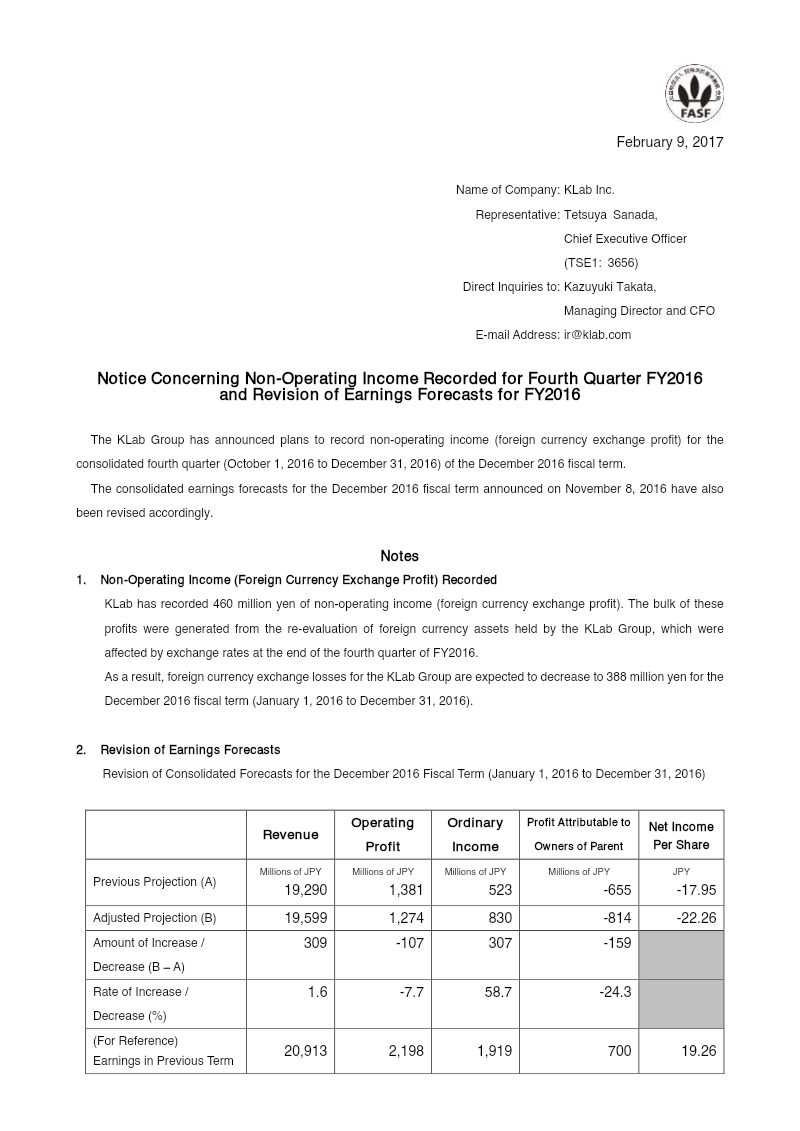
KLab Inc. has revised its consolidated earnings forecasts for the fiscal year ending December 31, 2016, following the recording of significant non-operating income during the fourth quarter. The primary driver for this adjustment is a 460 million yen foreign currency exchange profit resulting from the re-evaluation of foreign currency assets. This gain effectively reduced the group’s total foreign currency exchange losses for the full fiscal year to 388 million yen.
The revised projections indicate a mixed financial performance across different metrics. Revenue expectations increased by 1.6 percent to 19.599 billion yen, driven by the strong performance of Love Live! School Idol Festival in both Japanese and English markets, alongside the global success of Bleach: Brave Souls. However, operating profit forecasts were lowered by 7.7 percent to 1.274 billion yen due to rising outsourcing and subcontracting costs associated with joint-development projects and event business expenses.
Despite the boost in ordinary income, which rose 58.7 percent to 830 million yen because of the exchange gains, the net loss attributable to owners of the parent widened. The projected net loss increased from 655 million yen to 814 million yen, representing a 24.3 percent decline from previous estimates. This downward revision is attributed to one-time costs, including the liquidation of the offshore development center KLab Cyscorpions, Inc., and valuation losses on investment securities. These adjustments reflect the company's strategic restructuring and the impact of volatile currency markets on its international operations during the 2016 calendar year.
- KLab Inc. widened its projected net loss for FY2016 by 24.3%, moving from 655 million yen to 814 million yen.
- Operating profit forecasts were lowered by 7.7% to 1.274 billion yen, driven by increased outsourcing costs for joint-development projects and event expenses.
- Revenue projections for FY2016 increased by 1.6% to 19.599 billion yen, fueled by the performance of 'Love Live! School Idol Festival' and 'Bleach: Brave Souls'.
- Ordinary income rose by 58.7% to 830 million yen, primarily due to a 460 million yen foreign currency exchange profit recorded in the fourth quarter.
- The company incurred significant one-time costs, including the liquidation of its offshore subsidiary KLab Cyscorpions, Inc. and valuation losses on investment securities.
+1
KLabFeb 2017