1 free read left. Create a free account for unlimited reading + AI research.
Create free accountArticleKinephanos
This theory relies on speculative narratives of societal disenchantment rather than actual, complex experiences of fans.
It's like assuming a book's plot from its cover without reading any pages.
Key Flaw. The 'loss hypothesis' is not supported by empirical data from fan communities.
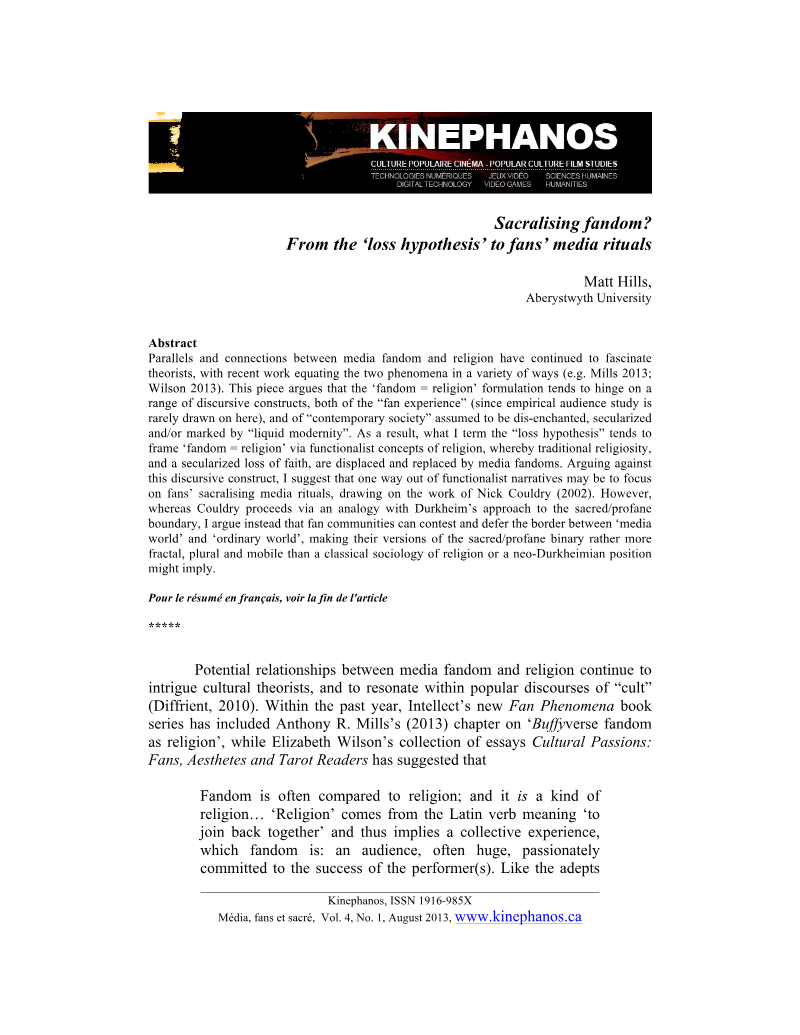
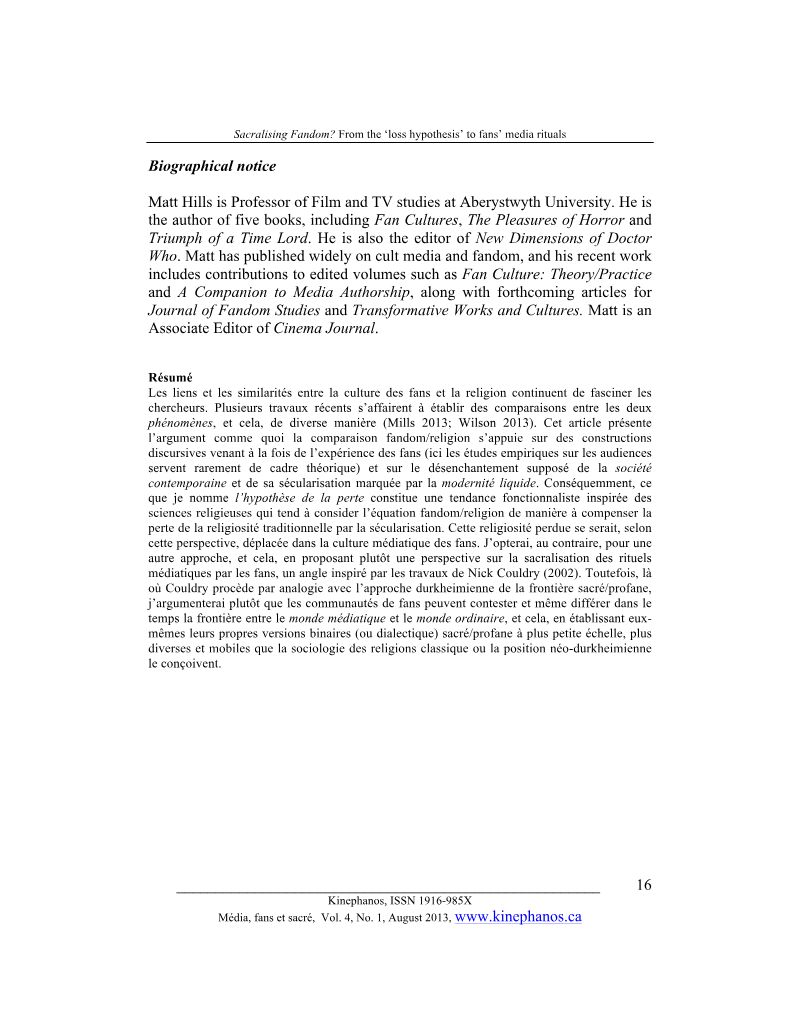
This analysis examines the prevailing academic tendency to equate media fandom with religious practice, a framework often referred to as the "loss hypothesis." This hypothesis posits that in a secularized, "liquid" modern society, fandom serves as a functionalist substitute for traditional religious faith, providing the collective meaning and ritualized experience that modern individuals supposedly lack. The study argues that this formulation is largely a discursive construct, frequently advanced by theorists without the support of empirical audience research. By relying on speculative narratives of societal disenchantment, these theories often fail to account for the actual, complex experiences of fans.
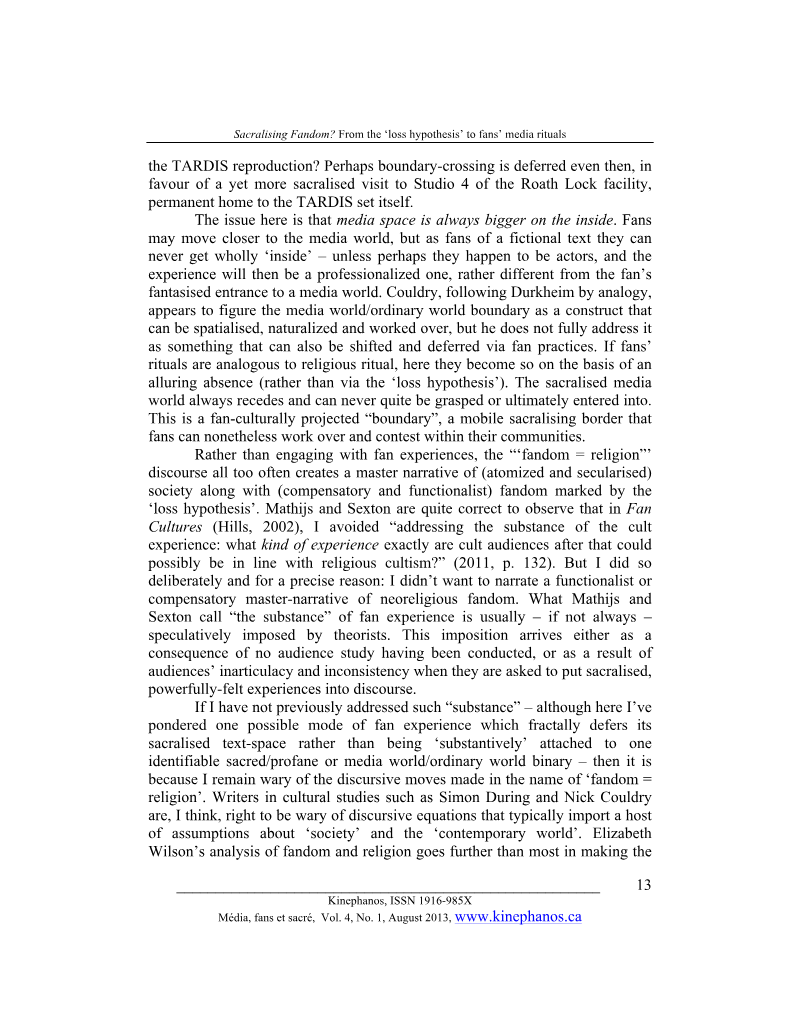
The research challenges the functionalist view by applying a critical lens to the concept of media rituals. While traditional sociology, such as the neo-Durkheimian approach, suggests that rituals reinforce a rigid boundary between the sacred and the profane, this analysis suggests that fan communities operate differently. Rather than adhering to a static, institutionalized divide, fans engage in mobile, fractal, and pluralistic rituals that continuously contest and defer the border between the "media world" and the "ordinary world." Because the media world is symbolically constructed as being "bigger on the inside," fans are perpetually engaged in a process of approaching a sacred space that remains perpetually out of reach, rather than simply replacing a lost religious faith.
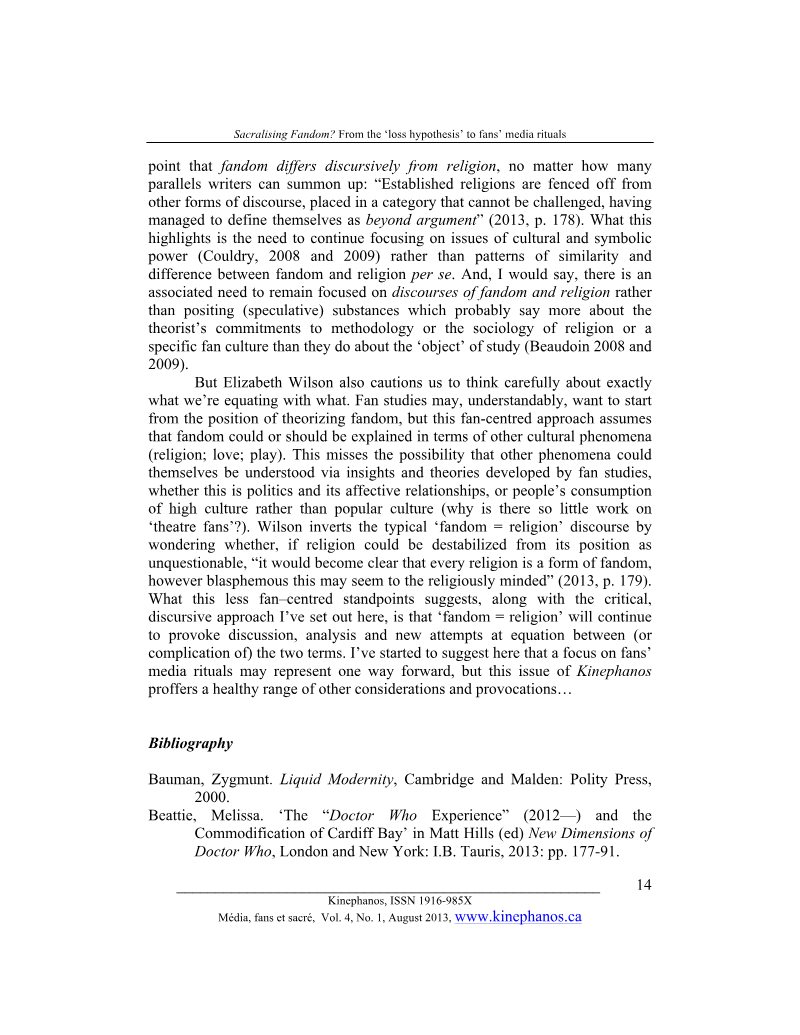
Ultimately, the study concludes that the "fandom equals religion" narrative is an oversimplification that prioritizes the theorist's own commitments over the nuanced reality of fan culture. It advocates for a shift in focus toward the study of cultural and symbolic power, suggesting that fan studies should move beyond seeking parallels with religion and instead explore how fan-based insights might better inform our understanding of other cultural phenomena, including politics and high-culture consumption.



Kinephanos · 2026
Kinephanos · 2026
Kinephanos · 2026
Kinephanos · 2025
Kinephanos · 2025
Kinephanos · 2025
Kinephanos · 2025
Kinephanos · 2025
Kinephanos · 2025
Kinephanos · 2025
Kinephanos · 2025
Kinephanos · 2025
International Journal of Role-Playing · 2026































Comments