Games Workshop Group
Game Co.34 documents
Documents
Financial16 pages
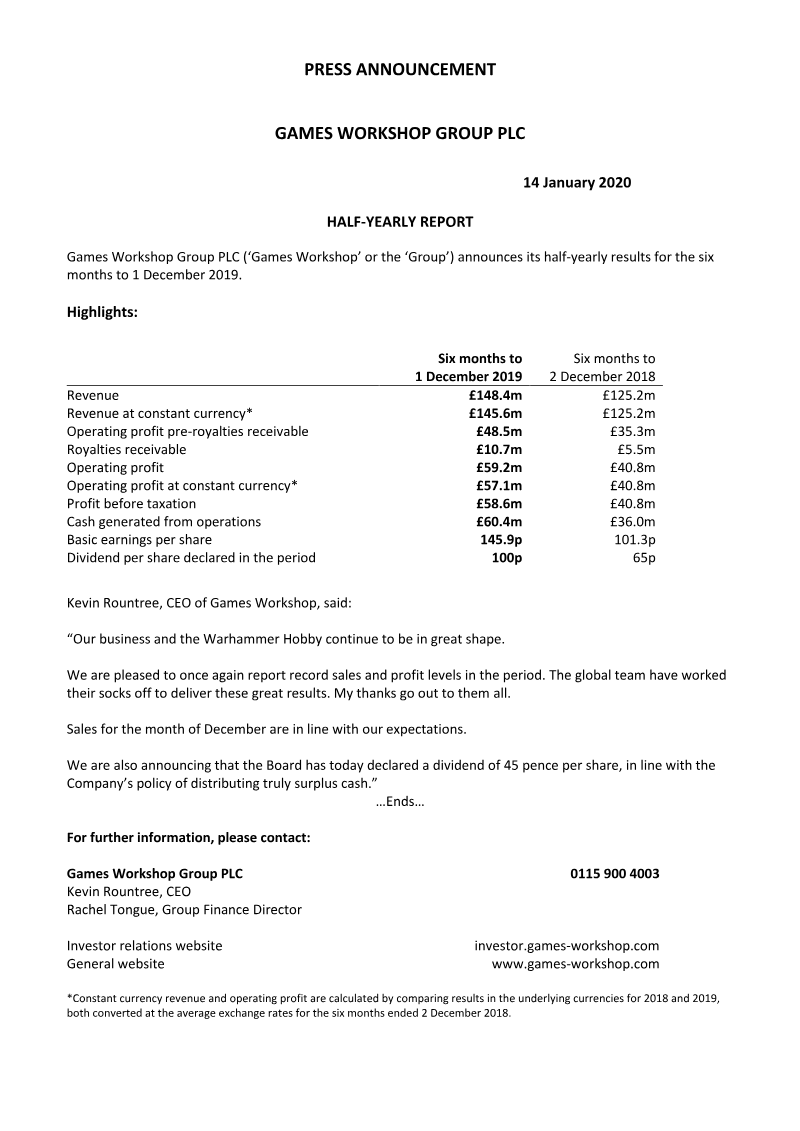
Half-Yearly Report: 2019-2020
Games Workshop achieved record financial performance during the six months ending December 1, 2019, characterized by a 19% increase in revenue to £148.4 million and a significant rise in profit before taxation to £58.6 million. This growth was primarily propelled by the Trade segment, which saw a 27% increase in sales and the addition of approximately 200 new accounts, alongside a doubling of royalty income to £10.7 million. Performance was particularly robust in North American markets and bolstered by the successful launch of the Citadel Colour paint range. The company maintained an exceptional return on capital employed of 111%, allowing for the distribution of 100p per share in dividends while sustaining a strong cash position of nearly £33 million.
The financial landscape of the period was also shaped by the adoption of IFRS 16, which integrated operating leases onto the balance sheet and resulted in the recognition of £33.6 million in right-of-use assets. Despite these accounting shifts and increased capital expenditure of £4.59 million, the group demonstrated high liquidity with £60.4 million in net cash generated from operating activities. Basic earnings per share rose to 145.9p, reflecting the overall increase in operating profit from £40.8 million in the previous year to £59.2 million.
Strategic focus remains centered on intellectual property exploitation and management quality as key internal drivers. While external uncertainties such as Brexit pose potential risks to European Union trade and recruitment, comprehensive mitigation plans are in place to ensure operational continuity. The combination of a debt-free balance sheet, seasonal sales peaks during the holiday period, and a growing global trade footprint reinforces a stable outlook for the remainder of the fiscal year.
- Games Workshop achieved record financial performance for the six months ending December 1, 2019, with revenue rising 19% to £148.4 million and profit before taxation increasing to £58.6 million.
- The Trade segment was a primary growth driver, recording a 27% sales increase and the addition of approximately 200 new accounts.
- Royalty income doubled to £10.7 million, while operating profit grew significantly from £40.8 million in the previous year to £59.2 million.
- The company maintained a high return on capital employed of 111%, supporting a dividend distribution of 100p per share and a cash position of nearly £33 million.
- Basic earnings per share rose to 145.9p, supported by £60.4 million in net cash generated from operating activities despite £4.59 million in capital expenditure.
Games Workshop GroupDec 2019

Financial78 pages
Games Workshop Group PLC Annual Report FY2019
Games Workshop achieved record-breaking financial performance for the 2018/19 fiscal year, with annual revenue surpassing £250 million for the first time. Reaching £256.6 million in sales and £81.3 million in profit before tax, the company demonstrated a third consecutive year of significant growth. This expansion was driven by a 29% increase in the trade channel, particularly within North American and Asian markets, alongside a rising contribution from intellectual property royalties. To sustain this momentum, the company invested approximately £14 million in manufacturing and tooling, including a new production facility in Nottingham and global warehousing upgrades.
The strategic focus centered on a centralized business model and high-quality fantasy miniatures, supported by the opening of 40 new retail stores and the addition of 600 trade accounts. Beyond core manufacturing, the company expanded its brand reach through the "Warhammer Story Forge" for animation and a development agreement for an Eisenhorn television series. While operating profit rose by 9%, gross margins saw a slight decline to 67.5% due to shifts in product and channel mix, and return on capital adjusted to 100% following substantial capital expenditures.
Corporate governance and workforce investment remained central to operations. The workforce grew to 2,110 employees, supported by the UK living wage and a discretionary £1,500 payment to all staff in recognition of exceptional performance. Executive remuneration also saw significant adjustments following external benchmarking, with CEO total pay rising to £1.077 million. Despite increased energy efficiency at headquarters, the company’s carbon footprint rose slightly to 5,240 tonnes of CO2e. Looking forward, the company maintains a strong balance sheet with £29.4 million in cash and no utilized borrowing facilities, confirming financial viability for the next three years while navigating potential economic uncertainties related to Brexit.
- Games Workshop achieved record financial performance in FY2019, reaching £256.6 million in revenue and £81.3 million in profit before tax.
- Growth was driven by a 29% increase in the trade channel, with significant expansion in North American and Asian markets.
- The company invested £14 million into capital expenditures, specifically targeting a new Nottingham production facility and global warehousing upgrades.
- Strategic brand expansion included the launch of 'Warhammer Story Forge' for animation and a development agreement for an 'Eisenhorn' television series.
- Operational scale increased through the addition of 40 new retail stores and 600 new trade accounts, bringing the total workforce to 2,110 employees.
Games Workshop GroupAug 2019
Financial15 pages
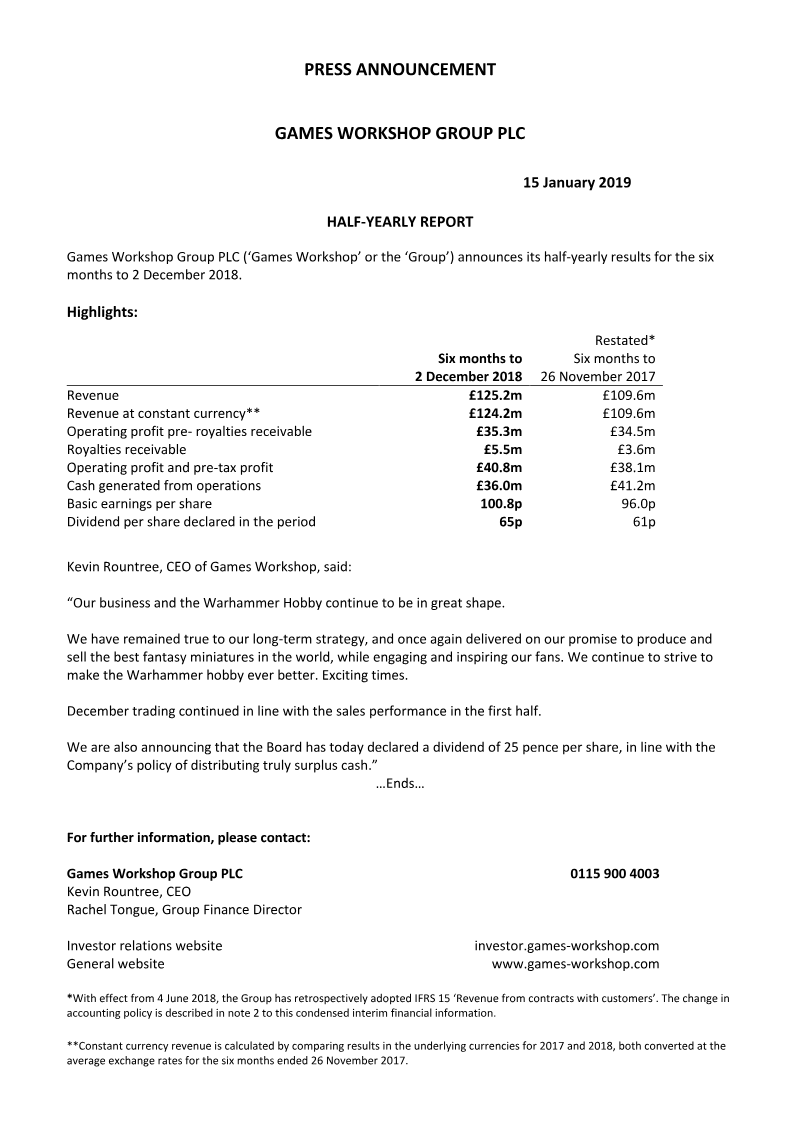
Half-Yearly Report: Six months to 2 December 2018
Games Workshop achieved record financial performance during the six months ending December 2, 2018, characterized by a 14.3% increase in revenue to £125.2 million and a rise in pre-tax profit to £40.8 million. This growth was primarily propelled by the trade channel, which surged 26% to reach £61.4 million, and a significant 30% increase in engagement through the Warhammer Community platform. While the retail segment also contributed £42.5 million to the total, online sales remained flat, and the product and supply divisions faced profit declines. Basic earnings per share rose to 100.8p, supporting the distribution of £21.0 million in dividends to shareholders at 65 pence per share.
The financial landscape was influenced by the retrospective adoption of IFRS 15 and IFRS 9 accounting standards, which necessitated adjustments to revenue recognition for royalty guarantees and delivery charges. Despite record profits, cash generated from operations decreased to £36.0 million as the group increased investment in working capital and inventory. Net inventory provisions more than doubled to £3.4 million, reflecting a strategic shift toward managing capacity constraints. The group maintained a robust balance sheet with net assets of £101.6 million and confirmed its status as a going concern with sufficient resources for the foreseeable future.
Operational focus during this period centered on large-scale infrastructure projects designed to sustain long-term growth. These initiatives include the construction of a new factory in Nottingham and the implementation of a comprehensive UK-wide ERP system. These capital commitments, totaling nearly £3 million, aim to optimize supply chain efficiency and address the physical limitations of current production facilities. By prioritizing these structural improvements alongside a strong trade performance, the group seeks to mitigate capacity risks and capitalize on the expanding global demand for its core hobby products.
- Games Workshop achieved record financial performance for the six months ending December 2, 2018, with revenue increasing 14.3% to £125.2 million and pre-tax profit rising to £40.8 million.
- The trade channel was the primary growth driver, surging 26% to £61.4 million, while the retail segment contributed £42.5 million and online sales remained flat.
- Basic earnings per share reached 100.8p, enabling the company to distribute £21.0 million in dividends to shareholders at 65 pence per share.
- Operational cash flow decreased to £36.0 million as the company increased investment in working capital and inventory, with net inventory provisions more than doubling to £3.4 million.
- The company is investing nearly £3 million in infrastructure projects, including a new Nottingham factory and a UK-wide ERP system, to address supply chain capacity constraints.
+1
Games Workshop GroupJan 2019

Report69 pages
Annual Report 2018
Games Workshop achieved record-breaking financial performance during the 2017/18 fiscal year, characterized by a 39% increase in revenue to £219.9 million and a near doubling of operating profit to £74.6 million. This growth, which propelled the company into the FTSE 250, was primarily driven by the global success of the Warhammer brand and a 54% surge in the trade segment. With 76% of sales generated internationally, the company significantly expanded its Nottingham-based manufacturing and R&D facilities, doubling plastic injection molding capacity and increasing inventory levels to £20.2 million to meet rising global demand.
Strategic priorities focused on long-term infrastructure and digital engagement, including the implementation of a new ERP system and a successful relaunch of Warhammer 40,000 that drove 70 million digital community page views. Financial stability remained robust, with the company maintaining a debt-free position and increasing cash reserves to £28.5 million. While management monitored risks related to Brexit and supply chain interruptions, the return on capital rose from 72% to 120%. Governance remained stable, with the board defending the tenure of long-serving directors based on their deep industry expertise, while also implementing a revised remuneration policy to align executive pay with market rates following the year’s exceptional performance.
The company’s commitment to sustainability and compliance was evidenced by a reduction in greenhouse gas emissions through solar energy investments and the achievement of full GDPR compliance. Looking forward, the company remains focused on multi-channel retail growth and IP licensing opportunities. Independent auditors confirmed the integrity of the financial statements, noting that while inventory valuation and development costs require significant management judgment, the group remains a strong going concern with high liquidity and a clear trajectory for continued global expansion.
- Games Workshop achieved record financial performance in the 2017/18 fiscal year, with revenue increasing 39% to £219.9 million and operating profit nearly doubling to £74.6 million.
- The company’s growth was driven by a 54% surge in the trade segment and the global success of the Warhammer brand, which helped propel the firm into the FTSE 250.
- To support international demand, which accounted for 76% of total sales, the company doubled its plastic injection molding capacity and increased inventory levels to £20.2 million.
- Operational efficiency and capital allocation were highly effective, with the return on capital rising from 72% to 120% while maintaining a debt-free balance sheet with £28.5 million in cash reserves.
- Digital engagement initiatives, highlighted by the relaunch of Warhammer 40,000, generated 70 million page views on the company's community platform.
Games Workshop GroupAug 2018
Financial16 pages
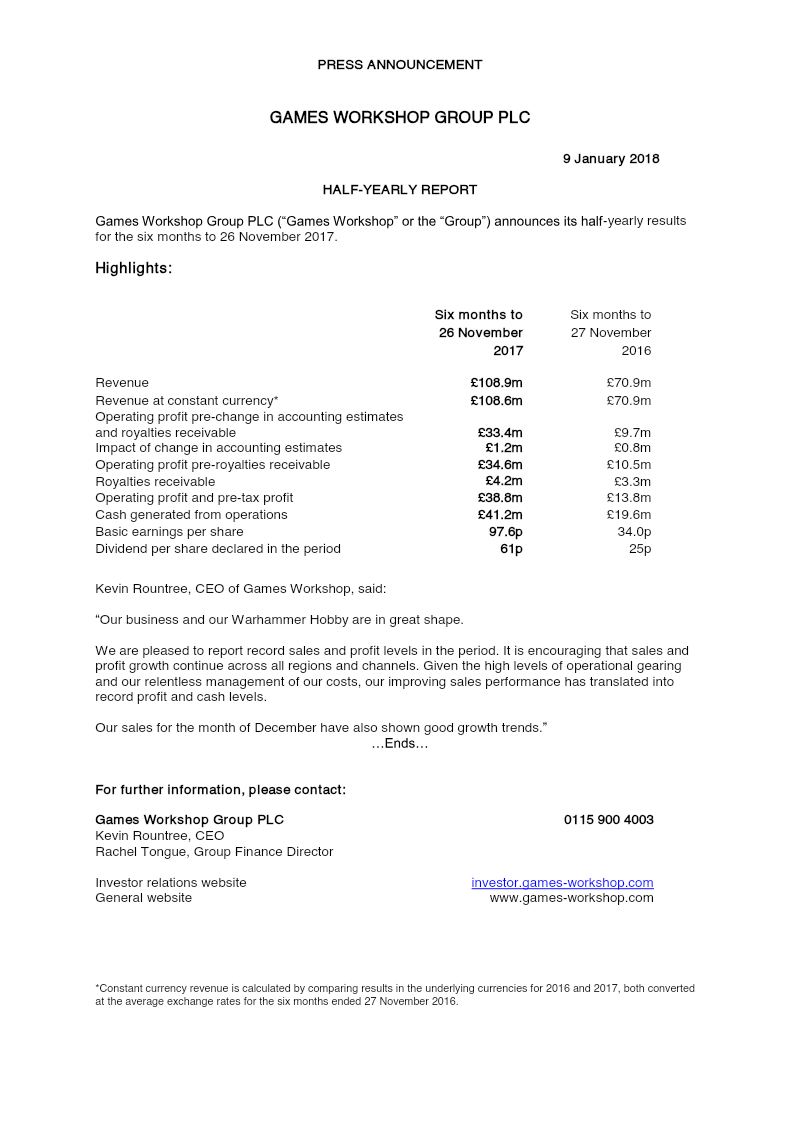
Half-Yearly Report: Six Months to 26 November 2017
Games Workshop achieved record-breaking financial performance during the six-month period ending November 26, 2017, characterized by a 54% surge in revenue to £108.9 million. This growth was distributed across all global sales channels, with the mail order segment experiencing a particularly sharp 71% increase. Profit before taxation nearly tripled, rising from £13.8 million to £38.8 million, while return on capital saw an extraordinary jump from 40% to 119%. These results reflect high operational gearing and intensified customer engagement across the company’s primary markets in North America, the United Kingdom, and Continental Europe.
The financial position of the group strengthened considerably, with cash equivalents rising to £28.6 million and net cash from operating activities reaching £36.0 million. While a change in accounting estimates regarding the amortization of development costs and moulding tools contributed a modest £1.2 million to the operating profit, the underlying drivers remained robust sales and vertical integration. To support this expansion, capital expenditure commitments more than doubled to £2.48 million compared to the previous year, signaling a strategic focus on scaling infrastructure to meet rising demand.
Despite the period’s success, management identified specific operational challenges related to the implementation of a new enterprise resource planning system and the capacity of the existing supply chain. Furthermore, the business remains subject to seasonal fluctuations, with the December Christmas period representing a critical peak for annual performance. Overall, the results demonstrate a period of rapid scaling and high profitability for the vertically integrated tabletop gaming manufacturer, supported by a healthy balance sheet and significant growth in its digital and trade segments.
- Games Workshop reported a 54% revenue increase to £108.9 million for the six months ending 26 November 2017, with profit before taxation nearly tripling to £38.8 million.
- Return on capital experienced a significant increase, rising from 40% to 119% during the period.
- Mail order sales were a primary growth driver, achieving a 71% increase across global channels.
- The company strengthened its financial position, ending the period with £28.6 million in cash equivalents and £36.0 million in net cash from operating activities.
- Capital expenditure commitments more than doubled to £2.48 million as the company invested in scaling infrastructure to meet rising demand.
Games Workshop GroupJan 2018

Report70 pages
Annual Report 2017
Games Workshop achieved record-breaking financial performance during the 2016/17 fiscal year, characterized by a 34% increase in revenue to £158.1 million and a doubling of operating profit to £38.3 million. This growth was balanced across all primary channels—trade, retail, and mail order—and supported by a robust gross margin of 72.4%. North America emerged as the largest geographic market, contributing £57.0 million to the total revenue. The company’s vertically integrated model, centered on its Nottingham manufacturing hub, produced 30 million miniatures and launched over 400 new products, while royalty income from licensed video games like Total War: Warhammer provided high-margin supplementary growth.
Strategic priorities focused on long-term stability and cash generation, resulting in a 72% return on capital and a 76% increase in dividends per share. Despite this success, the period involved significant administrative and leadership transitions. Long-standing Chairman Tom Kirby announced his retirement, and the board addressed a technical breach of the Companies Act 2006 regarding an "unlawful dividend" payment of £1.9 million. This was rectified through shareholder resolutions to release directors from liability and treat the payment as a loan offset by future dividends.
Operational investments included a major ERP system upgrade and a continued commitment to the UK Living Wage and universal profit-sharing, which saw a £4.9 million discretionary payment to the workforce. Environmental and governance disclosures highlight a reduction in carbon emissions and an 85% waste recycling rate. While the company maintains a conservative "survivalist" fiscal strategy, its strong liquidity position—ending the year with £17.9 million in cash and no debt—underpins its viability as a going concern through the 2020 horizon.
- Games Workshop achieved record financial performance in the 2016/17 fiscal year, with revenue increasing 34% to £158.1 million and operating profit doubling to £38.3 million.
- The company maintained a 72.4% gross margin and a 72% return on capital, supported by a debt-free balance sheet and £17.9 million in cash reserves.
- North America became the company's largest geographic market, contributing £57.0 million in revenue, while royalty income from licensed titles like Total War: Warhammer provided high-margin growth.
- The Nottingham manufacturing hub produced 30 million miniatures and launched over 400 new products, underpinned by a vertically integrated business model.
- Shareholders saw a 76% increase in dividends per share, despite the company addressing a technical breach of the Companies Act 2006 regarding an unlawful £1.9 million dividend payment.
Games Workshop GroupAug 2017
Financial15 pages
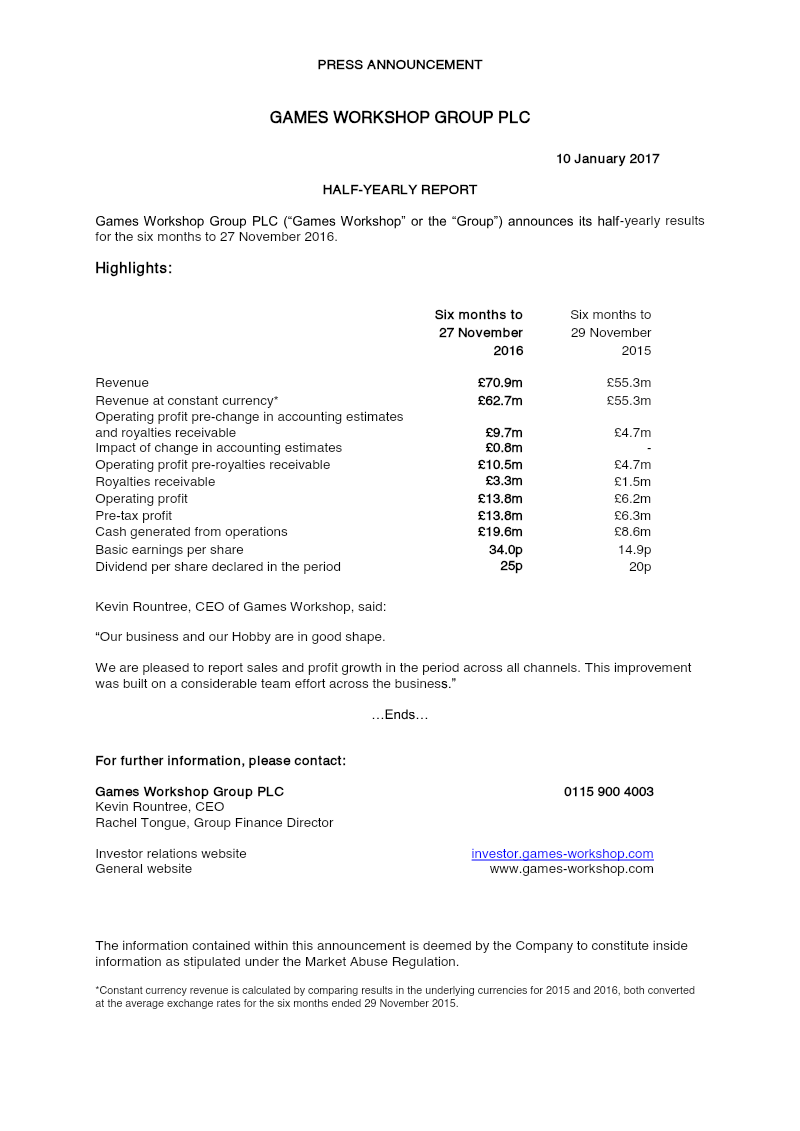
Half-Yearly Report: 27 November 2016
Games Workshop achieved substantial financial growth during the six months ending November 27, 2016, characterized by a 28% increase in revenue to £70.9 million and a more than doubling of pre-tax profit to £13.8 million. This performance reflects broad-based success across all primary sales channels, including Retail, Trade, and Mail Order. A significant driver of this profitability was a 120% surge in royalties receivable, which reached £3.3 million, alongside a robust return on capital of 40%. The period was marked by strong operational cash generation of £19.6 million, allowing for increased dividend payments of 25p per share and continued investment in the business.
The financial results were further bolstered by strategic adjustments to accounting estimates regarding the amortization of development costs and the depreciation of moulding tools. These changes, designed to better align expenditures with product revenue cycles, contributed an additional £0.8 million to the operating profit. Consequently, basic earnings per share rose to 34.0p, up from the previous year’s performance. The Group’s net cash position remained healthy, supporting £8.0 million in dividend distributions and £6.8 million in capital investments.
The overall trajectory indicates a period of high operational efficiency and market expansion for the tabletop gaming manufacturer. By leveraging strong performance in the Trade and Royalties segments, the company successfully translated increased external revenue into significant bottom-line growth. This fiscal period demonstrates a successful alignment of product development cycles with financial reporting, ensuring that the Group maintains a high level of liquidity while rewarding shareholders through consistent capital returns.
- Games Workshop reported a 28% revenue increase to £70.9 million and more than doubled pre-tax profit to £13.8 million for the six months ending November 27, 2016.
- Royalties receivable surged by 120% to £3.3 million, serving as a primary driver for the company's increased profitability.
- The company generated £19.6 million in operational cash, facilitating a dividend payment of 25p per share and £6.8 million in capital investments.
- Strategic accounting adjustments to the amortization of development costs and depreciation of moulding tools added £0.8 million to the operating profit.
- Basic earnings per share rose to 34.0p, supported by a 40% return on capital and a healthy net cash position.
Games Workshop GroupJan 2017
Financial14 pages
Half-Yearly Report and Trading Update
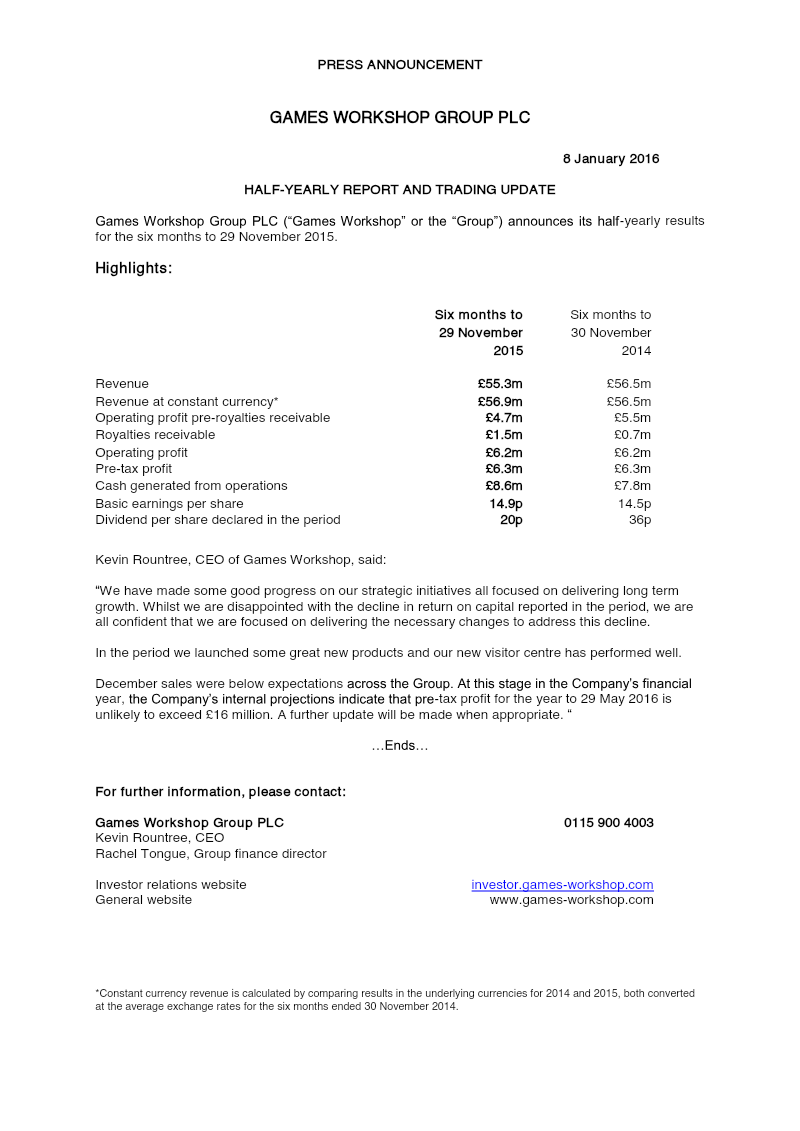
Games Workshop maintained a stable pre-tax profit of £6.3 million for the six months ending November 29, 2015, despite a 2.2% decline in reported revenue to £55.3 million. While constant currency sales saw a marginal increase of 0.7% and licensing royalties doubled to £1.5 million, core operating profit decreased by £0.8 million. This decline was primarily driven by unfavorable exchange rate fluctuations and increased capital investment in retail infrastructure. Performance across geographic segments remained mixed, with growth in Trade and Mail Order channels offset by a notable decline in Retail sales, particularly within Continental Europe.
The financial position remains supported by a profit of £4.78 million attributable to owners and a slight increase in basic earnings per share to 14.9p. Net cash from operating activities rose to £8.57 million, though total cash and cash equivalents decreased to £7.8 million following the distribution of £6.4 million in dividends. Significant investment in intangible assets continued, with £3.57 million in new additions bringing the net book value to £9.41 million, while contracted capital expenditure commitments were reduced to £867,000.
Despite the stable half-year results, a cautious outlook prevails following disappointing sales figures in December. Projections indicate that full-year pre-tax profit is unlikely to exceed £16 million. While the company continues to prioritize shareholder returns and operational investment, the immediate future is tempered by the volatility of the seasonal Christmas peak and the ongoing challenges of maintaining retail momentum in international markets.
- Games Workshop projects full-year pre-tax profit will likely not exceed £16 million following disappointing December sales figures.
- Pre-tax profit remained stable at £6.3 million for the six months ending November 29, 2015, despite a 2.2% decline in reported revenue to £55.3 million.
- Core operating profit fell by £0.8 million, driven by unfavorable exchange rate fluctuations and increased capital investment in retail infrastructure.
- Licensing royalties doubled to £1.5 million, providing a positive offset to a notable decline in retail sales, particularly within Continental Europe.
- Net cash from operating activities increased to £8.57 million, though total cash and cash equivalents fell to £7.8 million after the distribution of £6.4 million in dividends.
Games Workshop GroupJan 2016

Report65 pages
Games Workshop Group PLC Annual Report 2015
Games Workshop’s 2015 fiscal year was defined by a major leadership transition and significant structural reorganization aimed at stabilizing the business for long-term growth. Under the new leadership of CEO Kevin Rountree, the company reported a profit before taxation of £16.6 million on revenues of £119.1 million. While total revenue saw a 3.5% decline from the previous year—attributed to currency headwinds and internal restructuring—net profit attributable to owners rose significantly from £8.0 million to £12.3 million. This recovery supported a substantial dividend payout of 52 pence per share, totaling £16.6 million, reflecting a core strategic commitment to returning surplus capital to shareholders.
The company’s strategic focus shifted toward global expansion and operational efficiency, particularly through the rebranding of retail outlets to "Warhammer" and the implementation of a "one-man" store model to improve margins. Geographically, North America emerged as a key growth driver, contrasting with revenue declines in the United Kingdom and Continental Europe. A pivotal product milestone was the relaunch of the core fantasy line as Warhammer: Age of Sigmar. Simultaneously, the company expanded its high-margin licensing portfolio, which included 50 interactive products, and invested £6.4 million in a new global ERP system to modernize its digital and logistical infrastructure.
Operating with a workforce of 1,654 employees, the Group maintained a debt-free balance sheet and a strong cash position of £12.6 million. Governance and remuneration policies were updated to align with the new leadership, including a revised profit-sharing trigger based on sales revenue growth rather than operating profit. Despite some non-compliance issues regarding the UK Corporate Governance Code during the leadership handover, the company successfully formalized a global health and safety strategy and introduced a new all-employee Sharesave Plan. These initiatives underscore a transition toward a more standardized, scalable international business model focused on cash generation and disciplined capital allocation.
- Games Workshop reported a profit before taxation of £16.6 million on £119.1 million in revenue for fiscal year 2015, with net profit rising to £12.3 million from £8.0 million the previous year.
- The company maintained a debt-free balance sheet with £12.6 million in cash, supporting a dividend payout of 52 pence per share totaling £16.6 million.
- Total revenue declined by 3.5% due to currency headwinds and internal restructuring, with growth in North America failing to offset declines in the UK and Continental Europe.
- Operational efficiency initiatives included the rebranding of retail outlets to 'Warhammer,' the implementation of a 'one-man' store model, and a £6.4 million investment in a new global ERP system.
- The product portfolio was significantly updated with the relaunch of the core fantasy line as 'Warhammer: Age of Sigmar' and the expansion of a licensing portfolio comprising 50 interactive products.
+1
Games Workshop GroupAug 2015
Financial13 pages
Half-Yearly Report: Six Months to 30 November 2014
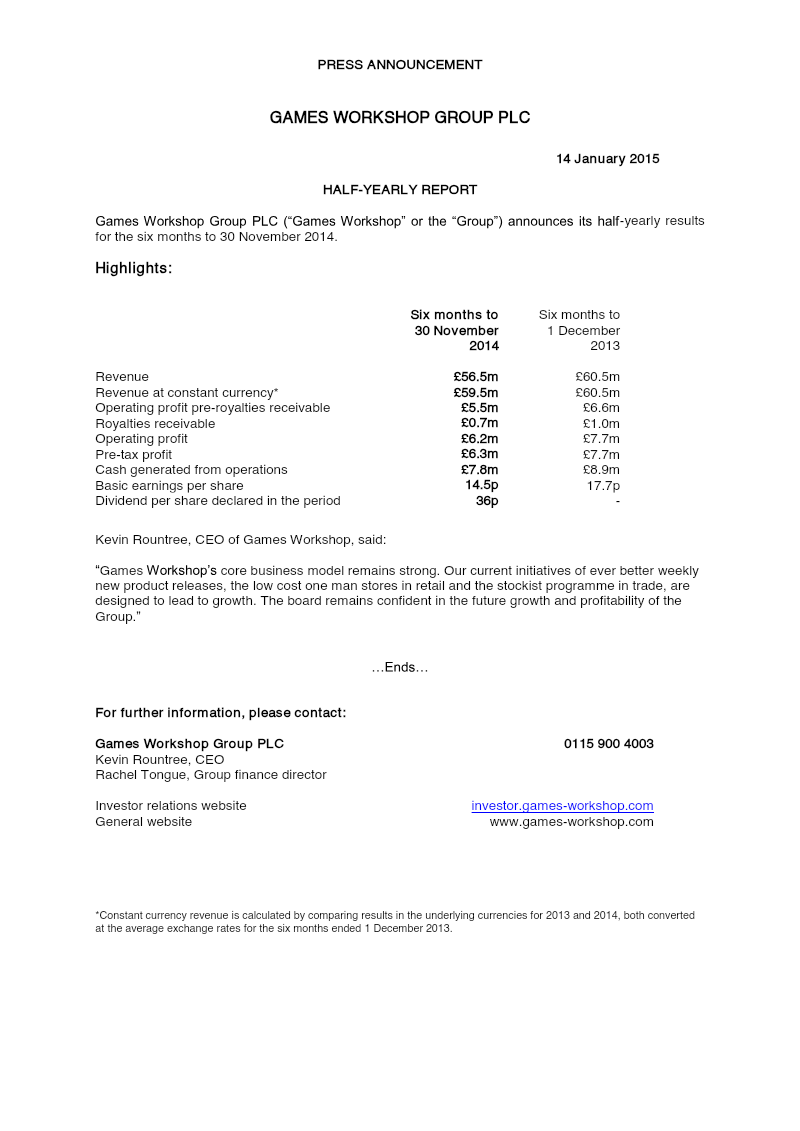
Games Workshop experienced a contraction in financial performance during the six months ending November 30, 2014, characterized by a 6.6% decline in revenue to £56.5 million and a 19% drop in pre-tax profit to £6.3 million. These results reflect a period of significant structural reorganization and the impact of unfavorable currency fluctuations. While the Mail Order segment remained highly profitable, the Retail channel recorded an operating loss of £1.3 million, largely due to redundancy costs and the ongoing transition toward a low-cost, one-man store model. Despite these challenges, the Group maintained sufficient cash generation to issue a dividend of 36p per share, though total cash and cash equivalents decreased by £9.3 million following these distributions.
The strategic focus during this period centered on operational efficiency and long-term infrastructure investment. Capital commitments rose to £3.3 million, directed toward enhancing the digital web store and renovating visitor facilities. Intangible assets and physical property reached a combined net book value of nearly £30 million following steady investment in production and intellectual property. Furthermore, the Group successfully reduced its total provisions from £3.53 million to £1.85 million as it utilized funds previously set aside for exceptional restructuring items.
Management remains focused on a high-frequency product release cycle to drive future growth, leveraging weekly launches to maintain consumer engagement. Although the retail landscape faced headwinds during the first half of the fiscal year, the stabilization of the store footprint and the utilization of seasonal sales peaks in December are expected to bolster the Group’s position. The transition toward a leaner retail estate and improved digital integration serves as the primary mechanism for recovering margins and ensuring long-term sustainability across global trade and retail channels.
- Games Workshop reported a 6.6% revenue decline to £56.5 million and a 19% drop in pre-tax profit to £6.3 million for the six months ending November 30, 2014.
- The Retail channel recorded an operating loss of £1.3 million, driven by redundancy costs and the transition to a one-man store model.
- Despite financial contraction, the company maintained a dividend of 36p per share, resulting in a £9.3 million decrease in total cash and cash equivalents.
- Capital expenditure reached £3.3 million, with investments prioritized for digital web store enhancements and visitor facility renovations.
- The company successfully reduced its restructuring provisions from £3.53 million to £1.85 million during the period.
Games Workshop GroupJan 2015