Games Workshop Group
Game Co.34 documents
Documents
Report24 pages
Half-Yearly Report: 2025
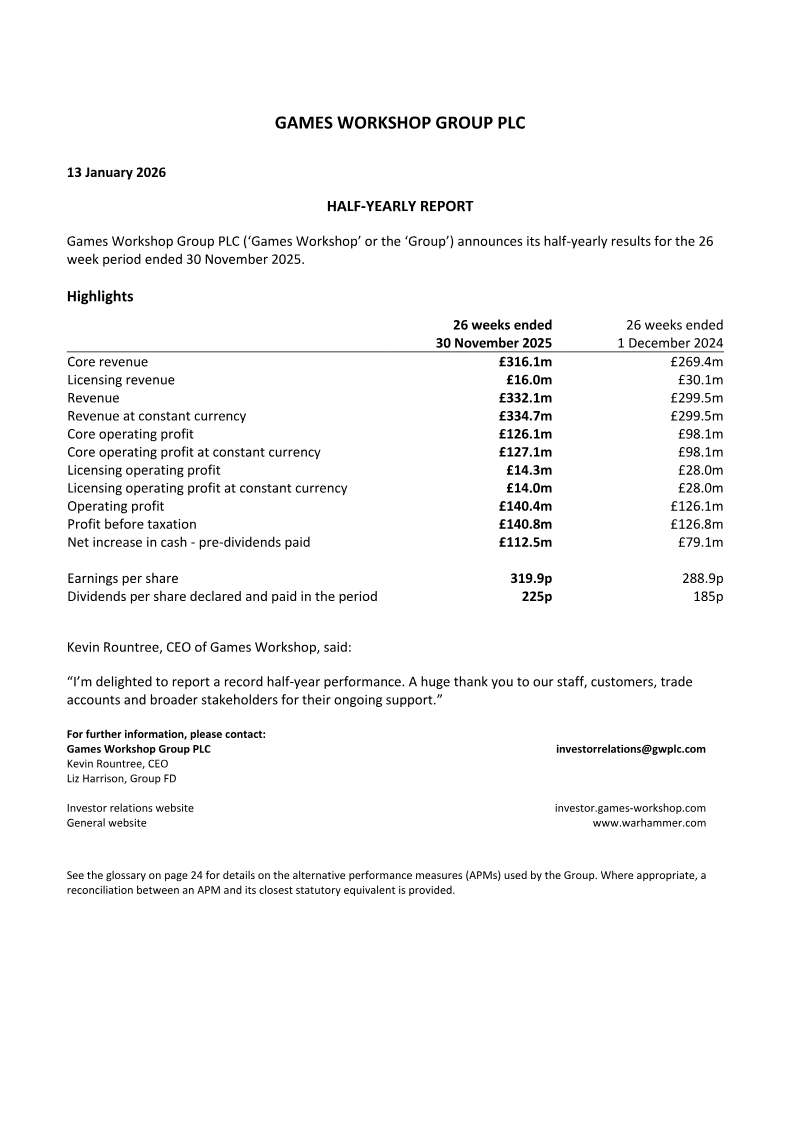
Games Workshop Group PLC (‘Games Workshop’ or the ‘Group’) announces its half-yearly results for the 26 week period ended 30 November 2025. 26 weeks ended 26 weeks ended 30 November 2025 1 December 2024 Core revenue £316.1m £269.4m Licensing revenue £16.0m £30.1m Revenue ...
- Games Workshop Group PLC reported a record half-year performance for the 26 weeks ended November 30, 2025, with total revenue reaching £332.1 million, up from £299.5 million in the prior year.
- Core revenue increased significantly to £316.1 million (from £269.4 million), while licensing revenue decreased to £16.0 million (from £30.1 million).
- Operating profit grew to £140.4 million (from £126.1 million), and profit before taxation increased to £140.8 million (from £126.8 million).
- Earnings per share rose to 319.9p (from 288.9p), and dividends per share declared and paid in the period were 225p (from 185p).
- The company is expanding its infrastructure with a new UK warehousing facility opening in 2027 and a new Warhammer World format location in North America also planned for 2027.
+1
Games Workshop Group

Report104 pages
Annual Report 2025
Annual Report 2025 details a landmark financial year for Games Workshop, characterized by record-breaking growth and the company’s promotion to the FTSE 100. For the 2024/25 period, total revenue rose to £617.5 million, with profit before taxation reaching £262.8 million. This performance was driven by a 14.2% increase in core sales—particularly within the trade channel and North American markets—and a near-doubling of licensing operating profit to £49.5 million, bolstered by the exceptional success of the Space Marine 2 video game.
The company continues to leverage a vertically integrated model, expanding its global footprint to 570 retail stores across 24 countries and an independent retailer network spanning 71 nations. To support this growth, significant capital investments are underway, including the construction of a fourth manufacturing facility by 2026 and a comprehensive IT systems overhaul slated for completion by 2029. While navigating macroeconomic challenges such as projected tariff impacts and supply chain disruptions, the Group maintained a robust liquidity position with £132.6 million in cash and distributed a record £20 million in profit-sharing to its workforce.
Strategic priorities have shifted toward long-term value alignment, evidenced by a new remuneration policy that introduces share-based compensation for executives and a "Triennial Share Award" linked to revenue and profit targets. Sustainability remains a core focus; despite a rise in total emissions driven by global freight, the company surpassed its 2032 reduction targets for Scope 1 and 2 emissions through facility electrification. Looking forward, the Group is prioritizing internal talent development, digital engagement through Warhammer+, and a potential media partnership with Amazon to further scale the brand's global reach.
- Games Workshop achieved record financial results for 2024/25 with £617.5 million in revenue and £262.8 million in profit before taxation, leading to its promotion to the FTSE 100.
- Licensing operating profit nearly doubled to £49.5 million, largely driven by the commercial success of the Space Marine 2 video game.
- Core sales grew by 14.2%, fueled by strong performance in the trade channel and North American markets.
- The company is scaling infrastructure with a fourth manufacturing facility scheduled for 2026 and a major IT systems overhaul targeted for 2029.
- Management has implemented a new executive remuneration policy featuring share-based compensation and a Triennial Share Award tied to specific revenue and profit targets.
+1
Games Workshop GroupAug 2025
Financial21 pages
Half-Yearly Report: 26 Week Period Ended 1 December 2024
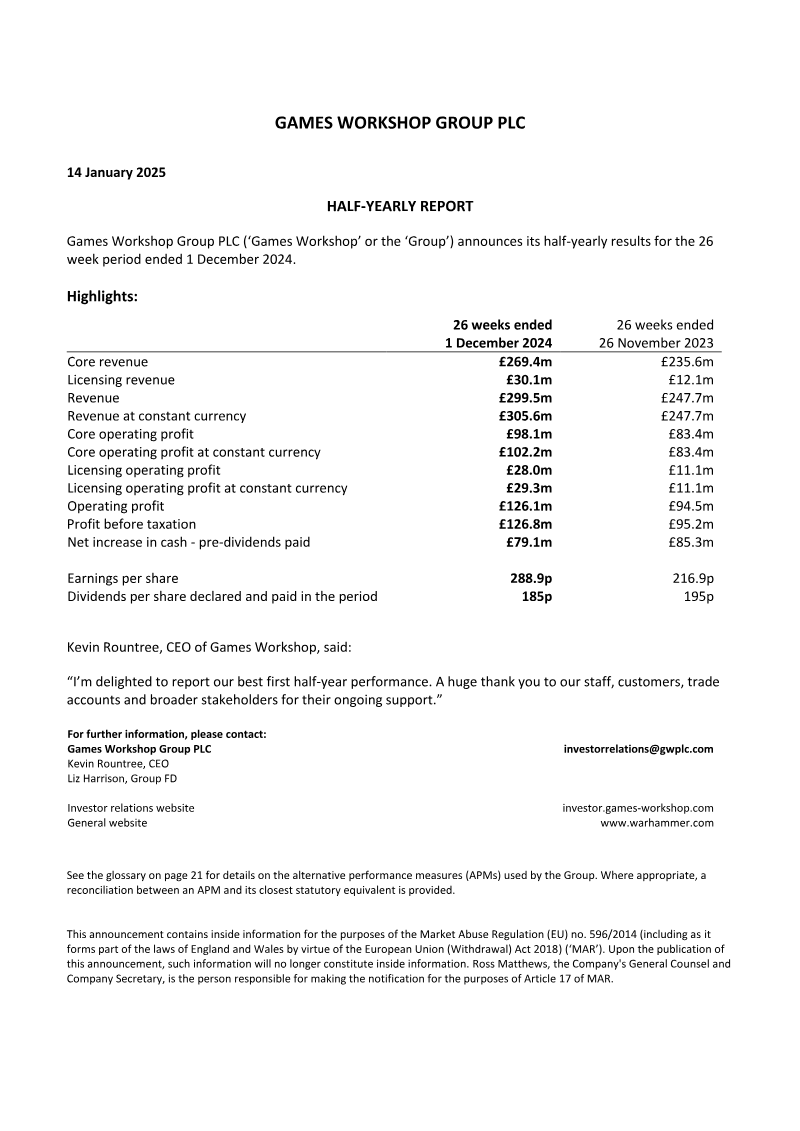
Games Workshop achieved record-breaking financial results for the 26-week period ended December 1, 2024, characterized by substantial growth in both core operations and intellectual property monetization. Total revenue reached £299.5 million, a significant increase from £247.7 million in the prior year, while profit before taxation rose to £126.8 million. This performance was underpinned by a 14.3% rise in core revenue, primarily driven by the Trade channel, which contributed £165.7 million. Licensing income experienced a dramatic surge, rising from £12.1 million to £30.1 million, largely due to the commercial success of the video game Space Marine 2 and the finalization of a major media deal with Amazon for film and television adaptations.
Geographic expansion remains a central strategic pillar, with a particular focus on North America and Asia. The company is on track to reach 200 profitable stores in North America by May 2025 and has identified over 30 potential locations for development in Japan over the next five years. While physical retail and trade channels showed robust growth across the UK, Europe, and North America, online sales saw a slight decline of 4.2% against difficult year-on-year comparisons. To support this global scale, capital investment increased to £14.3 million, directed toward expanding manufacturing and warehousing capacity in the UK, North America, and Australia, alongside critical upgrades to IT infrastructure.
The financial position remains strong with a net cash balance of £125.8 million, even after the distribution of £61 million in dividends. Despite these record results, the outlook includes careful monitoring of external risks such as potential US tariffs and ongoing cost inflation. Leadership transitions, including the appointment of a new Group Finance Director and Non-Executive Chair, coincide with a period of high digital engagement across community platforms and subscription services. The vertically integrated business model continues to demonstrate resilience, successfully converting increased global demand for the Warhammer brand into significant shareholder value.
- Games Workshop achieved record revenue of £299.5 million and profit before taxation of £126.8 million for the 26-week period ending December 1, 2024.
- Licensing income surged to £30.1 million, driven by the commercial success of the video game Space Marine 2 and a major media deal with Amazon.
- Core revenue grew by 14.3% to £299.5 million, with the Trade channel serving as the primary driver by contributing £165.7 million.
- The company is aggressively expanding its physical footprint, aiming for 200 profitable stores in North America by May 2025 and identifying 30 potential locations in Japan.
- Capital investment reached £14.3 million, focused on scaling manufacturing and warehousing capacity in the UK, North America, and Australia, as well as IT infrastructure upgrades.
Games Workshop GroupJan 2025
Financial24 pages
Half-Yearly Report: 26 Weeks Ended 30 November 2025
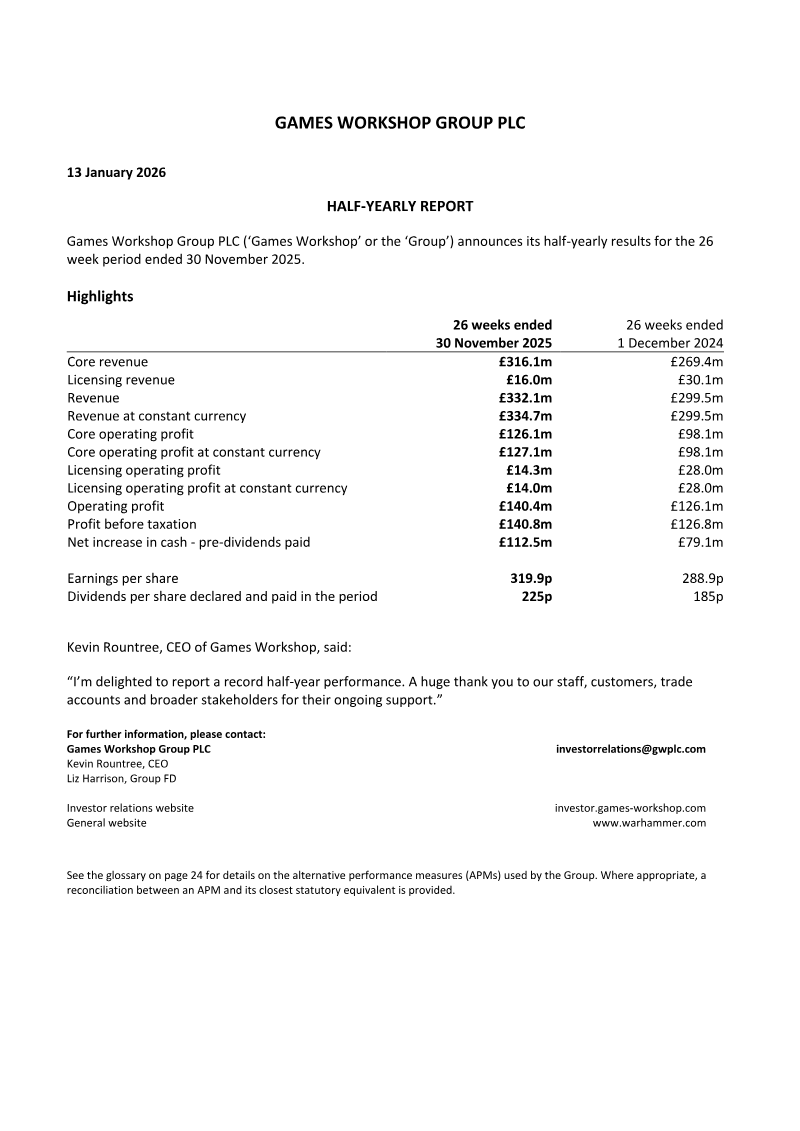
Games Workshop achieved record financial performance for the 26-week period ending November 30, 2025, characterized by robust core revenue growth and significant operational expansion. Total revenue rose to £332.1 million, a 10.9% increase over the previous year, while profit before tax climbed to £140.8 million. This growth was primarily fueled by the core business, particularly the trade channel, which saw a 25.2% increase to £207.4 million. High-profile product launches, including the record-breaking Space Wolves army box and new iterations for Horus Heresy and Age of Sigmar, underpinned this success.
While core operations flourished, licensing revenue experienced a contraction, falling from £30.1 million to £16.0 million. This decline is attributed to high prior-year comparatives following the major release of Space Marine 2, though long-term media prospects remain strong through ongoing development with Amazon MGM Studios. To protect margins against external pressures, such as £6.0 million in US tariff costs, the company implemented a 3.5% price increase and achieved a gross margin of 69.4%. Management also reaffirmed a strict policy against utilizing artificial intelligence in creative processes to preserve the brand's artistic integrity.
The company is aggressively investing in its global infrastructure to support future demand, with a fourth factory scheduled for 2026 and a robotic warehouse in the UK planned for 2027. Digital engagement continues to scale, with Warhammer+ reaching 248,000 subscribers and active digital users nearing 800,000. Supported by a strong cash position of £171.1 million and a global retail footprint of 575 stores, the Group remains a highly liquid going concern, returning £74.2 million to shareholders in dividends while maintaining progress toward its 2032 carbon emission targets.
- Games Workshop reported record financial performance for the 26 weeks ending November 30, 2025, with total revenue rising 10.9% to £332.1 million and profit before tax reaching £140.8 million.
- Core business growth was driven by a 25.2% increase in trade channel revenue to £207.4 million, bolstered by successful product launches including the Space Wolves army box and updates to Horus Heresy and Age of Sigmar.
- Licensing revenue fell by nearly half to £16.0 million compared to the previous year, primarily due to the absence of a major release comparable to the prior-year launch of Space Marine 2.
- To offset £6.0 million in US tariff costs and protect a 69.4% gross margin, the company implemented a 3.5% price increase across its products.
- The company is aggressively expanding infrastructure, with a fourth factory planned for 2026 and a robotic UK warehouse scheduled for 2027, supported by a strong cash position of £171.1 million.
+1
Games Workshop GroupJan 2025
Financial282 pages
Annual Report 2023
Tencent Holdings reported a robust financial performance for 2023, with total revenue reaching RMB 609 billion—a 9.8% increase year‑on‑year—driven by value‑added services, online advertising and fintech & business services. Gross profit rose 23% to RMB 293 billion, lifting the gross margin to 48%, while operating profit surged 44% to RMB 160 billion, delivering a 26% operating margin and a 19% net margin. Net profit attributable to equity holders fell to RMB 115 billion, reflecting a 39% decline, yet non‑IFRS profit grew 36% to RMB 158 billion, and basic earnings per share were RMB 12.19. Operating cash flow improved to RMB 221.96 billion, offset by RMB 125 billion of investing outflows and a modest increase in total borrowings to RMB 197.4 billion.
Strategically, the company set 2027 targets that include R&D investment of USD 78.5‑94.1 billion, overseas expansion of USD 31.4‑47.1 billion, and new product and service development of USD 15 billion. Cash is held almost entirely in RMB‑denominated accounts on the mainland, and the firm judges foreign‑exchange movements unlikely to materially affect results, monitoring leverage through a debt‑to‑adjusted‑EBITDA ratio.
Governance remained a focal point, with the board adhering to the Model Code for securities transactions, an insider‑information framework, and comprehensive directors‑and‑officers liability insurance. Share‑option programmes granted roughly 58 million awards without performance conditions, while dividend policy stayed flexible, proposing a final dividend of HKD 3.40 per share. The board composition featured eight members, including one executive director, and operated five specialised committees that oversaw risk, audit, remuneration and governance. A three‑lines risk‑management model identified ten material risks, highlighting heightened concerns around market competition, innovation and business continuity.
External auditors emphasized three key audit matters: revenue recognition for permanent virtual items, goodwill and investment impairment testing, and fair‑value measurement of Level 3 financial instruments. Overall, internal‑control, risk‑management and financial‑reporting systems were judged effective, supporting Tencent’s continued focus on user‑value creation, technological innovation and sustainable growth within the Chinese and global internet‑technology landscape.
- Tencent reported 2023 total revenue of RMB 609 billion, a 9.8% year-on-year increase, with operating profit surging 44% to RMB 160 billion.
- Non-IFRS profit grew 36% to RMB 158 billion, despite a 39% decline in net profit attributable to equity holders to RMB 115 billion.
- The company set aggressive 2027 strategic targets, including R&D investment of USD 78.5–94.1 billion and overseas expansion funding of USD 31.4–47.1 billion.
- Gross profit rose 23% to RMB 293 billion, improving the gross margin to 48% and the operating margin to 26%.
- Operating cash flow reached RMB 221.96 billion, while total borrowings increased to RMB 197.4 billion.
TencentMar 2024
Financial20 pages
Half-Yearly Report: 26 Week Period to 26 November 2023
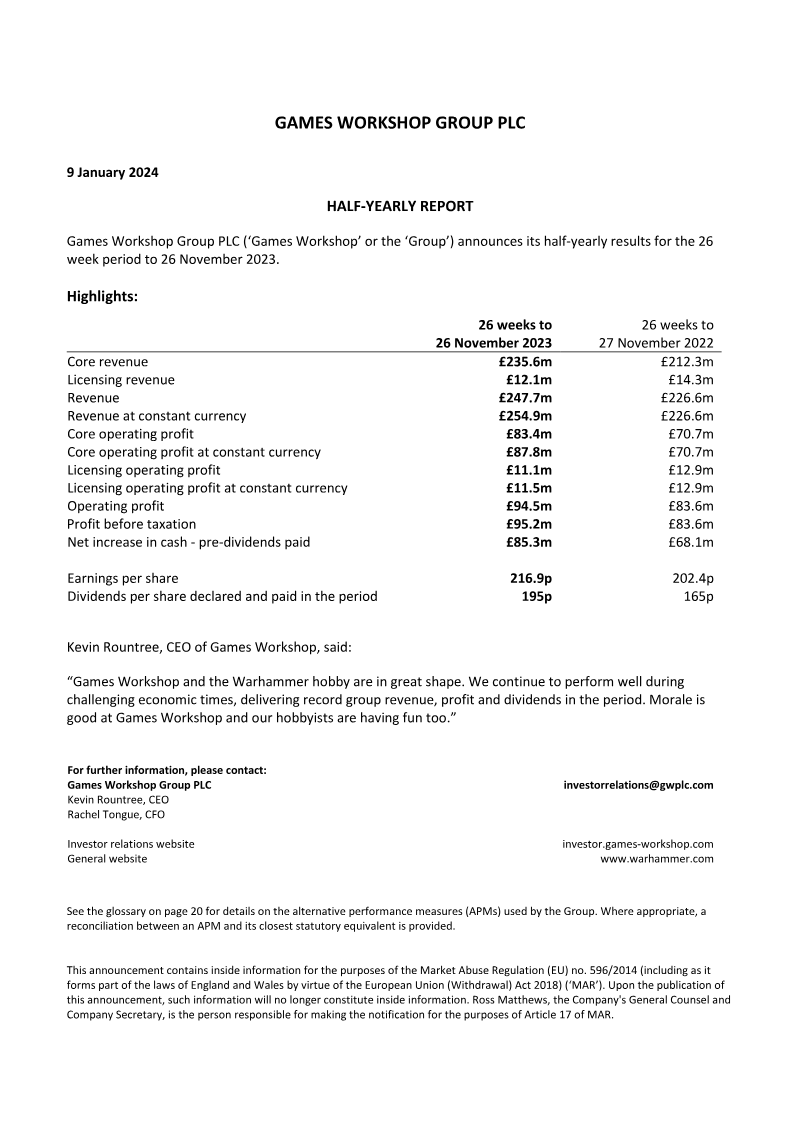
Games Workshop achieved record financial performance during the 26-week period ending November 26, 2023, characterized by significant growth in both revenue and profitability. Total revenue reached £247.7 million, a 9.3% increase over the previous year, while profit before tax rose to £95.2 million. This success was primarily driven by the core business segment, which saw an 11% rise in revenue fueled by the successful launch of the latest Warhammer 40,000 core set. Trade sales led this growth with a 12.6% increase, supported by record retail performances across the United Kingdom and North America.
Operational efficiency improved markedly as core gross margins rose from 64.2% to 69.4%, a result of reduced inventory provisions and lower logistics costs. While the core business thrived, licensing revenue experienced a slight decline to £12.1 million due to lower guarantee income, though the period was highlighted by a landmark development agreement with Amazon for film and television projects. Digital engagement also saw a sharp uptick, with active "My Warhammer" users increasing by 66% to 576,000 following a substantial £10.8 million investment in webstore infrastructure.
The financial position remains robust, with cash generated from operations rising to £116.9 million and cash equivalents reaching £111.3 million. This liquidity supported a dividend distribution of 195p per share, totaling £64.2 million. Despite an increased effective tax rate of 25% following UK statutory hikes, basic earnings per share grew to 216.9p. Looking forward, the company is expanding its global manufacturing and warehouse capacity while accelerating its carbon reduction initiatives ahead of the original 2032 schedule, maintaining a strong outlook across its primary markets in Europe and North America.
- Games Workshop achieved record financial performance for the 26-week period ending November 26, 2023, with revenue rising 9.3% to £247.7 million and profit before tax reaching £95.2 million.
- Core business revenue grew 11%, driven by the launch of the latest Warhammer 40,000 core set and a 12.6% increase in trade sales.
- Operational efficiency improved as core gross margins rose to 69.4% from 64.2%, aided by lower logistics costs and reduced inventory provisions.
- Digital infrastructure investment of £10.8 million resulted in a 66% increase in active 'My Warhammer' users, totaling 576,000.
- The company maintains a strong liquidity position with £111.3 million in cash equivalents, enabling a dividend distribution of 195p per share.
Games Workshop GroupJan 2024
Financial20 pages
Half-Yearly Report: 26‑Week Period to 27 November 2022
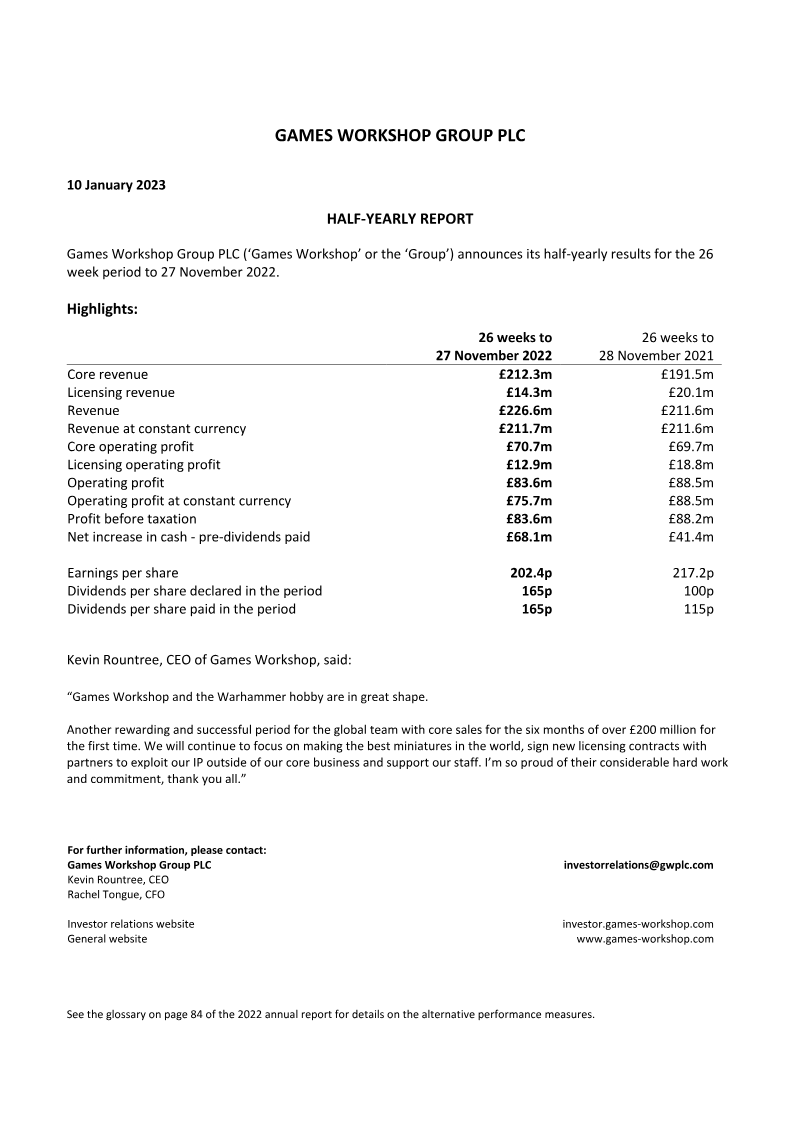
Games Workshop achieved record core revenue of £212.3 million during the 26-week period ending November 27, 2022, representing a 10.9% increase over the previous year. This growth was primarily driven by robust performance in the trade channel and a recovery in retail across the United Kingdom and Europe, even as online sales experienced a marginal decline and North American retail remained flat. Despite this top-line success, total profit before tax fell to £83.6 million from £88.2 million in the prior year. This contraction was largely attributed to a significant decrease in licensing income, which dropped to £14.3 million, alongside rising operational costs for materials, carriage, and staff investments.
The financial landscape was further characterized by a decline in constant currency gross margins, which fell by 4.5% to 64.1% due to global inflationary pressures. To mitigate long-term risks and support future growth, significant capital was directed toward infrastructure, including expanded manufacturing facilities in Nottingham, a new sales office in Barcelona, and a major £4.9 million webstore platform upgrade. Strategic focus remains centered on global intellectual property expansion, highlighted by a preliminary agreement with Amazon Studios to explore media opportunities.
The Group maintains a strong liquidity position with £85.2 million in cash and cash equivalents, allowing for the distribution of £54.2 million in dividends at 165p per share. While basic earnings per share decreased to 202.4p and the effective tax rate rose to 20.5%, the business remains a stable going concern. Management continues to monitor strategic risks involving IT infrastructure, intellectual property protection in media, and potential organizational complacency while navigating a complex macroeconomic environment.
- Games Workshop achieved record core revenue of £212.3 million for the 26-week period ending November 27, 2022, marking a 10.9% increase year-over-year.
- Profit before tax declined to £83.6 million from £88.2 million, driven by a drop in licensing income to £14.3 million and rising operational costs for materials, carriage, and staff.
- Gross margins fell by 4.5% to 64.1% due to global inflationary pressures, despite strong performance in trade channels and retail recovery in the UK and Europe.
- The company invested heavily in infrastructure, including a £4.9 million webstore platform upgrade and expanded manufacturing facilities in Nottingham.
- Management secured a preliminary agreement with Amazon Studios to explore media opportunities as part of a broader strategy to expand intellectual property.
Games Workshop GroupJan 2023

Report91 pages
Annual Report 2022
Games Workshop achieved record financial performance for the fiscal year ending May 29, 2022, reporting total revenue of £414.8 million and a profit before tax of £156.5 million. This growth was characterized by a 10% increase in core revenue and a near-doubling of licensing revenue to £28.0 million, bolstered by major agreements with partners such as Nexon. Despite macroeconomic pressures including Brexit-related supply chain costs and the conflict in Ukraine, the group maintained a debt-free balance sheet and continued its policy of returning surplus cash to shareholders, declaring £77.1 million in dividends.
The group’s vertically integrated business model remains centered in Nottingham, UK, supporting a global retail network of 6,200 accounts across 72 countries. Strategic investments focused on "future-proofing" operations, including £16.7 million in design, £5.7 million in tooling, and significant upgrades to North American warehouse capacity and UK manufacturing facilities. While core gross margins faced a 5.6% decline due to rising freight and inventory costs, the licensing division’s high profitability helped offset these operational headwinds.
Sustainability and governance were key areas of focus, with the establishment of a Social Responsibility and Sustainability strategy and a commitment to science-based carbon reduction targets. Although total greenhouse gas emissions rose by 5% due to business expansion, revenue-based emissions intensity decreased by 6%. Governance transitions included a leadership succession plan and the appointment of a new Audit and Risk Committee Chair. The board confirmed the group’s long-term viability through 2025, supported by robust cash reserves and a simplified executive remuneration structure that aligns leadership interests with long-term stability rather than short-term targets.
- Games Workshop achieved record financial performance for the fiscal year ending May 29, 2022, with £414.8 million in total revenue and £156.5 million in profit before tax.
- Licensing revenue nearly doubled to £28.0 million, driven by major partnerships including Nexon, which helped offset a 5.6% decline in core gross margins caused by rising freight and inventory costs.
- The company maintained a debt-free balance sheet and returned £77.1 million in dividends to shareholders, reflecting a continued commitment to surplus cash distribution.
- Strategic capital investment totaled £16.7 million in design and £5.7 million in tooling, alongside significant infrastructure upgrades to North American warehousing and UK manufacturing facilities.
- While total greenhouse gas emissions increased by 5% due to business expansion, the company achieved a 6% reduction in revenue-based emissions intensity.
Games Workshop GroupJan 2022
Financial20 pages
Half-Yearly Report: Six Months to 28 November 2021
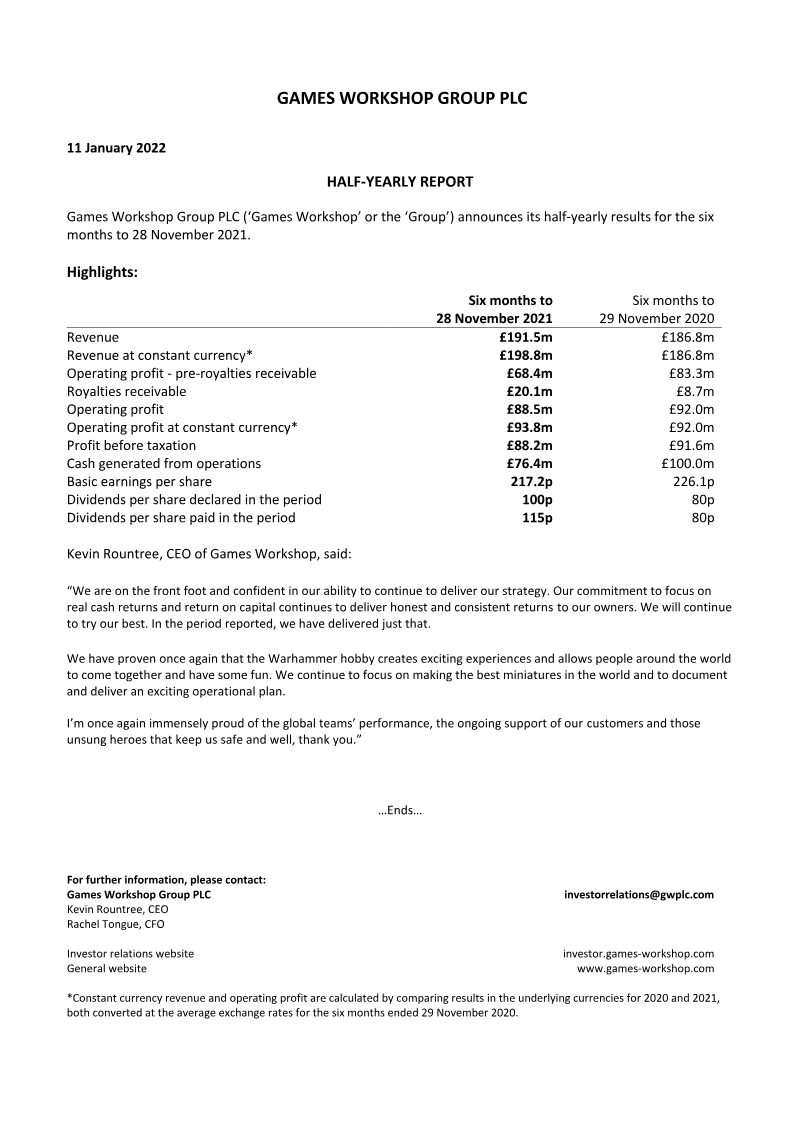
Games Workshop achieved record sales of £191.5 million during the six months ending November 28, 2021, representing a 3% increase over the previous year. This growth was primarily driven by robust performance in the trade and retail segments, which grew by 8% and 17% respectively at constant currency, alongside a significant rise in licensing royalties to £20.1 million. The period was marked by the successful launch of the Warhammer+ subscription service and the most successful fantasy release to date with Warhammer Age of Sigmar. However, online sales experienced a 10% decline as consumer behavior shifted back toward independent retailers and physical storefronts following the height of the pandemic.
Despite the rise in revenue, profit before tax decreased slightly to £88.2 million from £91.6 million in the prior year. This contraction was largely due to macroeconomic headwinds, including £2 million in additional Brexit-related shipping costs, raw material inflation, and increased staff expenses. Operational challenges were further compounded by a decrease in net cash from operating activities to £76.5 million, influenced by a £32.0 million increase in trade receivables and outstanding European VAT receipts. To mitigate these pressures and ensure long-term scalability, the company is investing £6 million in web store infrastructure and expanding manufacturing capacity with 43 active injection moulding machines.
The financial position remains secure with £88.6 million in cash and a continued commitment to shareholder returns, evidenced by dividends totaling 115 pence per share declared during the period. Management continues to prioritize the global production of miniatures and the protection of intellectual property as it expands into broader media. While COVID-19 uncertainties and logistical delays persist, current trading remains aligned with expectations. The company is also formalizing its social responsibility and climate initiatives under new senior leadership to ensure sustainable growth as it navigates the evolving global retail landscape.
- Games Workshop achieved record sales of £191.5 million for the six months ending 28 November 2021, a 3% year-over-year increase driven by strong trade and retail performance.
- Profit before tax declined to £88.2 million from £91.6 million, impacted by £2 million in Brexit-related shipping costs, raw material inflation, and higher staff expenses.
- Licensing royalties rose to £20.1 million, supported by the launch of the Warhammer+ subscription service and a record-breaking Warhammer Age of Sigmar release.
- Online sales fell by 10% as consumer behavior shifted back toward physical storefronts and independent retailers following the pandemic.
- Net cash from operating activities decreased to £76.5 million, largely due to a £32.0 million increase in trade receivables and outstanding European VAT receipts.
Games Workshop GroupJan 2022

Report89 pages
Annual Report 2021
Games Workshop achieved record-breaking financial performance for the 2021 fiscal year, with revenue rising 31% to £353.2 million and profit before tax exceeding £150 million for the first time. This growth was primarily driven by the successful launch of the latest edition of Warhammer 40,000 and a 70% surge in online sales, which effectively offset the impact of global retail lockdowns. The company maintained a debt-free balance sheet and a strong cash position of £85.2 million, allowing for a significant increase in dividends to 235 pence per share and the distribution of £13.2 million in profit-share and discretionary bonuses to its global workforce.
The company’s vertically integrated business model remains centered in Nottingham, UK, where it designs and manufactures its core intellectual property. While the UK remains the production hub, the business is increasingly international, with 77% of sales generated globally across 73 countries. North America stands as the largest geographic market, contributing £145.5 million in revenue. To support this global expansion, the group is investing heavily in physical infrastructure, including new warehousing in the UK and US, increased plastic production capacity, and the development of the Warhammer+ subscription service and digital licensing portfolio.
Strategic priorities for the 2021/22 period focus on IP exploitation through media and digital content, alongside a commitment to environmental, social, and governance (ESG) goals. The company reported a 21% reduction in Scope 1 and 2 emissions and formalized an ESG steering group to oversee long-term sustainability. Despite operational challenges related to COVID-19, Brexit, and supply chain disruptions, the group’s high return on capital employed (184%) and robust liquidity position underscore a stable outlook for continued international growth and brand development.
- Games Workshop achieved record financial results in fiscal year 2021, with revenue increasing 31% to £353.2 million and profit before tax surpassing £150 million.
- Online sales surged by 70%, effectively offsetting the impact of global retail lockdowns and supporting the successful launch of the latest Warhammer 40,000 edition.
- The company maintains a debt-free balance sheet with £85.2 million in cash, enabling a dividend increase to 235 pence per share and £13.2 million in employee profit-sharing.
- International expansion remains a core driver, with 77% of total revenue generated outside the UK and North America serving as the largest geographic market at £145.5 million.
- Strategic focus for 2021/22 centers on scaling digital and media IP through the Warhammer+ subscription service and expanding manufacturing infrastructure in the UK and US.
Games Workshop GroupAug 2021
Financial17 pages
Half-Yearly Report: Six Months to 29 November 2020
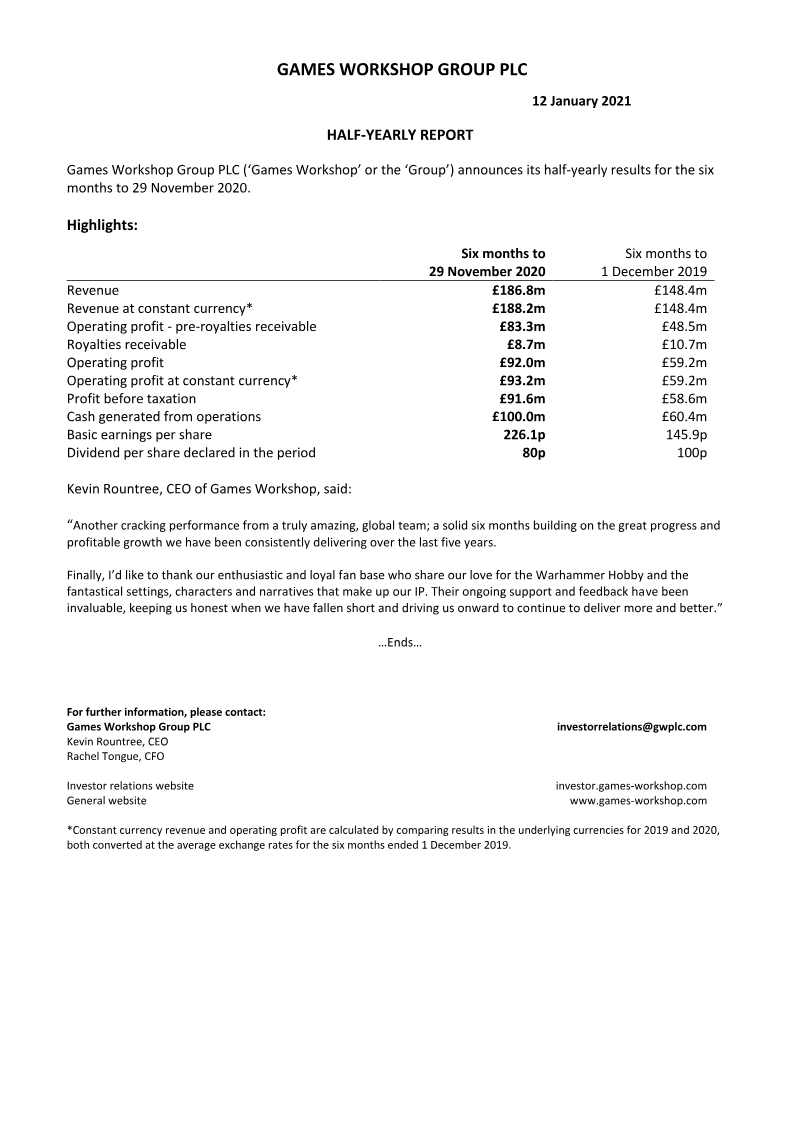
Games Workshop achieved record financial performance during the six months ending November 29, 2020, characterized by a 26% increase in revenue to £186.8 million and a substantial rise in operating profit to £92.0 million. This growth was primarily catalyzed by a significant surge in Warhammer 40,000 unit sales and a strategic shift in distribution channels. While physical retail faced persistent challenges due to global pandemic restrictions, an 87% increase in online revenue and a 33% growth in trade accounts more than compensated for the decline in storefront performance.
The company’s financial position strengthened considerably during this period, with net assets reaching £182.2 million and a cash balance of £96.5 million, nearly triple the previous year's figure. This liquidity was supported by £84.3 million in net cash from operating activities, allowing for a total dividend declaration of 80p per share and a £5.0 million discretionary payment to employees. To sustain this momentum, manufacturing output was increased by 30%, supported by ongoing capital investments in logistics infrastructure across the United Kingdom and North America.
Beyond core tabletop sales, the business continued to focus on the long-term exploitation of its intellectual property through licensing and media development, including the progression of a television series. Despite a temporary decrease in royalty income and the complexities of transitioning to IFRS 16 lease accounting, the overall trajectory remains positive. Strategic investments in IT and manufacturing, alongside a stable property and equipment portfolio, position the organization to manage its seasonal peaks and maintain its expansion within the global hobby market.
- Games Workshop achieved record financial performance for the six months ending November 29, 2020, with revenue rising 26% to £186.8 million and operating profit reaching £92.0 million.
- The company’s growth was driven by an 87% increase in online revenue and 33% growth in trade accounts, which offset physical retail declines caused by pandemic restrictions.
- Liquidity improved significantly, with the cash balance reaching £96.5 million—nearly triple the previous year's figure—supported by £84.3 million in net cash from operating activities.
- Manufacturing output was increased by 30% to meet demand, backed by ongoing capital investments in logistics infrastructure within the United Kingdom and North America.
- The company declared a total dividend of 80p per share and issued a £5.0 million discretionary payment to employees.
Games Workshop GroupJan 2021

Report82 pages
Annual Report 2020
Games Workshop achieved record-breaking financial results for the 2019/20 fiscal year, demonstrating significant resilience despite the operational disruptions caused by the COVID-19 pandemic. Annual revenue rose 5.1% to £269.7 million, while profit before tax reached £89.4 million. This performance marks the fourth consecutive year of record growth, driven primarily by a robust trade segment—which now accounts for 52% of total revenue—and a substantial increase in royalty income from licensing agreements in the video game and media sectors.
The company’s strategic focus remained on the global expansion of its Warhammer intellectual property and the modernization of its industrial infrastructure. Significant capital investments totaling £18 million were directed toward production and logistics expansions in Nottingham and North America, alongside the implementation of a new ERP system. While physical retail sales declined by 11% due to pandemic-related store closures, digital engagement and online sales saw marked growth. The company also successfully navigated the transition to IFRS 16 accounting standards, which brought £32.1 million in lease liabilities onto the balance sheet.
Geographically, North America remains the company's largest market, contributing £104.8 million to total revenue. Despite the economic uncertainties of the pandemic and Brexit, the Group maintained a strong liquidity position, ending the period with £52.9 million in cash and no utilized borrowing facilities. This financial stability allowed the board to maintain its commitment to shareholders through dividends of 145 pence per share and to support its workforce by providing full pay during shutdowns and distributing profit-share bonuses to all staff. The report concludes with a focus on long-term sustainability, ethical sourcing, and continued IP exploitation to ensure future viability.
- Games Workshop achieved record-breaking financial results for the 2019/20 fiscal year, with revenue rising 5.1% to £269.7 million and profit before tax reaching £89.4 million.
- The trade segment now accounts for 52% of total revenue, supported by a significant increase in royalty income from video game and media licensing.
- North America remains the company's largest market, contributing £104.8 million to total revenue despite pandemic-related operational disruptions.
- The company invested £18 million in capital projects, including production and logistics expansions in Nottingham and North America and the implementation of a new ERP system.
- Physical retail sales declined by 11% due to pandemic-related closures, though this was offset by growth in digital engagement and online sales.
+1
Games Workshop GroupAug 2020