Updated Mar 17, 2026 by Games Workshop Group
Financial · August 1, 2019
Published by Games Workshop Group
Games Workshop achieved record-breaking financial performance for the 2018/19 fiscal year, with annual revenue surpassing £250 million for the first time. Reaching £256.6 million in sales and £81.3 million in profit before tax, the company demonstrated a third consecutive year of significant growth. This expansion was driven by a 29% increase in the trade channel, particularly within North American and Asian markets, alongside a rising contribution from intellectual property royalties. To sustain this momentum, the company invested approximately £14 million in manufacturing and tooling, including a new production facility in Nottingham and global warehousing upgrades. The strategic focus centered on a centralized business model and high-quality fantasy miniatures, supported by the opening of 40 new retail stores and the addition of 600 trade accounts. Beyond core manufacturing, the company expanded its brand reach through the "Warhammer Story Forge" for animation and a development agreement for an *Eisenhorn* television series. While operating profit rose by 9%, gross margins saw a slight decline to 67.5% due to shifts in product and channel mix, and return on capital adjusted to 100% following substantial capital expenditures. Corporate governance and workforce investment remained central to operations. The workforce grew to 2,110 employees, supported by the UK living wage and a discretionary £1,500 payment to all staff in recognition of exceptional performance. Executive remuneration also saw significant adjustments following external benchmarking, with CEO total pay rising to £1.077 million. Despite increased energy efficiency at headquarters, the company’s carbon footprint rose slightly to 5,240 tonnes of CO2e. Looking forward, the company maintains a strong balance sheet with £29.4 million in cash and no utilized borrowing facilities, confirming financial viability for the next three years while navigating potential economic uncertainties related to Brexit.

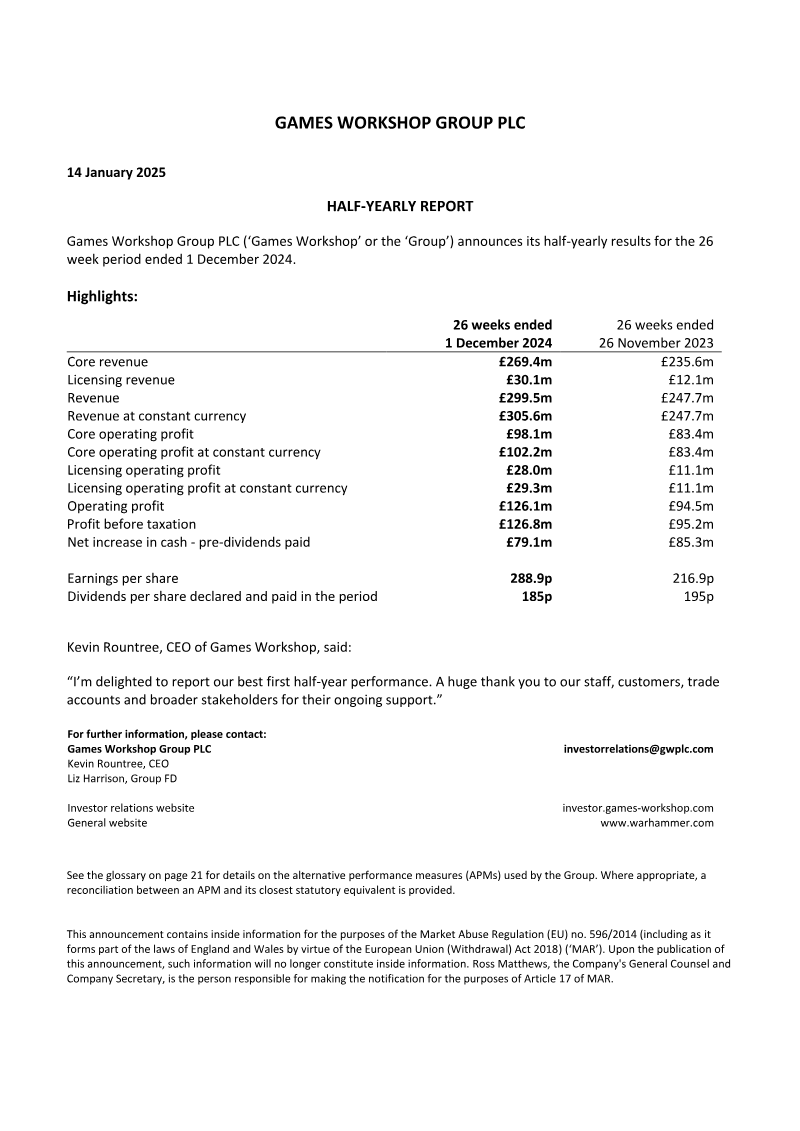
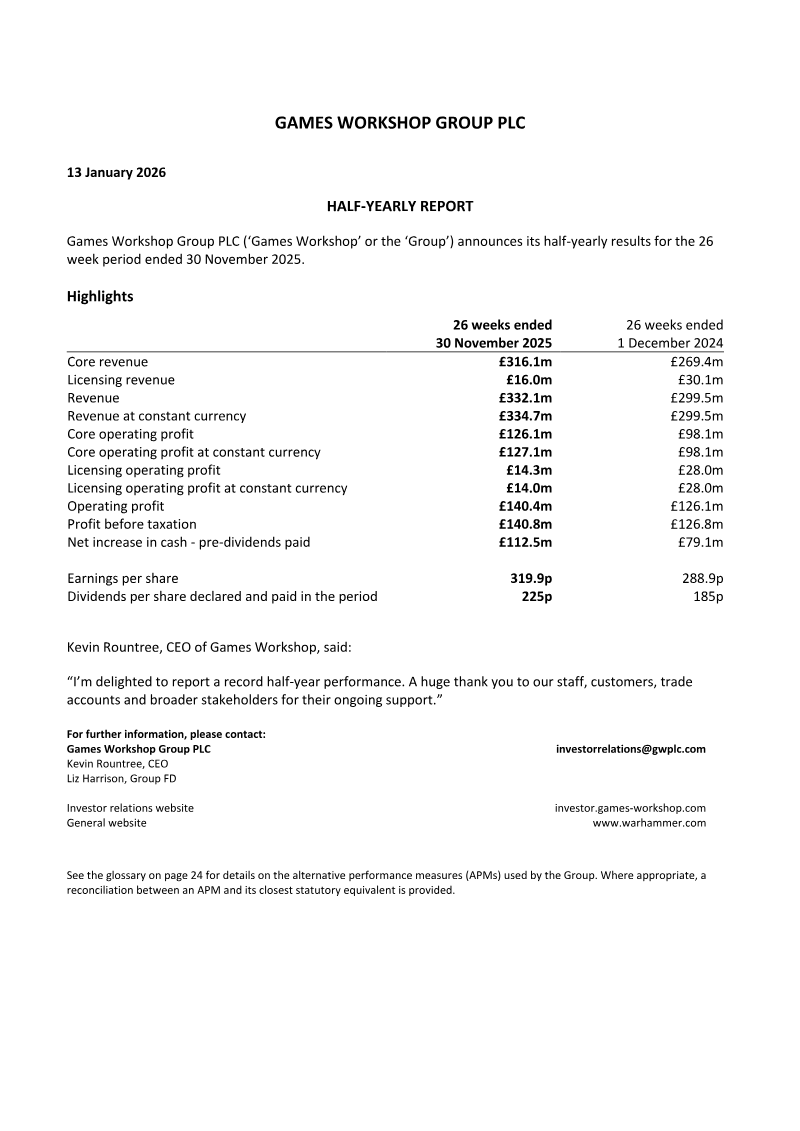
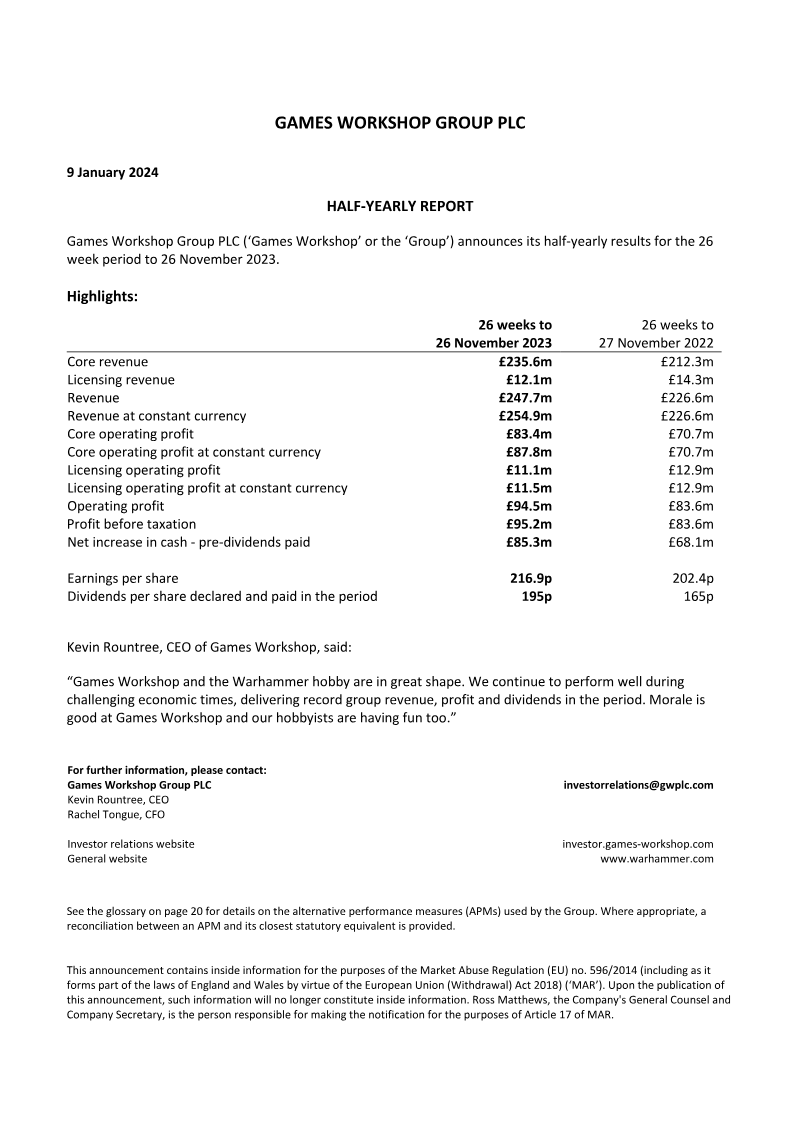
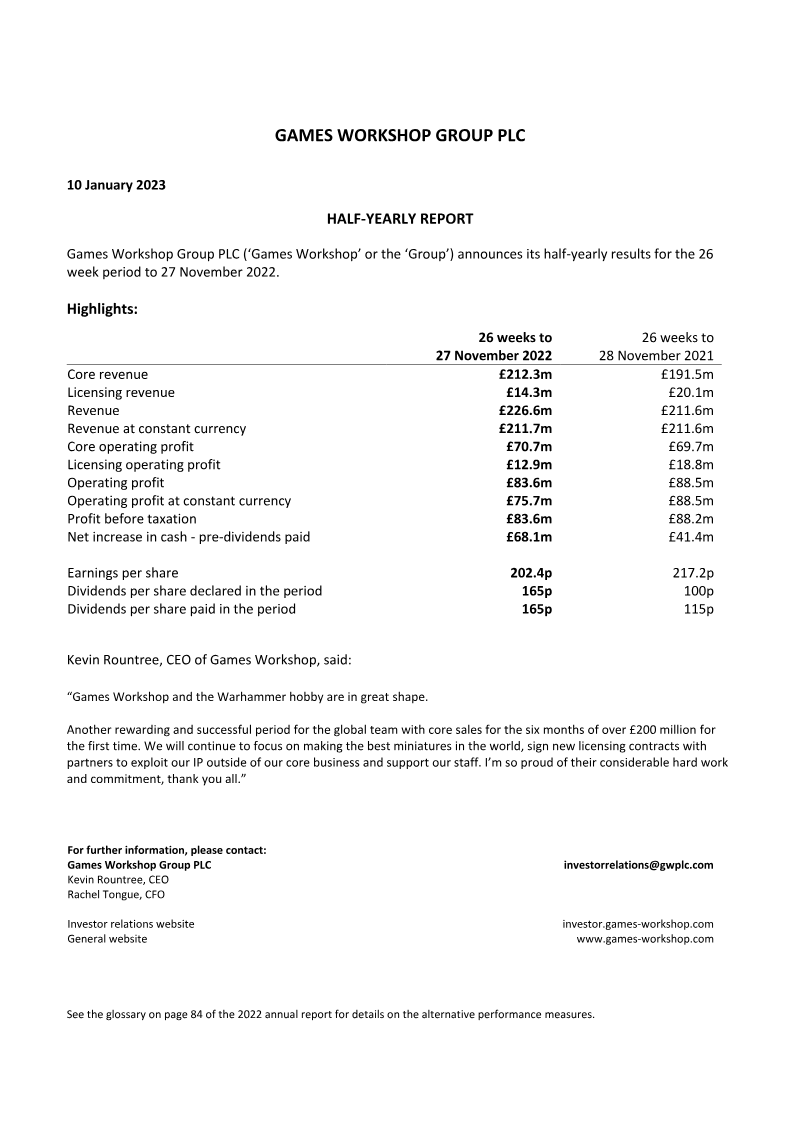
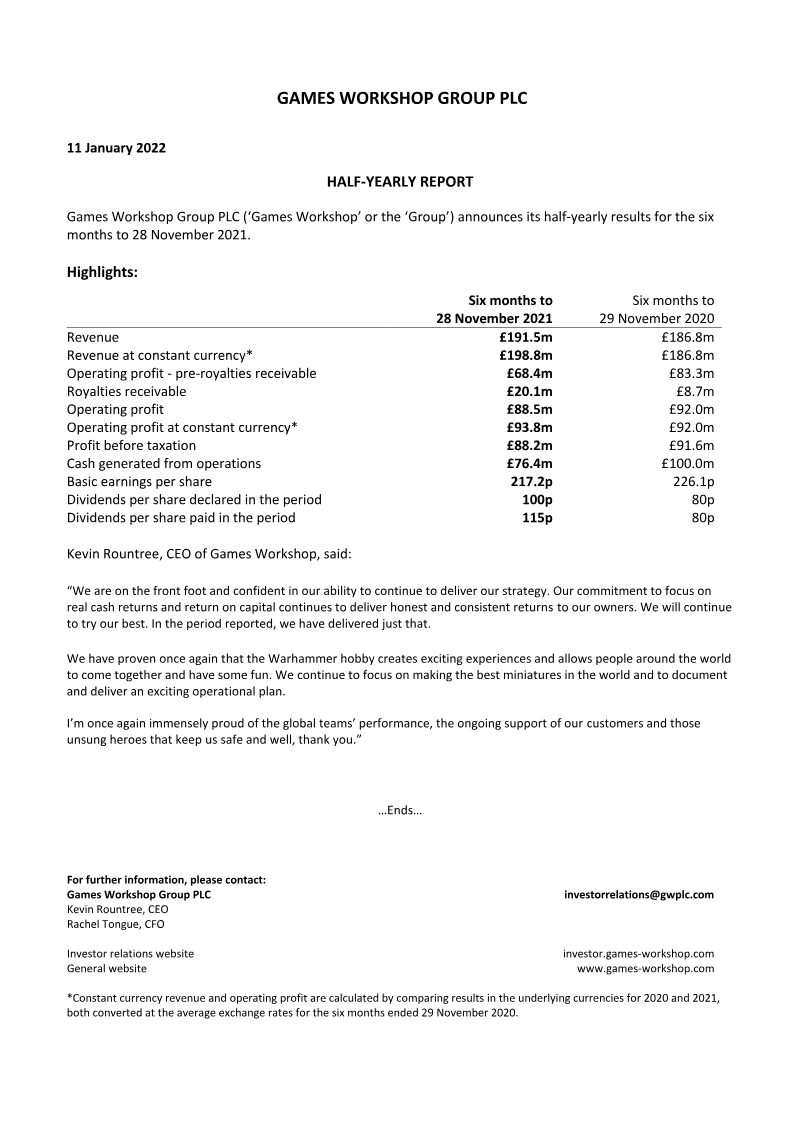
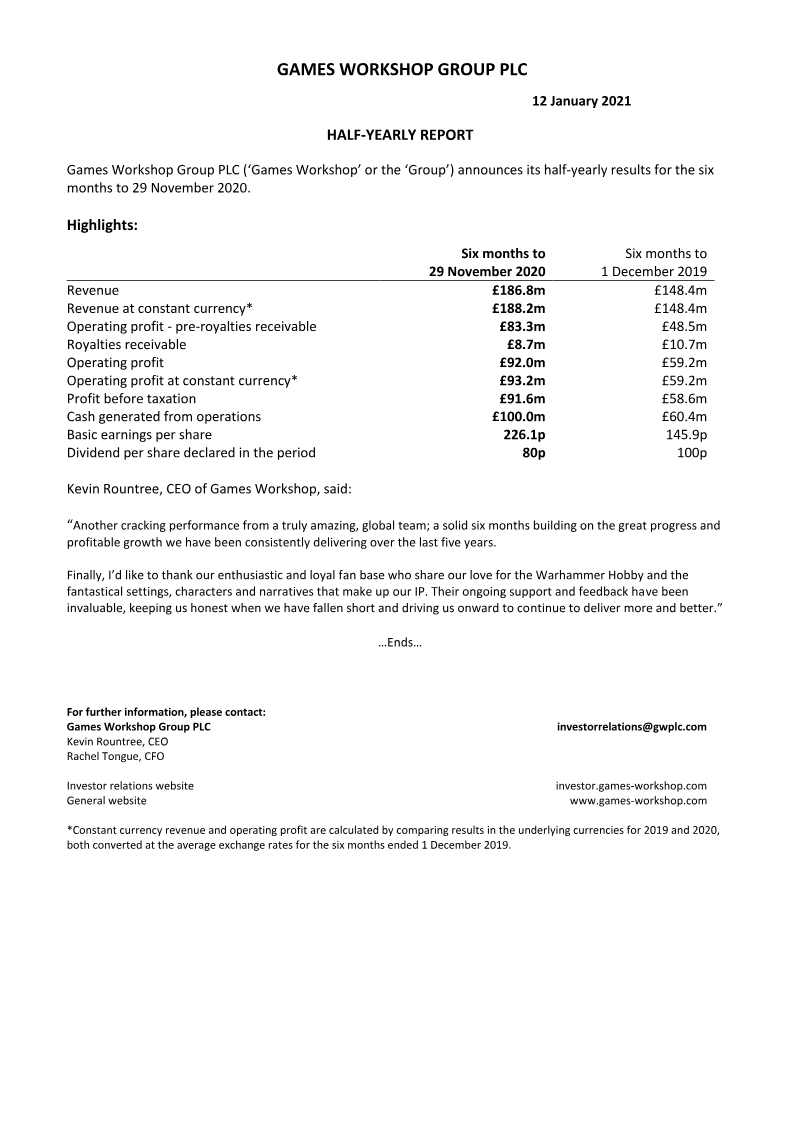
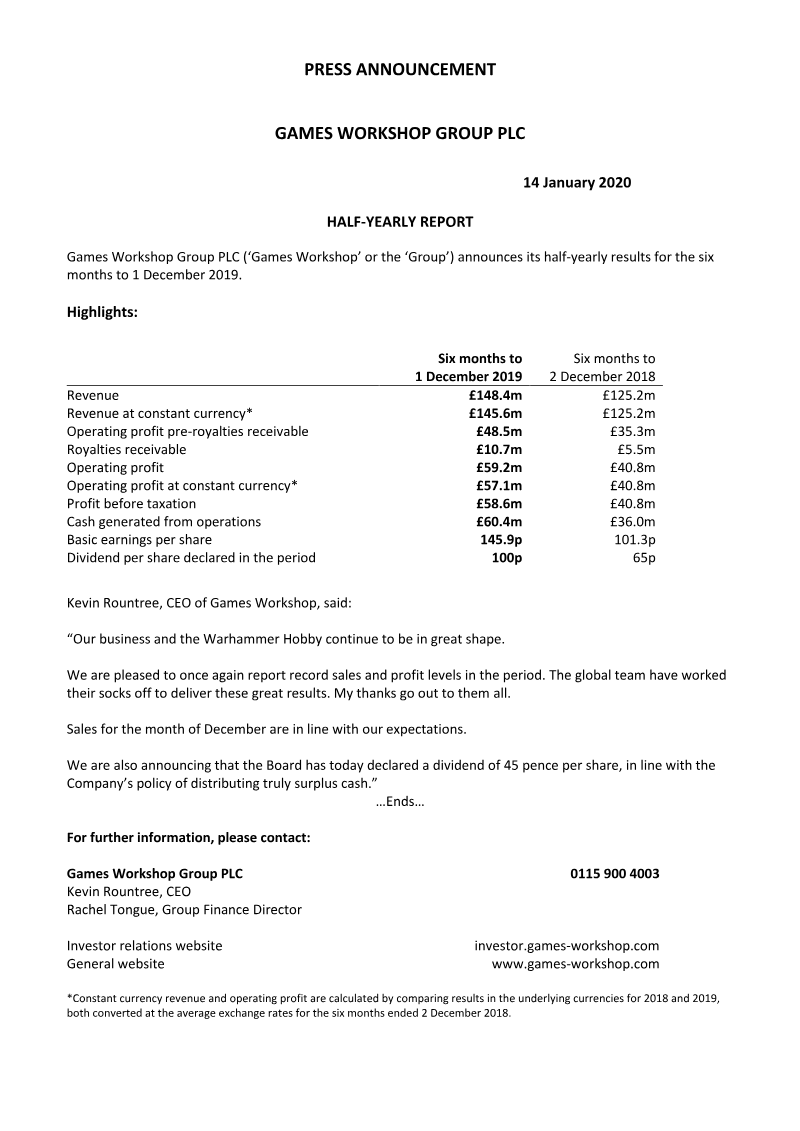
FINANCIAL HIGHLIGHTS Restated 2019 2018 £000 £000 Revenue 256,574 221,304 Revenue at constant currency* 255, 295 221,304 Operating profit - pre-royalties receivable 69,834 64,702 Royalties receivable 11,365 9,617 Operating profit 81,199 74,319 Profit before taxation 81,296 74,270 Cash generated from operations 88, 776 82,332 Earnings per share 202.9p 184.3p Dividends per share declared in the year 155p 126p CONTENTS Chairman’s statement 2 Strategic report 3 Directors’ report 15 Corporate governance report 21 Audit and risk committee report 25 Remuneration report 28 Directors’ responsibilities statement 37 Company directors and advisers 38 Indepe
21 Audit and risk committee report 25 Remuneration report 28 Directors’ responsibilities statement 37 Company directors and advisers 38 Independent auditors’ report 39 Consolidated income statement 45 Statements of comprehensive income 45 Balance sheets 46 Consolidated and Company statements of changes in total equity 47 Consolidated and Company cash flow statements 48 Notes to the financial statements 49 Five year summary 72 Financial calendar 72 Notice of annual general meeting 73 *Constant currency revenue is calculated by comparing results in the underlying currencies for 2019 and 2018, both converted at the 2018 average exchange rates as set out on page 12. 1 Games Workshop Group PLC
CHAIRMAN’S STATEMENT I’m delighted to report that Games Workshop’s financial year ended 2 June 2019 was another great year for the Company. Revenue and profit before tax were both at record levels, revenue exceeding £250 million for the first time. Games Workshop’s 2019 performance beat the 2018 result with sales and profit growth across all channels. This is the first time in the Company’s history that performance in the financial year following a Warhammer 40,000 launch year has beaten the Warhammer 40,000 year! Dividend payments in respect of the 2019 financial year amounted to 155 pence per share, compared with 126 pence per share in respect of 2018. I’m sure that Games Workshop shareholders appreciate the fact that our dividends are paid entirely out of surplus cash generated, not debt. We continue to have no borrowings. This performance was achieved notwithstanding a busy year on other fronts: phase 1 of Leenside - our new production facility in Nottingham – was completed (on time and on budget) and commenced operations in December 2018. Phase 2 of the Leenside project is underway and is expected to be operational in Autumn 2019. Other investment projects, which Kev describes in his report later in this annual report, continue to make progress. I would also draw to shareholders’ attention the growing contribution to our performance from royalty income. There is increasing interest on the part of media businesses in Games Workshop’s intellectual property - our rich fantasy worlds of Warhammer.
is annual report, continue to make progress. I would also draw to shareholders’ attention the growing contribution to our performance from royalty income. There is increasing interest on the part of media businesses in Games Workshop’s intellectual property - our rich fantasy worlds of Warhammer. We continue to try to remain alert to the business risks we must address. This includes the risks which confront every business routinely – for example, finding and retaining good people, innovation, sales growth, cost control – and those which a business that has grown fast over a short period of time might consider in particular, such as the effectiveness of our operating systems, our design, development and manufacturing capacity; in short, how best to address our ‘growing pains’. No easy task: your executive team has a lot on its plate. The process of refreshing the composition of the board of the Company continues. As noted in our 2018 annual report, Chris Myatt, our senior independent director, will step down from the board at our AGM in September 2019. Chris has been a great source of clear, independent-minded advice to Games Workshop since his appointment to the board as a non-executive director in April 1996. On behalf of everyone involved in any way in Games Workshop, thank you, Chris. We will miss your contribution.
ur AGM in September 2019. Chris has been a great source of clear, independent-minded advice to Games Workshop since his appointment to the board as a non-executive director in April 1996. On behalf of everyone involved in any way in Games Workshop, thank you, Chris. We will miss your contribution. Finding new non-executive director candidates who ‘fit’ with Games Workshop does take time – and we believe ‘fit’ to be of great importance. Your board has spent a good deal of time on this exercise since our last annual report. We have however now appointed as non-executive directors John Brewis in June 2018 and Kate Marsh in July 2019. Following the 2019 AGM, your board now has in place three non-executive directors (besides me). We will commence our search for a fourth non-executive in 2019/20 and I expect my successor as non-executive chairman to be appointed from this group within the next few years. We will keep you fully updated on our progress on this front. Our 2018 AGM had a structure similar to most other listed companies, focusing on normal AGM business. This year’s AGM will be similar in format, but following the AGM this year Kev and Rachel will make a presentation about the business. And, as before, there will be the opportunity for shareholders to meet and engage with all board members and some of our senior operational team.
mal AGM business. This year’s AGM will be similar in format, but following the AGM this year Kev and Rachel will make a presentation about the business. And, as before, there will be the opportunity for shareholders to meet and engage with all board members and some of our senior operational team. On the subject of trying to improve awareness generally about what we’re doing at Games Workshop and in particular in the light of the MIFID II regulations, we recently appointed Edison Group, an independent research firm, to publish research into our business. You can access this on our investor relations website. I encourage you to read it! I hope you will find it informative and helpful. Finally, and as was the case last year, I have three enjoyable responsibilities to discharge before concluding this statement: - Firstly, to thank our executive directors and the Games Workshop team as a whole for achieving such success this year. I know you will try and keep it up. The team’s performance has been fantastic. - Secondly, to thank our loyal customers: we will do our best to continue to produce what you’re looking for and to include you in the conversation. - Thirdly, to thank you, our shareholders, for your support and your loyalty. Do please try and come to our AGM on 18 September 2019: we look forward to seeing you there. With thanks, and best wishes. Nick Donaldson Non-executive chairman 29 July 2019 2 Games Workshop Group PLC
Games Workshop’s 2015 fiscal year was defined by a major leadership transition and significant structural reorganization aimed at stabilizing the business for long-term growth. Under the new leadership of CEO Kevin Rountree, the company reported a profit before taxation of £16.6 million on revenues of £119.1 million. While total revenue saw a 3.5% decline from the previous year—attributed to currency headwinds and internal restructuring—net profit attributable to owners rose significantly from £8.0 million to £12.3 million. This recovery supported a substantial dividend payout of 52 pence per share, totaling £16.6 million, reflecting a core strategic commitment to returning surplus capital to shareholders. The company’s strategic focus shifted toward global expansion and operational efficiency, particularly through the rebranding of retail outlets to "Warhammer" and the implementation of a "one-man" store model to improve margins. Geographically, North America emerged as a key growth driver, contrasting with revenue declines in the United Kingdom and Continental Europe. A pivotal product milestone was the relaunch of the core fantasy line as Warhammer: Age of Sigmar. Simultaneously, the company expanded its high-margin licensing portfolio, which included 50 interactive products, and invested £6.4 million in a new global ERP system to modernize its digital and logistical infrastructure. Operating with a workforce of 1,654 employees, the Group maintained a debt-free balance sheet and a strong cash position of £12.6 million. Governance and remuneration policies were updated to align with the new leadership, including a revised profit-sharing trigger based on sales revenue growth rather than operating profit. Despite some non-compliance issues regarding the UK Corporate Governance Code during the leadership handover, the company successfully formalized a global health and safety strategy and introduced a new all-employee Sharesave Plan. These initiatives underscore a transition toward a more standardized, scalable international business model focused on cash generation and disciplined capital allocation.
Games Workshop achieved record-breaking financial results for the 2019/20 fiscal year, demonstrating significant resilience despite the operational disruptions caused by the COVID-19 pandemic. Annual revenue rose 5.1% to £269.7 million, while profit before tax reached £89.4 million. This performance marks the fourth consecutive year of record growth, driven primarily by a robust trade segment—which now accounts for 52% of total revenue—and a substantial increase in royalty income from licensing agreements in the video game and media sectors. The company’s strategic focus remained on the global expansion of its Warhammer intellectual property and the modernization of its industrial infrastructure. Significant capital investments totaling £18 million were directed toward production and logistics expansions in Nottingham and North America, alongside the implementation of a new ERP system. While physical retail sales declined by 11% due to pandemic-related store closures, digital engagement and online sales saw marked growth. The company also successfully navigated the transition to IFRS 16 accounting standards, which brought £32.1 million in lease liabilities onto the balance sheet. Geographically, North America remains the company's largest market, contributing £104.8 million to total revenue. Despite the economic uncertainties of the pandemic and Brexit, the Group maintained a strong liquidity position, ending the period with £52.9 million in cash and no utilized borrowing facilities. This financial stability allowed the board to maintain its commitment to shareholders through dividends of 145 pence per share and to support its workforce by providing full pay during shutdowns and distributing profit-share bonuses to all staff. The report concludes with a focus on long-term sustainability, ethical sourcing, and continued IP exploitation to ensure future viability.
Games Workshop achieved record-breaking financial performance during the 2017/18 fiscal year, characterized by a 39% increase in revenue to £219.9 million and a near doubling of operating profit to £74.6 million. This growth, which propelled the company into the FTSE 250, was primarily driven by the global success of the Warhammer brand and a 54% surge in the trade segment. With 76% of sales generated internationally, the company significantly expanded its Nottingham-based manufacturing and R&D facilities, doubling plastic injection molding capacity and increasing inventory levels to £20.2 million to meet rising global demand. Strategic priorities focused on long-term infrastructure and digital engagement, including the implementation of a new ERP system and a successful relaunch of Warhammer 40,000 that drove 70 million digital community page views. Financial stability remained robust, with the company maintaining a debt-free position and increasing cash reserves to £28.5 million. While management monitored risks related to Brexit and supply chain interruptions, the return on capital rose from 72% to 120%. Governance remained stable, with the board defending the tenure of long-serving directors based on their deep industry expertise, while also implementing a revised remuneration policy to align executive pay with market rates following the year’s exceptional performance. The company’s commitment to sustainability and compliance was evidenced by a reduction in greenhouse gas emissions through solar energy investments and the achievement of full GDPR compliance. Looking forward, the company remains focused on multi-channel retail growth and IP licensing opportunities. Independent auditors confirmed the integrity of the financial statements, noting that while inventory valuation and development costs require significant management judgment, the group remains a strong going concern with high liquidity and a clear trajectory for continued global expansion.
Games Workshop achieved record-breaking financial performance for the 2021 fiscal year, with revenue rising 31% to £353.2 million and profit before tax exceeding £150 million for the first time. This growth was primarily driven by the successful launch of the latest edition of *Warhammer 40,000* and a 70% surge in online sales, which effectively offset the impact of global retail lockdowns. The company maintained a debt-free balance sheet and a strong cash position of £85.2 million, allowing for a significant increase in dividends to 235 pence per share and the distribution of £13.2 million in profit-share and discretionary bonuses to its global workforce. The company’s vertically integrated business model remains centered in Nottingham, UK, where it designs and manufactures its core intellectual property. While the UK remains the production hub, the business is increasingly international, with 77% of sales generated globally across 73 countries. North America stands as the largest geographic market, contributing £145.5 million in revenue. To support this global expansion, the group is investing heavily in physical infrastructure, including new warehousing in the UK and US, increased plastic production capacity, and the development of the Warhammer+ subscription service and digital licensing portfolio. Strategic priorities for the 2021/22 period focus on IP exploitation through media and digital content, alongside a commitment to environmental, social, and governance (ESG) goals. The company reported a 21% reduction in Scope 1 and 2 emissions and formalized an ESG steering group to oversee long-term sustainability. Despite operational challenges related to COVID-19, Brexit, and supply chain disruptions, the group’s high return on capital employed (184%) and robust liquidity position underscore a stable outlook for continued international growth and brand development.