Updated Mar 17, 2026 by Games Workshop Group
Financial · January 23, 2017
Published by Games Workshop Group
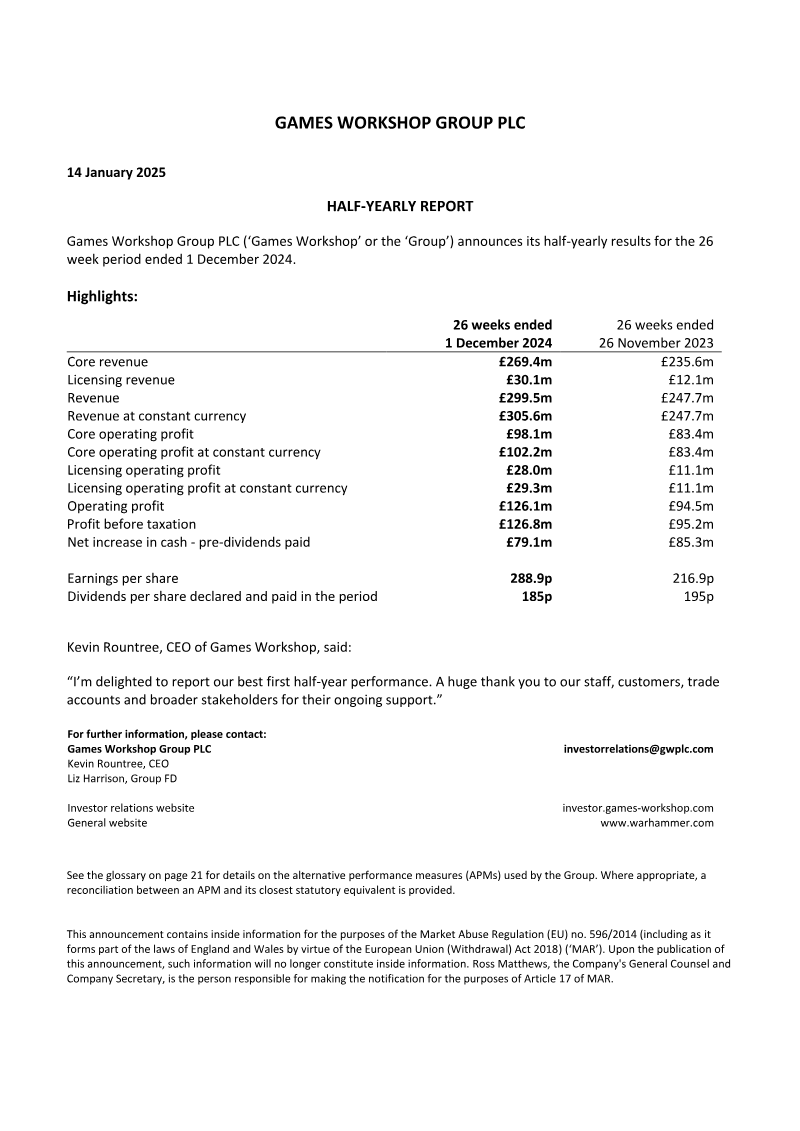
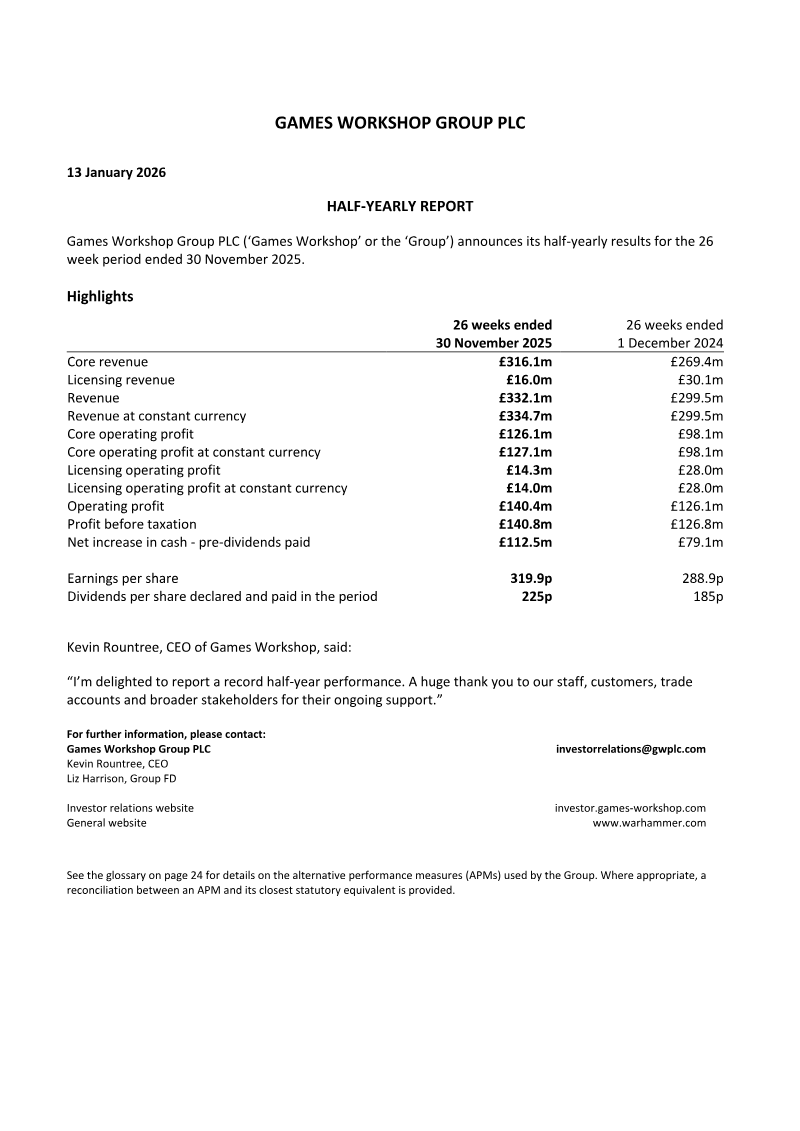
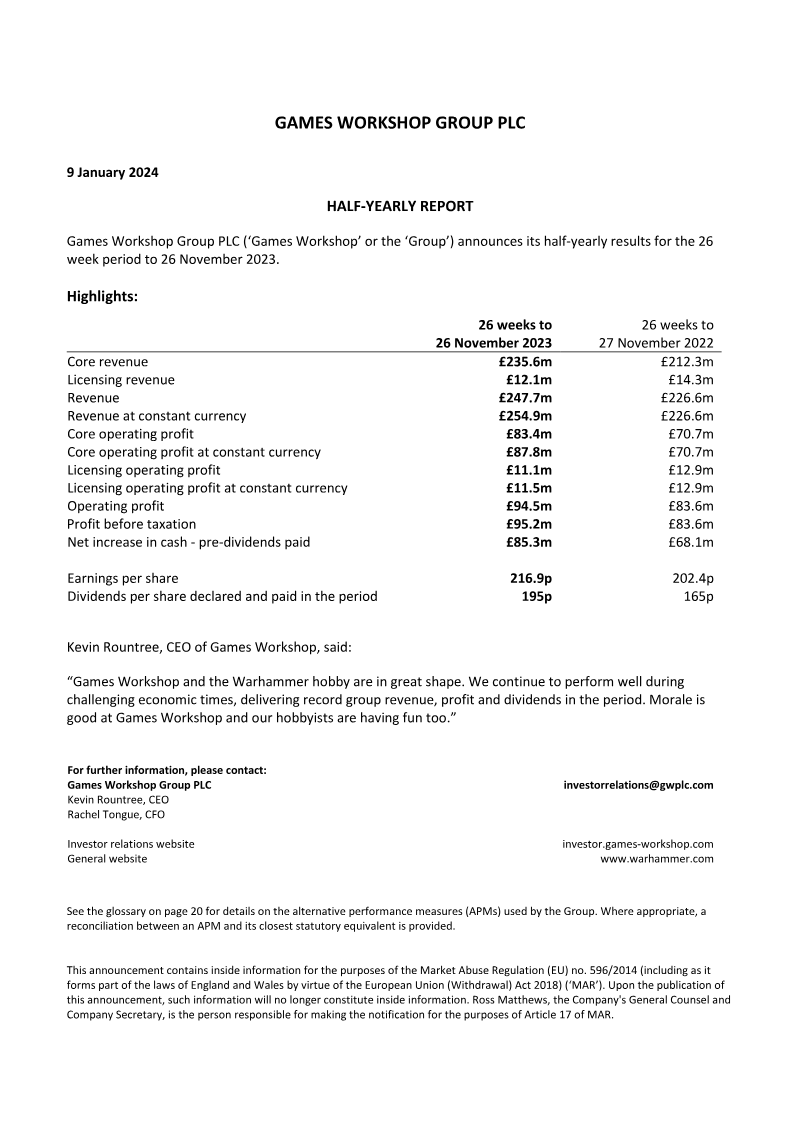
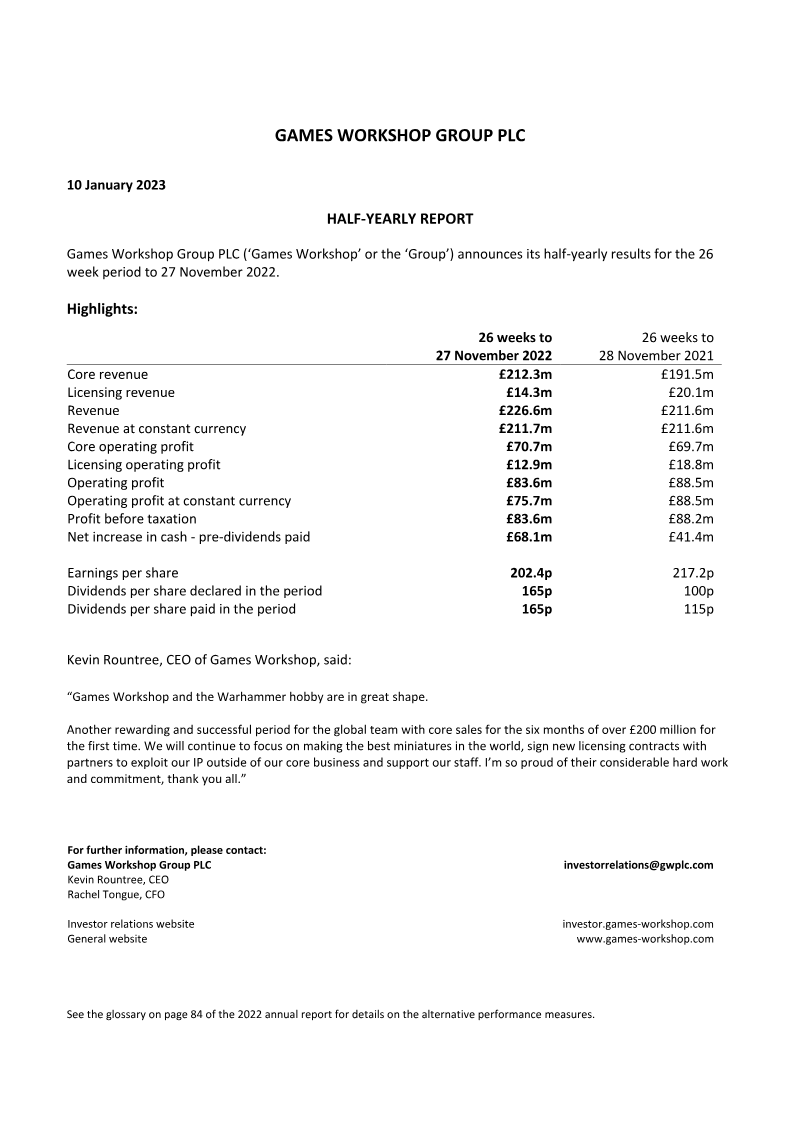
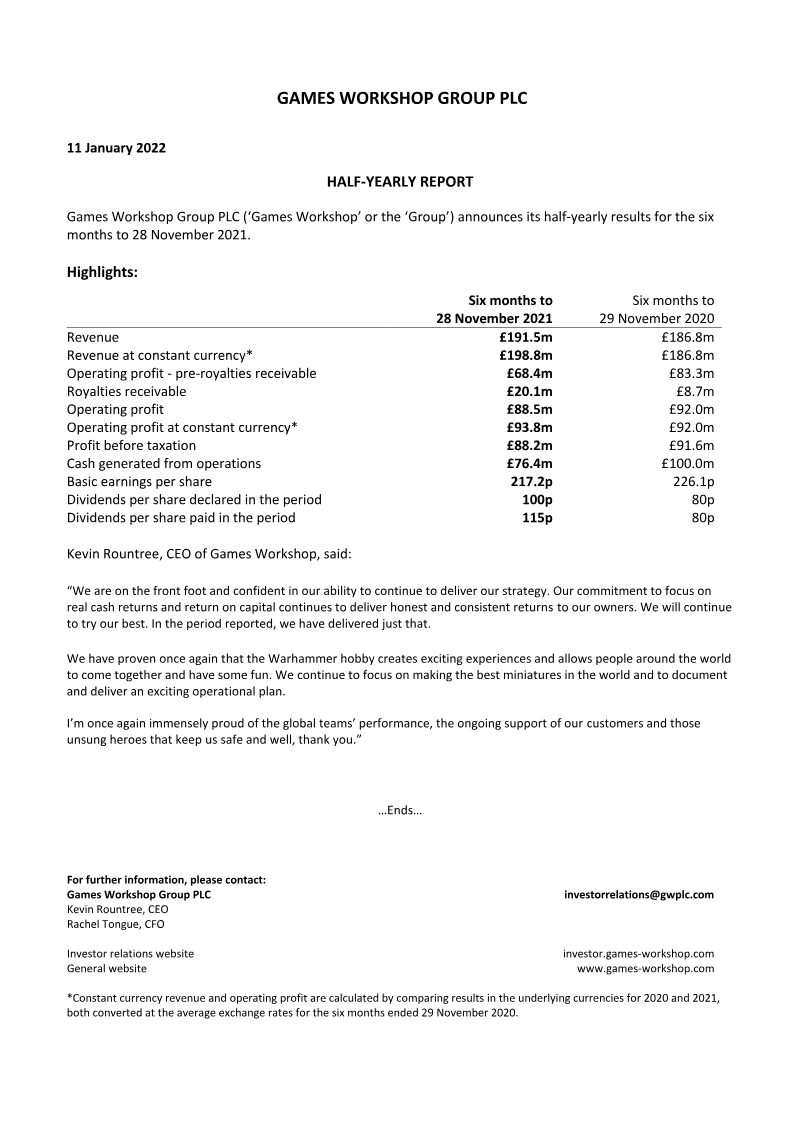
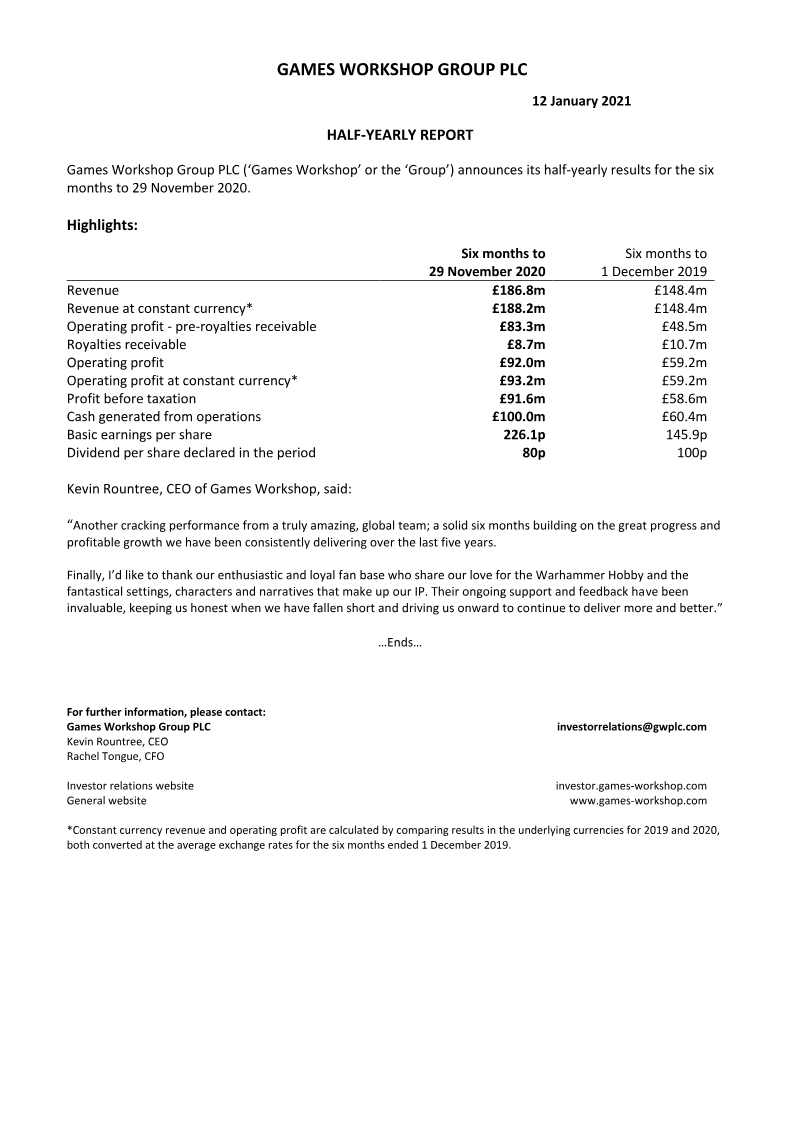
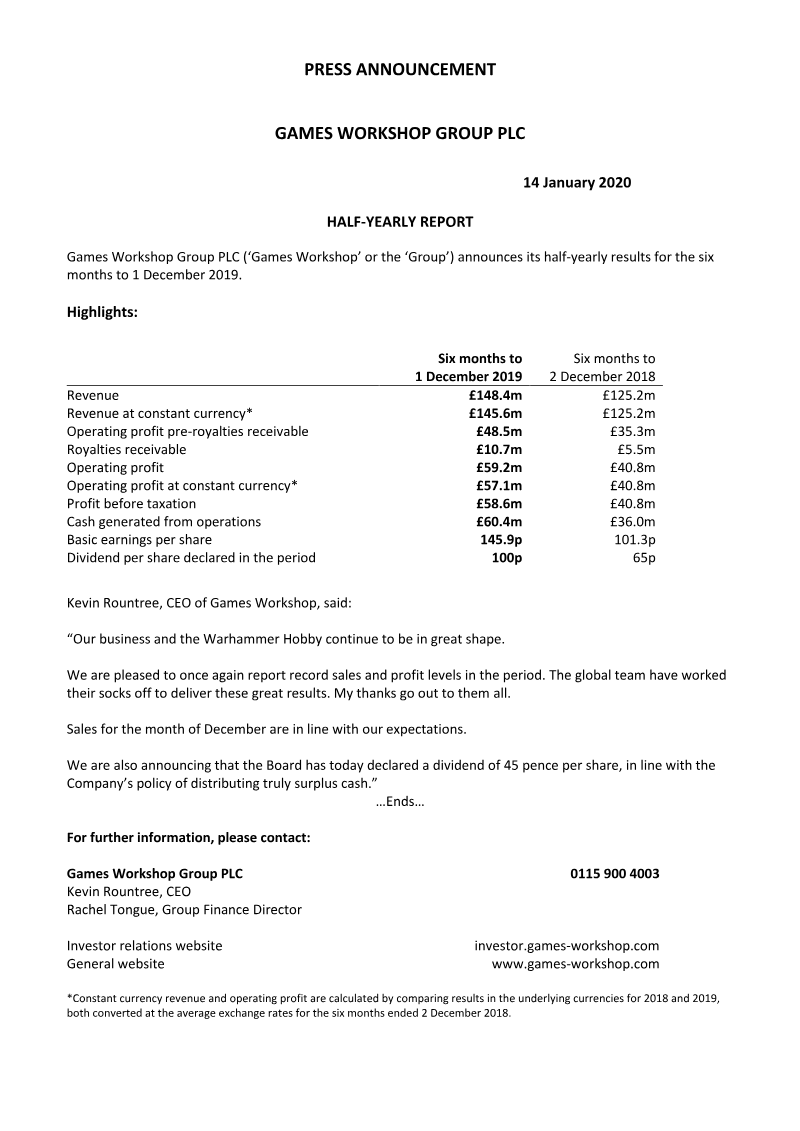
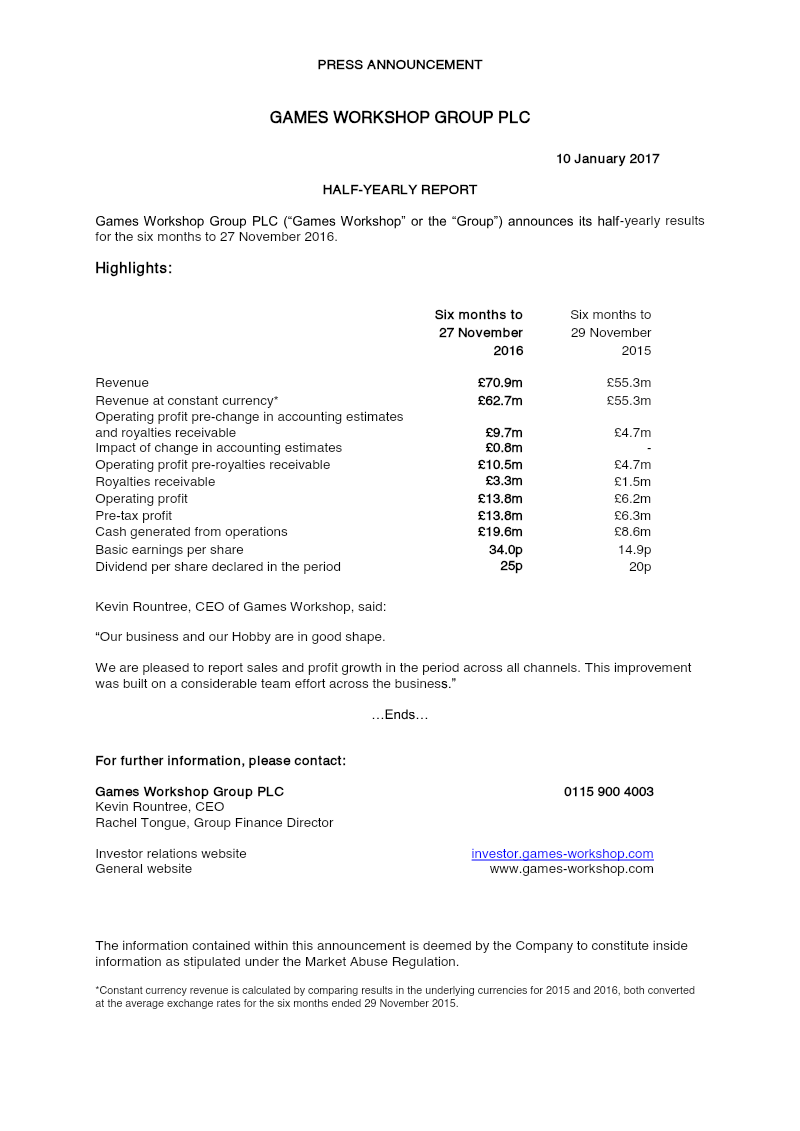
Games Workshop achieved substantial financial growth during the six months ending November 27, 2016, characterized by a 28% increase in revenue to £70.9 million and a more than doubling of pre-tax profit to £13.8 million. This performance reflects broad-based success across all primary sales channels, including Retail, Trade, and Mail Order. A significant driver of this profitability was a 120% surge in royalties receivable, which reached £3.3 million, alongside a robust return on capital of 40%. The period was marked by strong operational cash generation of £19.6 million, allowing for increased dividend payments of 25p per share and continued investment in the business. The financial results were further bolstered by strategic adjustments to accounting estimates regarding the amortization of development costs and the depreciation of moulding tools. These changes, designed to better align expenditures with product revenue cycles, contributed an additional £0.8 million to the operating profit. Consequently, basic earnings per share rose to 34.0p, up from the previous year’s performance. The Group’s net cash position remained healthy, supporting £8.0 million in dividend distributions and £6.8 million in capital investments. The overall trajectory indicates a period of high operational efficiency and market expansion for the tabletop gaming manufacturer. By leveraging strong performance in the Trade and Royalties segments, the company successfully translated increased external revenue into significant bottom-line growth. This fiscal period demonstrates a successful alignment of product development cycles with financial reporting, ensuring that the Group maintains a high level of liquidity while rewarding shareholders through consistent capital returns.

PRESS ANNOUNCEMENT GAMES WORKSHOP GROUP PLC 10 January 2017 HALF-YEARLY REPORT Games Workshop Group PLC (“Games Workshop” or the “Group”) announces its half-yearly results for the six months to 27 November 2016. Highlights: Six months to Six months to 27 November 29 November 2016 2015 Revenue £70.9m £55.3m Revenue at constant currency* £62.7m £55 .3 m Operating profit pre-change in accounting estimates and royalties receivable £9.7m £4.7m Impact of change in accounting estimates £0.8m - Operating profit pre-royalties receivable £10.5m £4.7m Royalties receivable £3.3m £1.5m Operating profit £13.8m £6.2m Pre-tax profit £13.8m £6.3m Cash generated from operations £19 .6 m £8.6m Basic earnings per share 34.0p 14.9p Dividend per share declared in the period 25p 20p Kevin Rountree, CEO of Games Workshop, said: “Our business and our Hobby are in good shape. We are pleased to report sales and profit growth in the period across all channels. This improvement was built on a considerable team effort across the business.” …Ends… For further information, please contact: Games Workshop Group PLC 0115 900 4003 Kevin Rountree, CEO Rachel Tongue, Group Finance Director Investor relations website investor.games-workshop.com General website www.games-workshop.com The information contained within this announcement is deemed by the Company to constitute inside information as stipulated under the Market Abuse Regulation.
e, CEO Rachel Tongue, Group Finance Director Investor relations website investor.games-workshop.com General website www.games-workshop.com The information contained within this announcement is deemed by the Company to constitute inside information as stipulated under the Market Abuse Regulation. *Constant currency revenue is calculated by comparing results in the underlying currencies for 2015 and 2016, both converted at the average exchange rates for the six months ended 29 November 2015.
FIRST HALF HIGHLIGHTS Six months to Six months to 27 November 29 November 2016 2015 Revenue £70.9m £55.3m Revenue at constant currency* £62.7m £55.3m Operating profit pre-change in accounting estimates and royalties receivable £9.7m £4.7m Impact of change in accounting estimates £0.8m - Operating profit pre-royalties receivable £10.5m £4.7m Royalties receivable £3.3m £1.5m Operating profit £13.8m £6.2m Pre-tax profit £13.8m £6.3m Cash generated from operations £19 .6 m £8.6m Basic earnings per share 34.0p 14.9p Dividends per share declared in the period 25p 20p Revenue by segment Six months to Six months to Six months to Six months to 27 November 29 November 27 November 29 November 2016 2015 2016 2015 Constant Constant Actual Actual currency currency rates rates Trade £24.9m £22.4m £29.3m £22.4m Retail £25.8m £21.5m £29.2m £21.5m Mail order £12.0m £11.4m £12.4m £11.4m Operating profit by segment Six months to Six months to Six months to Six months to 27 November 29 November 27 November 29 November 2016 2015 2016 2015 Constant Constant Actual Actual currency currency rates rates Trade £6.6m £5.8m £8.8m £5.8m Retail £(2.2)m £(3.1)m £(2.4)m £(3.1)m Mail order £6.4m £6.2m £6.7m £6.2m Product and supply £5.0m £4.7m £6.1m £4.7m Royalties £2.6m £1.2m £3.0m £1.2m Other costs £(8.1)m £(8.6)m £(8.4)m £(8.6)m INTERIM MANAGEMENT REPORT Our business and our Hobby are in good shape. We are pleased to report sales and profit growth in the period across all channels. This improvement was built on a considerable team effort across the business.
£1.2m £3.0m £1.2m Other costs £(8.1)m £(8.6)m £(8.4)m £(8.6)m INTERIM MANAGEMENT REPORT Our business and our Hobby are in good shape. We are pleased to report sales and profit growth in the period across all channels. This improvement was built on a considerable team effort across the business. In the period we focused and delivered on our operational plan and are making good progress on our strategic initiatives. I'm delighted that our new approach to marketing and merchandising has been received well. It's early days, we're having fun, and the feedback we've had is that our customers are enjoying the changes too. I intend to build on these improvements in the second half. One of our key measures of our performance is return on capital. During the period our return on capital grew from 36% at November 2015 to 40% at November 2016. This was driven by the increase in operating profit before royalties receivable, offset slightly by an increase in average capital employed**.
Sales Reported sales grew by 28% to £70.9 million for the period. On a constant currency basis, sales were up by 13% from £55.3 million to £62.7 million; split by channel this comprised: retail £25.8 million (2015: £21.5 million), trade £24.9 million (2015: £22.4 million) and mail order £12.0 million (2015: £11.4 million). Retail This channel showed growth in all territories. We opened, including relocations, 17 stores including our first stores for some time in Singapore, Malaysia and Hong Kong. After closing 8 stores, our net total number of stores at the end of the period is 460. The key priority in the period reported has been to give our store managers the appropriate product and sales support to help them recruit new customers, retain our existing customers and re-recruit lapsed customers. Recruiting new store managers remains a key area of focus. Trade All key territories achieved growth. In the period, our net number of trade outlets increased by 60 accounts. Mail order Sales in our online shops were up 8%. Our ‘Made to Order’ and ‘Last Chance to Buy’ web store initiatives, aimed at ensuring our customers have access to our broader range, have performed well. Non-core This includes licensing, digital, export, non-strategic trade accounts, book trade, magazine and massmarket opportunities. Non-core sales were up from £7.6 million to £9.8 million with sales growth reported across all areas. In the period, royalties receivable from licensing increased from £1.5 million to £3.3 million.
g, digital, export, non-strategic trade accounts, book trade, magazine and massmarket opportunities. Non-core sales were up from £7.6 million to £9.8 million with sales growth reported across all areas. In the period, royalties receivable from licensing increased from £1.5 million to £3.3 million. We launched in the period new editions of our White Dwarf magazine and Blood Bowl game, the first of many new products from our Specialist Design Studio. Both have sold through well. Operating profit Operating profit before royalty income increased by £5.0 million to £9.7 million (2015: £4.7 million) before the change in accounting estimates described below. On a constant currency basis, operating profit before the change in accounting estimates increased by £2.0 million to £6.7 million. With effect from 30 May 2016 the Group implemented a change in accounting estimates for the amortisation of development costs intangible assets and for the depreciation of moulding tools. The impact of the change for the six months to 27 November 2016 is an increase in operating profit of £0.8 million. The change in accounting estimates is described in note 2 to this half-yearly report. On a constant currency basis, royalty income increased by £1.3 million to £2.8 million (2015: £1.5 million). Total operating profit increased by £7.6 million to £13.8 million (2015: £6.2 million). The net impact in the six months to 27 November 2016 of exchange rate fluctuations was a gain of £3.5 million. It is not the Group’s policy to hedge against foreign exchange rate exposure.
Games Workshop achieved record-breaking financial performance during the six-month period ending November 26, 2017, characterized by a 54% surge in revenue to £108.9 million. This growth was distributed across all global sales channels, with the mail order segment experiencing a particularly sharp 71% increase. Profit before taxation nearly tripled, rising from £13.8 million to £38.8 million, while return on capital saw an extraordinary jump from 40% to 119%. These results reflect high operational gearing and intensified customer engagement across the company’s primary markets in North America, the United Kingdom, and Continental Europe. The financial position of the group strengthened considerably, with cash equivalents rising to £28.6 million and net cash from operating activities reaching £36.0 million. While a change in accounting estimates regarding the amortization of development costs and moulding tools contributed a modest £1.2 million to the operating profit, the underlying drivers remained robust sales and vertical integration. To support this expansion, capital expenditure commitments more than doubled to £2.48 million compared to the previous year, signaling a strategic focus on scaling infrastructure to meet rising demand. Despite the period’s success, management identified specific operational challenges related to the implementation of a new enterprise resource planning system and the capacity of the existing supply chain. Furthermore, the business remains subject to seasonal fluctuations, with the December Christmas period representing a critical peak for annual performance. Overall, the results demonstrate a period of rapid scaling and high profitability for the vertically integrated tabletop gaming manufacturer, supported by a healthy balance sheet and significant growth in its digital and trade segments.
Games Workshop maintained a stable pre-tax profit of £6.3 million for the six months ending November 29, 2015, despite a 2.2% decline in reported revenue to £55.3 million. While constant currency sales saw a marginal increase of 0.7% and licensing royalties doubled to £1.5 million, core operating profit decreased by £0.8 million. This decline was primarily driven by unfavorable exchange rate fluctuations and increased capital investment in retail infrastructure. Performance across geographic segments remained mixed, with growth in Trade and Mail Order channels offset by a notable decline in Retail sales, particularly within Continental Europe. The financial position remains supported by a profit of £4.78 million attributable to owners and a slight increase in basic earnings per share to 14.9p. Net cash from operating activities rose to £8.57 million, though total cash and cash equivalents decreased to £7.8 million following the distribution of £6.4 million in dividends. Significant investment in intangible assets continued, with £3.57 million in new additions bringing the net book value to £9.41 million, while contracted capital expenditure commitments were reduced to £867,000. Despite the stable half-year results, a cautious outlook prevails following disappointing sales figures in December. Projections indicate that full-year pre-tax profit is unlikely to exceed £16 million. While the company continues to prioritize shareholder returns and operational investment, the immediate future is tempered by the volatility of the seasonal Christmas peak and the ongoing challenges of maintaining retail momentum in international markets.
Games Workshop achieved record financial performance during the six months ending December 2, 2018, characterized by a 14.3% increase in revenue to £125.2 million and a rise in pre-tax profit to £40.8 million. This growth was primarily propelled by the trade channel, which surged 26% to reach £61.4 million, and a significant 30% increase in engagement through the Warhammer Community platform. While the retail segment also contributed £42.5 million to the total, online sales remained flat, and the product and supply divisions faced profit declines. Basic earnings per share rose to 100.8p, supporting the distribution of £21.0 million in dividends to shareholders at 65 pence per share. The financial landscape was influenced by the retrospective adoption of IFRS 15 and IFRS 9 accounting standards, which necessitated adjustments to revenue recognition for royalty guarantees and delivery charges. Despite record profits, cash generated from operations decreased to £36.0 million as the group increased investment in working capital and inventory. Net inventory provisions more than doubled to £3.4 million, reflecting a strategic shift toward managing capacity constraints. The group maintained a robust balance sheet with net assets of £101.6 million and confirmed its status as a going concern with sufficient resources for the foreseeable future. Operational focus during this period centered on large-scale infrastructure projects designed to sustain long-term growth. These initiatives include the construction of a new factory in Nottingham and the implementation of a comprehensive UK-wide ERP system. These capital commitments, totaling nearly £3 million, aim to optimize supply chain efficiency and address the physical limitations of current production facilities. By prioritizing these structural improvements alongside a strong trade performance, the group seeks to mitigate capacity risks and capitalize on the expanding global demand for its core hobby products.
Games Workshop experienced a contraction in financial performance during the six months ending November 30, 2014, characterized by a 6.6% decline in revenue to £56.5 million and a 19% drop in pre-tax profit to £6.3 million. These results reflect a period of significant structural reorganization and the impact of unfavorable currency fluctuations. While the Mail Order segment remained highly profitable, the Retail channel recorded an operating loss of £1.3 million, largely due to redundancy costs and the ongoing transition toward a low-cost, one-man store model. Despite these challenges, the Group maintained sufficient cash generation to issue a dividend of 36p per share, though total cash and cash equivalents decreased by £9.3 million following these distributions. The strategic focus during this period centered on operational efficiency and long-term infrastructure investment. Capital commitments rose to £3.3 million, directed toward enhancing the digital web store and renovating visitor facilities. Intangible assets and physical property reached a combined net book value of nearly £30 million following steady investment in production and intellectual property. Furthermore, the Group successfully reduced its total provisions from £3.53 million to £1.85 million as it utilized funds previously set aside for exceptional restructuring items. Management remains focused on a high-frequency product release cycle to drive future growth, leveraging weekly launches to maintain consumer engagement. Although the retail landscape faced headwinds during the first half of the fiscal year, the stabilization of the store footprint and the utilization of seasonal sales peaks in December are expected to bolster the Group’s position. The transition toward a leaner retail estate and improved digital integration serves as the primary mechanism for recovering margins and ensuring long-term sustainability across global trade and retail channels.