
Game Developers Conference
Game Developers Conference (GDC, now the GDC Festival of Gaming) is the professional event for the games industry. It publishes recorded talks and interviews, annual industry survey reports such as the State of the Game Industry, and news articles.
Documents
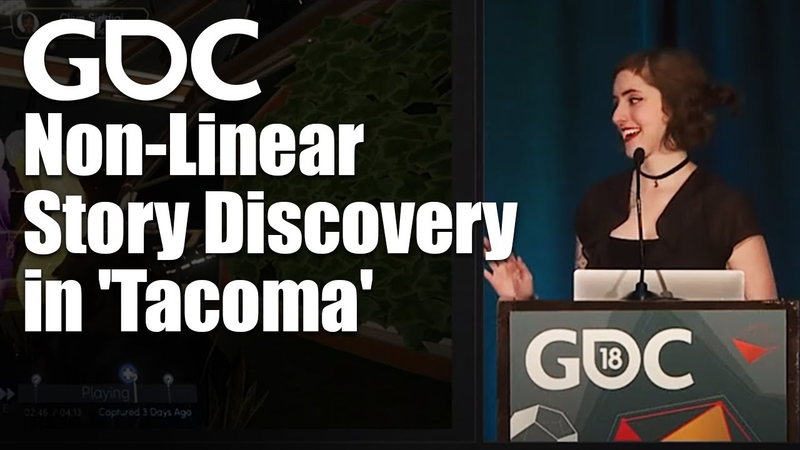
Designing for Non-Linear Story Discovery in Tacoma
The evolution of narrative design in Tacoma represents a significant departure from traditional linear storytelling, moving away from the static audio diaries popularized by earlier titles toward a dynamic, non-linear experience inspired by immersive theater.
- To support non-linear narrative discovery, the development team utilized a 'hub and spoke' level design, where a central room (like a dining area) allows players to observe multiple concurrent character interactions and choose which threads to follow.
- The team abandoned traditional 'key and lock' progression systems during playtesting because players prioritized finding keys in desktops, causing them to fast-forward through narrative content rather than engaging with the story.
- Level layouts were locked down in 'gray block' format before writing the script, as the physical placement of rooms and furniture dictated the characters' movements and interactions within the AR scenes.

Data-Driven or Data-Blinded? Uses and Abuses of Analytics in Games
Data analytics serves as a critical but inherently flawed instrument in game development, requiring a rigorous, detective-like methodology to avoid the pitfalls of misleading metrics.
- Data analytics should be used for optimization of known features rather than creative innovation, as over-reliance on metrics risks stifling breakthroughs in favor of safe, iterative design.
- To avoid misleading conclusions, analysts must move away from top-line averages and instead use granular, cross-referenced insights that account for power-law distributions and high-spending outliers.
- Statistical rigor is essential for accurate testing; teams should prioritize median-based metrics, such as the Wilcoxon rank-sum test, to prevent extreme outliers from skewing results.

High Resolution Pixel Art and Animation
This presentation outlines a professional workflow for creating high-resolution, fluid pixel art animations, emphasizing the integration of traditional animation principles into the digital medium.
- Integrate traditional animation principles—such as silhouette clarity, frame spacing, and smears—into pixel art to achieve fluid motion within limited-frame constraints.
- Leverage existing skill sets like 3D modeling and vector-based planning to inform pixel art, using vector software for initial rotation and scaling before final pixel-level refinement.
- Optimize production efficiency by 'cheating' through asset reuse, such as 360-degree turnarounds and motion blur, to avoid the labor-intensive process of drawing every frame from scratch.

Cloth Self Collision with Predictive Contacts
Predictive contact systems offer a high-performance solution for simulating cloth self-collision in real-time environments, effectively addressing the computational limitations of traditional continuous collision detection.
- Predictive contact systems achieve high-performance cloth self-collision by using predicted trajectories to generate simplified constraints, avoiding the computational intensity of traditional continuous collision detection.
- The implementation maintains a stable frame budget of approximately 380 microseconds per frame, enabling high-fidelity physics without compromising real-time gaming frame rates.
- The system utilizes dynamic collision radius approximation and velocity projection onto discrete separating directions to prevent common simulation artifacts like tunneling and interpenetration.

The Secrets to Creating an Indie Game Franchise
The development of an indie game franchise requires a shift in perspective from traditional commercial models toward a strategy centered on the player’s psychological experience.
- Successful franchises are built by mastering the ability to switch between the creator's perspective and the player's perspective to design and fulfill specific audience expectations.
- A franchise functions as a series of promises—such as personality, nostalgia, spectacle, or novelty—that signal to the player what they will experience across different media formats.
- The 'reliving promise' allows players to experience dependable pleasures, such as recurring audio cues or character motifs, while balancing familiar elements with new content to maintain engagement.

It's About Time: System Design for Mobile Free-to-Play
System design in mobile free-to-play games centers on the universal resource of time.
- System design in free-to-play games must be anchored in time as the universal resource, balancing player progression against energy limits, session frequency, and the time required to acquire content.
- Designers should establish a progression model by defining the desired time-to-level, then calculating the necessary daily payouts based on the number of sessions and actions a player performs.
- When tuning upgrade costs, a common formulaic approach is to increase costs by a fixed percentage—such as 250% per level—while rounding to larger increments to ensure the UI remains clean and readable.
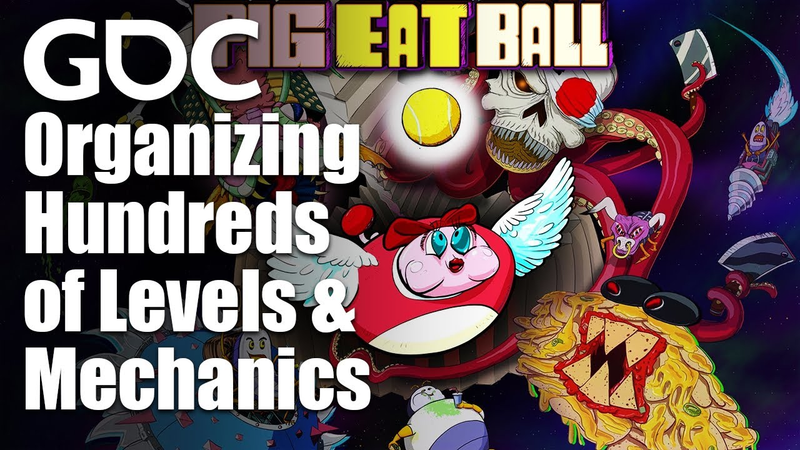
Set this Game in Order: Organizing Hundreds of Levels and Mechanics
Effective level design for complex games requires a structured approach to managing mechanics, difficulty, and spatial organization.
- Prioritize the development of custom tools for tracking game data, as these systems are essential for maintaining quality and polish in projects with hundreds of levels.
- Implement a 'heartbeat' difficulty curve that alternates between gentle learning phases and periodic spikes in challenge to maintain optimal player engagement.
- Isolate new mechanics within dedicated, low-stakes environments to ensure player mastery before integrating them into complex, multi-mechanic scenarios.
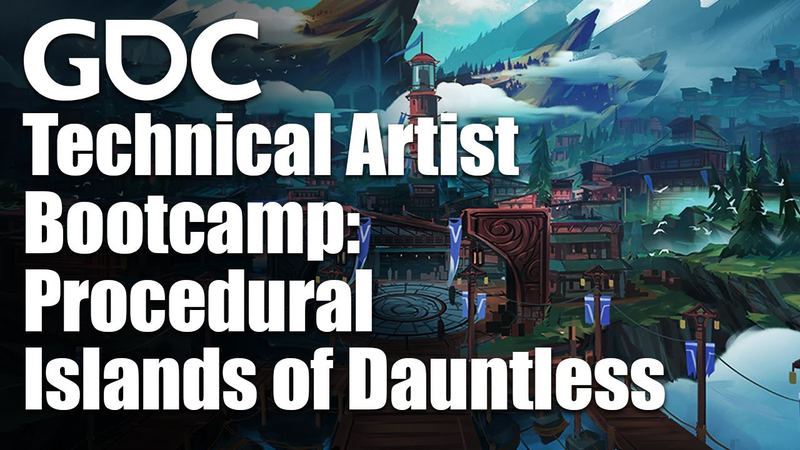
Procedural Islands of 'Dauntless'
The procedural island pipeline developed for the action RPG Dauntless addresses the challenge of creating diverse, high-quality game environments with a small development team.
- The Dauntless island pipeline integrates Houdini Engine with Unreal Engine to automate environment generation while maintaining manual artistic control over topology and foliage.
- The system utilizes a modular 'recipe' architecture that defines biomes by aggregating specific parameters, meshes, and foliage types.
- The generation process follows a multi-stage workflow, beginning with 2D Voronoi-based layout constraints and concluding with 3D landmass and asset instantiation.
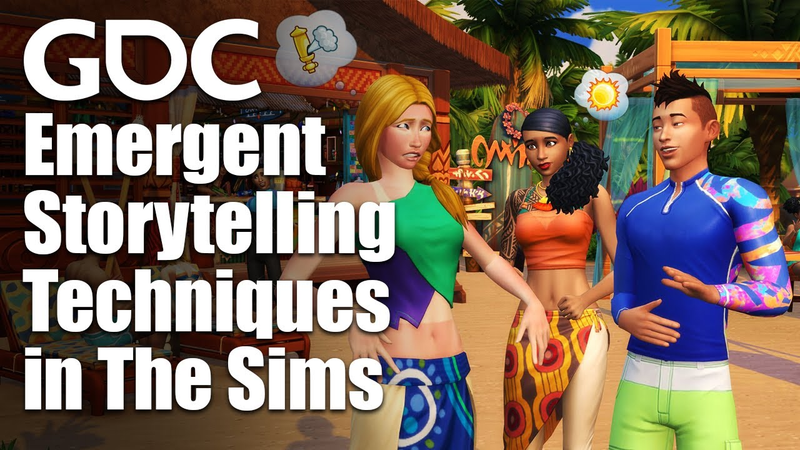
Emergent Storytelling Techniques in The Sims
The Sims functions as a sophisticated storytelling engine that prioritizes player agency and projection over traditional scripted narratives.
- The Sims utilizes a 'story tree' architecture that tracks thousands of potential narrative nodes in the background to surface context-aware character desires based on personality, history, and temporal decay.
- Player agency is maintained through a 'Yes, and' improvisational framework where autonomous feedback loops and relationship-based behaviors respond to player-directed actions.
- The game employs the 'snowflake con'—the perception that common gameplay outcomes are unique—and uses ambiguous Simlish dialogue to prevent explicit text from contradicting the player's internal narrative.
Good Design Makes Happy Customers: A Microtransaction Design Primer
Effective microtransaction design hinges on prioritizing player value over immediate revenue extraction.
- Prioritize long-term player trust and perceived value over short-term revenue extraction to prevent the erosion of the player base.
- Integrate microtransactions as a core design system that supports Self-Determination Theory by fostering player autonomy, mastery, and relatedness.
- Avoid manipulative marketing and high-pressure tactics, as players perform rigorous value assessments that quickly identify and reject exploitative practices.
How to Prioritize Your Dev Efforts in an Era of Rising Costs
Rising development costs necessitate a strategic shift toward sustainable production models that prioritize long-term engagement over high-spend user acquisition.
- Prioritize long-term retention over early metrics like D1 or CPI, as a flat retention curve is the most reliable indicator of a game's long-term viability.
- Build games with 'the right bones' for monetization from the start, as games with highly satisfying core mechanics—like Triple Town—can fail to generate revenue if they lack structural hooks for monetization.
- Maximize the ROI of content by reusing assets for seasonal events; since 97-99.8% of players are often experiencing an event for the first time, repeating content every 3-6 months is an effective way to reduce development costs.

Beyond Mobile: Integrating Product Management into AAA Development Teams
Product management has evolved from its origins in the free-to-play and social gaming sectors into a critical component of modern AAA development.
- Product management in AAA development serves as the essential bridge between creative design, data science, and live operations to maximize a title's lifetime value.
- Successful integration requires transitioning from a consultant-based model to a deeply embedded, collaborative structure where product managers work directly within core development teams.
- Product managers mitigate team resistance by replacing subjective decision-making with formal business reviews, framework-based strategies, and iterative experimentation.