
Game Developers Conference
Game Developers Conference (GDC, now the GDC Festival of Gaming) is the professional event for the games industry. It publishes recorded talks and interviews, annual industry survey reports such as the State of the Game Industry, and news articles.
Documents

Noise-Based RNG
Procedural content generation in modern game development requires a shift away from traditional state-based random number generators toward stateless noise functions.
- Stateless noise functions should replace traditional state-based random number generators like the Mersenne Twister to eliminate sequential dependencies and memory bottlenecks in multi-threaded game environments.
- Noise-based functions enable true random access by mapping inputs directly to deterministic outputs, allowing for the generation of specific content without processing preceding data.
- The stateless nature of noise functions facilitates efficient parallelization and ensures consistent, reproducible results across different hardware platforms.

Fast, Cheap and Flashy An Indie Art Direction Adventure
Effective art direction in independent game development requires balancing aesthetic ambition with the pragmatic constraints of production timelines and technical readability.
- Effective art direction must prioritize functional visual communication and clarity over individual asset complexity to ensure the game remains readable during gameplay.
- When facing a critical visual overhaul ten months before its 2015 launch, Tooth and Tail successfully pivoted to a 90s-inspired pixel art style to simplify animation workflows and unify its design language.
- Development teams can increase efficiency by using 3D models to generate pixel-art assets and testing small, incremental changes directly within the game engine to avoid labor-intensive manual processes.

Trolls: The Cost of Doing Nothing
The management of online toxicity and trolling is a critical business imperative for the gaming industry, directly impacting user retention, brand reputation, and financial performance.
- Users exposed to toxic behavior are approximately 320% more likely to quit a game, directly driving player churn and increasing the necessity for costly user acquisition.
- Unaddressed toxicity erodes the player base and damages brand reputation, making effective community management a critical factor for long-term financial performance and user retention.
- Moderation should utilize a tiered system where automated tools filter blatant hate speech while human-led tribunals are reserved for subjective, context-dependent reports.

Steps for Effective Localization
Effective localization in the modern gaming industry relies on the integration of centralized asset management systems to harmonize translation, audio, and quality assurance workflows.
- Centralize asset management systems to harmonize translation, audio, and quality assurance workflows, ensuring consistency and immersion across global markets.
- Engage localization experts during the earliest stages of development to select optimal pipelines—whether waterfall or iterative—that align technical processes with creative goals.
- Implement automation to shift teams from manual labor to high-level validation, using API-driven integrations to enforce technical constraints like character limits and subtitle timing.

How to Go from Good to Great
The transition from a mediocre creative team to a high-performing unit requires a fundamental shift from hyper-competitive individualism to a culture rooted in vulnerability and collective growth.
- Riot Games transitioned its visual effects department from a toxic, ego-driven environment to a high-performing unit by replacing scapegoating with a culture of vulnerability and collective growth.
- The implementation of 'campfires'—structured, informal gatherings—was the primary mechanism used to dismantle interpersonal barriers and foster open communication among artists.
- Long-term creative success is driven more by soft skills like adaptability and openness to feedback than by immediate technical proficiency.
Cold, Hard Cache Insomniacs Cache Simulator
Modern game development requires extreme precision in memory management, as inefficient access patterns frequently create performance bottlenecks that standard profiling tools fail to diagnose.
- The cache simulator uses CPU trap flags and vectored exception handling to trace memory behavior at the instruction level without the overhead of traditional sampling profilers or binary instrumentation.
- The tool identifies performance bottlenecks by calculating a 'badness factor,' which correlates L2 cache misses with specific execution frequencies to isolate high-impact code paths.
- By modeling specific architectures like the Jaguar CPU, the simulator allows developers to analyze cache performance on target hardware regardless of the host machine's specifications.

Procedural World Generation of Far Cry 5
The development of Far Cry 5 relied on a sophisticated procedural pipeline designed to manage the immense scale of the game world while maintaining artistic control and environmental consistency.
- Ubisoft developed a procedural pipeline for Far Cry 5 that automated complex world-building tasks, including freshwater network generation, biome distribution, cliff geometry creation, and fog density mapping.
- The procedural system operates on a sector-based granularity of 64 by 64 meters, allowing developers to bake data locally under the camera, across specific map sections, or within the camera's frustum to optimize performance.
- Cliff generation is driven by terrain slope thresholds, which are then remeshed to remove stretched quads and processed with flow simulations to create realistic geological stratification and erosion effects.
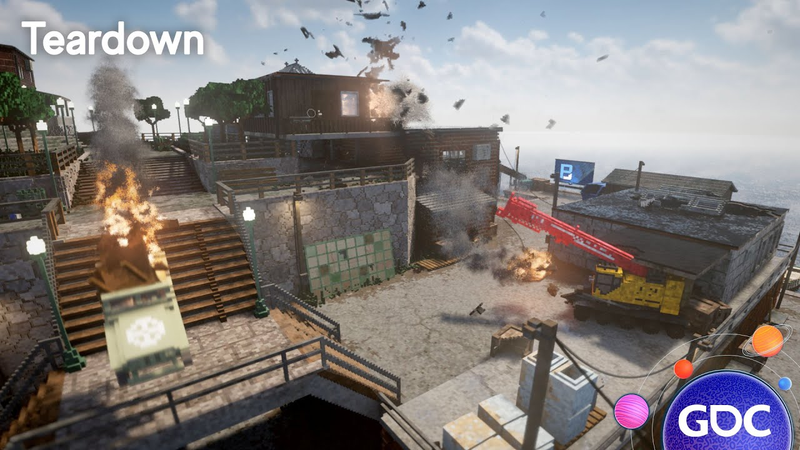
GDC Plays Teardown with Dennis Gustafsson
Teardown represents a significant technical achievement in the gaming industry, originating as an experimental project focused on ray tracing and voxel-based destruction.
- Tuxedo Labs developed a custom engine that replaces traditional polygons with volumetric voxel data, enabling deep integration between physics simulation and ray-traced rendering.
- The engine utilizes ray marching in fragment shaders to achieve high-fidelity lighting and complex environmental interactions, such as advanced fluid dynamics.
- Core gameplay logic was transitioned to Lua scripting to lower the barrier for modding, which facilitated significant community-driven growth and content expansion.
Bringing VR Experiences to Life with the Magic of Music
Immersive virtual reality experiences rely on the strategic integration of audio to bridge the gap between digital environments and player perception.
- In VR, treat all audio as multi-mono by separating stereo files into individual channels placed within the 3D environment to leverage spatialization rather than relying on standard stereo output.
- Utilize VR-specific input data, such as head rotation and hand positioning, to drive musical feedback that guides player interaction and helps them understand if they are progressing toward a goal.
- Design UI elements like buttons, levers, and knobs to function as musical instruments, using pitch and spatial audio to provide intuitive cues that help players navigate complex virtual environments.
Case Study: Ubisoft's Escape Rooms
Ubisoft Blue Byte has successfully pioneered a location-based entertainment model by leveraging its intellectual property to create immersive virtual reality escape rooms.
- Ubisoft Blue Byte expanded its VR escape room portfolio from one title in June 2018 to two by May 2019, scaling their partner network from zero to 200 locations worldwide in less than a year.
- The games are designed as multiplayer-only experiences for two or four players, utilizing a mirrored two-player design to simplify development and ensure consistent session completion within a 60-minute window.
- To ensure accessibility for non-gamers and diverse age groups, the design mandates non-violent gameplay, simple one-button controls, and room-scale movement that avoids complex locomotion.

War Remains: Using LBE to Transport Audiences to WWI
War Remains serves as a pioneering model for location-based virtual reality, designed to bridge the gap between historical education and visceral emotional engagement.
- War Remains utilizes a 650-square-foot physical set integrated with high-fidelity VR to create a persistent, tactile illusion of the 1917 Battle of Passchendaele.
- The experience achieves sensory immersion by ensuring every visual element in the virtual space corresponds to a tangible physical prop, such as sandbags and foam flooring.
- Technical immersion is enhanced through floor-integrated transducers and professional foley work that simulate the physical impact of artillery and drum fire.

GDC Plays Bugsnax with Young Horses
The development of Bugsnax represents a successful synthesis of iterative prototyping and systemic design, evolving from disparate concepts like on-rails photography and summer camp narratives into a cohesive, observational puzzle experience.
- Young Horses transitioned Bugsnax from an on-rails, physics-based capture game to an open-ended experience by layering complex creature behaviors and narrative-driven puzzles over the core mechanics.
- The development team utilized a modular logic system that allowed specific behaviors, such as hiding in bushes, to be applied broadly across different creature types rather than hard-coding actions for individual bugs.
- To address player confusion regarding character motivations and the protagonist's role, the team implemented an interview mechanic and a narrative framing device that establishes the player as a journalist.