
Game Developers Conference
Game Developers Conference (GDC, now the GDC Festival of Gaming) is the professional event for the games industry. It publishes recorded talks and interviews, annual industry survey reports such as the State of the Game Industry, and news articles.
Documents
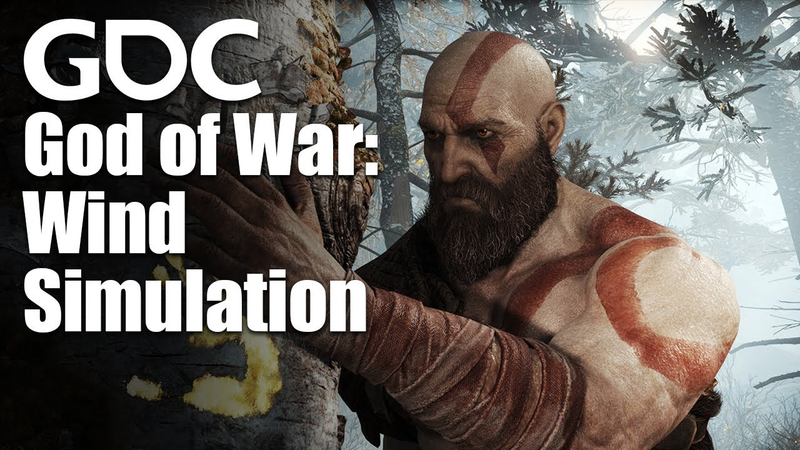
Wind Simulation in God of War
Achieving a dynamic and immersive environment in God of War required the implementation of a sophisticated three-tiered wind system.
- Santa Monica Studios implemented a 3D GPU fluid simulation for God of War (2018) to create a dynamic, living world where wind affects particles, hair, fur, cloth, and vegetation.
- The wind simulation utilizes a uniform 3D volume grid, optimized for a strict GPU time budget by separating diffusion and advection passes per axis to reduce register pressure and improve asynchronous scheduling.
- To handle contention during multi-threaded GPU writes, the team used a 16.16 fixed-point format with atomic integer additions, saving approximately 130 microseconds in high-contention scenarios.
Lessons for Narrative Design from Modern Tabletop RPGs
Modern tabletop role-playing games, particularly the emerging class of indie story games, provide a transformative framework for digital narrative design by shifting the focus from traditional win-loss mechanics toward collaborative, thematic exploration.
- Modern indie tabletop RPGs prioritize narrative experience over tactical or strategic challenges, often shifting the focus from winning or losing to collaborative storytelling.
- The 'Sega Principle' in story game design suggests that when one person holds all narrative authority, the game's focus is defined by what is not mechanized, meaning developers should carefully choose which elements to explicitly systemize versus which to leave open.
- Narrative authority can be distributed by carving up the traditional Game Master role into discrete chunks or by allowing authority to flow directly from the fiction, as seen in games like 'A Thousand and One Nights' or 'Fiasco'.
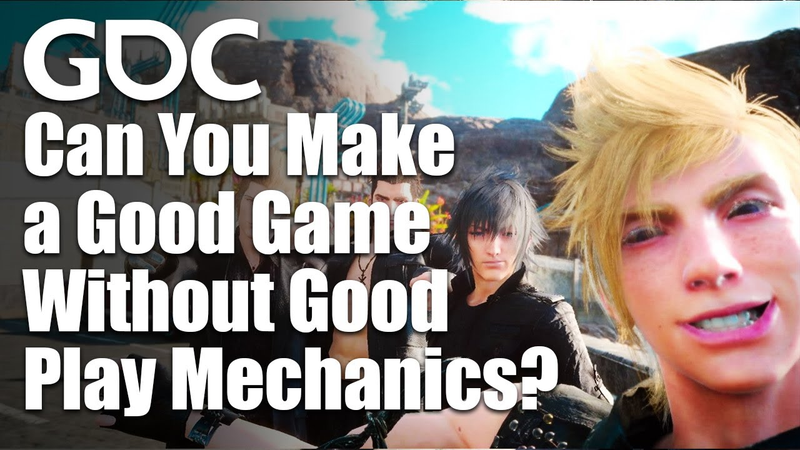
Can You Make a Good Game Without Good Play Mechanics?
Modern game design is evolving beyond a strict reliance on traditional play mechanics, shifting toward a broader definition of interactive experiences that prioritize player agency and emotional resonance.
- Game design should extend beyond traditional play mechanics, as fun can be derived from exploration, social interaction, and creative expression rather than just mechanical challenges.
- Exploration can be gamified without traditional obstacles by using 'itemization' and 'visualization,' such as using checklists or stamps to define boundaries and provide a sense of progress in open-world environments.
- In role-playing design, developers must distinguish between 'being you' (allowing player personality expression) and 'being him/her' (maintaining a character's consistent identity), ensuring that player choices align with the character's established persona to preserve immersion.

PR Success.gif: How to Get Your Game Across in 5 Seconds
Animated GIFs serve as a critical, low-cost marketing instrument for independent game developers, functioning as essential tools to capture the attention of players, press, and publishers in an era defined by fleeting digital engagement.
- Animated GIFs significantly outperform static images, with one developer reporting that GIFs were shared 10 times more often than screenshots.
- A 'main GIF' should act as a mini-trailer that highlights the game's core hook within the first one to two seconds to capture the attention of scrolling users.
- Recycle existing trailer footage by cutting it into smaller 10-second clips and teasers to generate multiple marketing assets without additional production work.

When Trainers' Eyes Meet: Creating Real Time Combat for Pokemon GO
The introduction of real-time combat to Pokémon GO serves as a strategic initiative to bolster player retention and re-engage lapsed users by transitioning from traditional turn-based mechanics to a faster, more interactive system.
- The transition to real-time combat was a strategic move to increase player retention and re-engage lapsed users by shifting away from traditional turn-based mechanics.
- Developers balanced accessibility and competitive depth by combining simple tap-to-attack controls with tactical features like protect shields and secondary move slots.
- To mitigate pay-to-win concerns and ensure competitive integrity, the game utilizes tiered battle leagues (Great, Ultra, and Master) defined by specific combat power caps.

Turing Tantrums: AI Devs Rant!! 2019 Edition
The modern game industry faces a critical stagnation in technical proficiency and design innovation, driven by an over-reliance on standardized game engines and superficial AI implementations.
- The game industry is suffering from a technical skills gap where educational pipelines prioritize standardized engine tool mastery over foundational programming, debugging, and optimization.
- Current AI development is stagnating due to an over-reliance on superficial tropes like basic pathfinding and repetitive dialogue barks rather than building systems with genuine depth.
- Systemic progress is hindered by high compute costs, opaque APIs, and a disconnect between academic theory and practical application in the workplace.
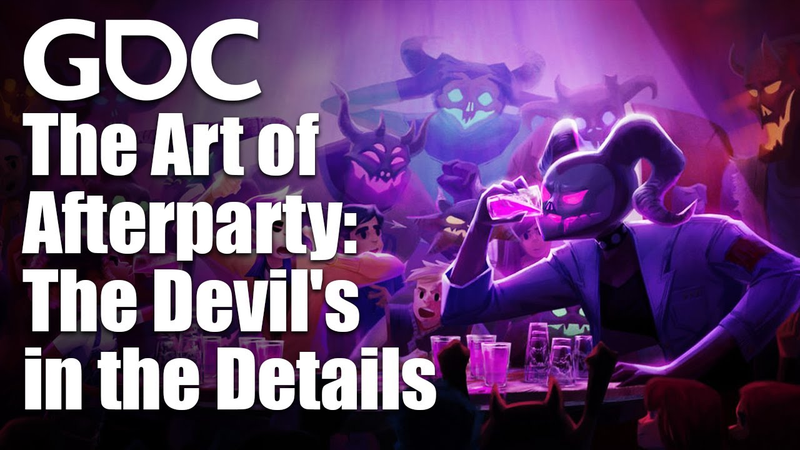
The Art of Afterparty: The Devil's in the Details
Afterparty represents a significant evolution in narrative-driven game design, transitioning from two-dimensional aesthetics to a fully realized 3D environment while preserving the signature branching dialogue mechanics of Night School Studio.
- To bridge the gap between concept art and in-game assets, Night School Studio developed a 'rotoscoping' pipeline where 3D geometry is modeled precisely around perspective-corrected concept art, which is then disassembled and textured for Unity.
- The game's visual identity was built on three pillars: 'comedic' dialogue and animation, an 'alive' world inspired by the nightlife of Shibuya, and 'heart' derived from character-driven storytelling.
- The 'liquid courage' mechanic allows players to influence dialogue branches by choosing specific drinks, which trigger a third, unique dialogue option during conversations.
Vehicle Physics and Tire Dynamics in Just Cause 4
The vehicle physics system in Just Cause 4 was designed to support over 100 diverse vehicle types within a large-scale open-world environment while maintaining a 30Hz simulation rate.
- To maintain stability in a 30Hz simulation, Avalanche Studios implemented friction clamps that prevent the physics model from diverging when applying high levels of grip.
- The team utilized a 'useful mass' heuristic to calculate friction clamping, which determines the ratio of vehicle mass represented by a single tire based on its relative wheel load.
- By decoupling the tire model from strict realism, developers can use steepness in friction curves to simulate 'feel'—where the slope represents grip levels and the leveling off of the curve simulates the sensation of sliding.
Plunge into Storytelling: Transitioning into Narrative Design from Other Disciplines
Transitioning into narrative design from other professional disciplines requires a strategic shift in how candidates present their existing expertise.
- Narrative design is distinct from pure writing, as it requires integrating storytelling into mechanics, UI, and feature sets rather than focusing solely on scripts.
- Candidates should leverage their previous experience in disciplines like art, audio, production, or QA to position themselves as cross-functional facilitators who bridge the gap between narrative goals and technical implementation.
- Applicants should curate modular portfolios that demonstrate both creative writing ability and technical skills, such as documentation, tutorial design, and genre-specific editing.
Content Fueled Gameplay Programming in Frostpunk
The development of Frostpunk centers on a data-driven architecture built upon a proprietary Liquid Engine, utilizing an Entity Component System (ECS) to manage the game’s intricate society-survival mechanics.
- 11 bit studios utilized a custom data-driven architecture based on Entity Component Systems (ECS) to manage the high entity count and complex gameplay logic required for Frostpunk.
- The architecture enforced a strict 'one system per component type' rule, which improved code clarity and maintainability for a growing development team by adhering to the single responsibility principle.
- Designers were empowered to control game flow, narrative events, and building visuals through a template-based system that allowed them to configure game state conditions and effects without direct programming.
Marvel's Spider-Man AI Postmortem
The development of Marvel’s Spider-Man necessitated a fundamental shift in artificial intelligence architecture to manage the complexity of 64 distinct enemy classes within an open-world environment.
- Insomniac Games utilized a data-driven approach for combat AI, where designers configured complex move sets and combos through data files rather than directly editing behavior trees or finite state machines.
- To prevent combat from feeling stagnant, the team implemented an 'intensity meter' that tracks enemy aggression and triggers special attack sequences or simultaneous strikes when the meter fills.
- The AI combat system manages enemy positioning using a 'hill climber' algorithm that iteratively pushes potential bot locations radially outward to maintain optimal spacing and keep enemies on the navigation mesh.
The Music of BATTLETECH: Big Sound on a Budget
The production of the BATTLETECH soundtrack demonstrates that large-scale, cinematic game audio is achievable under constrained financial conditions through rigorous planning and strategic resource allocation.
- The BATTLETECH soundtrack achieved a 240-minute runtime, including 60 minutes of live orchestral recordings, by strategically blending digital mock-ups with targeted live sessions.
- Budgetary efficiency was maximized by utilizing shared recording sessions in Europe and overdubbing smaller ensembles to simulate the aesthetic of a full-scale orchestra.
- Project success relies on shifting the composer’s focus toward infrastructure and management, specifically by delegating technical tasks to professional orchestrators, conductors, and contracting firms.