
Game Developers Conference
Game Developers Conference (GDC, now the GDC Festival of Gaming) is the professional event for the games industry. It publishes recorded talks and interviews, annual industry survey reports such as the State of the Game Industry, and news articles.
Documents
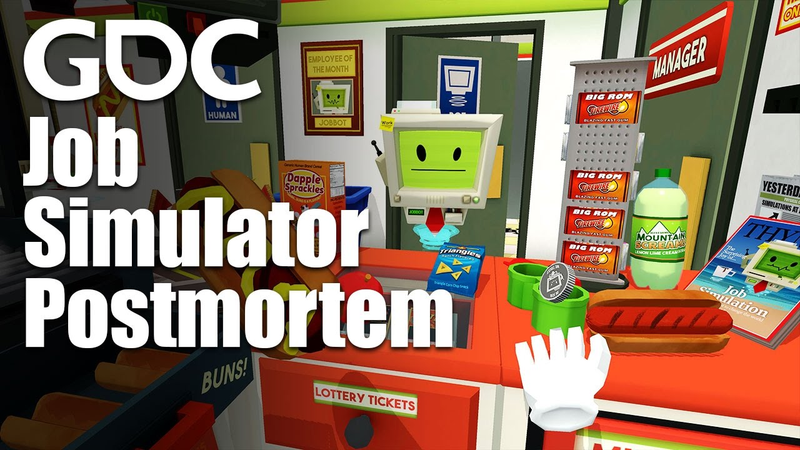
The Job Simulator Postmortem
The development of Job Simulator represents a pivotal case study in early virtual reality design, demonstrating that success in the medium requires prioritizing intuitive hand-based physics and strict adherence to user expectations over traditional PC gaming conventions.
- Success in VR design requires prioritizing intuitive, hand-based physics and near-field interactions over traditional PC gaming conventions.
- Immersion is best achieved through diegetic design, where functional elements like menus and tutorials are seamlessly integrated into the physical environment.
- The 'tomato presence' technique—replacing hand models with held objects—effectively mitigates visual discomfort caused by clipping while reinforcing player agency.
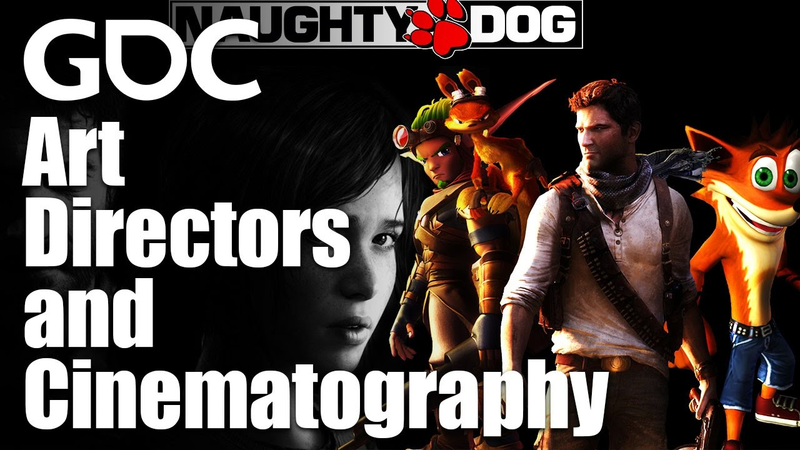
Cinematography for Art Directors
In this 2015 presentation, Naughty Dog’s Robh Ruppel explores the intersection of cinematography and game art, arguing that game developers must move beyond mere technical replication of reality to embrace deliberate, artistic visual storytelling.
- Art directors must treat the game screen as a curated canvas for intentional design rather than a passive recording of 3D space to achieve high-level visual storytelling.
- Game developers should map lighting and color palettes directly to the emotional beats of the script to ensure visual cohesion.
- Cinematographic techniques such as high-contrast lighting, silhouettes, and framing devices are essential tools for isolating characters and guiding player focus.
From Rational to Emotional: Designs that Increase Player Retention
Long-term player retention in the gaming industry relies on transitioning from purely rational mechanics to a framework rooted in emotional design.
- Long-term player retention is driven by shifting from purely rational mechanics to an emotional design framework that incorporates visceral, behavioral, and reflective components.
- Designers should utilize the peak-end rule, which posits that players evaluate their entire experience based primarily on the most intense moments and the conclusion of the session.
- Integrating players into social structures like guilds significantly increases both retention rates and player spending compared to those who play solo.
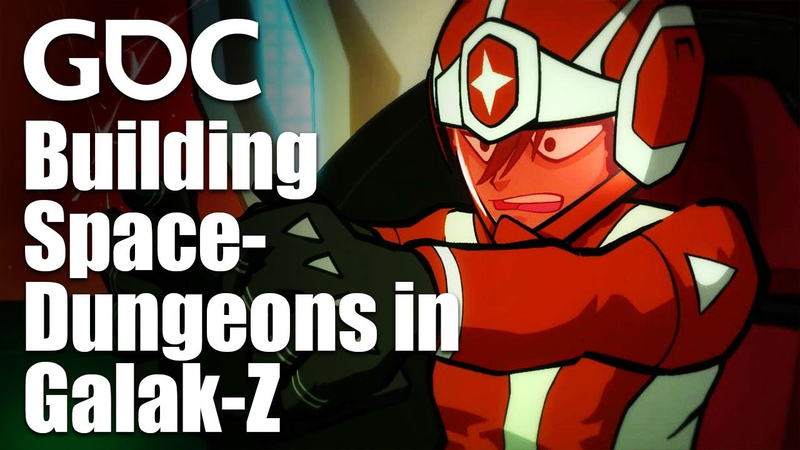
Galak-Z: Forever: Building Space-Dungeons Organically
The development of procedural dungeon generation for the 2D space shooter Galak-Z highlights a strategic shift from manual level design to a hybrid approach that balances algorithmic generation with hand-crafted content.
- The development team replaced manual level design with a hybrid system using Hilbert curves to map dungeon layouts, effectively preventing backtracking and incoherent intersections.
- The generation process utilizes a low-resolution grid to sample the Hilbert curve, establishing a primary path while designating specific dead ends for treasure and mission objectives.
- A custom room template editor allows designers to paint geometry and enemy paths, which are then populated using cellular automata to create organic, cave-like structures.
The Play of Stillness: Designing Experiential Play Spaces
Game design often suffers from an over-reliance on constant interactivity, mistakenly treating mechanical input as the primary source of player engagement.
- Designers should prioritize experiential spaces that foster mental activity and interpretation over constant mechanical input or feedback loops.
- Deep emotional resonance is achieved by balancing predictability with uncertainty, which compels players to construct their own internal models of the game world.
- Minimalist design approaches, as demonstrated in titles like 30 Flights of Loving and P.T., use sparse information to force players to project personal meaning onto the environment.
The Last Game I Make Before I Die: The Crashlands Postmortem
The development of the crafting RPG Crashlands emerged from a profound personal crisis, serving as a creative anchor for lead developer Samuel Coster following a stage 4B Non-Hodgkin's Lymphoma diagnosis.
- To ensure long-term studio sustainability, developers must prioritize building infrastructure like email lists and marketing tools rather than focusing solely on individual game development cycles.
- Differentiating a game from existing genre competitors requires moving beyond incremental improvements to create a unique value proposition, such as integrating a strong narrative into a crafting RPG to distinguish it from titles like Terraria or Don't Starve.
- Building direct relationships with platform holders at Steam, iTunes, and Google Play through consistent updates and press coverage is essential for securing critical launch-day featuring.
Classic Game Postmortem: Maniac Mansion
Maniac Mansion, released in 1987 by Lucasfilm Games, represents a foundational shift in the adventure game genre.
- The 1987 release of Maniac Mansion by Lucasfilm Games revolutionized the adventure genre by replacing text parsers with a visual, verb-based interface and introducing the cinematic cutscene.
- The development of the SCUMM (Script Creation Utility for Maniac Mansion) engine provided a multitasking scripting language that enabled efficient memory management on the Commodore 64 and served as the technical foundation for future adventure titles.
- The game introduced high replayability through a character-selection system, allowing players to choose three out of seven available characters, each with unique abilities that required different puzzle-solving strategies.
Balancing Cards in Clash Royale
The core objective of balancing in Clash Royale is to cultivate a dynamic and healthy meta-game that prioritizes strategic depth and gameplay variety.
- Balancing prioritizes maintaining the unique identity and soul of each unit over rigid mathematical formulas, using mechanical complexity as the primary differentiator between card rarities.
- The development team employs a standardized 10% increase in damage and hit points per level to ensure consistent unit interactions throughout the player progression experience.
- The balancing process relies on a synthesis of data analysis, community feedback, and developer intuition to identify gameplay gaps and monitor usage versus win rates across all skill levels.
Owlboy: The Evolving Art of a 10 Year Project
The decade-long development of the indie title Owlboy serves as a case study in the tension between creative perfectionism and the practical requirements of project completion.
- Owlboy was in development for 10 years, spanning an entire console generation and outliving the XNA programming language originally used for its creation.
- To maintain visual relevance, the developers implemented custom algorithms to smooth pixel art movement, moving beyond the traditional constraint of locking animations strictly to pixel grids.
- The game's narrative tone shifted significantly toward a story of friendship and personal struggle after the developers experienced major life events, including the death of a close friend.
Get Journalists to Cover Your Game: Lessons from Online Dating, Praying and No Man's Sky
The modern gaming landscape is defined by extreme saturation, with over 4,000 titles launching annually on Steam alone.
- With over 4,000 titles launching annually on Steam, the extreme market saturation necessitates a shift from broad outreach to highly targeted, high-impact communication.
- Developers must treat pitches like dating profiles, ensuring the core value proposition is conveyed within ten seconds using concise messaging.
- High-quality GIFs demonstrating immediate, watchable fun are essential assets for capturing journalist attention in a crowded media landscape.
Office Space: The Dos and Don'ts of Game Development Workplace Design
Modern game development environments frequently rely on outdated factory or laboratory models that prioritize rows of desks, often at the expense of developer productivity and well-being.
- Successful studio environments are shifting away from rigid, one-size-fits-all floor plans toward flexible, zone-based designs that provide distinct areas for both high-intensity collaboration and deep, quiet focus.
- One-third of the game development workforce views excessive office perks with skepticism, often perceiving them as a subtle pressure to extend working hours rather than a genuine benefit.
- Conventional office layouts based on factory or laboratory models frequently fail to address critical developer pain points, specifically excessive noise, inadequate lighting, and a lack of privacy.
Arcade to eSports: How Your Competitive Game Influences Player Culture and Values
The evolution of competitive gaming from the arcade era to modern eSports reveals that the structural design of a game directly dictates the values and social dynamics of its player base.
- Game structural design directly dictates the values and social dynamics of a player base, meaning competitive ecosystems must be built to reflect the game's inherent culture.
- The fighting game community maintains a grassroots, open-bracket culture by prioritizing direct participation and personal mastery over the passive consumption models common in modern eSports.
- To sustain competitive ecosystems, organizers should avoid standardized, spectator-focused industry models and instead foster accessible entry points through youth and collegiate formats.