
Game Developers Conference
Game Developers Conference (GDC, now the GDC Festival of Gaming) is the professional event for the games industry. It publishes recorded talks and interviews, annual industry survey reports such as the State of the Game Industry, and news articles.
Documents
Embracing Push Forward Combat in DOOM
The design philosophy behind the modern DOOM series centers on the concept of push-forward combat, a paradigm shift that rejects the defensive, cover-based mechanics prevalent in contemporary shooters.
- The 'Push Forward Combat' philosophy mandates that players must remain aggressive and mobile to succeed, utilizing mechanics like glory kills to replenish resources rather than relying on traditional cover-shooter mechanics like reloading.
- To maintain high-intensity pacing, developers implemented a three-tier enemy control hierarchy—twitch, falter, and stagger—which allows players to interrupt AI behavior and create openings for finishing moves.
- AI accuracy is intentionally tuned to miss when the player is moving, creating a dynamic where players feel empowered by speed and threatened when standing still, rather than relying on purely random accuracy offsets.
Photorealism Through the Eyes of a FOX: The Core of Metal Gear Solid Ground Zeroes (Sponsored)
Kojima Productions developed the proprietary Fox Engine to establish a new standard for photorealism in the Metal Gear Solid franchise, specifically targeting the transition to physically based rendering (PBR).
- Kojima Productions developed the proprietary Fox Engine to transition the Metal Gear Solid franchise to a physically based rendering (PBR) pipeline using a linear space workflow.
- The engine achieves photorealism by integrating raw photographic data and 3D scanning of physical sculptures and environmental objects to create accurate models.
- The deferred rendering pipeline utilizes a G-buffer to manage complex material properties, including subsurface scattering, anisotropic specular highlights, and view-dependent roughness.

Forging The River in The Flame in The Flood
The development of The Flame in the Flood centers on a sophisticated procedural generation framework designed to balance dynamic world-building with strict artistic oversight.
- To ensure reliable gameplay progression, the team replaced simple probability-based spawning with a scheduling approach that allows designers to define minimum, average, and maximum intervals for resource locations.
- The river generation system uses gradient descent to optimize island placement, where the state is defined by the X, Y, and rotation of each island and an error function penalizes constraint violations like river edge misalignment.
- To prevent the procedural generation from becoming stuck in local minima—which could cause catastrophic issues like river blockages—the team implemented optimization techniques to ensure the river remains navigable.

AAA Gaming While Blind
Blind gamers are successfully engaging with major AAA sports titles by utilizing 3D spatial audio, engine pitch, and haptic feedback to navigate complex digital environments.
- Developers are shifting from reactive accessibility patching to intentional, inclusive design by embedding features directly into the core development pipeline.
- Studios are utilizing 3D spatial audio, engine pitch, and haptic feedback to allow blind gamers to navigate complex AAA sports environments.
- A no-regression policy is becoming a critical industry standard to ensure accessibility features are maintained or improved through every subsequent game update.

Practical IP Law for Indie Developers 301: Plain Scary Edition
Intellectual property management serves as the foundational pillar for indie game developers, necessitating a proactive approach to securing creative assets.
- Formalize ownership of all creative assets by using explicit work-for-hire and assignment agreements with every contributor, as automatic copyright is insufficient for legal security.
- Prioritize early trademark registration for game titles as word marks to establish a priority date, as trademark rights are jurisdiction-specific and depend on active commercial use.
- Avoid relying on fair use as a legal defense due to its unpredictable, case-by-case nature, and instead use formal registration to maximize legal leverage.
Animation Bootcamp: Establishing an Ecology for NPCs
The primary objective of this presentation is to provide a structured, scalable methodology for establishing individual identities for non-player characters (NPCs) within large-scale game production environments.
- Establish an NPC 'ecology' by defining how characters interact with their environment and each other to avoid generic, disconnected design in large-scale productions.
- Utilize Maslow’s hierarchy of needs to define core character objectives, preventing a reliance on default, repetitive physiological behaviors.
- Create 'one-sheets' as a visual shorthand for multidisciplinary teams, replacing lengthy biographies with coordinate graphs that map binary personality traits like 'sly versus inept'.
Animation Bootcamp: 2018 Tricks of the Trade
Modern game animation relies on a strategic blend of technical optimization and disciplined workflow management to achieve high-fidelity character movement.
- Reduce asset bloat by replacing complex, linear animation sets with data-driven systems that utilize orientation mapping and ground distance inputs.
- Prioritize the use of blend trees over state machines to achieve more responsive, seamless character transitions and dynamic movement.
- Maintain high-quality animation standards through low-tech visualization techniques, such as using dry-erase markers on monitors to track arcs and orthographic views to correct posing.

You're Not Broken: Finding Your Creative Way Through Difficult Times
Severe personal trauma, including illness and significant life loss, fundamentally alters cognitive function, often inducing a state of trauma brain that mimics the impairments associated with medical conditions like chemo brain.
- Severe trauma induces a physiological 'trauma brain' state that mimics medical cognitive impairments, leading to decision paralysis and an inability to perform creative work.
- Creative capacity is not permanently lost during periods of high stress but is temporarily obstructed by the brain’s survival-focused response.
- Restoring creative function requires prioritizing physiological foundations, specifically sleep, social connection, and environmental stability.
Harvesting Interactive Fiction
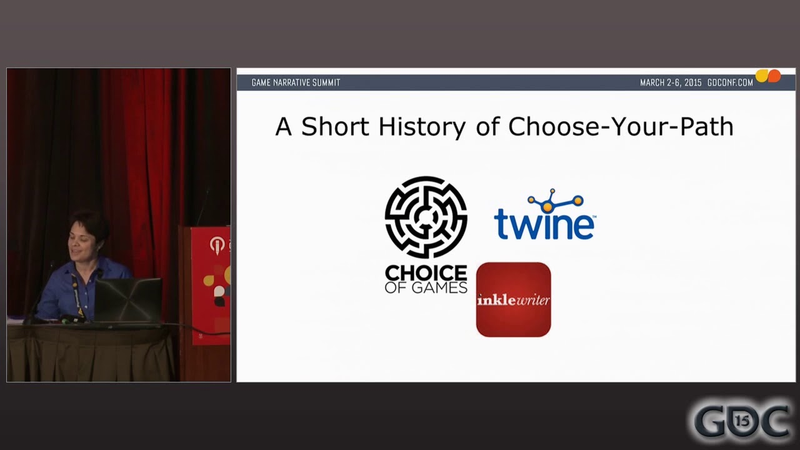
Interactive fiction, once considered a niche hobbyist pursuit, has re-emerged as a significant force in the mainstream gaming market, evidenced by the critical and commercial success of titles like 80 Days, Device 6, and A Dark Room.
- Interactive fiction has transitioned from a niche hobbyist pursuit to a commercially viable sector, exemplified by the success of titles such as 80 Days, Device 6, and A Dark Room.
- Modern narrative design is shifting away from traditional parser-based inputs toward branching structures enabled by accessible development tools like Twine, ChoiceScript, and inklewriter.
- Developers can cultivate player 'complicity' by designing systems that grant players a sense of ownership over the plot, making inevitable narrative outcomes feel like personal choices.
Narrative in Games - Role, Forms, Problems, and Potential
Video games possess a unique capacity for interactivity that distinguishes them from traditional linear media like film and theater.
- Game narrative design must shift from linear, pre-scripted cinematic sequences to dynamic, systemic frameworks that prioritize player agency.
- Current industry reliance on borrowed tropes from film and theater often conflicts with interactivity, leading to broken immersion and limited narrative potential.
- Meaningful storytelling in games should emerge as a byproduct of player interaction with the environment rather than through static, developer-authored plots.
The 2018 Failure Workshop
The independent game development sector frequently suffers from a culture that prioritizes rigid production schedules over product quality, leading to avoidable commercial failures and significant psychological distress.
- Prioritizing rigid production schedules over product quality leads to avoidable commercial failures, negative community sentiment, and significant psychological distress for development teams.
- The case of Moon Hunters illustrates that rushing unfinished, buggy software to meet arbitrary deadlines results in immediate revenue loss and necessitates extensive, burnout-inducing post-launch support.
- Developers should shift focus toward long-term sustainability by prioritizing core gameplay quality over release efficiency, as flawed launches can be salvaged through consistent updates and transparent communication.
Watch Dogs: Hacking it to 11
The audio design for Watch Dogs centers on the challenge of maintaining a cohesive, narrative-driven sonic identity within the unpredictable constraints of an open-world environment.
- To manage memory and processor constraints, the audio team replaced long, multi-layered musical tracks with a modular system that chops compositions into smaller, reusable parts that trigger based on in-game actions.
- The team implemented a reactive music engine that uses short, looping segments to minimize latency between game events and musical transitions, allowing the score to skip or advance sections based on player input.
- The audio team utilized a 'piano validation' technique, testing complex synth or guitar riffs on a clean piano to ensure harmonic stability and compatibility before committing to final production.