
Eludamos: Journal for Computer Game Culture
Open-access peer-reviewed journal on computer game culture, published since 2007 (now via Septentrio Academic Publishing).
Documents
A Feel for the Game: AI, Computer Games and Perceiving Perception
Ouellette and Conway's "A Feel for the Game: AI, Computer Games and Perceiving Perception" argues that current game artificial intelligence, built on symbolic manipulation and binary logic, cannot perceive or care about the significance of play, and that this shortcoming explains why human-level game AI remains largely…
- The authors argue that current game AI, built on symbolic manipulation and binary logic, cannot perceive or care about the significance of play, which they see as the core reason human-level game AI remains largely unrealized despite early optimism from researchers such as van Lent and Laird.
- The paper identifies 'affective intentionality' (the 'as-if' commitment that gives play its meaning) as neglected in both game AI models and game design, which have prioritized behavioral responses over the perception and emotional engagement players actually experience.
- The authors propose that game AI should perceive players' affective responses, not merely their actions, citing Forza Horizon 4's adaptive drivetar difficulty as an early practical instance of this approach.

Games and AI: Paths, Challenges, Critique
This editorial introduction to the 2019 issue of Eludamos, co-authored by Mathias Fuchs and Andreas Sudmann, examines the intersecting histories and futures of games and artificial intelligence.
- Games and AI influence each other in both directions: games serve as a testbed for AI research, while AI increasingly shapes game design, testing, and marketing.
- The authors frame the issue as a critical inquiry into the sociocultural, ideological, and economic dimensions of AI, rather than a purely technical account of its capabilities.
- A 2012 University of Toronto team won the ImageNet competition using convolutional neural networks trained on GPU hardware developed for gaming, showing how the games industry indirectly advanced AI.
Challenging the User-Avatar Dichotomy in Avatar Customization Research
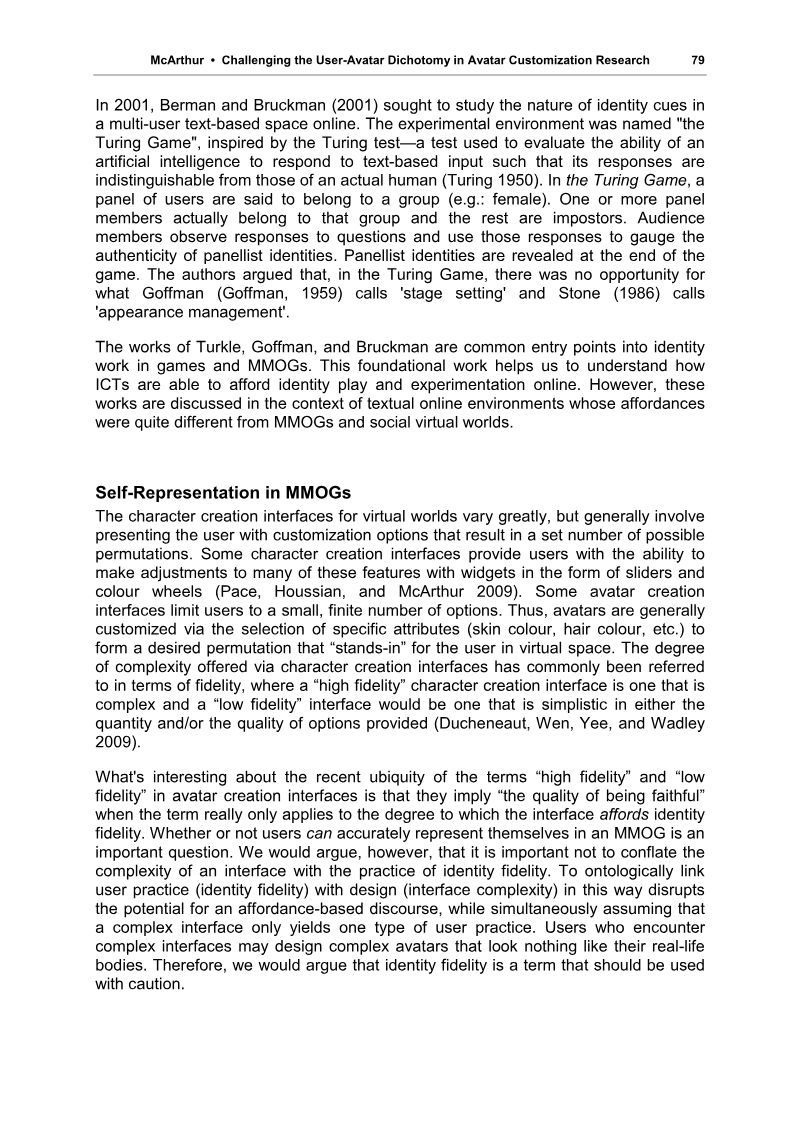
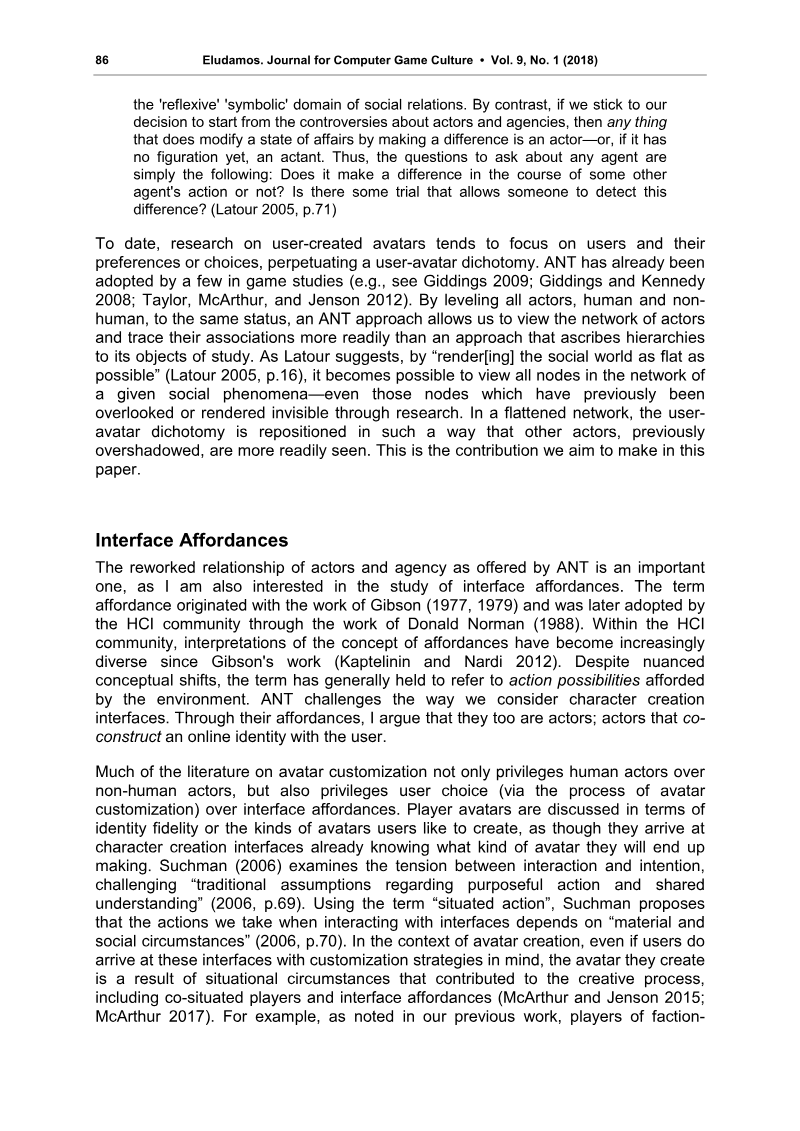
Victoria McArthur's 2018 Eludamos article challenges the dominant "user-avatar dichotomy" in avatar customization research, which treats avatars as objects shaped primarily by users' identity motivations.
- Avatars should be understood as emerging from heterogeneous actor-networks that include interface affordances, game-world aesthetics, co-situated players, and socio-cultural ideologies, not merely as tools of user identity expression.
- Interfaces are active co-constructors of identity rather than neutral tools, so self-representation research must move beyond anthropocentric frameworks.
- Designers now control the range of customization options available to players, and default avatars (such as The Sims' white male character) carry social stigma while reinforcing dominant cultural assumptions.
Playing the (International) Movie: Intermediality and the Appropriation of Symbolic Capital in Final Fight and the Beat 'em up Genre
Zanotti's article examines how Japanese beat 'em up video games of the 1980s, most prominently Final Fight (Capcom, 1989), remediated the conventions of American urban vigilante and gang cinema into interactive form.
- Zanotti argues that Japanese beat 'em up games of the 1980s, led by Capcom's Final Fight (1989), remediated American urban vigilante and gang films into interactive form, appropriating Hollywood's symbolic capital to achieve international success few other Japanese cultural sectors matched that decade.
- Films such as Death Wish, Dirty Harry, The Warriors, and Streets of Fire supplied the genre's narrative and moral framework, in which a lone hero restores personal rather than systemic order through endless street brawls.
- The article traces the genre across 1980s and early 1990s arcade titles from Capcom, Data East, Irem, Konami, Technōs Japan, and SNK, contrasting them with earlier martial-arts fighters like Karate Champ and Urban Champion that lacked the urban vigilante framing.
"No Going Back": The Telltale Model as Thought Experiment
Sarian's "No Going Back" argues that Telltale Games' choice-driven narratives, despite offering little ludic consequence, generate genuine meaning by functioning as philosophical thought experiments that confront players with moral dilemmas and expose their underlying values.
- Sarian argues that Telltale Games' choice-driven narratives generate genuine meaning as philosophical thought experiments, even though their choices carry little ludic (gameplay) consequence.
- The serial, television-like structure of these games defers consequences and keeps narratives largely linear, while end-of-episode survey screens compare individual choices against community data.
- The analysis links the model's limitations to the ELIZA effect, where an illusion of complexity dissolves under scrutiny, but contends that this illusion is not disqualifying.
Mobile Gaming Behaviors: An Exploratory Study of Mobile Game Players' Agency in Space and Time
Sky LaRell Anderson's 2018 study in Eludamos examines how mobile game players exercise corporeal and temporal agency, arguing that mobile gaming, unlike console or PC play, frees players' bodies to move through varied spaces and times.
- Mobile gaming's defining feature is corporeal and temporal freedom: players in this 2018 study played from couches, beds, cars, desks, and waiting rooms, unlike the more fixed setups of console or PC play.
- The freedom of mobile play carries physical costs, with players reporting eye, neck, and wrist strain from varied device-holding positions and unusual play postures.
- Touch-screen technology extends play to unconventional body parts such as toes, elbows, and facial movements, which the author argues broadens access for diverse bodies.
The Eternal Recurrence of All Bits: How Historicizing Video Game Series Transform Factual History into Affective Historicity
Tobias Winnerling's 2014 article argues that historicized video game series, including Civilization, Age of Empires, Assassin's Creed, and the Anno titles, transform factual history into what he calls "affective historicity."
- Tobias Winnerling's 2014 article argues that historicized game series such as Civilization, Age of Empires, Assassin's Creed, and the Anno titles convert factual history into "affective historicity," evoking a feeling of the past through aesthetic, imaginative, and procedural means rather than verifiable causal reasoning.
- These series are linked by gameplay progression and recurring mechanics rather than chronology, so an earlier-set entry like Anno 1404 can seem more advanced than a later one like Anno 1701.
- Winnerling frames the serial, self-referential structure as eternal recurrence (drawing on Deleuze, Guattari, and Nietzsche), in which games endlessly re-enact and reinterpret historical signs, producing a hermeneutic spiral rather than a closed circle.

Gandalf on the Death Star: Levels of Seriality between Bricks, Bits, and Blockbusters
Nørgård and Toft-Nielsen's article argues that digital seriality in playful franchises should be understood not as a corporately controlled process of transmedia world-building but as a plural, processual, and participant-driven phenomenon.
- The article argues that digital seriality in playful franchises is plural, processual, and participant-driven rather than a corporately controlled process of transmedia world-building, using LEGO as its central case.
- The authors find Henry Jenkins's transmedia storytelling concept too narrow and propose an expanded framework of "serialities-in-use" that includes transformational and transgressive fan engagement alongside franchise-directed world-building.
- The model distinguishes intra-, inter-, and para-ludic levels of seriality, textual seriality (within immersive play worlds) from actional seriality (through embodied interaction design), and "drillable" vertical engagement from "spreadable" horizontal engagement.
Digital Seriality as Structure and Process
"Digital Seriality as Structure and Process" argues that the contemporary web is experienced largely through a handful of centralized interfaces, such as Google, YouTube, and Facebook, and that these interfaces function as forms of seriality rather than as open, unstructured networks.
- Digital experience is concentrated in a handful of centralized interfaces such as Google, YouTube, and Facebook, which the authors treat as forms of seriality rather than open, unstructured networks.
- The authors argue that seriality bridges the paradigmatic (database) and syntagmatic (narrative) dimensions of media, challenging the view that the two are opposed, using search results ordered by PageRank as an example.
- On YouTube, metadata-driven recommendation paths and channel subscriptions shift the locus of flow from the image to the interface, requiring active user agency, while recommendation systems tend toward loop-like repetition.
Types and Bytes: Ludic Seriality and Digital Typography
Lisa Gotto's "Types and Bytes: Ludic Seriality and Digital Typography" examines how the digital game Type Rider (2013) renders the historical transformation of typography visible and open to play.
- Gotto argues that typography has shifted from the fixed, serialized logic of print toward the mobile, iconic, and infinitely alterable character of digital text.
- The game Type Rider (2013) traces writing's history from cave drawings through the printing press, cinema, and the graphical user interface, making letters both navigable elements and representational objects.
- The central claim is that player actions both control and generate serial visual meaning, turning typography into a dynamic, player-driven practice rather than a completed product.
Seriality's Ludic Promise: Film Serials and the Pre-History of Digital Gaming
Scott Higgins's "Seriality's Ludic Promise" argues that Hollywood sound serials, the youth-oriented chapter plays produced from the 1930s to the mid-1950s, constitute a pre-history of digital gaming.
- Scott Higgins argues that Hollywood sound serials (youth-oriented chapter plays, 1930s to mid-1950s) are a pre-history of digital gaming, because their formulaic cliffhangers and arbitrary "take outs" work more like game rules than causal story logic.
- The study's production data covers more than 200 serials made between 1930 and 1956, most running twelve to fifteen chapters.
- Cliffhangers are framed as "ludic ruptures," and serials are positioned as ludic problem spaces that viewers engage with through play, drawing on Henry Jenkins's concept of narrative architecture.
"Did You Shoot the Girl in the Street?" – On the Digital Seriality of The Walking Dead
Maria Sulimma's analysis, published in Eludamos in 2014, examines Telltale's The Walking Dead game series as a case study in digital seriality, arguing that its timed choice-based mechanics and staggered episodic release create distinct modes of player reception and community.
- Maria Sulimma's 2014 Eludamos analysis treats Telltale's The Walking Dead as a case study in digital seriality, arguing that timed choices and staggered episodic release create distinct modes of player reception and community.
- The study argues that digital seriality's feedback loops between developers and players, combined with the series' cross-media franchise positioning, set it apart from non-digital serial forms.
- Although player choices often carry limited narrative consequence, the author contends that the structure heightens immersion and sustains engagement.