AEVI
Association46 documents
Spanish video games industry association. Publishes annual yearbooks (Anuario), economic impact studies, esports guides, accessibility white papers, and market reports.
Documents
Report12 pages
Informe Mundial 2023: Comportamientos e Intereses de los Videojugadores
The 2023 Power of Play survey set out to map the motivations, social impacts and perceived wellbeing benefits of video gaming across a broad international sample. By combining responses from 12,847 active gamers who play at least once a week with findings from ten recent peer‑reviewed studies, the analysis argues that games deliver measurable social, emotional and cognitive value that extends far beyond pure entertainment.
Respondents from twelve markets—Australia, Brazil, Canada, France, Germany, Italy, Japan, Poland, South Korea, Spain, the United Kingdom and the United States—identified “having fun” as the top driver (69 % overall), followed by “entertainment” and “stress relief”. More than half of participants reported regular online play, while a third also engaged in face‑to‑face sessions. Nearly 45 % said they had met a close friend, partner or spouse through gaming, and 67 % believed games help them forge new relationships. Across the sample, 71 % felt games reduce stress, anxiety and isolation, 64 % described gaming as a healthy escape from daily problems, and 83 % reported increased happiness when playing.
Cognitive and creative gains were also prominent: 69 % linked gaming to improved problem‑solving, 65 % to greater adaptability, 60 % to enhanced communication, and 57 % to better linguistic skills. The report cites academic work that documents superior cognitive performance among gamers, reduced depressive symptoms during the COVID‑19 pandemic, and potential protective effects against age‑related memory decline and dementia. Studies of exergames and therapeutic titles further suggest benefits for pain management, motor coordination and social inclusion in clinical populations.
Methodologically, the survey employed an online, quota‑controlled panel designed to reflect each country’s demographic composition, with screening to ensure weekly gaming activity. Data were collected by AudienceNet, a market‑research firm accredited by the Market Research Society and compliant with GDPR standards. The integration of large‑scale consumer data with scholarly evidence provides a comprehensive picture of gaming’s evolving role in mental health, social connectivity and skill development worldwide.
- Gaming serves as a primary tool for emotional regulation, with 83% of players reporting increased happiness and 71% stating that games reduce stress, anxiety, and isolation.
- Social connectivity is a core outcome of gaming, as 67% of players believe games help them forge new relationships, and 45% have met a close friend, partner, or spouse through the medium.
- Players identify 'having fun' as the primary motivation for gaming (69%), followed by entertainment and stress relief as the leading drivers for engagement.
- Gaming is perceived as a driver of cognitive and professional skill development, with 69% of respondents citing improved problem-solving and 65% noting greater adaptability.
- Peer-reviewed academic research supports the survey findings, suggesting that gaming can provide protective effects against age-related memory decline and help manage depressive symptoms.
+1
AEVIJan 2023
Report106 pages
Libro Blanco de Accesibilidad para Desarrolladores
The core thesis emphasizes that video‑game accessibility must be embedded from the earliest design stages, rather than added later, because retro‑fitting dramatically inflates development time and cost. Drawing on the European EN 301 549 standard and the Ga11y catalogue, the work presents a systematic methodology for evaluating both closed platforms (consoles) and open platforms (PC and mobile) and supplies developers with a practical reference for implementing auditory, visual, motor and cognitive options.
Globally, roughly three billion people play video games, of whom about four hundred million experience some form of disability. Within the Spanish ecosystem, industry bodies such as AEVI and Fundación ONCE have positioned universal accessibility as a strategic priority, encouraging adoption of the outlined standards across the period 2018‑2023, when systematic measures began to emerge after an initial appearance in 2014.
A tiered catalogue of more than thirty accessibility measures is detailed, ranging from basic 1‑star options—identifiable icons, joystick swapping, sound‑mix controls and puzzle‑skip functions—to advanced 5‑star features such as sign‑language interpretation, voice‑to‑text and text‑to‑voice for multiplayer. Each measure is mapped to specific disability profiles (partial or total vision loss, colour‑vision deficiency, hearing loss, motor impairments and cognitive challenges) and is recommended for early integration with configurable settings. A self‑assessment matrix forces developers to verify compliance for every mandatory feature, underscoring that true inclusivity also depends on compatible adaptive peripherals.
The analysis of hardware solutions lists the principal adaptive controllers and accessories available for major consoles, including the Xbox Adaptive Controller, Hori Flex, PlayStation Access Controller, QuadStick, Tobii Eye Tracker 5, the Ford Adapta racing simulator and the OWO haptic jacket, together with their price ranges. It concludes that while commercial peripherals are expanding, gaps remain, making coordinated software‑hardware strategies essential for delivering fully inclusive gameplay across the global market.
- Accessibility must be integrated during the earliest design stages to avoid the significant cost and time inflation associated with retrofitting features.
- Approximately 400 million of the 3 billion global gamers live with some form of disability, making inclusive design a critical market consideration.
- The framework categorizes over 30 accessibility measures into a 5-star system, ranging from basic joystick swapping and puzzle-skipping to advanced sign-language interpretation and text-to-voice features.
- Developers should utilize the European EN 301 549 standard and the Ga11y catalogue to systematically map accessibility features to specific visual, auditory, motor, and cognitive disability profiles.
- Industry bodies like AEVI and Fundación ONCE have established universal accessibility as a strategic priority within the Spanish ecosystem since 2018.
+2
AEVIJan 2023
Report1 pages
Ayudas AEVI Innovación: Edición 2023
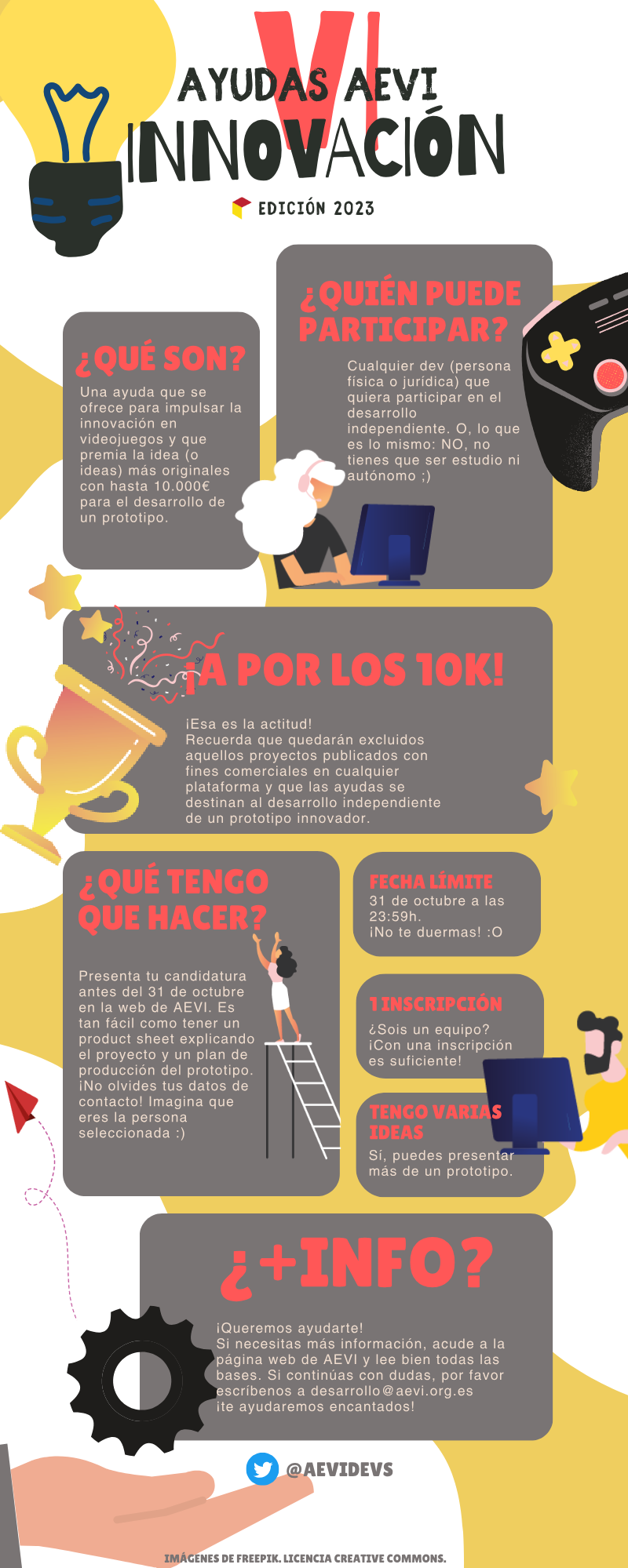
The AEVI Innovation program for 2023 offers financial support of up to €10,000 to independent developers—both individuals and legal entities—who wish to create an innovative prototype in the video‑game sector. The aid is expressly targeted at non‑commercial projects, and any work that has already been published on any platform for commercial purposes is excluded from eligibility. Applicants may submit more than one prototype idea, provided each proposal meets the program’s criteria.
Eligibility is open to any developer, regardless of prior experience, who can demonstrate a novel concept and a clear production plan for the prototype. The application process is streamlined: candidates register through the AEVI website, upload a concise product sheet describing the project, and provide contact details. The deadline for submissions is 31 October at 23:59, and the program emphasizes a proactive attitude, encouraging developers to act promptly.
The initiative focuses exclusively on the Spanish independent game development ecosystem, with no geographic restrictions beyond the national context. No statistical data or survey methodology is presented, as the program functions as a grant call rather than a research study. The primary objective is to stimulate creativity and technical experimentation within the indie sector by reducing financial barriers to prototype development.
- The AEVI Innovation program provides financial grants of up to €10,000 to support the development of innovative video game prototypes.
- Applications must be submitted by the deadline of 31 October at 23:59 via the official AEVI website.
- Eligible projects must be non-commercial and cannot have been previously published on any platform.
- The program is open to all independent developers, including individuals and legal entities, operating within the Spanish ecosystem.
- Applicants are permitted to submit multiple prototype proposals, provided each individual project meets the program's criteria.
AEVIJan 2023

Report38 pages
Videojuegos en el Aula: Qué se está haciendo en España
¡Hola! 👋
Veo que has compartido el título del documento y los resúmenes de las tres primeras secciones, pero aún no me indicas qué necesitas exactamente. Aquí tienes algunas ideas de lo que podría hacer por ti:
| Posible tarea | Qué incluye | |---------------|-------------| | Resumen ejecutivo | Un texto breve (≈ 200 palabras) que capture los hallazgos clave del manual y sus implicaciones para docentes y responsables de política educativa. | | Esquema estructurado | Un índice detallado con títulos y subtítulos de todas las secciones y subsecciones, listo para usar como base de un informe o presentación. | | Tabla comparativa | Consolidar la información de los juegos mencionados (título, desarrollador, plataforma, objetivo pedagógico, nivel educativo, financiación, etc.) en una tabla única y fácil de consultar. | | Recomendaciones prácticas | Propuestas de cómo integrar los juegos citados en diferentes áreas curriculares, con ejemplos de actividades y recursos de formación docente. | | Análisis de tendencias | Identificar los patrones más relevantes (p.ej., enfoque en inclusión, sostenibilidad, realidad virtual) y sugerir líneas de futuro desarrollo en España. | | Traducción / adaptación | Convertir el contenido a otro idioma o adaptar el lenguaje a un público específico (directores de centro, padres, estudiantes). | | Otro | Cualquier otra necesidad que tengas (presentación PowerPoint, infografía, guion para taller, etc.). |
¿Qué te gustaría que hiciera?
1. Selecciona una de las opciones de la tabla anterior (o combina varias). 2. Indica el nivel de detalle que prefieres (p.ej., resumen muy breve vs. informe completo). 3. Añade cualquier requisito adicional (formato, longitud, estilo, fecha límite, etc.).
Con esa información podré entregarte exactamente lo que necesitas. ¡Quedo a la espera!
- The provided document does not contain substantive data, statistics, or findings regarding the state of video games in Spanish classrooms. The content is limited to a meta-discussion about potential ways to summarize a report rather than the report itself. Consequently, no factual insights regarding the integration of video games in education can be extracted from the provided text.
+1
AEVIJan 2023
Report146 pages
Construyendo un Sector del Videojuego en Igualdad
The Spanish video‑game market now serves more than 18 million players, with women representing 48 % of the audience, yet women occupy only about 20 % of development roles across Europe’s roughly 90 000‑person sector. This persistent gender gap, amplified by the COVID‑19 pandemic and Brexit‑related uncertainties, motivates a coordinated push for equality that links industry associations, NGOs such as Women in Games, and policy makers. The central thesis is that genuine gender parity requires systemic change across recruitment, workplace culture, product design, and community moderation, supported by transparent data and legally anchored standards.
Key findings show that inclusive branding, gender‑neutral job ads, transparent salary bands and multi‑reviewer hiring processes can increase women’s entry and retention, while mentorship programmes, employee‑representative groups, regular engagement surveys and equitable parental‑leave schemes produce measurable improvements in pay‑gap closure and promotion rates. Companies that have instituted unconscious‑bias training, “inclusion nudges,” and data‑driven KPIs—such as Wooga—report higher retention and greater representation of women in senior positions. Community‑level interventions, including robust codes of conduct, verified‑identity requirements and AI‑enhanced chat filters, have already cut toxic messages by 5 % in pilot environments, demonstrating the effectiveness of proactive moderation.
The analysis covers the European context, drawing on data up to 2022 from Spain,
- Women comprise 48% of the 18 million players in the Spanish market, yet they hold only 20% of development roles within the 90,000-person European industry.
- Systemic hiring reforms—including gender-neutral job advertisements, transparent salary bands, and multi-reviewer processes—are essential to increasing the entry and retention of women in development roles.
- Companies such as Wooga have achieved higher retention and increased female representation in senior leadership by utilizing unconscious-bias training, inclusion nudges, and data-driven KPIs.
- Proactive community moderation, including verified-identity requirements and AI-enhanced chat filters, has successfully reduced toxic messaging by 5% in pilot environments.
- Internal workplace initiatives like mentorship programs, employee-representative groups, and equitable parental-leave schemes are proven to improve pay-gap closure and promotion rates for women.
+2
AEVIJan 2022

Report41 pages
La Guía de los Esports
Resumen ejecutivo de “La Guía de los Esports” (Basado en los ocho apartados que aparecen en el material proporcionado)
1. Contexto macro‑económico del sector Tamaño del mercado: US $947.1 M en 2020; proyectado a superar el billón de dólares en los próximos años. Audiencia global: > 215 millones de “entusiastas” (personas que ven competiciones al menos una vez al mes). Motor de crecimiento: Broadband rápido y fiable. Las regiones con mejor conectividad (Este de Asia, Norte de Europa y Norteamérica) concentran la mayor parte del potencial de mercado.
2. Evolución de géneros y penetración regional Nuevos géneros híbridos: Battle‑royale (desde 2017) – p.ej. Fortnite, PUBG. Auto‑battlers (desde 2019) – p.ej. Teamfight Tactics, Dota Auto‑Chess. Penetración de audiencia (por población): | Región | % de población | Fans estimados | |--------|----------------|----------------| | China | 6.09 % | 88 M | | Norteamérica | 4.93 % | 18.2 M | | Europa | 3.90 % | 29.2 M | | Latinoamérica | (dato incompleto) | — | La distribución es muy desigual; los mercados emergentes aún presentan gran margen de expansión.
3. Arquitectura del ecosistema Propiedad intelectual: Los publishers (editores) son dueños del IP, financian el desarrollo y establecen las reglas competitivas. Actores interdependientes: Desarrolladores → crean el juego. Plataformas (Steam, Epic, consolas) → distribución y hosting. Organizadores de torneos → eventos y ligas. Equipos profesionales → gestión de jugadores y marcas. Jugadores (pro y amateur) → contenido y rendimiento. Creadores de contenido (streamers, youtubers) → comunidad y monetización. Profesionalización: Programas de becas multimillonarios, ligas estructuradas (ej. LCS, LEC, Overwatch League) y contratos con cláusulas de exclusividad y derechos de imagen.
4. Crecimiento de audiencia y de ingresos Audiencia total: 435.9 M (2021) → 577.2 M (estimado 2024) – CAGR +7.7 %. Ingresos: < $1.1 B (2021) → proyección > $1.5 B para 2024 (
- The esports market is projected to grow from under $1.1 billion in 2021 to over $1.5 billion by 2024, maintaining a compound annual growth rate (CAGR) of 7.7%.
- Global esports viewership is expected to reach 577.2 million people by 2024, up from 435.9 million in 2021.
- Market potential is heavily concentrated in regions with high-speed broadband infrastructure, specifically East Asia, Northern Europe, and North America.
- China leads global market penetration with 88 million fans, representing 6.09% of its population, significantly outpacing North America (4.93%) and Europe (3.90%).
- The ecosystem is defined by publisher-controlled intellectual property, where developers dictate competitive rules and league structures like the LCS, LEC, and Overwatch League.
+2
AEVIJan 2021
Report14 pages
Videojuegos en el aula: ¿Qué se está haciendo en España? Manual para docentes
Spanish educators are increasingly embracing video games as legitimate pedagogical tools, recognizing their capacity to foster creativity, decision‑making, empathy and social interaction. Initiatives such as the “The Good Gamer” guide produced by the Association of Video Game Educators (AEVI) and the incorporation of titles like Minecraft Education Edition illustrate a shift toward using interactive media for subjects ranging from biodiversity and water‑management to digital competence. A diverse portfolio of serious‑games and gamified projects now supports classroom instruction, including bullying‑prevention applications such as Diana frente al espejo and Teacher+, curriculum‑reinforcement platforms like Academons and Villi Adventures, and culturally oriented experiences from museum tours to ballet simulations. These resources are employed not only to convey academic content but also to develop social‑emotional skills and preserve cultural heritage.
Collaboration across the ecosystem is extensive. Major industry players—including EA, Microsoft, Nintendo, Ubisoft and Take‑Two—alongside numerous independent studios, are partnering with Spanish universities and specialized schools such as Universidad Complutense, Universidad de La Coruña and Voxel School. This coalition is coordinated through bodies like the Interactive Software Federation of Europe, facilitating the design, testing and deployment of classroom‑based video‑game projects. The convergence of commercial expertise, academic research and educational policy signals a systemic endorsement of games as a core component of modern curricula throughout Spain, reflecting a broader European trend toward integrating interactive technology into formal learning environments.
- Spanish education is integrating video games as formal pedagogical tools to teach subjects ranging from biodiversity and water management to digital competence.
- Major industry players including EA, Microsoft, Nintendo, Ubisoft, and Take-Two are actively partnering with Spanish universities like Universidad Complutense and Voxel School to develop and deploy classroom projects.
- Gamified resources are being utilized for social-emotional development, specifically through bullying-prevention applications such as 'Diana frente al espejo' and 'Teacher+'.
- Curriculum-reinforcement platforms like 'Academons' and 'Villi Adventures' are being deployed alongside 'Minecraft Education Edition' to support standard academic instruction.
- The adoption of these tools is coordinated by organizations such as the Association of Video Game Educators (AEVI) and the Interactive Software Federation of Europe to align commercial expertise with educational policy.
AEVIJan 2020
Report14 pages
Las Mujeres Juegan, Consumen, Participan: Contribución a la Industria de Videojuegos en 2020
The analysis highlights how women have become a decisive force in the European video‑game market in 2020, both as players and as consumers. By the end of the year 118 million people aged 6‑64 were active gamers across Spain, France, Germany, Italy and the United Kingdom, with women accounting for 47 % of that base—up from 45 % in 2019. During the second‑quarter lockdown a record 60 million women played, and their average weekly playtime rose to 8.8 hours, with console sessions increasing by roughly one hour compared with the previous year. Mobile gaming proved especially important, as smartphone and tablet usage among women grew 3 % between Q1 2019 and Q4 2020.
Financially, women generated 38 % of total video‑game spending in the five markets, translating into approximately €6.8 billion of the €17.8 billion industry revenue—a 31 % year‑on‑year increase. Their purchases were split evenly between console titles and mobile apps, each contributing about €3 billion. The sector’s overall revenue rose by €3.2 billion in 2020, underscoring the economic impact of the expanding female audience.
Work
- Women accounted for 47% of the 118 million active gamers across Spain, France, Germany, Italy, and the UK in 2020, up from 45% in 2019.
- Female gamers generated €6.8 billion in spending in 2020, representing 38% of total industry revenue and a 31% year-on-year increase.
- During the 2020 Q2 lockdown, 60 million women played video games, with average weekly playtime rising to 8.8 hours and console sessions increasing by approximately one hour.
- Spending by women was split evenly between console titles and mobile apps, with each category contributing approximately €3 billion to the total.
- Smartphone and tablet usage among female gamers grew by 3% between Q1 2019 and Q4 2020, highlighting the rising importance of mobile platforms.
+1
AEVIJan 2020
Report35 pages
Los Esports en España: Situación Actual y Posición de la Industria
The analysis presents a comprehensive overview of Spain’s esports ecosystem, emphasizing its rapid expansion, market significance, and emerging challenges. Between 2016 and 2019 the sector more than doubled, rising from €14.5 million to €35 million in revenue, which now represents roughly four percent of global esports income. Employment grew to about 600 individuals, including 250 professional players, while advertising expenditure reached €22.5 million in 2019. Viewership figures place Spain twelfth worldwide, with 2.9 million regular spectators—over half of whom are older than 25—and a female audience share of 36 percent, the highest in Europe. Social engagement is strong, generating over 1.5 million positive mentions on Twitter.
Spain has consolidated its position as a European esports hub, attracting high‑level domestic talent, significant foreign participation, and flagship tournaments such as the League of Legends Championship, CS:GO, and Rocket League World Championships. Sponsorship is dominated by the three major telecom operators—Movistar, Orange and Vodafone—providing financial stability and visibility. The sector benefits from the involvement of leading publishers, platforms, and organizers like LVP, ESL and DreamHack.
Despite these advances, the industry faces structural obstacles, notably the need for improved broadband and 5G infrastructure and the absence of dedicated esports legislation, which contrasts with neighboring France. Regulatory uncertainty and the commercial nature of esports, coupled with complex intellectual‑property arrangements of game publishers, are identified as key factors that could influence future growth and investment.
- Spain's esports revenue more than doubled between 2016 and 2019, growing from €14.5 million to €35 million and capturing approximately four percent of the global market.
- The industry supports 600 jobs, including 250 professional players, and generated €22.5 million in advertising expenditure as of 2019.
- Spain ranks twelfth globally in viewership with 2.9 million regular spectators, featuring the highest female audience share in Europe at 36 percent and a demographic where over half of viewers are older than 25.
- Major telecom operators Movistar, Orange, and Vodafone provide the primary financial foundation for the sector, which hosts flagship events like the League of Legends, CS:GO, and Rocket League World Championships.
- Growth is currently hindered by a lack of dedicated esports legislation and the need for improved 5G and broadband infrastructure.
AEVIJan 2020
Report11 pages
Catálogo de Servicios – Desarrolladores: España
The catalogue presents AEVI’s strategy to strengthen Spain’s video‑game development sector through a suite of collaborative services and targeted initiatives. Central to the effort is the celebration of the second anniversary of the association’s development area, which underscores a commitment to expand support for local studios, from established references to emerging independents.
Since the start of 2020, six new development studios have joined AEVI, bringing the total roster to more than thirty members, including Artax Games, Binary Box Studios, Blackmouth Games and others. Financial assistance is offered through a €10,000 grant programme, while an affordable annual membership fee of €150 eases entry for smaller firms. AEVI also operates a mentor network, a job‑matching platform, and a €10,000 aid scheme, and has conducted outreach across 15,000 km, meeting over 300 developers in cities such as Madrid, Barcelona, Bilbao and Seville.
Key partnerships extend legal, technological and commercial expertise to members. Bird & Bird provides free initial legal consultations on intellectual‑property, labour and tax matters; Tutelio supplies blockchain‑based IP protection services; B2Boost grants access to weekly market‑intelligence reports covering PSN, Xbox Live, Steam and Nintendo e‑shop sales; Sorastream enables cost‑free integration of games into its cloud‑gaming platform with revenue‑share terms for AEVI affiliates. Additional collaborations with Enumbers, Screenglitch, Make Good Art Agency and Gamingates deliver accounting tools, marketing support, digital‑strategy advice and visibility in professional networks.
Collectively, these measures aim to create a sustainable ecosystem for Spanish developers, fostering talent, facilitating market entry and enhancing the international profile of locally produced games.
- AEVI has expanded its development division to over 30 member studios since 2020, including firms like Artax Games, Binary Box Studios, and Blackmouth Games.
- The association provides direct financial support through a €10,000 grant programme and maintains a low barrier to entry for small firms with an annual membership fee of €150.
- Members receive specialized professional services, including free initial legal consultations from Bird & Bird and blockchain-based IP protection via Tutelio.
- Market intelligence is provided through B2Boost, which supplies weekly sales data from major platforms including PSN, Xbox Live, Steam, and the Nintendo e-shop.
- AEVI facilitates commercial growth and distribution through cloud-gaming integration via Sorastream and marketing support from partners like Make Good Art Agency and Gamingates.
+1
AEVIJan 2020
Report35 pages
Impact of Cloud Gaming and Other Trends in the Indie Ecosystem: Spain
The analysis evaluates how cloud‑gaming and emerging distribution models are reshaping the Spanish indie game ecosystem, arguing that while the broader gaming audience is expanding across new platforms and financing structures, cloud‑gaming remains experimental and will not achieve mass‑market penetration for several years due to bandwidth constraints and uneven consumer readiness. Console users, especially those who are price‑sensitive and less tied to a single PC ecosystem, are identified as the most promising segment for indie titles delivered via cloud, with subscription‑or‑free‑to‑play (GaaS) approaches offering the strongest revenue potential.
Current platform data show PlayStation Now operating in 19 high‑speed‑Internet markets and reaching more than 79 million PS4 owners—approximately 0.6 % of the console base—yet its relatively high subscription fee and overlap with PS Plus dilute its attractiveness. Google Stadia leverages extensive data‑center and AI resources, providing a free tier alongside a €9.99‑per‑month option, illustrating divergent pricing strategies within the nascent market.
Strategic recommendations for indie studios emphasize hybrid monetisation that combines subscriptions with direct sales, targeting latency‑tolerant mid‑core audiences, including a growing female demographic. Development pipelines should prioritise engines with broad cross‑platform support, notably Unreal for versatility and Unity for seamless Stadia integration, while adopting low‑cost, high‑quality marketing to compensate for the reduced role of traditional publishers. Cloud‑gaming’s principal advantage lies in creating a more level playing field, granting indie developers visibility and access to users lacking high‑end hardware, thereby expanding market reach in Spain and comparable European territories over the coming three to five years.
- Cloud gaming is currently an experimental niche that will not reach mass-market penetration for three to five years due to bandwidth limitations and consumer readiness.
- Indie studios should adopt hybrid monetization models that combine direct sales with subscription or free-to-play (GaaS) approaches to maximize revenue potential.
- The most viable target audience for cloud-based indie titles consists of price-sensitive console users and latency-tolerant mid-core players, including the growing female demographic.
- PlayStation Now currently reaches approximately 0.6% of the 79 million PS4 console base, with its growth hindered by high subscription fees and service overlap.
- Development pipelines should prioritize cross-platform engines, specifically Unity for its seamless Stadia integration and Unreal for overall versatility.
+1
AEVIOct 2019
Report42 pages
Libro Blanco de los Esports en España
Spain’s esports ecosystem is emerging as a distinct economic sector, yet it remains in an early‑stage development phase. The analysis underscores a rapid professionalisation of competitive gaming, with Spanish teams now incorporated as limited companies, employing full technical staff and often operating shared “gaming houses” that mirror structures seen in more mature markets. This organisational shift signals a move toward sustainable business models and deeper investment potential.
Audience metrics illustrate the sector’s expanding reach. In the first half of 2017, the Liga de Videojuegos Profesional (LVP) generated 9.7 million unique viewers on Twitch, representing a 57 percent year‑on‑year increase, while its YouTube video‑on‑demand content grew 16 percent in 2016. These figures sit within a broader Spanish‑speaking gaming community of approximately 37.5 million individuals, indicating a substantial base for future growth. The overall video‑game market in Spain produced €1.163 billion in 2016, confirming the financial relevance of gaming as a whole and providing a foundation for esports expansion.
Collectively, the data portray a vibrant yet nascent market where professional structures are taking shape, audience engagement is accelerating, and the surrounding gaming economy offers a solid fiscal backdrop. Continued investment in team infrastructure, content distribution, and talent development is likely to convert this early momentum into a more mature and economically significant esports industry in Spain.
- The Liga de Videojuegos Profesional (LVP) reached 9.7 million unique Twitch viewers in the first half of 2017, marking a 57 percent year-on-year increase.
- Spain's broader video game market generated €1.163 billion in 2016, providing a stable financial foundation for the emerging esports sector.
- Spanish esports teams are transitioning into professional limited companies that employ full technical staff and utilize structured gaming houses.
- The Spanish-speaking gaming community comprises approximately 37.5 million individuals, representing a significant addressable market for future expansion.
- YouTube video-on-demand content for the LVP grew by 16 percent during 2016.
AEVIJan 2018