AEVI
Association46 documents
Spanish video games industry association. Publishes annual yearbooks (Anuario), economic impact studies, esports guides, accessibility white papers, and market reports.
Documents
Report15 pages
Aspectos Laborales en el Desarrollo de Videojuegos
The guide aims to equip professionals in the Spanish video‑game sector with a practical framework for complying with national labour legislation while fostering safe, flexible and sustainable work environments. It stresses that employment relationships must be governed primarily by the Estatuto de los Trabajadores and the 2022 labour reform, positioning indefinite contracts as the default model and limiting temporary contracts to production‑related needs or substitution of specific workers.
Key legal risks are highlighted, notably the use of “falso autónomo” arrangements. Indicators such as dependence, lack of entrepreneurial risk, fixed remuneration and provision of equipment can reclassify a contractor as an employee, exposing firms to Social Security back‑payments of up to €50 000, fines ranging from €3 750 to €12 000 per case and additional penalties of 100‑150 % of the owed contributions. Incorrectly formalised temporary contracts trigger automatic conversion to permanent status and fines between €751 and €7 500 per affected worker.
The document outlines the regulatory regime for teleworking, requiring a voluntary agreement, employer‑borne provision costs of roughly €25‑35 per month, and detailed specifications on schedules and monitoring tools. Non‑compliance is penalised as a grave infringement with fines identical to those for improper temporary contracts. Prevention of occupational risks, especially the “crunch” phenomenon, is mandated under the 1995 Prevention of Risks Law; violations can attract fines from €45 up to €983 736, and employers may face civil liability for work‑related injuries or illnesses.
Additional obligations include mandatory daily working‑time records introduced in 2019, the use of irregular‑hour distribution up to 10 % of total hours with five‑day notice and strict rest‑period safeguards, and the implementation of digital‑disconnection protocols, equality plans for firms with more than fifty employees, whistle‑blowing channels and digital‑device usage policies. The guide, authored by legal experts and industry consultants, synthesises statutory provisions and recent reforms to provide a comprehensive compliance checklist for developers, publishers and marketing teams operating within Spain’s
- Misclassifying contractors as 'falso autónomo' carries severe financial risk, including Social Security back-payments of up to €50,000, fines of €3,750 to €12,000 per case, and additional penalties of 100–150% of owed contributions.
- Indefinite contracts are the mandatory default under the 2022 labour reform, with improperly formalised temporary contracts triggering automatic conversion to permanent status and fines ranging from €751 to €7,500 per worker.
- Violations of occupational risk prevention laws, particularly regarding 'crunch' culture, can result in fines reaching up to €983,736 and potential civil liability for work-related health issues.
- Teleworking requires a formal voluntary agreement and employer-covered costs of approximately €25–35 per month, with non-compliance classified as a grave infringement subject to fines of €751 to €7,500.
- Employers must maintain mandatory daily working-time records and adhere to strict rest-period safeguards, while also implementing digital-disconnection protocols and whistle-blowing channels.
+1
AEVIJan 2025
Report15 pages
Guías AEVI: Propiedad intelectual e industrial
The guide aims to equip video‑game developers and publishers with a practical framework for safeguarding the creative and technical assets that constitute a game’s intellectual and industrial property. It clarifies the dual nature of IP under Spanish law—copyright and related rights on the one hand, and industrial property (patents, trademarks, designs, trade secrets) on the other—explaining which categories protect specific game elements such as scripts, music, graphics, code, user‑interface designs, character names and logos.
Key conclusions stress that copyright arises automatically upon creation, lasting 70 years after the author’s death (or 70 years from disclosure for collective works), while related rights endure 50 years. Trademark protection requires registration and lasts ten years per filing, renewable indefinitely; design protection covers the external appearance of a GUI for five‑year periods, renewable up to 25 years. Trade‑secret measures rely on confidentiality agreements and technical safeguards rather than formal registration. The guide also outlines the legal regimes governing ownership of works created by employees, freelancers or collaborators, noting that Spanish law lacks a “work‑for‑hire” concept and therefore mandates explicit written assignments of exploitation rights, typically detailed in employment or service contracts.
Practical recommendations include a step‑by‑step checklist for identifying each asset, determining the appropriate protection mechanism, confirming that all contributors have assigned their rights, and implementing NDAs to preserve secrecy during development. The guide further outlines limited exceptions for using third‑party material—public‑domain works, specific statutory limits, and narrowly defined descriptive uses of trademarks—while warning that doctrines such as “fair use” are not recognized in the EU. Overall, the document provides a comprehensive, Spain‑focused roadmap for building a robust IP portfolio that enhances a game’s market value and minimizes infringement risk.
- Spanish law does not recognize the 'work-for-hire' doctrine, meaning developers must secure explicit written assignments of exploitation rights in all employment and service contracts to ensure legal ownership of creative assets.
- Copyright protection for video game elements arises automatically upon creation and lasts for 70 years after the author's death, or 70 years from disclosure in the case of collective works.
- Trademark protection requires formal registration and provides 10-year terms that are renewable indefinitely, while industrial design protection for GUIs lasts for five-year periods, renewable up to a maximum of 25 years.
- Trade secrets are protected through internal confidentiality agreements and technical safeguards rather than formal registration, making NDAs essential during the development phase.
- The EU legal framework does not recognize the 'fair use' doctrine, limiting the use of third-party materials to public domain works, specific statutory exceptions, and narrow descriptive trademark uses.
AEVIJan 2025
Legal13 pages
Guía sobre derechos de los consumidores, publicidad y protección de datos: España
The guide serves as a practical reference for video‑game publishers, developers and marketers operating in Spain, outlining how consumer‑protection, advertising and data‑privacy regulations apply to digital game products. Its central thesis is that compliance with the General Law for the Defense of Consumers and Users, the General Advertising Law, the Unfair Competition Law and the EU General Data Protection Regulation (GDPR) is essential not only to avoid legal sanctions but also to build trust with players, including minors.
Key findings stress that gamers enjoy the same rights as purchasers of physical goods, notably a 14‑day withdrawal period, clear information on pricing, age‑rating labels and protection against abusive contract clauses. Developers must maintain and communicate updates, and they are obliged to disclose the legal nature of non‑fungible tokens (NFTs), ensuring transparency about ownership, licensing and the irrevocability of blockchain transactions. Advertising rules prohibit concealed sponsorship, misleading urgency, false reviews and any content that exploits minors, promotes violence, discrimination or unhealthy behaviours; influencer promotions must carry explicit sponsorship disclosures. Data‑privacy obligations require clear privacy notices, lawful bases for processing, secure handling of personal and special‑category data, and parental consent for users under 14, with documented procedures for verification.
The scope covers the Spanish market and applies to all digital game content, in‑game purchases, loot boxes, NFTs and related services, without reference to a specific time frame beyond the 2025 publication date. The methodology consists of a synthesis of existing national and EU legislation, interpreted for the video‑game sector, and presented as actionable checklists rather than empirical research. By following the outlined practices, industry actors can align their operations with current legal standards and mitigate regulatory risk.
- Digital game consumers in Spain are entitled to the same legal protections as physical goods buyers, including a mandatory 14-day withdrawal period and protection against abusive contract clauses.
- Data privacy regulations require explicit parental consent for processing the personal data of users under 14, necessitating documented verification procedures.
- Advertising standards strictly prohibit concealed sponsorships, misleading urgency, and fake reviews, while mandating that influencer promotions include clear sponsorship disclosures.
- Developers must provide full transparency regarding the legal nature of NFTs, specifically addressing ownership rights, licensing terms, and the irrevocability of blockchain transactions.
- Compliance obligations extend to all digital game content, including in-game purchases, loot boxes, and NFTs, under the framework of the General Law for the Defense of Consumers and Users and the GDPR.
+1
AEVIJan 2025
Report17 pages
La Fiscalidad en el Sector de los Videojuegos: España
The guide aims to clarify the tax framework that applies to video‑game developers, publishers and related service providers operating in Spain, outlining both mandatory obligations and available fiscal incentives. It serves as a practical reference for resident legal entities, self‑employed professionals and non‑resident firms that generate income in the Spanish market, helping them meet compliance deadlines while exploiting deductions that can significantly lower the effective tax burden.
Key obligations are mapped to the principal Spanish taxes: corporate income tax (IS) at a standard 25 % rate, personal income tax (IRPF) ranging from 19 % to 47 % for individuals, value‑added tax (IVA) generally set at 21 %, the economic activities tax (IAE) with fixed tariffs and exemptions for the first two years or turnover below €1 million, and withholding obligations on salaries and payments to non‑resident contractors. Filing deadlines are detailed for each model form (e.g., Model 200/210 for IS, Model 303/390 for IVA, Model 111/190 for IRPF withholdings) and the guide notes the possibility of fiscal consolidation for groups of related companies.
The most valuable incentives for the sector include a 12 % deduction on qualifying research, development and innovation (R&D +i) expenses, which can rise to 45 % for projects carried out in the Canary Islands, and a patent‑box regime that reduces taxable income from intangible assets such as patents and advanced software. The 2022 Spanish Video‑Game Development White Paper underpins the emphasis on genuine technological advancement. Start‑up companies meeting ENISA criteria benefit from a reduced corporate rate of 15 % for four years, exemption from advance payments, and deferred tax liabilities. Small and medium‑sized entities with turnover under €10 million can also apply accelerated depreciation, enhanced lease deductibility and loss‑carry‑forward mechanisms.
Operational guidance covers the procedural steps required to register for a tax identification number, declare activity commencement or cessation, and submit electronic filings via the Agencia Tributaria’s portal using a digital certificate. Complementary tools include a searchable tax‑question database, an annually updated taxpayer calendar, virtual assistance services for the main tax types, and a dedicated helpline. Together, these resources aim to streamline compliance, reduce administrative risk and enable video‑game firms to maximize the fiscal advantages embedded in Spanish law.
- Video game companies in Spain can access a 12% tax deduction for qualifying R&D+i expenses, which increases to 45% for projects developed in the Canary Islands.
- Start-ups meeting ENISA criteria qualify for a reduced 15% corporate tax rate for four years, along with exemptions from advance payments and deferred tax liabilities.
- The standard corporate income tax (IS) rate in Spain is 25%, while personal income tax (IRPF) for self-employed professionals ranges from 19% to 47%.
- A patent-box regime is available to reduce taxable income derived from intangible assets, including patents and advanced software.
- Small and medium-sized enterprises with an annual turnover under €10 million are eligible for accelerated depreciation, enhanced lease deductibility, and loss-carry-forward mechanisms.
+2
AEVIJan 2025
Report43 pages
Videojuegos en el Aula: ¿Qué se está haciendo en España? Manual para docentes 2025
Video games have become a central cultural and educational tool in Spain, where more than 22 million people—over half of them women—play an average of 8.2 hours each week. This widespread engagement is leveraged to motivate learning, prompting the development of a coordinated ecosystem that supplies teachers with curated resources, professional training, and ready‑to‑use platforms such as Dok Student, Cokitos, Mundo Primaria, Eutopía and Escapeweb. Publicly funded titles like ABC Dinos, BookyPets and Quijote: Quest for Glory employ RPG, tower‑defense and card mechanics to reinforce early literacy, while historically grounded games such as Dîrok, Plus Ultra Legado and El Enigma de Toledo integrate rigorous research into curricula, supporting both STEM competencies and language development.
A parallel surge in health‑oriented games addresses the mental‑health concerns of Spanish adolescents, with 41 % reporting problems and one‑third never having discussed them. These applications aim to provide preventive support and therapeutic engagement within school settings. Meanwhile, esports and gamified learning are gaining institutional traction; a national competition rewards winning schools with €20 000 in technology, and industry partnerships like GGTech’s site visits illustrate viable career pathways. Complementary initiatives, such as Cruz Roja’s 150‑hour Unity programming course for unemployed youth and the Andalusian “Desafía & Aprende” program, further embed game design skills into broader employment strategies.
Overall, the Spanish educational landscape demonstrates a rapid, multi‑sectoral integration of video games that spans literacy, history, health, and vocational training, reflecting a strategic response to the medium’s pervasive cultural presence and its potential to enhance learning outcomes across the country.
- Spain’s gaming ecosystem is supported by over 22 million players, with women accounting for more than half of the user base and an average weekly playtime of 8.2 hours.
- Educational integration is facilitated by a standardized infrastructure of platforms including Dok Student, Cokitos, Mundo Primaria, Eutopía, and Escapeweb.
- Publicly funded titles like ABC Dinos, BookyPets, and Quijote: Quest for Glory utilize RPG and tower-defense mechanics to improve early literacy, while games like Dîrok and El Enigma de Toledo support STEM and history curricula.
- To address the 41% of Spanish adolescents reporting mental health concerns, schools are increasingly adopting therapeutic and preventive video game applications.
- Institutional support for esports and gamification includes a national competition offering €20,000 in technology prizes and industry-led career exposure through partners like GGTech.
+3
AEVIJan 2025
Report2 pages
Comportamientos e Intereses de los Videojugadores: Spain
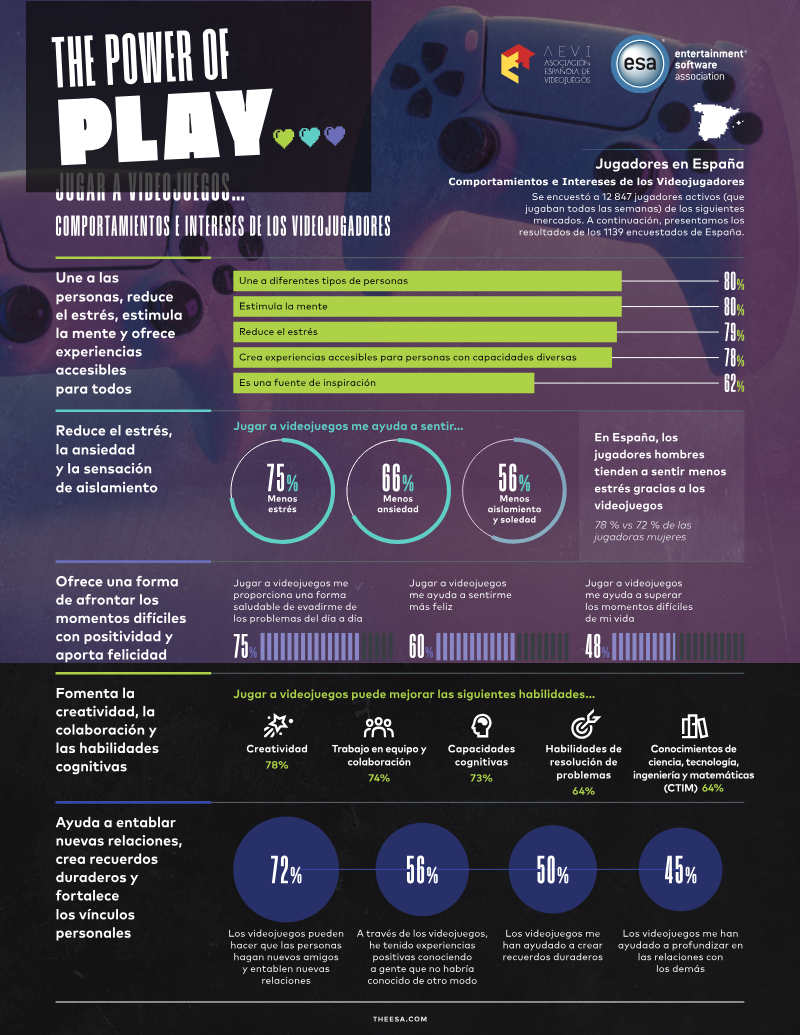
The study investigates how Spanish video‑game players experience play, what motivates them, and which social and cognitive benefits they perceive. It situates Spain within a broader cross‑national analysis that also includes Poland, South Korea and Australia, focusing on active gamers who play at least once a week.
Data were collected through an online questionnaire administered to 12,847 weekly players across the four markets, of which 1,139 respondents were from Spain. The sample spans ages 16 to 65 plus and includes both genders, allowing comparison of habits and attitudes between men and women and across age brackets.
Among Spanish gamers, 80 % cite “meeting different people” and “stimulating the mind” as primary reasons for playing, while 78 % report that games help reduce stress and anxiety. Men are slightly more likely than women to feel less isolated (78 % vs 72 %) and to use gaming as a healthy outlet for daily pressures (75 % of men versus 60 % of women). Solo play remains the most common mode, yet eight out of ten men regularly play with others online, and roughly half of all respondents combine solo and online sessions.
Social interaction is linked to perceived skill gains: 78 % associate multiplayer play with enhanced creativity, 74 % with teamwork, and 64 % with improved cognitive and STEM‑related abilities. Integrated communication tools are used frequently by 29 % of younger male players, while 55 % of all participants view playing with others—whether online or in person—as a positive experience that fosters lasting friendships and shared memories.
Overall, Spanish gamers view video games as a versatile medium that delivers entertainment, mental‑health relief, social connection and transferable competencies, underscoring the sector’s relevance for both consumer satisfaction and broader wellbeing initiatives.
- 80% of Spanish gamers play primarily to meet new people and stimulate their minds, while 78% use gaming as a tool to reduce stress and anxiety.
- Multiplayer gaming is perceived as a driver for skill development, with 78% of players associating it with creativity, 74% with teamwork, and 64% with improved cognitive and STEM-related abilities.
- Social gaming is a core habit, as 55% of all participants view playing with others as a positive experience that fosters lasting friendships and shared memories.
- While solo play remains the most common mode, 80% of male gamers play online with others regularly, and roughly 50% of all respondents combine solo and online sessions.
- Gender differences exist in perceived benefits, with men more likely than women to report feeling less isolated (78% vs 72%) and using gaming as a healthy outlet for daily pressure (75% vs 60%).
+1
AEVIJan 2024
Report2 pages
The Power of Play: España
Summary of “The Power of Play: España” (Survey of Spanish Video‑Game Players)
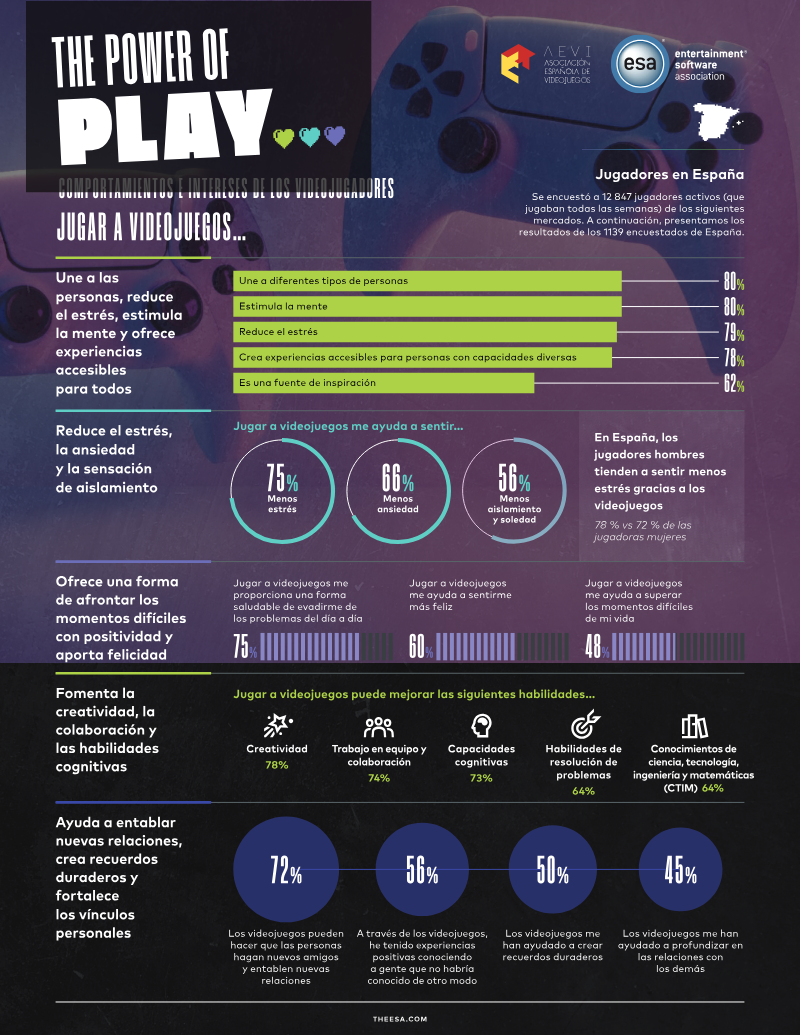
1. Scope & Sample Population surveyed: 12 847 active gamers (play ≥ once a week) across several markets. Spanish subsample: 1 139 respondents (men + women) who answered the questionnaire.
2. Demographic Profile
| Age group (years) | % of Spanish respondents | |-------------------|---------------------------| | 16‑18 | 8 % (men) / 41 % (women) | | 19‑24 | 49 % (men) / 28 % (women) | | 25‑34 | 28 % (men) / 28 % (women) | | 35‑44 | – | | 45‑54 | – | | 55‑64 | – | | 65+ | – |
\The table in the original document mixes gender‑specific percentages; the numbers above reflect the most clearly reported figures.
Gender split (overall): Roughly equal, with a slight male majority in the 19‑24 bracket. Play mode: 8 out of 10 male gamers (≈ 80 %) report playing with other players online. For women, solo play is still the most common, but a sizable minority also play online or in person.
3. Primary Motivations for Playing
| Motivation | % of respondents (overall) | |------------|----------------------------| | Fun / Entertainment | 85 % | | Stress reduction / relaxation | 78 % (men) – 75 % (women) | | Social connection (meeting new people, making friends) | 62 % (men) – 55 % (women) | | Escapism / coping with daily problems | 28 % (men) – 48 % (women) | | Feeling happier / more positive | 75 % (men) – 60 % (women) | | Creating lasting memories | 45 % (men) – 35 % (women) |
Note: The percentages are drawn from multiple overlapping questions (e.g., “Jugar a videojuegos me ayuda a sentir…”, “Reduce el estrés, la ansiedad, el aislamiento”). The highest‑scoring items are fun, stress relief, and social interaction.
4. Perceived Benefits
4.1 Psychological & Emotional Stress & anxiety: 78 % of men and 75 % of women say gaming helps them feel less stressed and less anxious. Isolation: 78 % of men and 72 % of women report a reduction in feelings of loneliness.
- Gaming is primarily used for emotional regulation in Spain, with 78% of men and 75% of women reporting that it effectively reduces stress and anxiety.
- Social connection is a major driver for the Spanish gaming population, with 62% of men and 55% of women citing it as a primary motivation for play.
- Online multiplayer engagement is significantly higher among men, with approximately 80% reporting they play with others online, whereas women show a stronger preference for solo play.
- Gaming serves as a vital tool for combating loneliness, as 78% of men and 72% of women report that playing reduces their feelings of isolation.
- The Spanish gaming demographic is heavily concentrated in younger age brackets, with 49% of male players and 28% of female players falling within the 19–24 age range.
+3
AEVIJan 2024
Report26 pages
Manifiesto de Video Games Europe 2024-2029
The European video‑game sector seeks recognition as a distinct blend of technology and creative culture and urges policymakers to embed this identity in the EU’s 2024‑2029 strategic framework. By positioning games as a driver of digital innovation, cultural expression, and economic growth, the manifesto argues that tailored legislation, financing, and data‑collection mechanisms are essential to sustain the industry’s momentum and competitiveness.
Between 2019 and 2024 the sector expanded by 16 %, reaching €24 billion in revenue and employing roughly 110 000 highly‑skilled workers across the Union. More than half of Europeans (53 %) now play games, with women accounting for 46.7 % of the audience and the average gamer aged 32. Research indicates that girls who game are three times more likely to pursue STEM studies, underscoring the medium’s educational impact. The self‑regulatory PEGI system, which has labelled over 40 000 titles in 40 countries, has cut non‑compliant sales by up to 50 %, demonstrating effective consumer protection without heavy legislative burden.
Current EU financing tools—tax credits and grants—are deemed insufficient to match the incentives offered by hubs such as Canada, the United Kingdom and France. The manifesto calls for a dedicated funding framework that channels public resources toward innovative, creative projects, alongside flexible talent‑attraction visas and Horizon‑funded labour‑market mapping to close digital‑skills gaps. It also highlights the strain of 850 new obligations introduced between 2017 and 2022, amounting to more than 5 000 pages of regulation, which increase compliance costs for developers and publishers.
To solidify the sector’s contribution, a unified intellectual‑property regime and a revision of NACE classification codes are proposed, enabling accurate economic measurement. Mandatory PEGI‑based age controls, parental‑lock tools and proactive chat moderation address the 53 % of Europeans prioritising child‑friendly environments. Finally, the industry’s low‑carbon digital products and initiatives such as “Playing for the Planet” and “Green Game Jam” are presented as foundations for a climate‑responsible future, aligning gaming with
- The European video game sector generated €24 billion in revenue between 2019 and 2024, representing a 16% growth rate and supporting 110,000 highly-skilled jobs.
- The industry faces a significant regulatory burden, having been subjected to 850 new obligations and over 5,000 pages of legislation between 2017 and 2022.
- Current EU financing tools are insufficient to compete with global hubs like Canada and the UK, prompting calls for a dedicated funding framework and improved tax incentives.
- The PEGI self-regulatory system has successfully labeled over 40,000 titles across 40 countries, reducing non-compliant sales by up to 50%.
- Video games have reached 53% of the European population, with a demographic split of 46.7% women and an average player age of 32.
+1
AEVIJan 2024
Report159 pages
Impacto de la aplicación de sistemas de incentivos fiscales en la industria de videojuegos: España
The analysis evaluates how a targeted fiscal‑incentive regime would reshape Spain’s video‑game industry, arguing that a 20 % corporate‑tax credit for developers could expand sector turnover from €1.435 billion in 2022 to roughly €5.5 billion by 2028—a compound annual growth rate of about 27 %—and raise full‑time employment from just under 10 000 jobs to more than 23 000 by 2030, an 80 % increase. Despite the lower tax rate, overall fiscal receipts would grow, with a direct contribution of €1.9 billion and an additional €1.0 billion generated through reinvestment and consumer spending, indicating a net positive return for the Treasury.
Spain’s ecosystem comprises roughly 760 active studios, of which 445 are incorporated, and 71 publishers, with the top ten accounting for almost 95 % of revenue. Development costs vary markedly by platform—averaging €419 k for consoles, €338 k for PC and €94 k for mobile—while break‑even periods range from 8.6 to 15.5 months, underscoring the financing pressure on predominantly
- Implementing a 20% corporate tax credit for developers is projected to grow Spain’s video game sector turnover from €1.435 billion in 2022 to €5.5 billion by 2028, representing a 27% compound annual growth rate.
- The proposed fiscal incentives are expected to increase full-time employment in the industry from under 10,000 jobs to more than 23,000 by 2030.
- The tax regime is forecast to be net-positive for the Treasury, generating €1.9 billion in direct contributions plus an additional €1.0 billion through reinvestment and consumer spending.
- The Spanish market is highly concentrated, with the top ten companies accounting for approximately 95% of total industry revenue.
- Development costs vary significantly by platform, averaging €419k for consoles, €338k for PC, and €94k for mobile.
+2
AEVIJun 2023
Report14 pages
Videojuegos en el aula
Spanish educators are progressively integrating video games into classroom practice, positioning interactive media as legitimate learning tools rather than mere entertainment. The manual demonstrates that, when combined with teacher training, games can stimulate creativity, empathy and digital competence, providing an engaging complement or alternative to traditional textbooks. Initiatives such as AEVI’s “The Good Gamer,” the nationwide rollout of Minecraft Education Edition, and locally developed titles—including EduZland, BetterWorld, Planet Rescuers, Koral and Endling—are now employed in more than a thousand schools to address subjects ranging from mathematics and language to civic values, environmental stewardship and mental‑health awareness.
A thriving ecosystem of Spanish‑origin serious games supports this pedagogical shift. Projects like Teacher+, Diana frente al espejo, Academons, Villi Adventures, 200 y +, Bailando un Tesoro, Poky Drivers, JUNIOR Esports, Futuros Talentos, Nintendo ESNE, EVAD Kids and Minecraft Education target a broad spectrum of curricular content—science, language, history, health and safety—and promote transversal values such as equality, anti‑bullying, teamwork and sustainability. The breadth of offerings illustrates a coordinated effort to embed game‑based learning across primary and secondary education.
The landscape is reinforced by a wide coalition of Spanish game developers, publishers and academic programs, including major studios such as Riot Games, Ubisoft and Take‑Two Interactive, alongside numerous university‑based game schools. This cross‑sector network is linked to the broader European context through the Interactive Software Federation of Europe, which represents trade associations from eighteen European nations and leading global companies. Together, these actors create a robust, responsible and economically vibrant environment for video‑game education and production throughout Spain and the wider European market.
- Video games are being integrated into over 1,000 Spanish schools as legitimate pedagogical tools to teach subjects ranging from mathematics and language to civic values and mental health.
- The Spanish educational ecosystem utilizes a diverse portfolio of serious games, including Minecraft Education Edition, EduZland, BetterWorld, Planet Rescuers, Koral, Endling, and Teacher+.
- Game-based learning in Spain is supported by a broad coalition of major global publishers, including Riot Games, Ubisoft, and Take-Two Interactive, alongside specialized university-based game schools.
- Educational initiatives such as AEVI’s 'The Good Gamer' and various locally developed titles are being used to foster transversal skills like empathy, creativity, digital competence, and teamwork.
- The Spanish sector is aligned with the broader European market through the Interactive Software Federation of Europe, which coordinates trade associations across eighteen nations to support responsible game production.
AEVIJan 2023

Report106 pages
Llibre Blanc d’Accessibilitat per al Desenvolupament de Videojocs
The central thesis is that video‑game accessibility must be embedded from the earliest design stages, using a standardized, non‑subjective evaluation framework, to achieve universal inclusion while avoiding the steep costs of retro‑fitting. Drawing on the European EN 301 549 ICT‑accessibility standard and the Ga11y portal launched in July 2022, the analysis provides a comprehensive catalogue of functional measures that map directly to specific disability profiles.
The market context is global, with more than three billion gamers worldwide, roughly 400 million of whom have a disability, and an estimated 18 million regular players in Spain. Despite growing awareness since 2014 and heightened industry focus from 2018, major publishers often omit disclosure of the accessibility features they implement. The work outlines 28 “star‑rated” guidelines, ranging from simple one‑star options such as clear iconography, customizable audio mixes, and control‑swap mechanisms, to complex five‑star solutions like sign‑language interpretation and AI‑driven navigation assistance. Each measure is linked to visual, auditory, motor, speech or cognitive impairments, and the guidance stresses that low‑complexity features can be integrated early with minimal technical effort, delivering broad, cost‑effective support.
A parallel emphasis is placed on the expanding hardware ecosystem. Commercial adaptive controllers—from the modular Sony Access Controller to eye‑tracking solutions like Tobii Eye Tracker 5—are complemented by low‑cost 3‑D‑printed accessories that enable bespoke adaptations. Collaboration between industry bodies such as AEVI and the Fundación ONCE underpins the push for mandatory, inclusive design practices across the European development landscape, positioning accessibility as a strategic imperative rather than an optional add‑on.
- Accessibility must be integrated during early design phases to avoid the high costs of retrofitting, utilizing the European EN 301 549 ICT-accessibility standard as a foundational framework.
- The global gaming market includes over three billion players, with approximately 400 million individuals living with a disability and 18 million regular players in Spain.
- The Ga11y portal, launched in July 2022, provides a catalogue of 28 star-rated accessibility guidelines that map specific technical solutions to visual, auditory, motor, speech, and cognitive impairments.
- Low-complexity features, such as customizable audio mixes and control-swap mechanisms, can be implemented with minimal technical effort to provide broad, cost-effective support.
- Hardware accessibility is expanding through a combination of commercial adaptive controllers like the Sony Access Controller and Tobii Eye Tracker 5, alongside low-cost, 3D-printed bespoke accessories.
+2
AEVIJan 2023
Report42 pages
Estudio sobre el Consumo de Videojuegos entre la Población Adulta Española y en Familia
The study investigates how video‑games are consumed in Spain, focusing on family interaction, the adoption of parental‑control tools, and the impact of streaming personalities on player behaviour. It draws on data collected in 2022 and compares it with earlier figures from 2015 to illustrate recent trends.
A striking finding is that nearly eight in ten Spanish parents reported playing video games together with their children in 2022, up from just over a third in 2015, indicating a rapid cultural shift toward shared digital entertainment within households. Despite this increase in joint play, only about thirty‑nine percent of gamers employ any form of parental control—seventeen point five percent do so regularly and twenty‑two percent occasionally—while more than forty percent never use such measures and almost twenty percent claim ignorance of them. This gap suggests limited awareness and uptake of safety mechanisms despite heightened parental involvement.
The research also highlights the growing relevance of streamers, noting that many families monitor the content creators their children follow, which further shapes consumption patterns and expectations. Overall, the findings point to a need for broader education on parental‑control options and for policies that address the influence of streaming platforms, as the Spanish gaming market continues to expand across all age groups.
- Shared family gaming in Spain has surged significantly, with nearly 80% of parents playing with their children in 2022 compared to just over 33% in 2015.
- Parental control adoption remains low, as only 39% of gamers use these tools, with 17.5% using them regularly and 22% occasionally.
- A significant portion of the gaming population is disengaged from safety measures, with over 40% of users never employing parental controls and nearly 20% reporting they are unaware of their existence.
- Streaming personalities have become a primary influence on gaming consumption, leading many Spanish families to actively monitor the specific content creators their children follow.
- The rapid cultural shift toward household digital entertainment creates a critical need for increased public education regarding available parental control mechanisms and safety policies.
+1
AEVIJan 2023