Slovakia reports and market data
13 game industry reports, presentations and talks about slovakia from writers such as Slovak Game Developers Association, PocketGamer.biz and Swiss Game Developers Association, newest from 2024. Every document has a summary and key insights with the page they come from, and 148 charts and tables are extracted as data.
Key figures
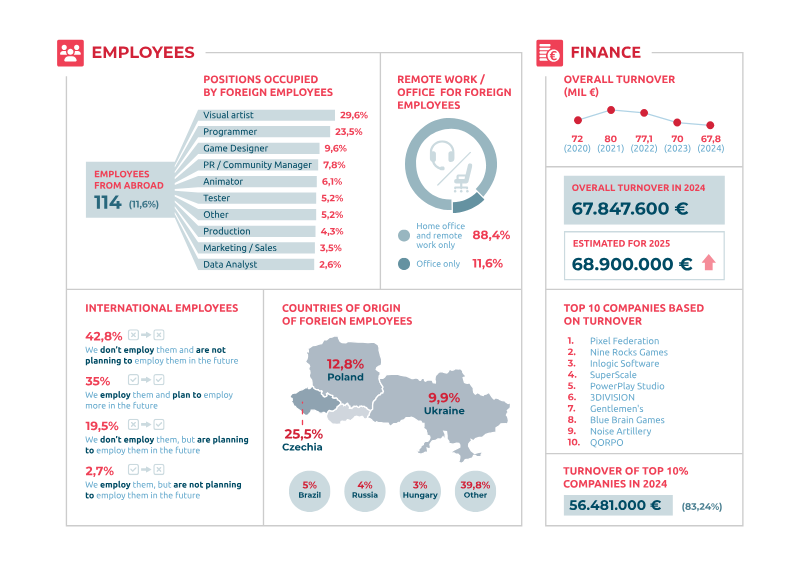
The Slovak game industry generated 67.8 million euros in total turnover in 2024, with high market concentration where the top 10% of companies account for over 83% of total revenue.
Slovak Game Developers Association, 2024 · Slovak Game Industry Infographic 2024, p. 1
The workforce is highly internationalized, with foreign nationals—primarily from Slovakia, Ukraine, and the EU—making up 31 percent of total employees.
Asociace českých herních vývojářů, 2022 · Herní průmysl ČR: 2022, p. 4
The Slovak game development industry grew to 83.2 million EUR in total turnover in 2022, a significant increase from 24.1 million EUR in 2016.
Slovak Game Developers Association, 2022 · Slovak Game Development Industry 2022, p. 4
The Slovak game industry generated EUR 84.7 million in annual turnover in 2021, with 86 percent of that revenue concentrated within the top 10 percent of the 63 active companies.
Slovak Game Developers Association, 2021 · Slovak Game Industry: 2021 Statistics, p. 1
The Slovak game industry generated a total turnover of approximately €84.7 million in 2021, supported by a diverse ecosystem ranging from small independent teams to large studios.
Slovak Game Developers Association, 2021 · Slovak Game Industry: 2021, p. 4
Documents
Czech Gaming Industry: 2022
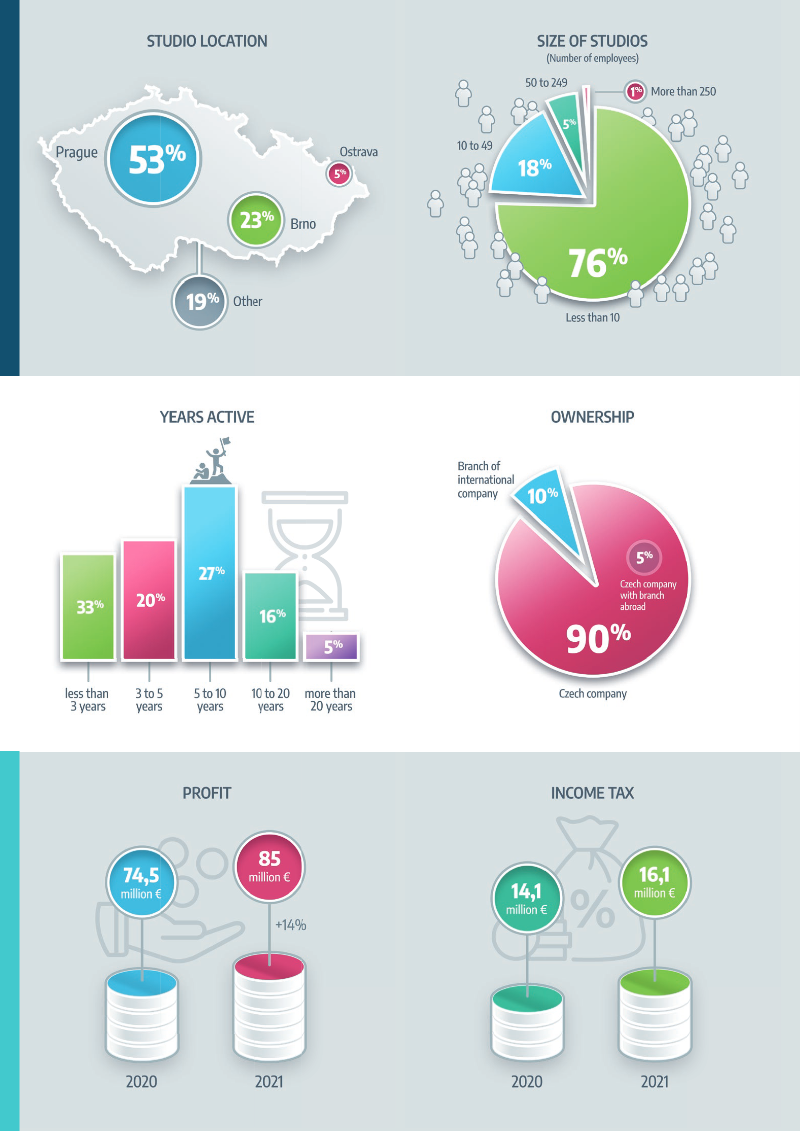
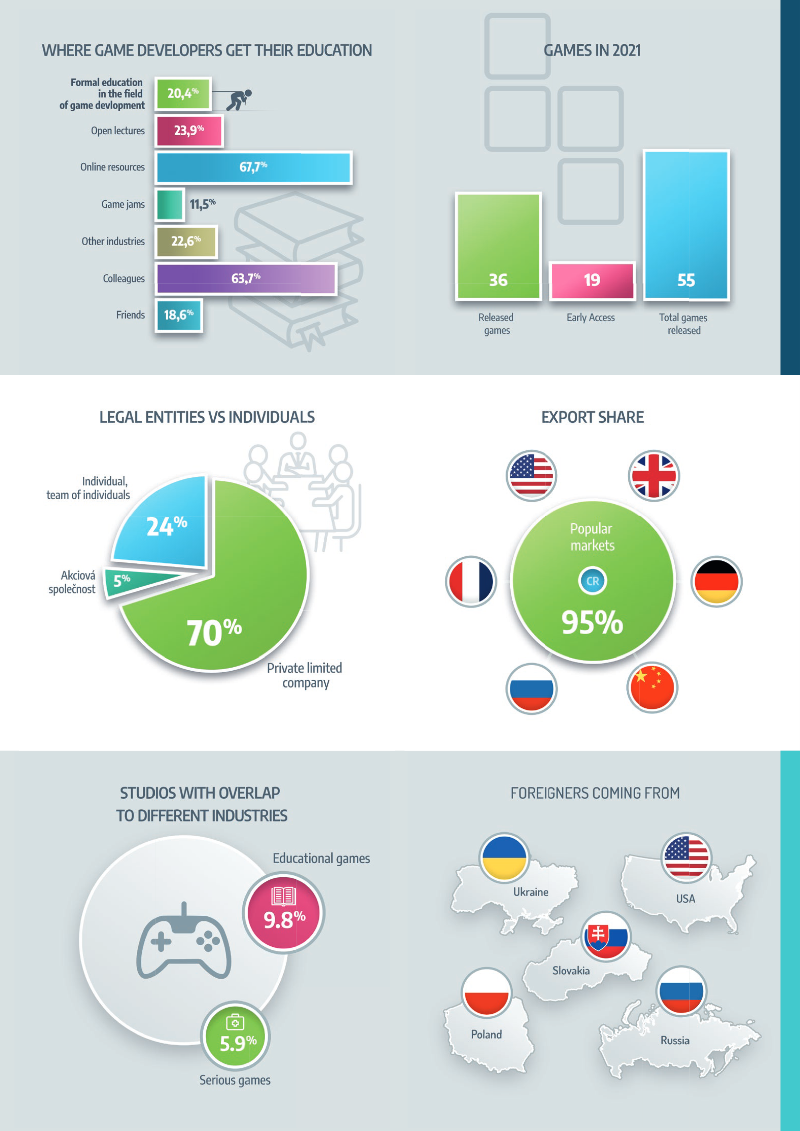
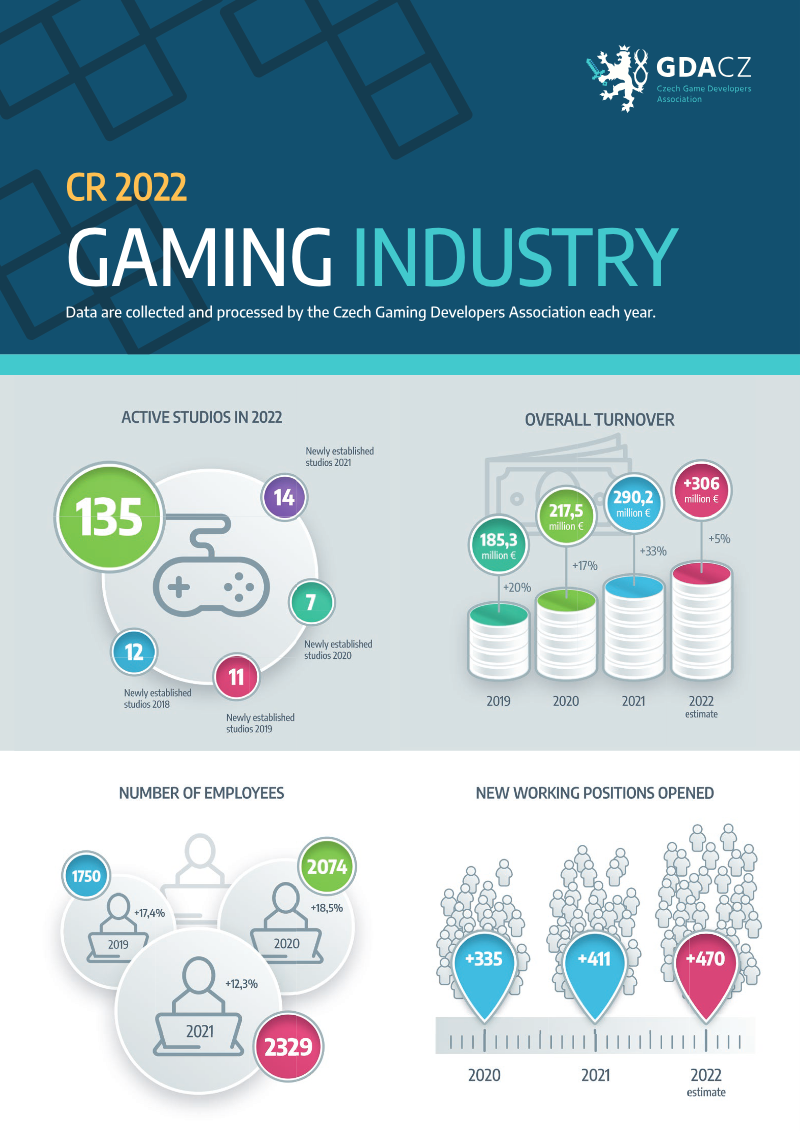
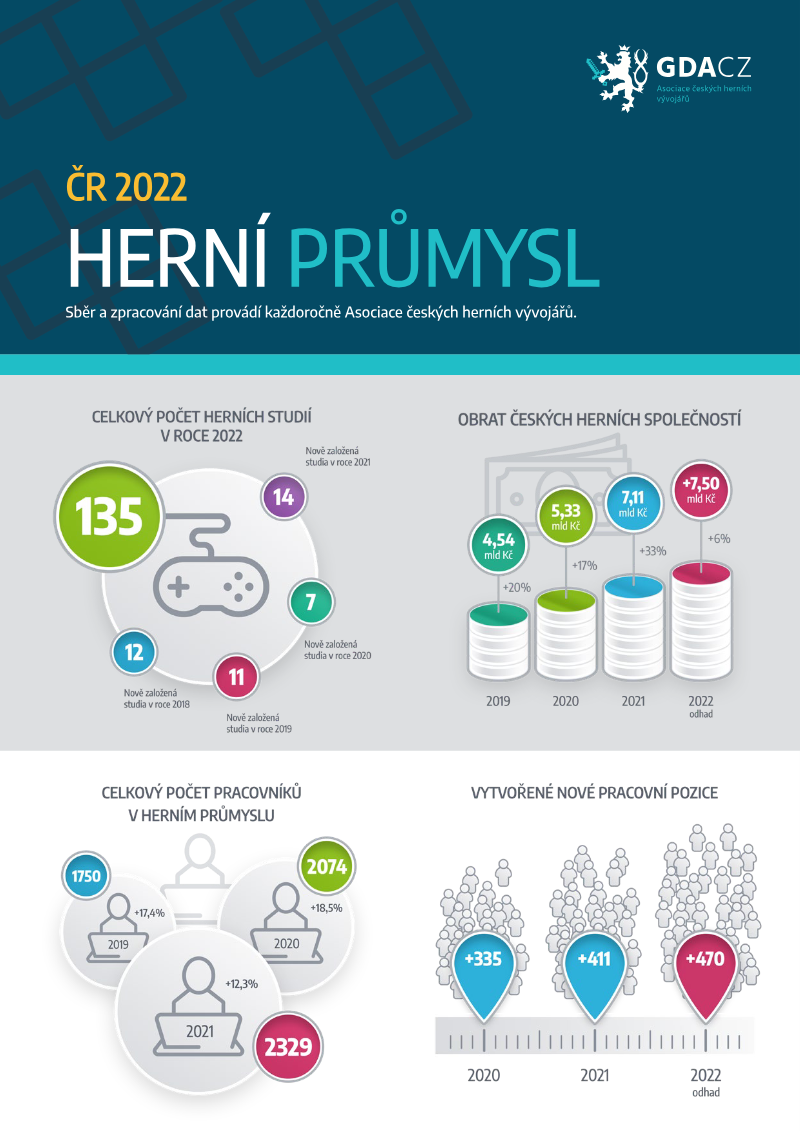
The Czech gaming industry demonstrated robust growth in 2022, characterized by a significant increase in total turnover and workforce expansion.
- The Czech gaming industry generated 290.2 million euros in revenue in 2022, marking a 33 percent year-over-year increase.
- The sector expanded to 135 active studios and 2,329 total employees, representing a 12.3 percent growth in the workforce with 470 new positions created.
- The industry is highly export-oriented, with 95 percent of its total revenue derived from international markets.
Slovak Game Industry Infographic 2024
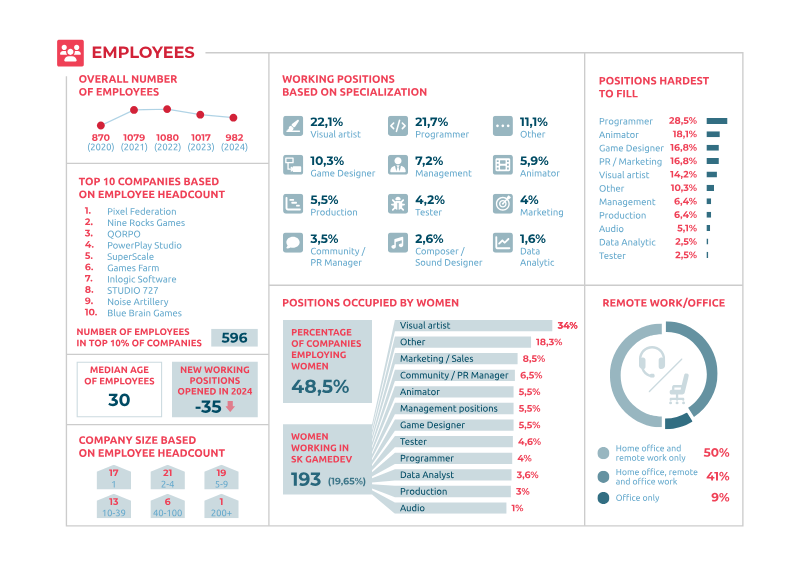
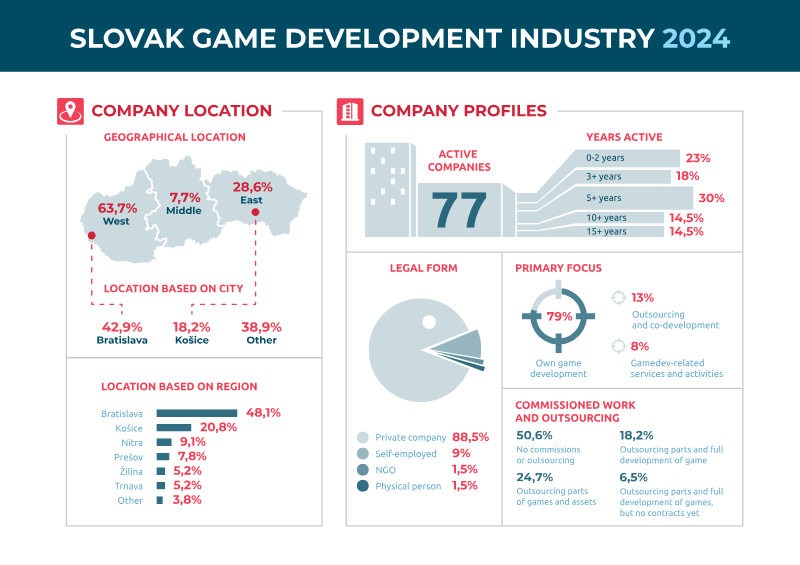
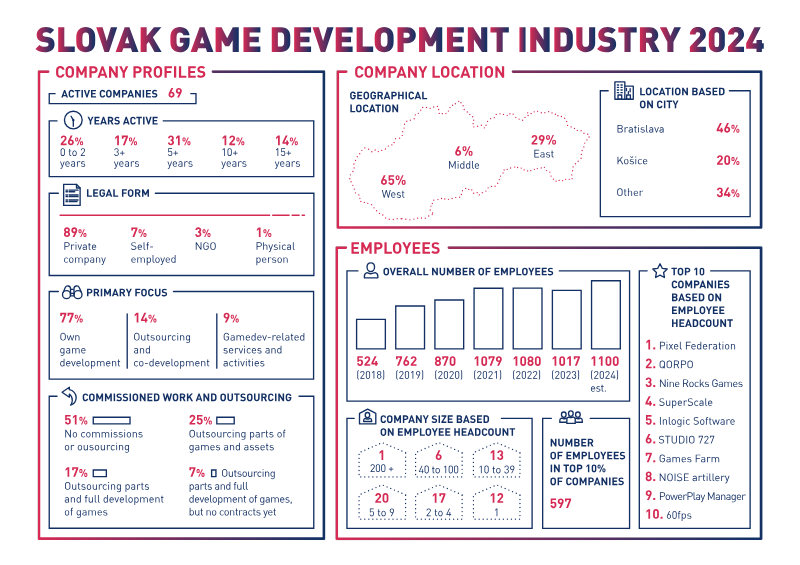
The 2024 Slovak Game Industry report provides a comprehensive overview of the nation’s game development sector, detailing its economic performance, workforce composition, and operational landscape as of December 31, 2024.
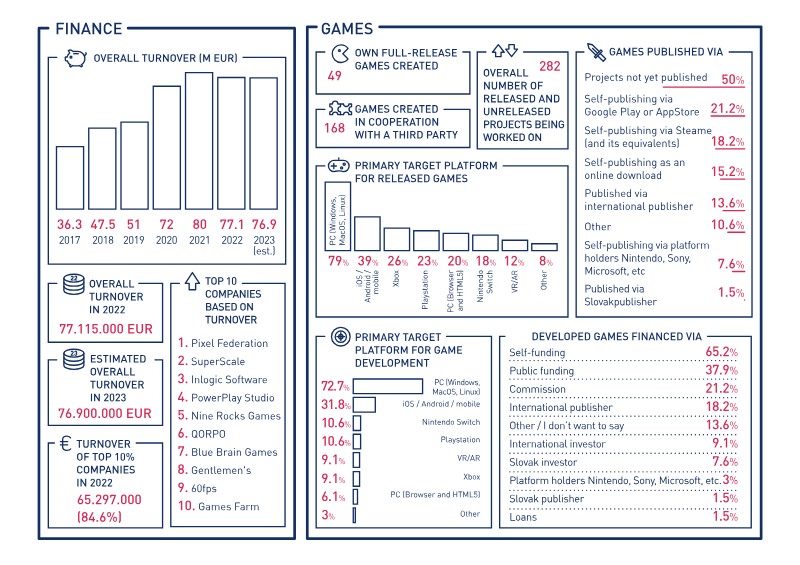
- The Slovak game industry generated 67.8 million euros in total turnover in 2024, with high market concentration where the top 10% of companies account for over 83% of total revenue.
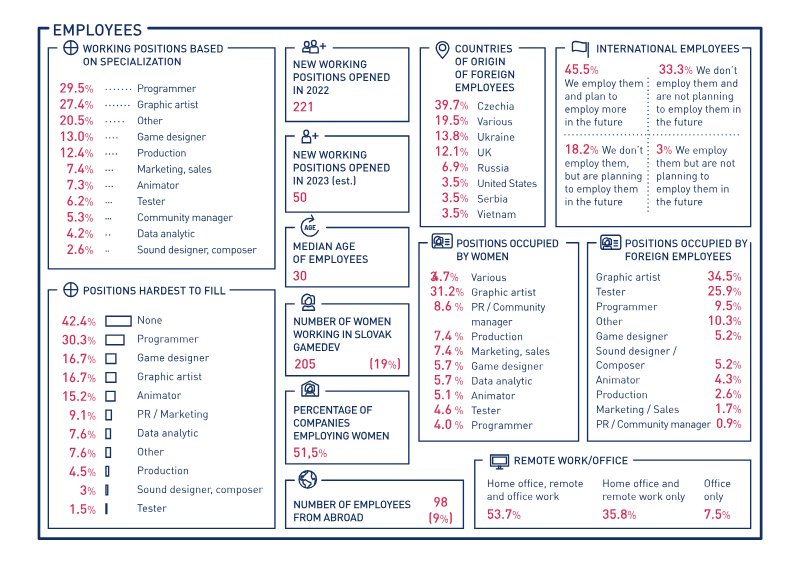
- The sector employs 982 professionals with a median age of 30–35, and while male-dominated, women comprise nearly 20% of the workforce, primarily in visual arts and marketing.
- Self-funding is the primary financial model for 80.5% of companies, indicating a reliance on internal capital over public funding or international publishing deals.
Company Profiles: Slovakia 2024
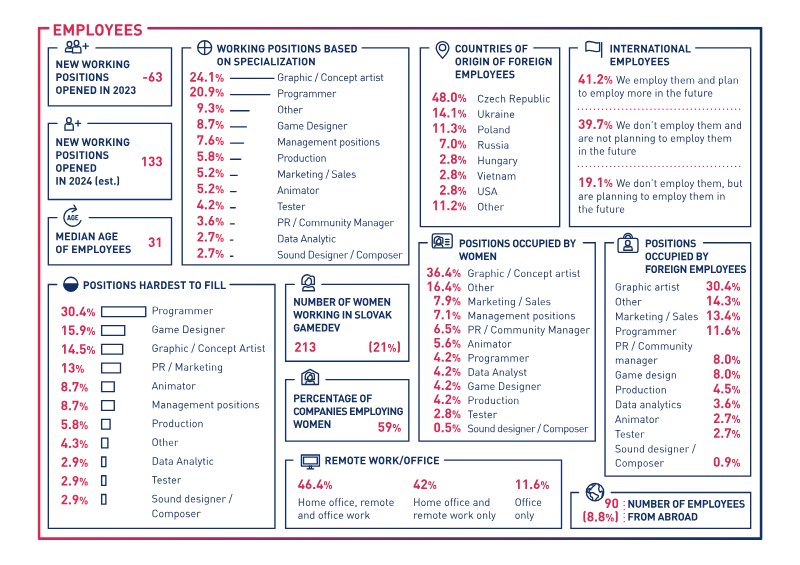
The Slovak game development industry in 2024 is characterized by a stable ecosystem of 69 active companies, primarily concentrated in the western region of the country, particularly Bratislava.
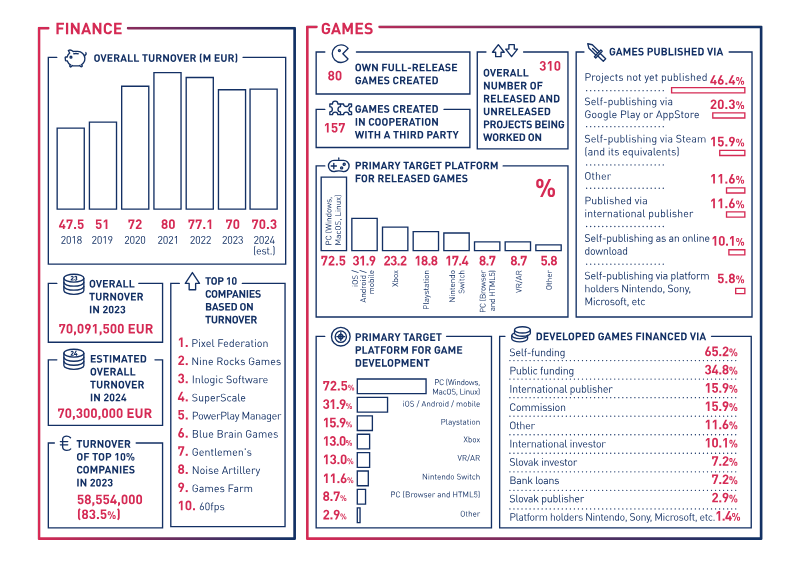
- The Slovak game industry is highly concentrated, with the top 10% of companies—including Pixel Federation and Nine Rocks Games—generating 83.5% of the sector's 70 million EUR annual turnover.
- The industry consists of 69 active companies, 77% of which focus on original game development rather than outsourcing services.
- After a slight contraction in 2023, the workforce is projected to reach approximately 1,100 employees by the end of 2024, with a median age of 31 and 21% female representation.
Slovak Game Development Industry 2023
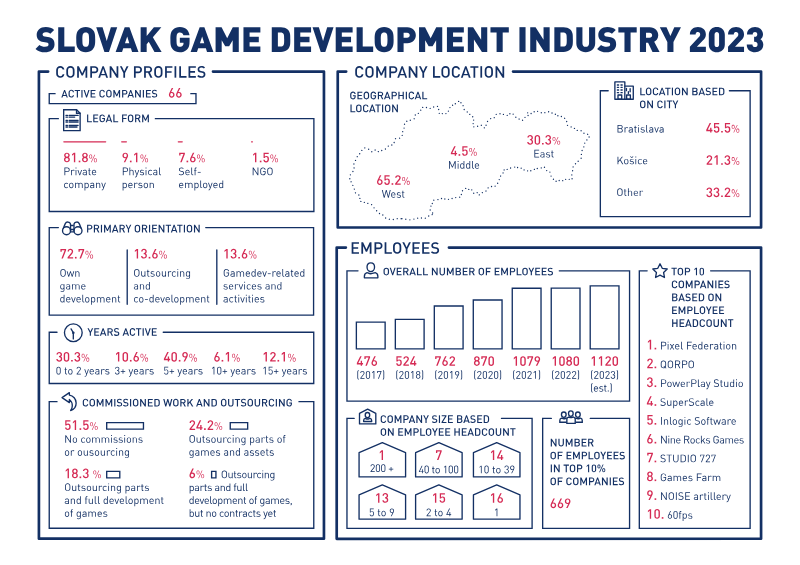
The Slovak game development industry in 2023 is characterized by a stable ecosystem of 66 active companies, primarily concentrated in the western region of the country.
- The Slovak game industry is highly centralized, with the top 10% of companies accounting for 60% of the 1,120-person workforce and 84.6% of the total annual turnover.
- Industry revenue has plateaued, with turnover reaching €77.1 million in 2022 and an estimated €76.9 million in 2023.
- Pixel Federation, SuperScale, and Inlogic Software are the dominant market leaders in both headcount and revenue.
Herní průmysl ČR: 2022
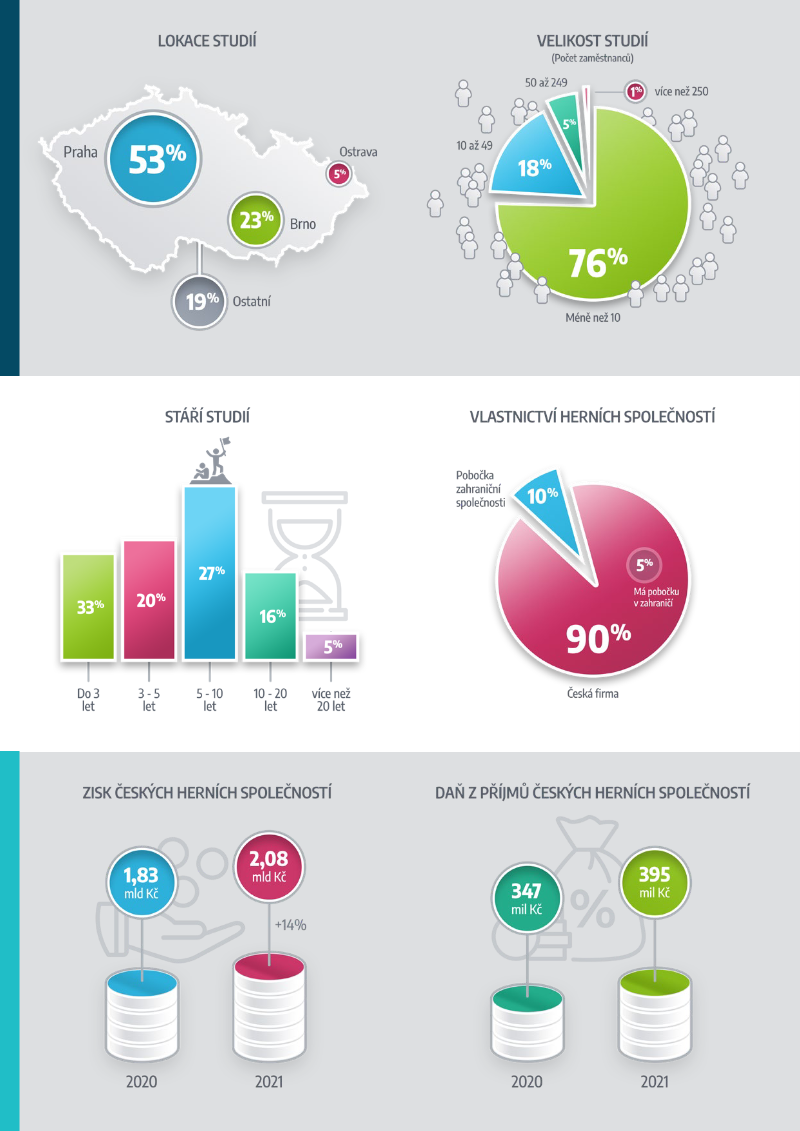
The Czech game development industry demonstrated robust growth and structural maturity throughout 2022, characterized by a steady expansion of the studio ecosystem and significant financial performance.
- The Czech game industry generated 2.08 billion CZK in total revenue in 2022, representing a 14 percent increase over previous periods.
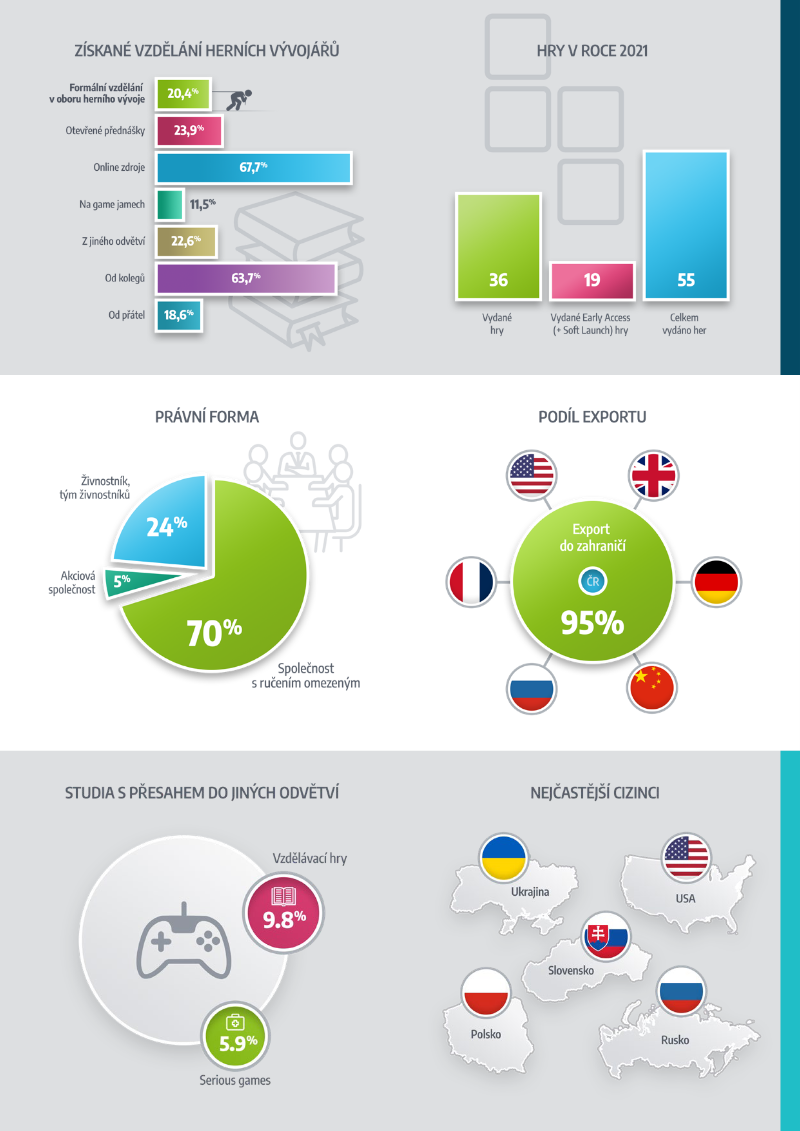
- The sector is highly export-oriented, with 95 percent of the 135 active studios generating revenue from international markets.
- The industry is dominated by small-to-medium enterprises, as 76 percent of studios employ fewer than 10 people.
Slovak Game Development Industry 2022
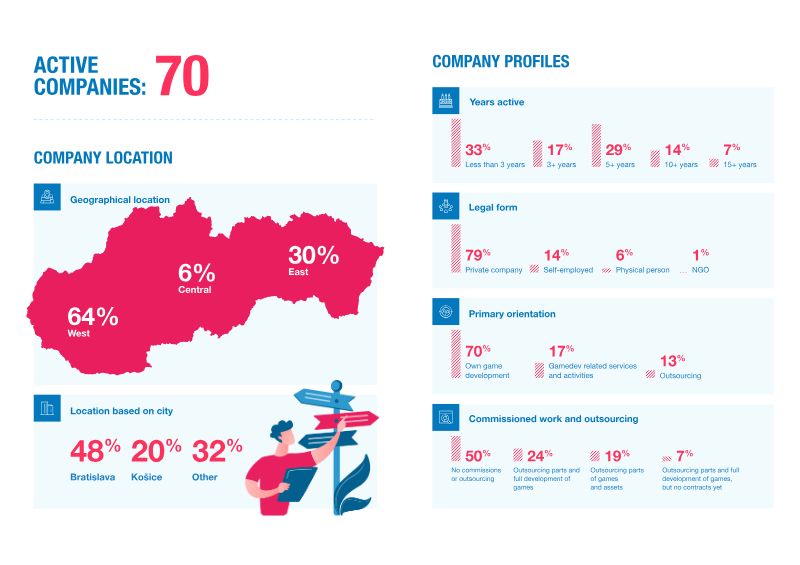
The Slovak game development industry experienced significant growth through 2022, characterized by a robust expansion in both workforce size and total financial turnover.
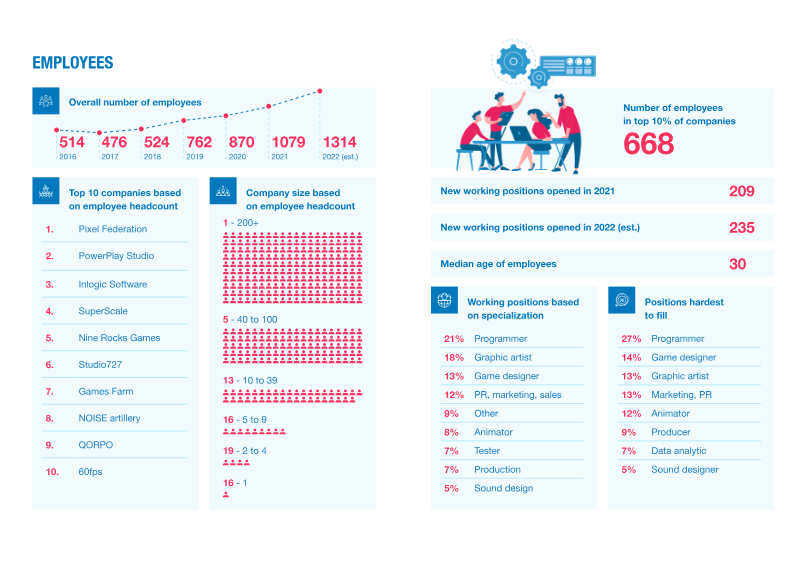
- The Slovak game development industry grew to 83.2 million EUR in total turnover in 2022, a significant increase from 24.1 million EUR in 2016.
- The workforce expanded to 1,314 professionals by the end of 2022, more than doubling the 514 employees recorded in 2016.
- The sector is highly concentrated, with 70 active companies primarily based in the western region, where 64% of the industry is located in Bratislava.

Slovak Game Industry Report 2022
The Slovak game industry demonstrated significant resilience and expansion throughout 2022, successfully navigating global economic volatility and shifting market landscapes.
- The Slovak game industry experienced significant growth in 2021, both in terms of developers and revenue, despite global challenges like the COVID-19 pandemic and the post-IDFA period.
- The top 10% of Slovak game companies generated EUR 69.4 million in turnover in 2021.
- Foreign employees constitute 7% (79 individuals) of the Slovak game industry workforce, with Czechia (16%), Ukraine (12%), and the USA (9%) being the primary countries of origin.
Slovak Game Industry: 2021 Statistics
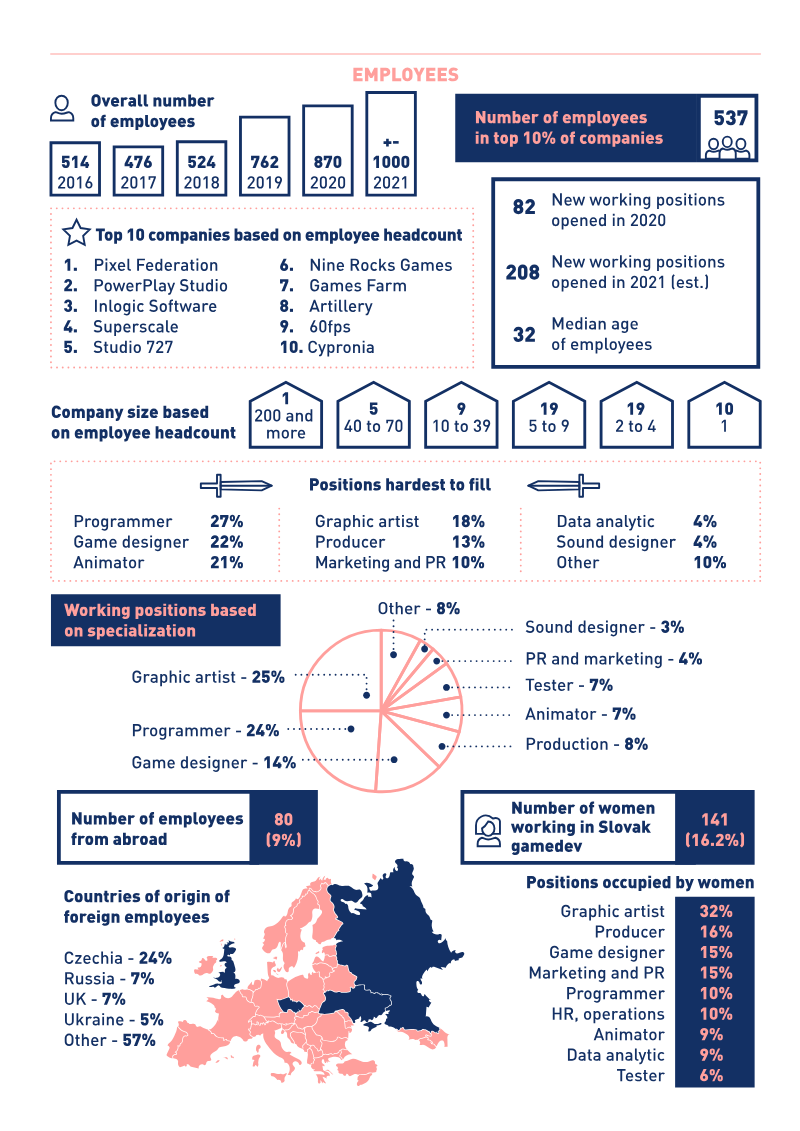
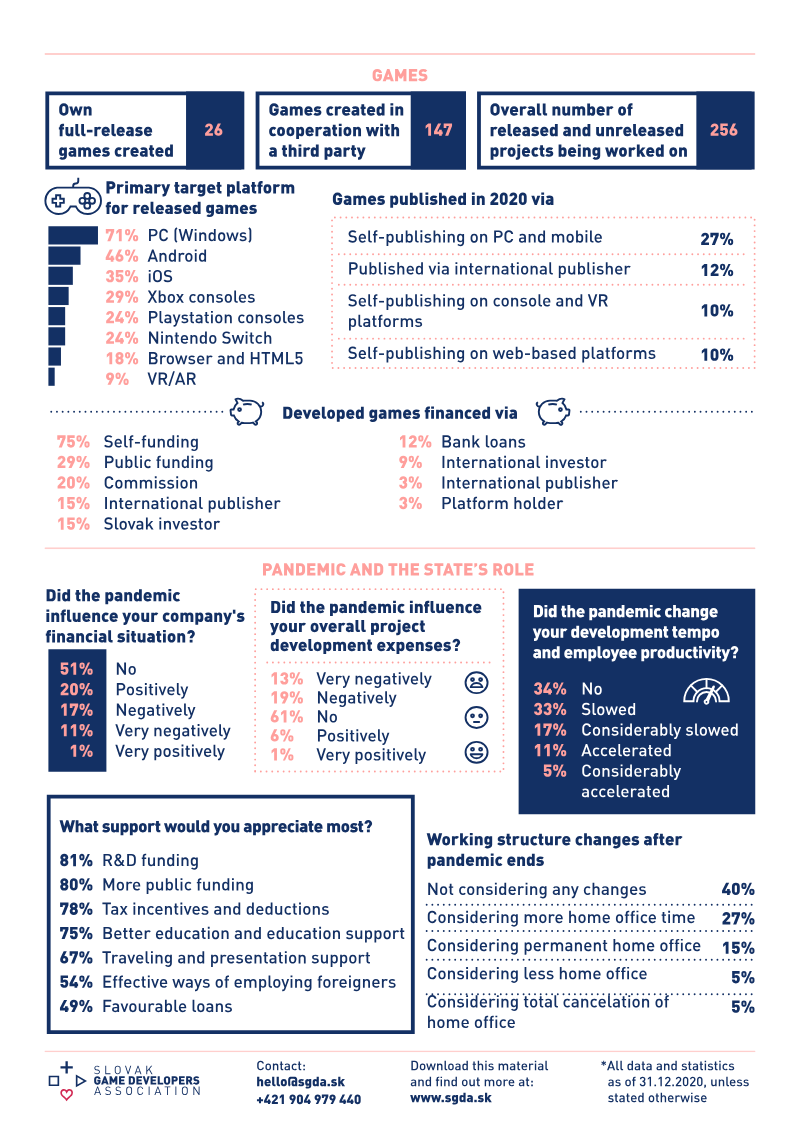
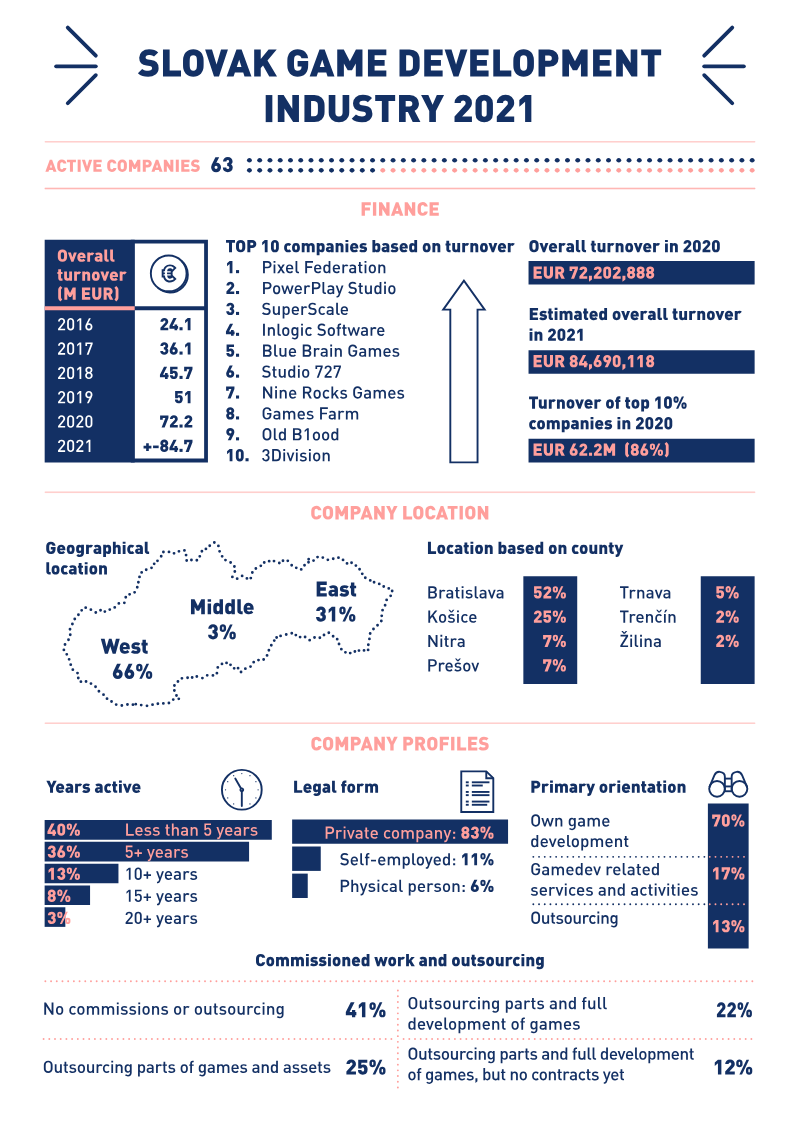
The Slovak game industry demonstrated robust growth throughout 2021, characterized by a steady increase in both financial turnover and workforce expansion.
- The Slovak game industry generated EUR 84.7 million in annual turnover in 2021, with 86 percent of that revenue concentrated within the top 10 percent of the 63 active companies.
- Industry employment reached 1,000 professionals by 2021, characterized by a young median age of 32 and a 9 percent reliance on international talent.
- Original intellectual property is the primary business model, with 70 percent of firms prioritizing their own game development over outsourcing or commissioned work.
Slovak Game Industry: 2021
The Slovak game industry demonstrated significant economic resilience and expansion throughout 2021, achieving a total turnover of approximately €84.7 million.
- The Slovak game industry generated a total turnover of approximately €84.7 million in 2021, supported by a diverse ecosystem ranging from small independent teams to large studios.
- Since 2017, the Slovak Arts Council has distributed over €2.2 million to more than 210 applicants to foster industry innovation.
- In 2021, the Slovak Arts Council allocated €400,000 to support 21 individual projects, covering up to 95% of costs for smaller studios.
Slovak Game Industry Infographic
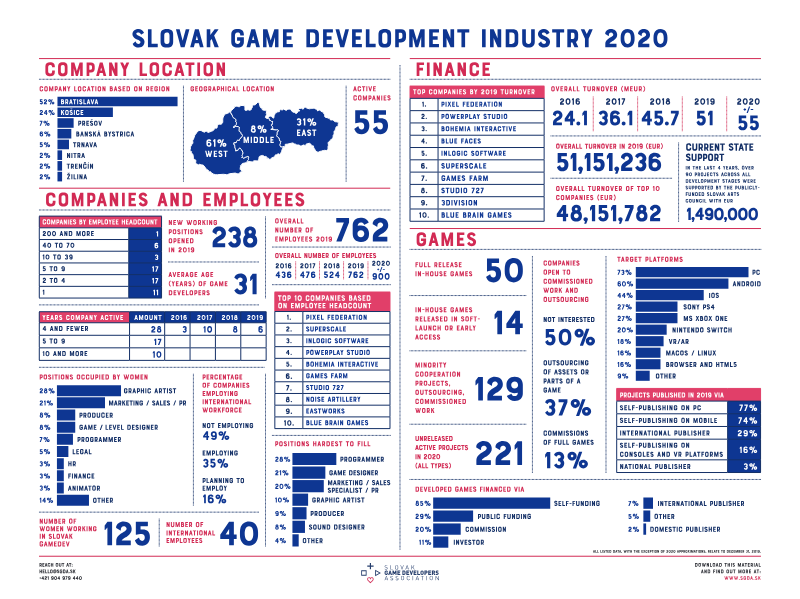
The Slovak game industry demonstrates consistent growth and professional maturation, characterized by a robust increase in both turnover and workforce capacity.
- The Slovak game industry experienced significant workforce expansion between 2016 and 2019, growing from 436 to 762 employees.
- The top ten companies in the sector generated over 48 million euros in annual turnover as of 2019.
- The industry is geographically concentrated, with 52 percent of the 55 active companies based in Bratislava and 24 percent in Košice.
Slovak Game Industry Annual Report 2020/2021
The Slovak game industry represents a resilient and rapidly maturing sector, characterized by a robust ecosystem of independent studios that generated approximately €51 million in turnover during the 2019 fiscal period.
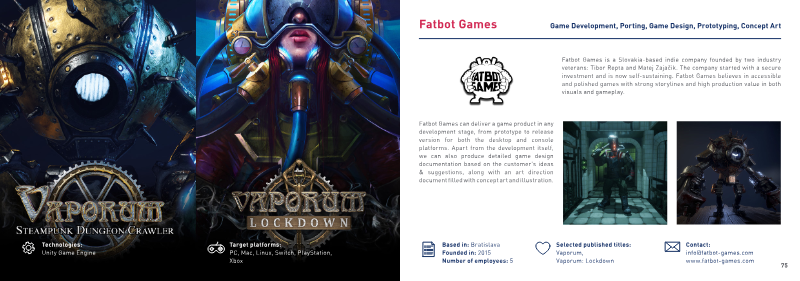
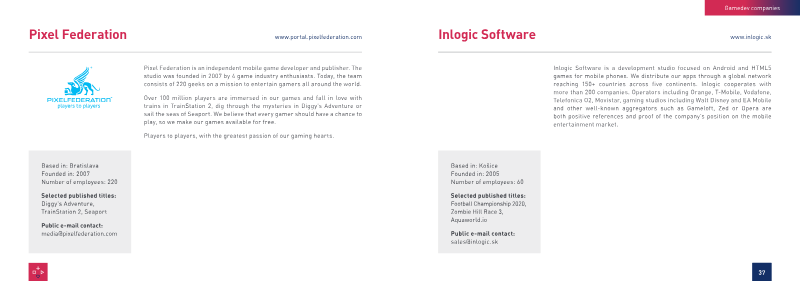
- Slovak game development includes studios like Tater Games (founded 2019, 7 employees, released Nunu Spirits, Cyber Forge), Atomic Realm (founded 2019, 4 employees, released Magnet Run, developing Squabble), and Fatbot Games (founded 2015, 6 employees, released Vaporum).
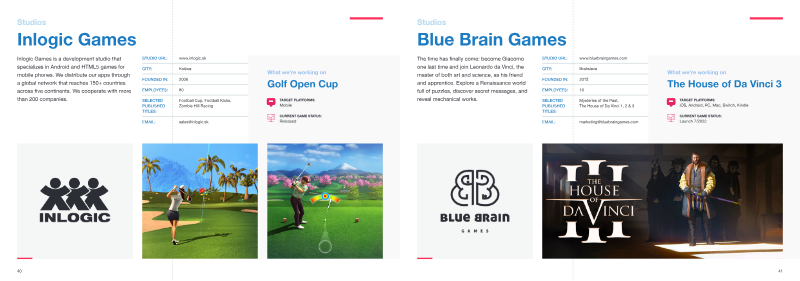
- Larger studios include Pixel Federation (founded 2007, 220 employees, titles like Diggy's Adventure, TrainStation 2) and Inlogic (founded 2005, 60 employees, titles like Football Championship 2020, Zombie Hill Race 3).
- Several studios focus on specific niches: Incidental Minds (founded 2018, 6 employees) develops 2D illustrated story-driven and strategic games, while Neutraworks (founded 2018, 6 employees) is an independent studio.
Slovak Game Industry 2019
The Slovak game industry experienced a period of robust expansion in 2019, characterized by a growing professional workforce of 682 individuals and total annual revenues reaching €56.6 million.
- The Slovak game development industry is growing, with increasing numbers of studios, profits, project quality, and employed professionals.
- Self-funding is the primary source of funding for Slovak game companies (81%), followed by public funding (35%) and investors (22%).
- 42% of Slovak game studios self-publish their games, while 42% use a publisher (11% foreign, 8% Slovak) and 16% are publisher holders.