GDACZ – Czech Game Developers Association
Association3 documents
Documents
Article
Czech Games Industry Study
The Czech Games Industry Study serves as a comprehensive assessment of the economic impact, structural composition, and developmental challenges facing the Czech game development sector. By monitoring industry performance, the study aims to advocate for systemic improvements in government support, education, and international labor mobility. The analysis highlights that while the industry is a significant cultural and economic force—generating revenue that exceeds the domestic film industry—it requires targeted policy interventions to sustain long-term growth and global competitiveness.
Key findings indicate a resilient but fluctuating market. After a record-breaking 2021, industry turnover declined by 22% in 2022 to CZK 5.57 billion, remaining stagnant through 2023. However, projections for 2024 suggest a recovery with anticipated growth of approximately 17%, targeting a turnover of CZK 6.5 billion. The sector is highly export-oriented, with 98% of total revenue derived from international markets. The industry comprises roughly 170 studios, primarily concentrated in Prague (52%) and Brno (20%), and is characterized by strong domestic ownership, with foreign-owned branches representing only 7% of the market.
Employment remains a critical bottleneck, with the industry employing approximately 2,765 people as of 2023. Despite creating over 400 jobs annually, more than 60% of companies report a shortage of qualified labor. The current educational landscape is insufficient to meet this demand, forcing studios to rely on international recruitment, with foreign nationals accounting for 36% of the workforce. To address these gaps, the industry calls for enhanced government support regarding visa accessibility, specialized academic programs, and direct investment initiatives to ensure the sector remains a viable and growing pillar of the national digital economy.
- The Czech game industry is a major economic force that generates more revenue than the domestic film industry, with 98% of its income derived from international exports.
- After a 22% decline in 2022 to CZK 5.57 billion, the industry remained stagnant in 2023 but is projected to recover in 2024 with 17% growth to reach CZK 6.5 billion.
- The sector faces a critical labor shortage, with over 60% of the 170 studios reporting difficulty finding qualified staff to fill roles for the 2,765-person workforce.
- The industry relies heavily on international talent to bridge the educational gap, with foreign nationals currently making up 36% of all employees.
- The market is characterized by strong domestic ownership, with only 7% of the 170 studios operating as foreign-owned branches.
+2
GDACZ – Czech Game Developers Association
Report4 pages
Czech Gaming Industry Report 2024
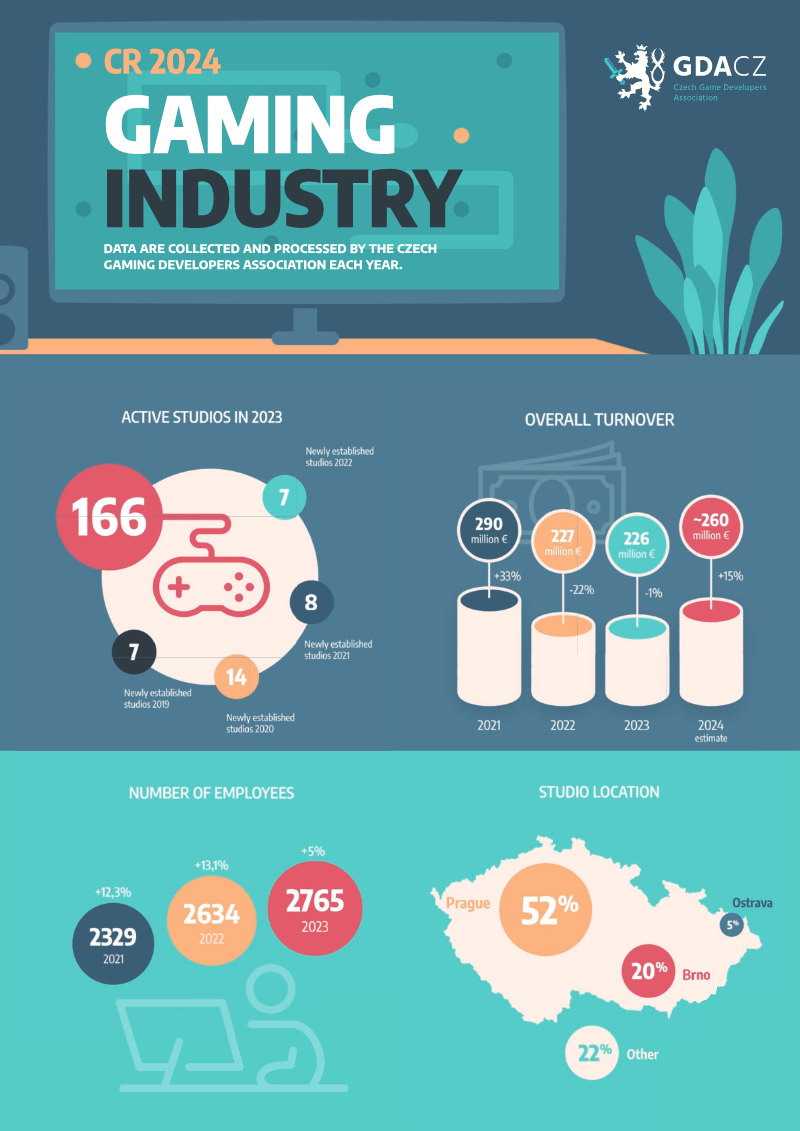
The Czech Gaming Developers Association compiled an annual industry overview to map the sector’s economic performance, workforce composition and structural trends for 2023 and early 2024. By aggregating self‑reported financial and employment data from member studios, the analysis aims to illustrate growth trajectories, geographic concentration and the evolving profile of talent within the Czech game development ecosystem.
Overall turnover reached €226 million in 2023, marking a 33 % increase over the previous year, while the number of active studios rose modestly, with newly established entities numbering 166 in 2023 compared with 260 in 2022. Employment expanded to roughly 4,165 staff, a 12.3 % rise, with the majority concentrated in Prague (52 %), followed by Ostrava (13 %) and Brno (20 %). The sector released 29 new titles in 2023, supplemented by 10 early‑access projects and 10 DLCs, for a total of 39 releases.
Ownership structures remain dominated by private limited companies, accounting for the bulk of legal entities, while joint‑stock and foreign‑branch configurations each represent about 5 % of the market. Job creation accelerated, with over 430 new positions announced across the year, a 20‑23 % increase relative to prior periods. The workforce is increasingly international: 34 % of employees are foreign nationals, predominantly from EU member states, while 66 % are Czech. Educational backgrounds are diverse, with roughly half holding higher‑education degrees and a similar share possessing vocational or technical qualifications. The report’s methodology relies on annual surveys administered by the association, covering all registered Czech game development firms and providing a comprehensive snapshot of the industry’s health and direction.
- The Czech gaming industry reached a total turnover of €226 million in 2023, representing a 33% year-over-year growth.
- Total employment in the sector grew by 12.3% to 4,165 staff, with over 430 new positions created throughout 2023.
- The industry released 39 total projects in 2023, consisting of 29 new titles, 10 early-access projects, and 10 DLCs.
- The workforce is increasingly international, with foreign nationals—primarily from EU member states—comprising 34% of all employees.
- Geographic concentration remains high, with 52% of the workforce based in Prague, followed by 20% in Brno and 13% in Ostrava.
GDACZ – Czech Game Developers AssociationJan 2024
Report45 pages
Czech Video Game PC, Console and Mobile Game Developers in Czech Republic 2020
The study maps the structure and dynamics of the Czech video‑game industry as of 2020, highlighting its rapid export‑driven expansion and the strategic challenges it faces in talent development and public support. The sector comprises roughly 110 domestic development studios, of which only a small fraction are foreign branches, employing about 1,750 specialists. Turnover rose from CZK 2.26 billion in 2017 to over CZK 5 billion in 2020, equivalent to more than €190 million, reflecting an average annual growth rate of 29 % over the previous five years and an export share near 95 % to markets such as the United States, Germany and the United Kingdom. Revenue in 2019 already surpassed €169 million, outpacing the national film industry by a factor of three, and the market is projected to exceed €190 million in 2020.
The analysis of the publishing and distribution landscape shows a shift away from traditional full‑development financing toward a model where publishers act mainly as marketing and launch partners, while online platforms now dominate the transaction chain, reducing costs and marginalising physical distributors, of which only ten remain active in the country. Consumer data reveal an average gamer age of 33, a gender split of one‑third women, and annual spending of roughly CZK 4 billion, with a strong preference for story‑driven titles.
Human‑capital constraints emerge as a critical bottleneck: the industry confronts intense competition for skilled staff, a fragmented education pipeline, and limited visibility of creative industries within public policy. Unlike neighboring Poland and Germany, which allocate substantial public funds to game‑industry support, the Czech Republic offers virtually no dedicated subsidies for research, development or innovation, despite the sector’s outsized contribution to national exports. The findings suggest that sustained growth will depend on coordinated investment in education, clearer industry‑government linkages, and targeted public financing to bolster the sector’s competitive edge.
- The Czech video game industry experienced rapid growth between 2017 and 2020, with annual turnover rising from CZK 2.26 billion to over CZK 5 billion, representing a 29% average annual growth rate.
- The sector is highly export-oriented, with approximately 95% of revenue generated from international markets, primarily the United States, Germany, and the United Kingdom.
- As of 2020, the industry comprised roughly 110 domestic studios employing 1,750 specialists, with revenue already tripling that of the national film industry by 2019.
- The publishing landscape has shifted away from traditional full-development financing toward a model where publishers primarily handle marketing and launch, while online platforms have marginalized physical distribution.
- Human capital remains a critical bottleneck due to a fragmented education pipeline and intense competition for skilled talent, compounded by a lack of dedicated public subsidies for research and development compared to neighboring countries.
+2
GDACZ – Czech Game Developers AssociationJan 2020