Mergers Acquisitions
Documents
Q1‑Q3 2020: Recap of the Investment Activity in the Video Game Market
The first three quarters of 2020 saw the global gaming industry navigate significant volatility caused by the COVID-19 pandemic, ultimately demonstrating strong resilience and a rapid recovery in deal activity. While private investments dropped sharply in May 2020, the market rebounded by July, closing 100 transactions worth approximately $2.78 billion. This investment activity was heavily concentrated at the later stages, with American companies like Epic Games, Roblox, and Scopely accounting for over 90% of total capital value. Conversely, early-stage venture capital remained more geographically diverse, with U.S. startups representing only 30% of those funds.
Mergers and acquisitions remained robust throughout the period, largely unaffected by macroeconomic instability. The mobile segment led in volume with 41 deals totaling $4.6 billion, while the PC and console segment reached $10.5 billion in value, driven primarily by Microsoft’s $7.5 billion acquisition of ZeniMax. Strategic buyers such as Tencent, Embracer Group, and Stillfront Group continued to consolidate the market. Public offerings followed a similar recovery arc; after a near-total halt in the first half of the year, the market reopened in June with significant IPOs from Asian companies and capital raises by Western firms to fund future acquisitions.
The landscape of financial backers was led by specialized venture funds like Makers Fund, Play Ventures, and BITKRAFT Ventures in terms of deal volume, while KKR and Andreessen Horowitz dominated in total value through large-scale, later-stage investments. Strategic activity was characterized by "mastodons" like Microsoft and Zynga, alongside aggressive consolidation efforts by European holding companies. Analysts expect continued momentum into 2021, driven by the need for content on subscription platforms and the scaling of major mobile publishers ahead of potential public listings.
- The gaming industry demonstrated strong resilience in 2020, with a July rebound leading to 100 transactions worth approximately $2.78 billion in private investment.
- M&A activity was significant, with the PC and console segment reaching $10.5 billion in value, largely driven by Microsoft’s $7.5 billion acquisition of ZeniMax.
- The mobile gaming segment led in deal volume with 41 transactions totaling $4.6 billion, supported by ongoing consolidation from strategic buyers like Tencent, Embracer Group, and Stillfront Group.
- Late-stage private investment was highly concentrated, with American companies such as Epic Games, Roblox, and Scopely accounting for over 90% of the total capital value.
- Early-stage venture capital remained geographically diverse, with U.S. startups representing only 30% of those specific funds.
Investment Activity Report Q1–Q3 2020
The report documents investment activity in the global gaming industry from January to September 2020, covering mobile, PC & console, multiplatform, VR/AR, cloud‑native and esports segments. Total deal value reached $27.5 billion across 1,000 transactions, with gaming deals accounting for the largest share ($15.3 billion in 211 contracts). Platform & tech deals contributed $4 billion, esports $685 million and other categories $504 million. Public offerings dominated the capital‑raising landscape, generating $9.2 billion from 51 IPOs and PIPEs, while M&A activity totaled $6.6 billion across 132 deals and private venture investments added $4.7 billion from 254 rounds.
Early‑stage VC activity fell sharply after the COVID‑19 outbreak in May, dropping to 5–7 deals per month, but later‑stage and corporate funding remained relatively stable at 1–2 deals monthly until July. The period saw $2.7 billion raised by developers and publishers, with 69 pre‑seed/seed/Series A rounds and 9 Series B+ deals. U.S. firms dominated later‑stage funding (over 90% of value), whereas only 30% of early‑stage capital went to U.S. startups. Three high‑profile transactions—Scopely ($200 m), Roblox ($150 m), and Epic Games ($1.78 b)—accounted for 78% of total capital inflows.
M&A activity remained resilient, with major deals such as Zynga’s acquisition of Peak Games ($2 billion) and Microsoft’s purchase of ZeniMax ($7.5 billion). Tencent, Zynga, and Microsoft were the top strategic acquirers, collectively exceeding $11 billion in announced deals. Public market activity stalled early in the year but rebounded in June with IPOs from Archosaur Games ($280 m) and Kakao Games ($330 m). The report highlights a shift toward mobile acquisitions, sustained corporate investment despite pandemic disruptions, and a growing trend of large‑scale consolidations in the gaming sector.
- The global gaming industry saw $27.5 billion in total deal value across 1,000 transactions during the first nine months of 2020, with gaming-specific deals accounting for $15.3 billion.
- M&A activity was defined by large-scale consolidation, led by Microsoft’s $7.5 billion acquisition of ZeniMax and Zynga’s $2 billion purchase of Peak Games, with Tencent, Zynga, and Microsoft collectively exceeding $11 billion in deal value.
- Public offerings were the primary driver of capital, generating $9.2 billion from 51 IPOs and PIPEs, while private venture investments contributed $4.7 billion across 254 rounds.
- Three high-profile transactions—Epic Games ($1.78 billion), Scopely ($200 million), and Roblox ($150 million)—accounted for 78% of total venture capital inflows.
- Early-stage venture capital activity experienced a sharp decline following the May 2020 COVID-19 outbreak, dropping to 5–7 deals per month, while later-stage and corporate funding remained more resilient.

InvestGame Deals Report 2020 – Game M&A
The 2020 Game M&A landscape reached a record $33.6 billion in transaction value across 664 deals, with public offerings contributing 45% of the volume and $15.1 billion in 2020 alone, while M&A activity totaled $12.6 billion (potentially $22.2 billion when including recent mega‑deals). The United States dominated the market, accounting for 36% of deal value and hosting four of the top‑10 transactions. Tencent, Embracer, Stillfront, and Zynga were the leading acquirers, together representing 60% of total value. Swedish firms, particularly Embracer and Stillfront, led a domestic acquisition boom that captured 31% of all announced gaming M&A deals.
Investment trends reflected the low‑interest‑rate environment and robust public‑market valuations. Venture capital and corporate funding surged to $5.9 billion, with 363 private deals (55% of transactions) and a pronounced late‑stage focus on multiplatform, mobile, and PC/console titles. Early‑stage VC funding reached $333 million across 82 deals, while late‑stage rounds were concentrated in a handful of large transactions. IPO activity rose to 18 deals ($2.8 billion), led by Asian firms such as Kakao Games and Archosaur, and public PIPE funding exceeded $95 million in the Esports & Other segment.
The Esports & Other sector saw 37 M&A deals totaling $500 million, with control‑type acquisitions dominating (35 of 37). Majority stake takeovers were common, and the segment attracted significant public PIPE funding. Two hardware firms—NACON and Corsair Gaming—raised $350 million through IPOs, while Skillz leveraged a SPAC to achieve a $9 billion market cap. These findings underscore a 2020 environment of heightened M&A activity, concentrated investment in key geographic hubs, and a strategic shift toward multiplatform and esports opportunities.
- The 2020 gaming market hit a record $33.6 billion in total transaction value across 664 deals, driven by $15.1 billion in public offerings and $12.6 billion in M&A activity.
- Tencent, Embracer, Stillfront, and Zynga emerged as the dominant market forces, collectively accounting for 60% of the total M&A value.
- The United States led the global market by capturing 36% of total deal value and hosting four of the year's top-10 largest transactions.
- Swedish firms, specifically Embracer and Stillfront, drove a domestic acquisition boom that accounted for 31% of all announced gaming M&A deals.
- Venture capital and corporate funding reached $5.9 billion across 363 private deals, with a clear strategic focus on late-stage investments in multiplatform, mobile, and PC/console titles.
Game Developer Index: Sweden 2020
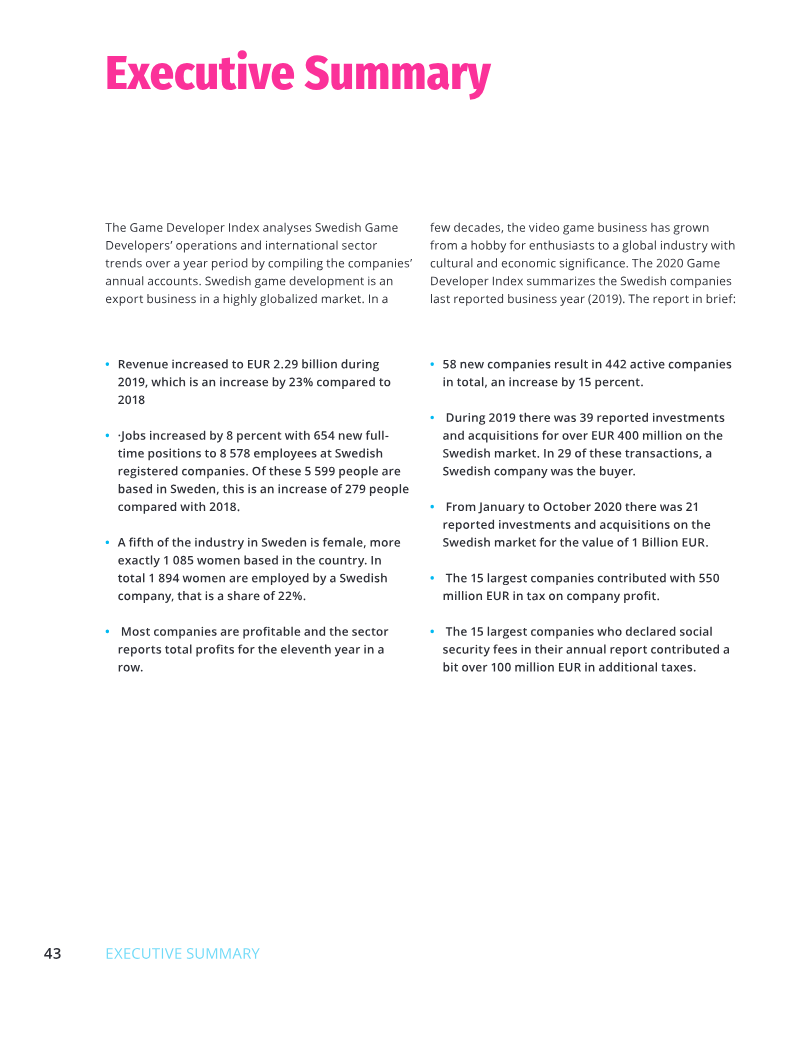
The Swedish game development industry demonstrates robust economic expansion and sustained profitability, functioning as a highly globalized export sector. By analyzing annual accounts from Swedish-registered companies, the industry reports a significant revenue increase to EUR 2.29 billion in 2019, representing a 23 percent growth over the previous year. This marks the eleventh consecutive year of total sector profitability, supported by a 15 percent increase in the number of active companies, which reached 442 by the end of 2019.
Employment trends reflect this upward trajectory, with the workforce growing by 8 percent to a total of 8,578 full-time positions. Of these, 5,599 employees are based within Sweden. While the industry continues to scale, gender diversity remains a focal point, with women comprising 22 percent of the total workforce. The sector’s economic impact extends to significant tax contributions, as the 15 largest companies alone provided EUR 550 million in corporate profit taxes and over EUR 100 million in additional social security fees.
Investment activity highlights the industry's maturity and attractiveness to capital. During 2019, the market saw 39 transactions involving investments and acquisitions totaling over EUR 400 million, with Swedish firms acting as the primary buyer in the majority of cases. This momentum accelerated into 2020, with 21 transactions recorded between January and October valued at EUR 1 billion. Despite these successes, the industry identifies ongoing challenges, particularly regarding the access to specialized talent and the navigation of complex digital market regulations. Future growth is expected to rely on regional clusters, incubators, and a continued commitment to increasing workforce diversity to maintain global competitiveness.
- The Swedish game industry generated EUR 2.29 billion in revenue in 2019, marking a 23 percent year-over-year increase and the eleventh consecutive year of sector-wide profitability.
- Investment activity surged significantly, with 39 transactions totaling over EUR 400 million in 2019, followed by 21 transactions valued at EUR 1 billion between January and October 2020.
- The industry workforce grew to 8,578 full-time positions by the end of 2019, with 5,599 of those employees based in Sweden and women representing 22 percent of the total headcount.
- The sector’s 15 largest companies contributed EUR 550 million in corporate profit taxes and over EUR 100 million in social security fees during 2019.
- The number of active game development companies in Sweden reached 442 by the end of 2019, representing a 15 percent increase from the previous year.
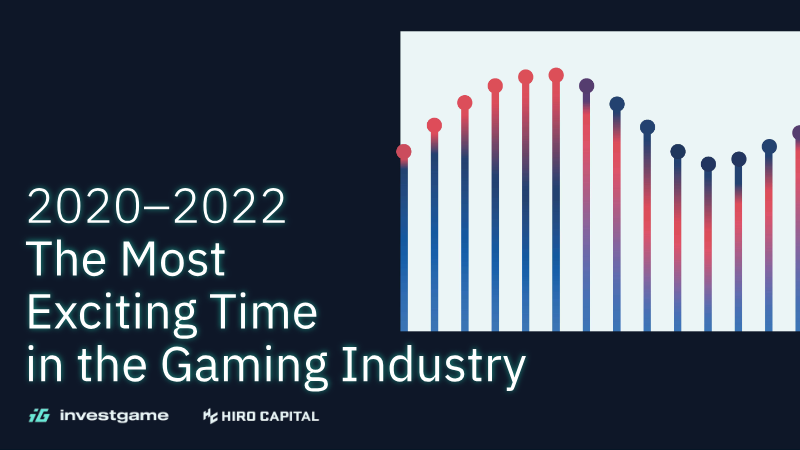
2020–2022: The Most Exciting Time in the Gaming Industry
This analysis examines global investment and merger and acquisition (M&A) activity within the video game industry from 2020 through 2022. The primary thesis posits that the industry has passed a historic peak of deal-making and is now entering a "Great Reset" characterized by market cooling, lower valuations, and a shift in investor priorities. While the era of massive public offerings and late-stage venture capital (VC) surges has slowed due to macroeconomic headwinds like inflation and rising interest rates, the industry remains fundamentally strong with significant "dry powder" available for early-stage startups and strategic consolidations.
The data reveals a volatile three-year cycle. M&A activity reached a zenith in 2022 with $37.7 billion in closed deals—a 199% increase in value from 2021—driven by massive consolidations such as Take-Two’s acquisition of Zynga. Conversely, public offerings plummeted by 82% in 2022 as the IPO and SPAC windows effectively closed. Private investments also saw a 16% decline in value in 2022 after doubling the previous year. Despite these drops, early-stage VC remained resilient, with over $6.2 billion raised by gaming-focused funds ready for deployment.
Geographically and segmentally, the scope is global, with specific attention paid to the decline of mobile gaming hype post-IDFA and the rising interest in PC, console, and AI-driven startups. The report highlights a stark cooling in Web3 gaming, where investor "FOMO" has been replaced by a focus on fundamental gameplay and infrastructure. Gender diversity remains a challenge in the sector; 89% of funded or acquired companies were led by men in 2022, a negligible change from 90% in 2021.
Methodologically, the findings are based on tracked closed transactions across video game publishers, developers, and hardware providers. Data was aggregated from public media, S&P Capital IQ, and partner insights, utilizing a weighted ranking system to identify the most active investors. The analysis concludes that while the "peak wave" has passed, the industry is transitioning into a more disciplined phase of the investment cycle.
- M&A activity reached a historic peak in 2022 with $37.7 billion in closed deals, representing a 199% increase over 2021, largely driven by major consolidations like Take-Two’s acquisition of Zynga.
- Public offerings for gaming companies collapsed in 2022, with an 82% decline in value as IPO and SPAC windows effectively closed due to macroeconomic headwinds.
- Private investment value fell by 16% in 2022 following a doubling of investment the previous year, signaling a shift toward a more disciplined, cooling market.
- Despite the broader market slowdown, early-stage venture capital remains robust, with over $6.2 billion in dry powder currently available for deployment into new startups.
- Investor interest has shifted away from Web3 gaming and mobile gaming—the latter impacted by post-IDFA challenges—toward PC, console, and AI-driven development.
Global Video Game Deals Report 2020
The 2020 fiscal year marked a historic period of consolidation and capital infusion for the global video game industry, largely catalyzed by the COVID-19 pandemic and the resulting surge in at-home entertainment. Total deal value reached $33.6 billion across 664 transactions, encompassing mergers and acquisitions, private investments, and public offerings. The United States and China emerged as the primary geographical drivers, collectively representing 63% of the total deal value. The market demonstrated significant resilience, recovering from a stagnant first quarter to reach record-breaking activity levels in the second half of the year.
M&A activity was a primary pillar of this growth, totaling $12.6 billion across 219 deals. This sector was dominated by public strategic acquirers such as Tencent, Embracer Group, Stillfront, and Zynga, who accounted for 60% of the total M&A value. Private investment also reached new heights, with $5.9 billion raised through venture capital and corporate rounds, specifically targeting multiplatform developers and mobile studios. Public markets followed a similar trajectory; after a quiet start to the year, public offerings surpassed $15.1 billion, supported by high-profile IPOs from companies like Unity Software and Kakao Games, as well as significant fixed-income activity as firms moved to refinance debt at lower interest rates.
The analysis segments the industry into gaming, platform technology, and esports. While gaming remained the most active sector, platform and tech saw substantial late-stage investments in companies like Roblox and Epic Games. Looking forward, the industry is expected to see continued consolidation led by Nordic and Chinese firms, increased competition between traditional venture capital and large strategic investors, and a robust pipeline of IPO candidates. This data was compiled by tracking closed transactions across public media and financial databases, excluding pure gambling and betting entities to focus on the core video game ecosystem.
- The global video game industry reached a record $33.6 billion in total deal value across 664 transactions in 2020, driven by pandemic-induced demand for at-home entertainment.
- Public offerings were the largest financial contributor at $15.1 billion, bolstered by high-profile IPOs from Unity Software and Kakao Games alongside corporate debt refinancing.
- Mergers and acquisitions totaled $12.6 billion across 219 deals, with Tencent, Embracer Group, Stillfront, and Zynga accounting for 60% of that value.
- The United States and China served as the primary market drivers, collectively representing 63% of the total global deal value.
- Private investment reached $5.9 billion, with venture capital and corporate funding rounds specifically targeting mobile studios and multiplatform developers.

Games Workshop Group PLC Annual Report 2015
Games Workshop’s 2015 fiscal year was defined by a major leadership transition and significant structural reorganization aimed at stabilizing the business for long-term growth. Under the new leadership of CEO Kevin Rountree, the company reported a profit before taxation of £16.6 million on revenues of £119.1 million. While total revenue saw a 3.5% decline from the previous year—attributed to currency headwinds and internal restructuring—net profit attributable to owners rose significantly from £8.0 million to £12.3 million. This recovery supported a substantial dividend payout of 52 pence per share, totaling £16.6 million, reflecting a core strategic commitment to returning surplus capital to shareholders.
The company’s strategic focus shifted toward global expansion and operational efficiency, particularly through the rebranding of retail outlets to "Warhammer" and the implementation of a "one-man" store model to improve margins. Geographically, North America emerged as a key growth driver, contrasting with revenue declines in the United Kingdom and Continental Europe. A pivotal product milestone was the relaunch of the core fantasy line as Warhammer: Age of Sigmar. Simultaneously, the company expanded its high-margin licensing portfolio, which included 50 interactive products, and invested £6.4 million in a new global ERP system to modernize its digital and logistical infrastructure.
Operating with a workforce of 1,654 employees, the Group maintained a debt-free balance sheet and a strong cash position of £12.6 million. Governance and remuneration policies were updated to align with the new leadership, including a revised profit-sharing trigger based on sales revenue growth rather than operating profit. Despite some non-compliance issues regarding the UK Corporate Governance Code during the leadership handover, the company successfully formalized a global health and safety strategy and introduced a new all-employee Sharesave Plan. These initiatives underscore a transition toward a more standardized, scalable international business model focused on cash generation and disciplined capital allocation.
- Games Workshop reported a profit before taxation of £16.6 million on £119.1 million in revenue for fiscal year 2015, with net profit rising to £12.3 million from £8.0 million the previous year.
- The company maintained a debt-free balance sheet with £12.6 million in cash, supporting a dividend payout of 52 pence per share totaling £16.6 million.
- Total revenue declined by 3.5% due to currency headwinds and internal restructuring, with growth in North America failing to offset declines in the UK and Continental Europe.
- Operational efficiency initiatives included the rebranding of retail outlets to 'Warhammer,' the implementation of a 'one-man' store model, and a £6.4 million investment in a new global ERP system.
- The product portfolio was significantly updated with the relaunch of the core fantasy line as 'Warhammer: Age of Sigmar' and the expansion of a licensing portfolio comprising 50 interactive products.