Employment

163 documents·66 publishers

Documents

Page 1
Report1 pages

Current Report No. 2/2021: Appointment of Supervisory Board Members

The report announces the appointment of supervisory board members for PCF Group S.A. on 14 January 2021, following a declaration by the group of entitled shareholders. Under Polish corporate statutes and the 2018 Ministry of Finance regulation on current information, the board now includes Mikołaj Wojciechowski, Krzysztof Dolias, and Bartosz Biełuszko, all elected pursuant to the shareholders’ personal rights. Wojciechowski is designated as chairman of the supervisory board.

The document confirms that all required information under § 10 of the Ministry regulation is incorporated in the company’s prospectus, approved by the Polish Financial Supervision Authority on 25 November 2020, and remains current as of the report date. No additional data or statistics are presented; the scope is limited to the corporate governance update for PCF Group S.A. in Poland, covering a single event within the 2021 reporting period. The methodology is straightforward: the board composition was determined by shareholder vote in accordance with statutory provisions, and the report serves to inform stakeholders of this change.

  • On 14 January 2021, PCF Group S.A. appointed Mikołaj Wojciechowski, Krzysztof Dolias, and Bartosz Biełuszko to its supervisory board.
  • Mikołaj Wojciechowski has been designated as the chairman of the newly appointed supervisory board.
  • The board members were elected based on the personal rights of entitled shareholders in accordance with Polish corporate statutes.
  • The appointment process and board composition comply with the requirements detailed in the company’s prospectus, which was approved by the Polish Financial Supervision Authority on 25 November 2020.
  • This corporate governance update fulfills the disclosure obligations mandated by the 2018 Ministry of Finance regulation regarding current information.
PCF Group
Page 1
Report1 pages

Current Report No. 3/2022: Resignation of a Supervisory Board Member of PCF Group S.A.

The report announces the resignation of Dr. Aleksander Ferenc from the Supervisory Board of PCF Group S.A., effective March 3, 2022. The board’s decision is communicated in compliance with Polish financial regulatory requirements, specifically the 2018 Minister of Finance regulation on ongoing information obligations for issuers. The announcement confirms that Dr. Ferenc’s resignation was submitted and accepted on the same day, and expresses gratitude for his contributions to the company.

Simultaneously, the report states that Dr. Ferenc will continue to support PCF Group S.A.’s parent company, People Can Fly, in mergers and acquisitions (M&A) and integration activities from March 3, 2022 onward. No additional data on financial performance or strategic initiatives are provided; the focus remains strictly on governance changes and the continuity of Dr. Ferenc’s advisory role within the broader corporate group.

The scope is limited to PCF Group S.A., a Warsaw‑based entity, and its parent company People Can Fly. The time frame is the specific date of resignation, March 3, 2022, with implications for ongoing M&A support. Methodology is not applicable beyond the regulatory reporting framework mandated by Polish financial law.

  • Dr. Aleksander Ferenc resigned from the Supervisory Board of PCF Group S.A., effective March 3, 2022.
  • Following his resignation from the board, Dr. Ferenc transitioned to an advisory role supporting the parent company, People Can Fly, specifically focusing on mergers, acquisitions, and integration activities.
  • The resignation was formally processed and accepted on March 3, 2022, in accordance with Polish financial regulatory requirements.
  • The governance change is limited to the Supervisory Board of the Warsaw-based PCF Group S.A. and does not impact the company's broader operational or financial reporting.
  • No changes to the company's strategic initiatives or financial performance were announced in conjunction with this board-level personnel shift.
PCF Group
Page 1
Report1 pages

Raport Bieżący Nr 15/2025: Podjęcie Decyzji o Redukcji Zespołu Deweloperskiego Projektu Gemini

PCF Group S.A. has initiated a workforce reduction affecting over 60 employees previously assigned to the development of Project Gemini. This decision follows the formal suspension of all development activities related to the title, which was being produced in Europe under a work-for-hire agreement with Square Enix Limited. The restructuring is a direct consequence of the publisher’s failure to provide a subsequent executive agreement, rendering the future of the collaboration and the project’s continuation untenable.

The termination of the development team marks a significant shift in the company’s operational strategy regarding this specific partnership. By failing to secure a follow-up contract, the company faced critical uncertainty regarding the project's viability, necessitating the immediate downsizing of the dedicated staff. This action reflects the inherent risks associated with the work-for-hire business model, where project continuity is heavily dependent on the publisher’s commitment to ongoing executive agreements.

Management maintains that the current status of Project Gemini remains uncertain, and no further development work is scheduled at this time. Future updates regarding the project’s status or potential changes to the company’s relationship with the publisher will be disclosed as they arise. This reduction represents a definitive step in mitigating the financial and operational impact caused by the cessation of work on the project.

  • PCF Group S.A. has suspended all development activities for Project Gemini, a title previously produced under a work-for-hire agreement with Square Enix Limited.
  • The company has initiated a workforce reduction affecting over 60 employees who were assigned to the Project Gemini development team.
  • The project's cancellation stems from Square Enix Limited's failure to provide a necessary subsequent executive agreement, rendering the collaboration untenable.
  • Management has confirmed that no further development work on Project Gemini is currently scheduled, leaving the project's future status uncertain.
  • This downsizing serves as a strategic move to mitigate the financial and operational impact caused by the sudden cessation of the project.
+1
PCF Group
Page 1
Report1 pages

Raport Bieżący Nr 18/2025: Podjęcie Decyzji o Redukcji Zespołu Deweloperskiego Projektu Bifrost

PCF Group S.A. has initiated a significant workforce reduction following the recent suspension of development on Project Bifrost. This strategic decision marks a shift in the company’s internal resource allocation, as the project was previously being developed under a self-publishing model funded entirely by the company’s own capital. The move reflects a broader effort to streamline operations and mitigate financial exposure associated with the project’s cessation.

The restructuring impacts over 50 employees who were directly involved in the development of Project Bifrost. To retain institutional knowledge and maintain operational continuity, the company has extended offers to the remaining staff members to transition into roles within other active projects currently under development by the group. This approach aims to preserve human capital while pivoting resources toward more viable production pipelines.

These actions represent a definitive step in the company’s management of its current portfolio. By reassigning personnel and reducing the headcount associated with the halted project, the organization is adjusting its cost structure to align with its updated strategic priorities. Future updates regarding the status of Project Bifrost will be disclosed as they arise, ensuring transparency regarding the company’s ongoing development activities and organizational adjustments.

  • PCF Group S.A. has officially suspended development of Project Bifrost, a title previously managed under a self-publishing model funded by the company's own capital.
  • The project cancellation has resulted in a workforce reduction impacting over 50 employees.
  • To preserve institutional knowledge, PCF Group S.A. is offering remaining staff from the Bifrost team roles within other active projects.
  • The restructuring is a strategic move to streamline operations, mitigate financial exposure, and realign the company's cost structure.
  • Management is pivoting internal resources toward more viable production pipelines following the cessation of the Bifrost project.
+1
PCF Group
Page 1
Report60 pages

Gamedev Salary Pulse 2026: North America, Western Europe, Nordics, Central and Eastern Europe

The game development industry is currently navigating a period of profound structural instability, characterized by widespread workforce reductions and a pervasive sense of professional anxiety. Despite the rapid integration of artificial intelligence, the primary driver of current career displacement remains studio restructuring rather than technological replacement. While the majority of the workforce remains employed in hybrid or remote roles, a significant portion of professionals are actively reassessing their career trajectories. This climate of cautious realism is reflected in market sentiment, where nearly 40 percent of industry participants anticipate further decline, leading to increased emotional fatigue and a shift in priorities toward time-based benefits, such as the four-day workweek, over traditional office perks.

Geographically, the industry maintains a clear hierarchy in compensation, with North America consistently commanding the highest salary tiers across all seniority levels. In contrast, Central and Eastern Europe continue to function as the most cost-effective hubs for talent acquisition. This regional disparity underscores a broader trend of geographic diversification, as studios balance the need for specialized expertise with the economic realities of global operations. Although the workforce remains mobile, the prevalence of remote work has effectively anchored many professionals, creating a distinct divide where on-site employees demonstrate a significantly higher propensity for international relocation compared to their remote counterparts.

The current landscape is defined by a maturing workforce dominated by mid-to-senior level professionals, accompanied by a concerning decline in new entrants. This demographic shift, coupled with the ongoing volatility in employment, has necessitated more flexible recruitment strategies. Studios are increasingly moving away from traditional hiring models, favoring diverse solutions that range from subscription-based flat-fee packages to comprehensive recruitment process outsourcing. As the industry continues to evolve, these data-driven benchmarks serve as a critical framework for both studios and professionals attempting to navigate the complexities of global compensation and shifting labor market dynamics.

  • Nearly 40 percent of game industry professionals anticipate further market decline, driving a shift in worker priorities toward time-based benefits like the four-day workweek over traditional office perks.
  • Workforce reductions and studio restructuring remain the primary drivers of career displacement, significantly outpacing job losses attributed to artificial intelligence integration.
  • North America maintains the highest global salary tiers for all seniority levels, while Central and Eastern Europe remain the most cost-effective regions for talent acquisition.
  • The industry is experiencing a demographic shift characterized by a maturing workforce of mid-to-senior level professionals and a concerning decline in new entrants.
  • Remote work has anchored the workforce, resulting in a clear divide where on-site employees are significantly more likely to relocate internationally than their remote counterparts.
+3
8BitMar 2026
Page 1
Report83 pages

2024 Corporate Responsibility Report: Sustainable Progress for an Enduring Enterprise

Atec 2024 Corporate Responsibility Report 2024 Corporate Responsibility Report Sustainable progress for an enduring enterprise Sustain s for an enduring enterprise 2024 Corporate Responsibility Report Message from leadership 4 Social 39 Governance 69 Our company 5 Empowered employees 40 Governance framework 70 Building and sustaining Safety and health 46 Cybersecurit...

  • Atec, with a $29.9 billion market cap and $47.4 billion in assets as of Dec. 31, 2024, has a long history of quality earnings with a compound annual growth rate of ~6.7% from 2015-2024, and projects long-term EPS growth of 6.5%-7%.
  • The company plans a $28.0 billion capital investment from 2025-2029, primarily focused on electric generation ($13.2 billion) and electric distribution ($5.3 billion), to invest in renewable/low-carbon energy and modernize infrastructure.
  • Atec actively remediated environmental sites in 2024, including completing sediment remediation at the Milwaukee Solvay Car Ferry Slip and continuing work on several former manufactured gas plant (MGP) sites.
  • Combustion product production decreased from 508,200 metric tons in 2022 to 476,000 in 2024, while beneficial use remained high at 99% in both 2023 and 2024, exceeding production in 2024 by utilizing surplus from prior years.
  • Atec's WEC Energy Group achieved first place in the 2024 E Source Large Business Customer Satisfaction Study, and Wisconsin Public Service was named a 'Customer Champion' and 'Most Trusted Brand' in Escalent’s 2024 study.
Atec
Page 1
Report93 pages

Responsibility Report 2020: Partners for Greater Purpose

Leading in a Changing World R 2 ABOUT THIS REPORT 21 ENVIRONMENT 3 Letters from Ecolab’s Chief Executive Officer 22 Environmental Management and Chief Sustainability Officer 23 Energy and Emissions 5 Combatting the Covid-19 Pandemic 31 Water 6 About Ecolab 37 Materials Use and Waste 8 OUR APPROACH 40 Ch...

  • Ecolab has set ambitious 2030 Impact Goals, aiming to save 300 billion gallons of water (69% progress), avoid 6 million metric tonnes of CO2e (58% progress), provide safe food to 2 billion people (65% progress), and clean 90 billion hands (73% progress).
  • Ecolab's sustainability strategy is core to its business, focusing on innovative solutions to minimize environmental and social impact, particularly addressing water scarcity and climate change.
  • Ecolab developed the Smart Water Navigator, a publicly available online tool in partnership with S&P Global Trucost and Microsoft, to help businesses improve water resilience through a four-step process: Identify, Target, Implement, and Track.
  • Ecolab's governance structure for sustainability includes the Safety, Health and Environment (SHE) Committee of the Board, which has the highest responsibility for sustainability matters, including climate and water issues, reporting to the full Board.
  • Ecolab's facilities demonstrate strong management systems, with 56% achieving ISO 14001 certification, 31% OHSAS 18001 or ISO 45001 certified, and 74% of manufacturing sites having ISO 9001 certification.
Ecolab
Page 1
Report86 pages

2020 Report on Corporate Responsibility

2020 Report on Corporate Responsibility Our frameworks: Our corporate responsibility report is prepared in accordance with the Global Reporting Initiative’s (GRI) Core Standards, and the Greenhouse Gas Protocol (GHG Protocol). We also provide reporting indices for the Task Force on Climate-related Financial Disclosures (TCFD), and the Sustainability Accounting Standards Board (SASB) Oil & Gas Services Industry Standard - Extractives & Minerals Processing Sector.

  • Baker Hughes reduced its Scope 1 & 2 greenhouse gas emissions by 15% in 2020 compared to 2019, with Scope 1 emissions decreasing from 497,144 CO2e in 2019 to 432,316 CO2e in 2020, and Scope 2 market-based emissions decreasing from 303,647 CO2e to 252,069 CO2e.
  • The company significantly increased its electricity from renewables and zero-carbon sources, reaching 22% of total electricity (163,075 MWH) in 2020, up from 15% (104,457 MWH) in 2019 and 3% (17,762 MW) in 2018.
  • Baker Hughes increased female representation in its workforce from 17% in 2019 to 18% in 2020, with stronger hiring rates for women (27% in 2020 vs. 22% in 2019).
  • Total combined contributions to communities, including financial and in-kind donations, increased substantially from $26 million in 2019 to $119 million in 2020, with company in-kind contributions rising from $24 million to $115 million.
  • Water use decreased from 7,882 million liters in 2019 to 5,798 million liters in 2020, and the volume of significant spills decreased from 1,598 barrels in 2019 to 738 barrels in 2020.
Baker Hughes
Page 1
Report47 pages

IBM 2020 Corporate Responsibility Report

While the events of 2020 have tested and tried the world’s resolve in entirely new ways, they also revealed humanity’s determination to adapt and emerge stronger. It was a profound reminder that, when pressed for more, individuals and organizations will rise to reinvent themselves and apply ingenuity to the most challenging of societal problems.

  • IBM transitioned 95% of its employees to remote work in March 2020 and is shaping the future of work for a post-COVID era, focusing on employee well-being and flexible innovation.
  • IBM aims to achieve net-zero greenhouse gas (GHG) emissions by 2030 through energy conservation, efficiency, and renewable electricity, without using financial certificates or nature-based carbon offsets.
  • IBM's SkillsBuild program has enrolled 215,000 people worldwide, completing 341,000 learning hours in technical and workplace skills, with over 4,000 learners in India finding full-time employment.
  • IBM spent $2.1 billion directly with first-tier diverse suppliers in 2020, with the largest portion ($1.53 billion) in the United States.
  • IBM plans to eliminate nonessential, single-use plastics from cafeteria operations by 2025 and from IBM logo hardware packaging by year-end 2024, aiming for 100% reusable, recyclable, or compostable essential plastic packaging.
+1
IBM
Page 1
Report79 pages

2020 Corporate Responsibility Report

OVERVIEW 3 PEOPLE & COMMUNITIES 32 A Letter from our Chairman & CEO and CSO 3 Employee Health & Safety  33 About This Report Our Company 4 Employee Engagement & Development 35 Keurig Dr Pepper (KDP) has reported on Key Highlights 5 Diversity & Inclusion ...

  • All K-Cup pods produced by Keurig Dr Pepper (KDP) are now recyclable, made from #5 polypropylene plastic.
  • KDP achieved 90% recyclable or compostable packaging across its total portfolio in 2020, up from 86% in 2018, and increased post-consumer recycled (PCR) content to 22% in 2020 from 20% in 2018.
  • KDP aims to replenish 100% of the water used for beverages in its highest water-risk operating communities by 2025, with a 20% improvement in water use efficiency targeted by the same year.
  • KDP achieved its 100% responsibly sourced coffee commitment and has engaged over 1 million people in its supply chain since 2014 to improve their lives, with over $64 million in social impact investments since 2003.
  • KDP's plastic packaging that is recyclable or compostable increased from 64% in 2019 to 74% in 2020, and PCR content in plastic packaging rose from 0.4% in 2019 to 2% in 2020.
+1
Keurig Dr Pepper
Page 1
Report47 pages

2024 Corporate Responsibility Report

+ Publication Date: July 30, 2025 Publication Date: July 30, 2025 2 Introduction The Care The People The Planet 32 Governance, Policies & We Advance We Support We Share Systems Infrastructure 5 Who We Are 39 Appendix Overview 41 Sustainability Accounting 7 IDEXX Corporate ...

  • IDEXX is a global leader in pet healthcare innovation, providing diagnostic and software products and services in veterinary medicine, employing approximately 11,000 people and serving customers in over 175 countries.
  • In 2024, IDEXX's overall Greenhouse Gas (GHG) emissions increased by 10.5%, primarily due to increased energy consumption at the newly operational Horizon Center in Scarborough, Maine, though the company remains on track to meet its 2030 GHG emissions reduction goal of 37.8% for Scope 1 & 2.
  • IDEXX donated over 21,000 SNAP™ tests in 2024 for disaster response, education, and community outreach, contributing to enabling access to care for over 79,000 animals in underserved communities.
  • Employees logged over 86,000 hours of learning and development in 2024, including 23,200 hours in leadership and AI, and 50,200 hours in skill-based training.
  • IDEXX reduced its freight forwarders from 18 to three in 2024 to ship products more sustainably, prioritizing ocean shipping over air when possible.
+1
IDEXX
Page 1
Report19 pages

Cyprus Game Industry: Senior+ Employment Landscape 2025

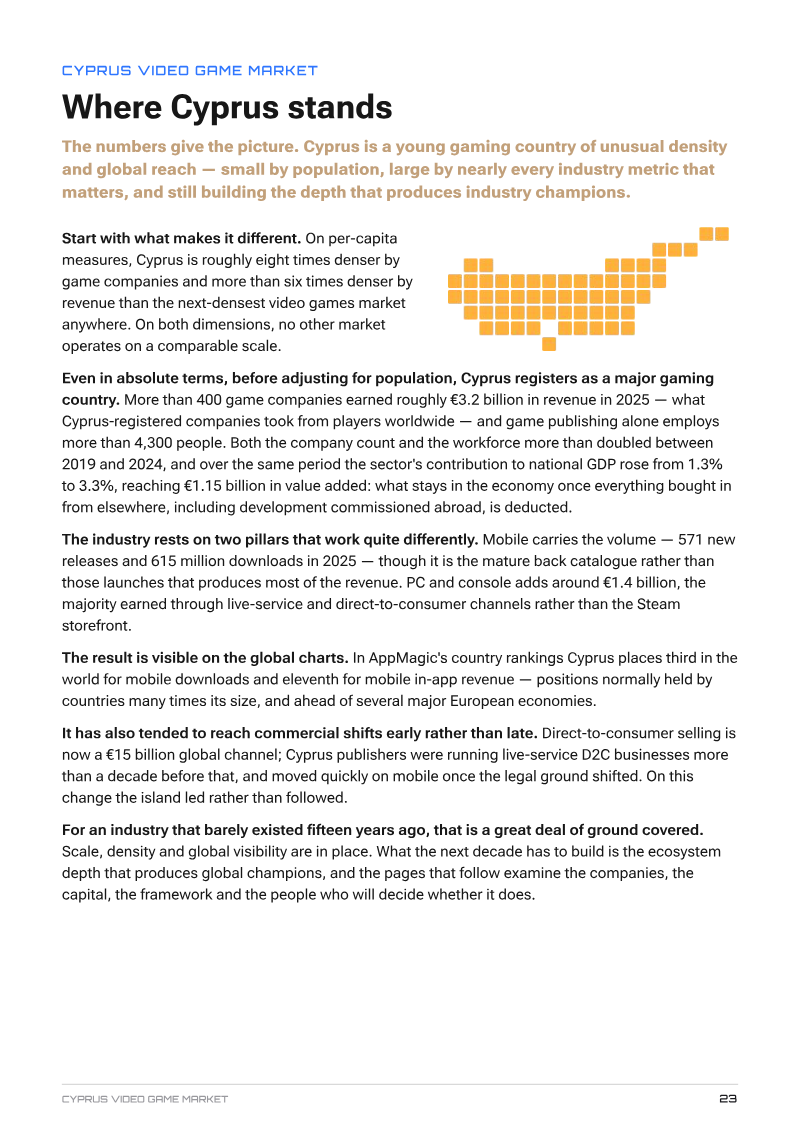
The study examines the senior‑level employment landscape in Cyprus’s game industry for 2025, drawing on an anonymous survey of 113 professionals and a comparative analysis with European peers. Findings reveal that senior‑plus talent in Cyprus exhibits low job mobility, with 71 % reporting no change in the past year and only 20 % moving voluntarily. When moves occur, they are largely strategic, aimed at improving compensation or scope rather than reacting to instability. Senior professionals prioritize financial reliability, clear role definitions, and predictable work environments over brand visibility or rapid career acceleration. Lifestyle factors—including climate, taxation, and family considerations—reinforce long‑term retention and reduce relocation willingness.

Job security perceptions are higher in Cyprus (average 2.68 on a 5‑point scale) than across Europe, yet the expected risk of job loss in the next year is also higher for many roles. Burnout and limited professional development opportunities emerge as key structural risks, with 66 % reporting burnout and only 53 % receiving employer‑funded training. Overtime is common, with 27 % working one to two times a month and 45 % accepting it as part of leadership duties, contributing to long‑term fatigue.

Salary data show Cyprus median salaries for senior roles (e.g., €98 k for top management) below European averages, while desired salaries are substantially higher (e.g., €135 k for top management). Relocation openness is moderate, with 36 % not open and 32 % very open; visa support, health insurance, and relocation bonuses are the most valued benefits.

Overall, the market is mature but faces challenges in retaining talent through sustained engagement and development rather than short‑term compensation incentives. The primary risk for employers is gradual burnout and skill stagnation hidden behind long tenure, rather than sudden turnover.

  • Senior-level talent in Cyprus exhibits low job mobility, with 71% of professionals reporting no change in employment over the past year.
  • A significant retention risk exists in the form of burnout, which affects 66% of senior professionals, compounded by the fact that only 53% receive employer-funded training.
  • Median salaries for top management in Cyprus are approximately €98k, falling significantly short of the €135k desired by professionals in these roles.
  • Overtime is a systemic issue, with 45% of leaders accepting it as a standard duty and 27% of the broader senior workforce working overtime at least once or twice a month.
  • While 36% of senior professionals are not open to relocation, 32% are very open, with visa support, health insurance, and relocation bonuses identified as the most critical incentives.
+1
Values ValueMar 2026

Publishers

Related Topics