Updated Mar 21, 2026 by Atec
Report
Published by Atec
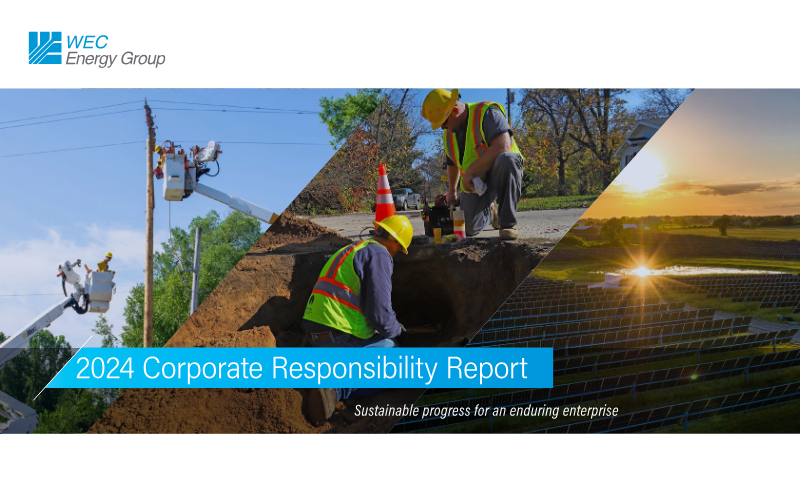
Atec 2024 Corporate Responsibility Report 2024 Corporate Responsibility Report Sustainable progress for an enduring enterprise Sustain s for an enduring enterprise 2024 Corporate Responsibility Report Message from leadership 4 Social 39 Governance 69 Our company 5 Empowered employees 40 Governance framework 70 Building and sustaining Safety and health 46 Cybersecurit...
Atec 2024 Corporate Responsibility Report onsibility Corporate Responsib 2024 Corporate Responsibility Report 2024 Report Sustainable progress for an enduring enterprise Sustainable progress Sustainable progress for Sustain s for an enduring enterprise an enduring enterprise
2024 Corporate Responsibility Report Message from leadership 4 Social 39 Governance 69 Our company 5 Empowered employees 40 Governance framework 70 Building and sustaining Safety and health 46 Cybersecurity 75 long-term value 6 Community engagement 54 Stakeholder transparency 76 Key facts 7 Supply chain integrity 58 Government relations 78 Operational performance 9 Customers 60 Awards and recognition 81 Operational performance Financial discipline 11 Energy reliability 61 Financial discipline 11 Appendix 82 Environment 13 Customer satisfaction 64 Environment 13 Forward-looking statement 83 Environmental responsibility 14 Energy affordability 66 Environmental responsibility 14 Climate strategy 27 Economic development 68 Innovation 36 27 Innovation 36
About this report This annual Corporate Responsibility Report is a comprehensive overview of our sustainability-related performance for 2024. The information presented in this report is prepared in alignment with the Sustainability Accounting Standards Board (SASB) framework and, where relevant, the Task Force on Climate-Related Financial Disclosures (TCFD), with additional guidance from the Global Reporting Initiative (GRI). Report sections reflect the 17 priority sustainability issues we have identified as most important to our company and our stakeholders. Delivering affordable, reliable and clean energy to our customers. Reducing greenhouse gas emissions. Building and maintaining safe, resilient infrastructure. These imperatives continue to drive our decision-making, and the results are clear. As you will see, we are working to build a bright, We are headquartered in Milwaukee, This report principally covers the year 2024 for WEC Energy Group Inc. (WEC) and its sustainable future while providing the energy our Wisconsin, near the shore of Lake subsidiaries on a consolidated basis, and some content also reflects 2025 information, due Michigan, and supply energy to to the timing of publication. The performance data is focused on the operations of Wisconsin customers depend on. customers across the U.S. Midwest. Electric Power Co. and Wisconsin Gas LLC, doing business as We Energies, and Wisconsin Public Service Corp. in Wisconsin; Michigan Gas Utilities Corp. and Upper Michigan Energy Resources Corp. in Michigan; Minnesota Energy Resources Corp. in Minnesota; The Peoples Gas Light and Coke Co. and North Shore Gas Co.
er Co. and Wisconsin Gas LLC, doing business as We Energies, and Wisconsin Public Service Corp. in Wisconsin; Michigan Gas Utilities Corp. and Upper Michigan Energy Resources Corp. in Michigan; Minnesota Energy Resources Corp. in Minnesota; The Peoples Gas Light and Coke Co. and North Shore Gas Co. in Illinois; and WEC Infrastructure LLC and its subsidiaries. Except where otherwise specified, report content does not include performance data from external organizations or activities over which the company has limited control or influence, such as contractors and suppliers.
A message from the president and chief executive officer Across the Midwest, 4.7 million customers depend on WEC Energy Group companies to power and heat their homes and businesses safely and reliably. We take that responsibility seriously, and we’re dedicated to a sustainable strategy as we expand our operations to meet their needs. In the years ahead, we expect to see unprecedented electric demand growth from economic development in our region. We are working diligently and collaborating with large customers to meet their requirements while making significant progress toward a cleaner energy future. A balanced generation mix, including modern natural gas generation and renewable energy, is key to maintaining essential reliability and flexibility year-round. We continued to make good progress across our business in advancing our “all of the above” approach toward reshaping our generation fleet. As we added solar, batteries and natural gas generation, we were able to retire older, less efficient fossil generation units. We also completed construction of a liquefied natural gas facility to support reliability at times of peak demand. To help chart our path forward, we continue to invest in research, technology and system improvement. We look forward to significant opportunities ahead, guided by our commitment to excellence and good corporate citizenship. Thank you, as always, for your engagement. AsaJdaln
mes of peak demand. To help chart our path forward, we continue to invest in research, technology and system improvement. We look forward to significant opportunities ahead, guided by our commitment to excellence and good corporate citizenship. Thank you, as always, for your engagement. AsaJdaln The following pages describe the ways in which we are maintaining that balance — while serving our customers, supporting our employees and communities, and Scott J. Lauber protecting our environment. President and Chief Executive Officer
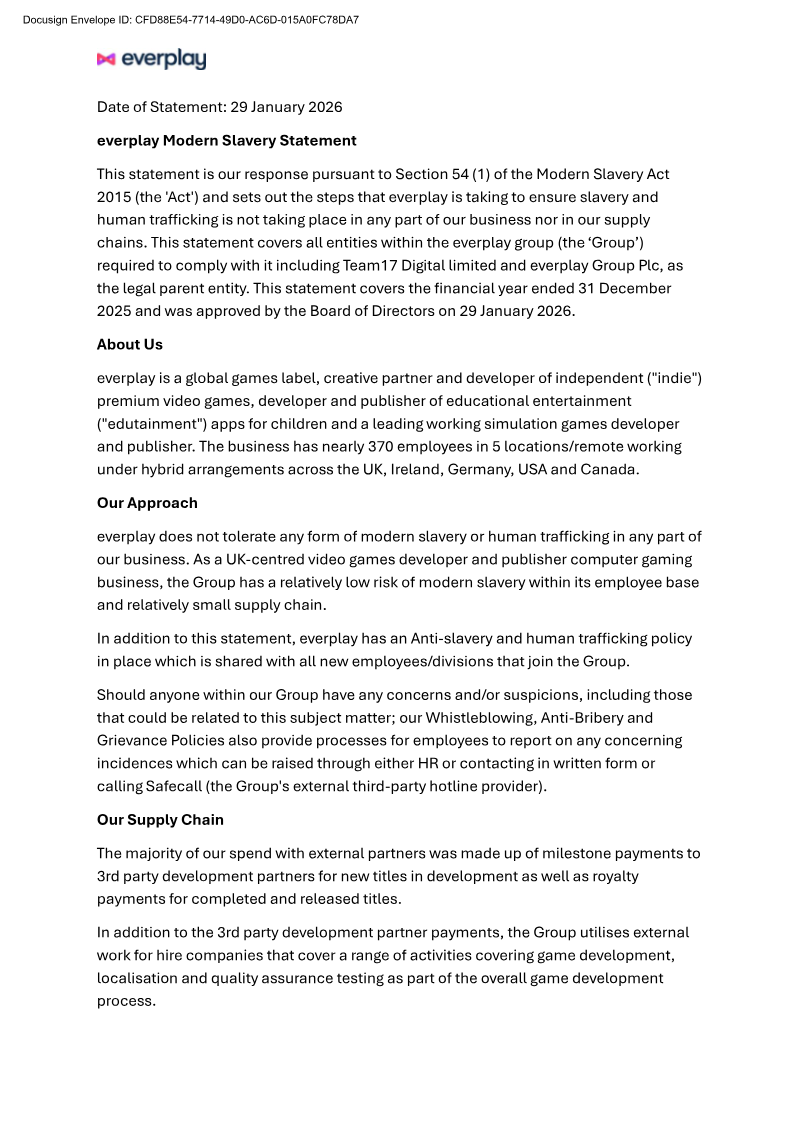
Everplay maintains a zero-tolerance stance toward modern slavery and human trafficking across its global operations and supply chains. As a UK-centered video games developer and publisher, the organization identifies as having a relatively low inherent risk due to the nature of the digital entertainment industry. The operational scope covers the financial year ending December 31, 2025, and encompasses approximately 370 employees working across the United Kingdom, Ireland, Germany, the United States, and Canada. The primary supply chain expenditures involve milestone and royalty payments to third-party development partners, alongside work-for-hire contracts for game development, localization, and quality assurance testing. While the overall risk profile remains low, the organization identifies localization and quality assurance as areas carrying a slightly higher risk. To mitigate these concerns, all new and renewing contracts include mandatory compliance clauses regarding the Modern Slavery Act 2015, granting the company the right to terminate agreements in the event of a breach. Governance is managed through the Audit Committee, which reports to the Board of Directors at least twice annually. Due diligence efforts include a risk-based approach to supplier assessment and the implementation of internal policies such as whistleblowing, anti-bribery, and grievance procedures. Employees and third parties are provided with confidential reporting channels, including an external hotline. The effectiveness of these measures is tracked through an annual risk register assessment, which currently reports zero incidents of modern slavery. Training and awareness initiatives are provided to ensure that employees and stakeholders can identify and report potential risks effectively.
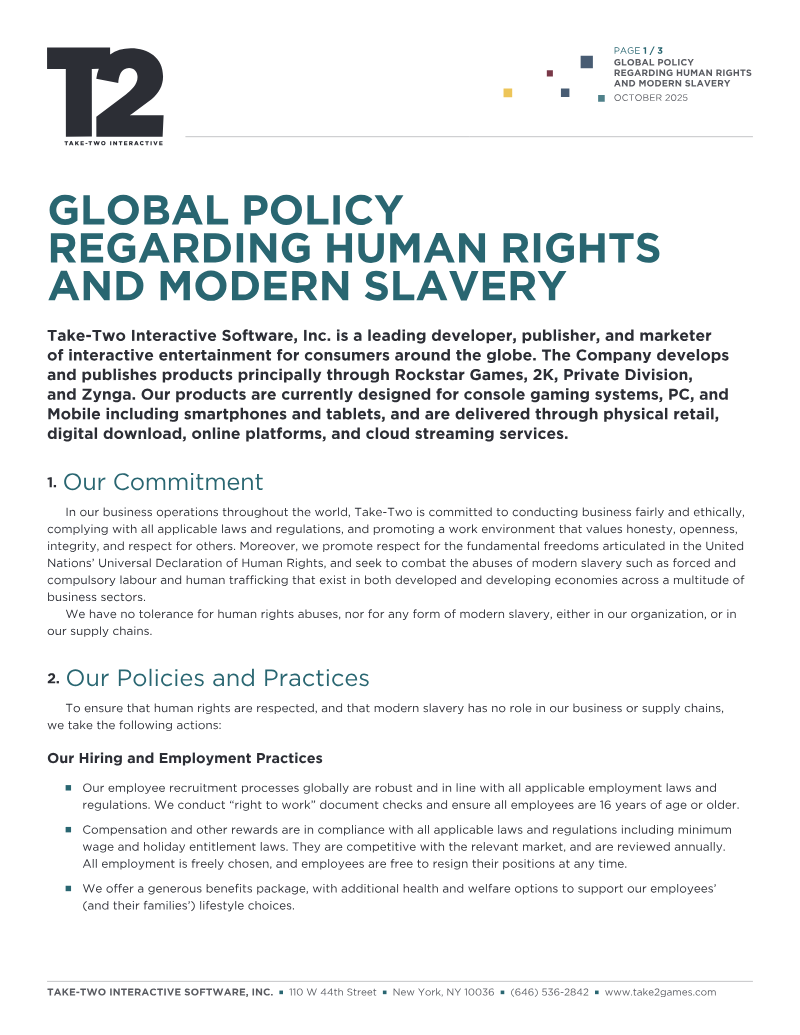
Take-Two Interactive Software establishes a comprehensive framework for maintaining ethical business practices and safeguarding human rights across its global operations as of October 2025. The primary objective is to eliminate modern slavery, forced labor, and human trafficking within the organization and its extensive supply chains. This commitment extends across all major publishing labels, including Rockstar Games, 2K, Private Division, and Zynga, covering the development and distribution of interactive entertainment for console, PC, and mobile platforms. The policy outlines rigorous hiring and employment standards, mandating that all employees be at least 16 years of age and that employment is strictly voluntary. Compensation and benefits are reviewed annually to ensure they meet or exceed legal minimums and market standards. Furthermore, the company enforces a strict non-discrimination policy, ensuring that recruitment and career advancement are based solely on ability and merit rather than protected characteristics. These internal standards are reinforced by a Global Code of Business Conduct and Ethics that applies to all directors, officers, employees, and contractors. To ensure compliance throughout the supply chain, which includes disc replicators, printers, and logistics providers in regions such as North America, Europe, and Japan, the company utilizes a dedicated Supplier Code. This requires third-party partners to represent that they do not utilize child, prison, or slave labor. Oversight is maintained through biennial training for employees and targeted training for consultants. Additionally, the company provides a confidential reporting hotline managed by an independent third party, protecting whistleblowers from retaliation. Key suppliers are also expected to conduct periodic internal or independent audits to verify adherence to labor, health, and safety standards.
The FY 2025 impact analysis presents Electronic Arts’ comprehensive ESG strategy, arguing that responsible stewardship of people, planet, and data is integral to sustainable growth in the interactive‑entertainment sector. By quantifying progress across talent, climate, privacy and security, the report demonstrates how the company translates corporate responsibility into measurable outcomes while maintaining its global market position. Across a workforce of more than 6,000 employees worldwide, 83 % now have access to internal AI tools, and 17 % of new hires are returning staff, contributing to an industry‑leading attrition rate of –0.1 %. Expanded benefits—including paid parental leave and bereavement support—paired with a balanced gender composition, underpin the talent‑focused results. Community engagement generated 18,000 volunteer hours and $5.9 million in investments, reinforcing the social dimension of the strategy. Environmental performance shows a clear downward trajectory: total operational emissions fell to 6.6 Mt CO₂e in FY25, down from 7.3 Mt in FY24 and 10.6 Mt in FY23, with Scope 1 emissions at 2.98 Mt and Scope 2 (market‑based) comprising the remainder, while energy consumption reached 380,859 GJ, fully sourced from office operations. The company’s carbon‑neutral status and renewable‑energy initiatives address identified climate risks such as acute physical events, volatile energy prices, rising carbon costs and emerging reporting regulations. Data‑privacy and security are governed by a privacy‑by‑design framework overseen by the Audit Committee, delivering explicit player notice, consent and control, data‑minimisation, and partner‑risk contracts. The security management system aligns with ISO, NIST and CIS standards, undergoes annual independent validation, operates a 24‑hour SOC and mandates annual training for all staff. An articulated AI governance model completes the governance pillar, ensuring responsible deployment of emerging technologies. Collectively, these initiatives illustrate a holistic, globally scoped commitment to ESG excellence throughout FY 2025.
This research examines the professional landscape of the global gaming industry, drawing on a survey of over 160 professionals conducted during Gamescom 2025. The sample represents a diverse geographic spread, with significant participation from Europe and North America, alongside emerging representation from Latin America, Asia-Pacific, and Africa. Demographically, the industry remains male-dominated (65%), though women (30%) and non-binary individuals (6%) constitute a notable portion of the workforce. The data highlights a mid-career-heavy industry, where nearly half of the respondents possess six to ten years of experience, while newcomers are increasingly rare due to slowed recruitment and a preference for senior talent. The central thesis identifies a stark paradox: while 76% of professionals report high job satisfaction driven by a deep passion for creative expression, trust in the industry as a sustainable career path has collapsed, evidenced by a Net Promoter Score (NPS) of -40. This disillusionment is most pronounced among veterans aged 45 and older. While the "spark of passion" remains the primary motivator for joining and staying in the field, it is increasingly undermined by systemic issues. Key deterrents include low compensation (54%), unstable employment (43%), and burnout (30%). The findings conclude that the industry is at a critical juncture. Professionals envision a future defined by player-centric design, cross-platform development, and increased diversity. However, they warn that the current model—characterized by "suits" maximizing short-term profits and frequent layoffs—is unsustainable. The research suggests that a "Golden Age" of gaming can only be achieved by shifting from profit-driven exploitation of passion toward structural stability, fair compensation, and genuine collaboration. Without these changes, the industry risks a continuous drain of the talent required to sustain its creative output.