Showing 30 of 654 results · 1.05s
Jan 2023
Mobile Growth & Monetization Report 2023
Unity
mobile gaming landscape in 2023 reflects a strategic pivot toward operational efficiency as developers navigate softening in-app purchase (IAP) and advertising revenues. Success currently hinges on capturing
Report41 pages
Jan 2025
Mobile Monetization Report 2025
AppMagic
global mobile gaming market reached $57.1 billion between 2023 and 2025, representing a 3.4% increase driven primarily by the App Store and emerging regions such as LATAM
Report61 pages
The Gaming App Insights Report: 2026 Edition
Adjust
mobile gaming industry is undergoing a fundamental strategic transition, moving away from a reliance on high-volume user acquisition toward a model centered on long-term retention
Report35 pages
Middle East & Africa Gaming Review 2025
Lucidity Insights
positioning the region as a growing share of the global gaming economy. Mobile dominance, government‑backed visions, and esports infrastructure are reshaping competitive dynamics across the region. Funding
Report52 pages
The Take-Two Diaspora: Why Alumni Win Big in Mobile, Not AAA
InvestGame, GDev
Dream Games’ $2.5 billion sale in July 2025. The portfolio spans mobile casual titles, instant‑play games, sports apps, and publishing ventures, but shows a pronounced skew toward
Report8 pages
Jan 2021
Mobile Ad Creative Report: August 2021
Sensor Tower
Mobile gaming creative trends in August 2021 centered on humanizing digital experiences and leveraging high-profile cultural partnerships. Analysis of top-performing ads across platforms like YouTube, Instagram
Report30 pages
Jan 2022
State of Mobile 2022
data.ai
individual titles that each surpassed $100 million in annual consumer spend. Mobile gaming remains the primary engine of monetization, reaching a record $116 billion in spend. While hypercasual
Report73 pages
Jan 2021
Store Intelligence Data Digest: Q4 2021
Sensor Tower
these installs, representing a 2.7 percent year-over-year increase. While the mobile gaming sector remained a primary driver of volume, led by the global success of Garena
Report80 pages
Jun 2024
Q2’24 Gaming Deals Report
InvestGame
instability and turbulence in gaming stocks. Geographically, Asia remains the primary driver for mobile gaming hits, with titles like Dungeon & Fighter: Origin generating significant in-app purchase revenue
Report19 pages
May 2026
Vietnam Domestic Gaming Industry Report: 2025
Ocean Entertainment Group, Meridian Play
Vietnamese mobile gaming market represents a significant growth sector in Southeast Asia, reaching a valuation of approximately $825 million in 2025. With an estimated 54 to 58.5 million
Report15 pages
Jan 2022
Video Games Development Industry in Romania – 2022 (Summary & Key Insights)
RGDA – Romanian Game Developers Association
Amber Studio | Cluj‑Napoca | 38 % of market share (≈ €80 M) | Focus on mobile & mid‑core games; rapid hiring. | | 4 | Gameloft Romania | Turda, Târgu Mureș
Report3 pages
Jan 2022
Uso de Videojuegos Didácticos en el Aula: Pautas para el Éxito del Aprendizaje
EUN Partnership AISBL
measurable gains in mathematics, geography, health, ethics and language outcomes. Serious‑game applications range from mobile‑AR health simulators to environmental awareness titles, while game‑jam events
Report98 pages
Jan 2025
Games Industry Region Report: China 2025
PocketGamer.biz
platforms such as WeChat Mini Games, which provide unique avenues for engagement alongside traditional gaming segments. Looking toward the future, the Chinese games industry is poised to lead
Report20 pages
Jan 2022
Gaming Deals Activity Report: H1 2022
InvestGame, Hiro Capital
pandemic era toward a more disciplined investment environment that prioritizes established mobile platforms and robust, sustainable gaming ecosystems
Report25 pages
The Great Mobile Reversal: Why Buyers Pay Billions for What VCs Abandoned
InvestGame
analysis examines the evolution of mobile gaming investment and M&A activity from 2020 through the first half of 2025. Mobile platforms have dominated the sector, accounting
Report12 pages
Jan 2024
Africa Games Industry Report 2024
Maliyo Games
than doubled from 77 million in 2015 to 186 million in 2021, with mobile gaming accounting for 95 % of players and nearly 90 % of the region
Report72 pages
Interview with Game Expert at Line Studio: Japan Market Insights
Korea Creative Content Agency
Prepared for Korean Game Developers & Publishers Date: March 2026 Executive Summary Japan’s mobile gaming ecosystem is undergoing a rapid shift. While heavyweight, long‑session RPGs once dominated
Report21 pages
Jan 2024
The State of Games Media Buying United States Spotlight
Mintegral
United States mobile gaming market maintained its position as a global leader in advertising activity during the first half of 2024. While the region ranks first globally
Report16 pages
Jan 2024
Mobile Growth and Monetization Report 2024
Unity
mobile gaming landscape is defined by a strategic transition from volume-based user acquisition toward high-value retention and diversified monetization. While only 1.83% of users convert
Report48 pages
Jan 2021
Market Snapshot: Q2 2021 US, China & Japan
GameRefinery
mobile gaming market in the second quarter of 2021 experienced notable shifts in genre performance and publisher dominance across the United States, China, and Japan. The primary objective
Report20 pages
Jul 2026
Farming Sims: Cultivating Long-term Engagement
Bryter
games have established themselves as a dominant and enduring genre within the global mobile gaming market. By analyzing data from a survey of 1,000 US mobile gamers
Report13 pages
Jan 2022
Global Gaming Report 2021
Drake Star Partners
secured $3.6 billion in financing. Investment trends shifted toward high-growth platforms and mobile gaming, exemplified by substantial private rounds for companies like Epic Games and Jam City
Report24 pages
Jan 2019
Finnish Game Industry Report 2018
Neogames Finland
Remedy Εntertainment • Control Rival Games • Τhief of Τhieves: Season One Superplus Games • Ηills of Steel Nitro Games • Ηeroes of Warland Κukouri Mobile Εntertainment • Pixel Worlds Publisher Neogames Finland
Report136 pages
Jan 2022
Key Insights into Brazilian Gamers
Newzoo
gaming is the dominant platform, utilized by 60% of the gaming population, followed by console and PC at 31% and 30% respectively. Despite the prevalence of mobile, average
Report18 pages
Jan 2025
Mobile Casual Benchmarks Report 2025
Appodeal
various casual genres and subgenres. Based on data collected from over 10,000 mobile games and billions of installs between June 2024 and January 2025, the findings offer
Report25 pages
Jan 2020
Investment Activity Report Q1–Q3 2020
InvestGame
June with IPOs from Archosaur Games ($280 m) and Kakao Games ($330 m). The report highlights a shift toward mobile acquisitions, sustained corporate investment despite pandemic disruptions
Report11 pages
Jan 2022
State of Mobile: Germany 2022
data.ai
mobile landscape is defined by a sophisticated mix of high-spending gaming audiences, a rapidly maturing mobile commerce sector, and a strong reliance on mobile utilities for daily
Report70 pages
May 2025
Press Start on Growth: Unlocking the Full Potential of the UK Video Games Industry
Ukie
year‑on‑year and now accounts for only 4 % of total spend, while mobile games grew 8 %—still below the 13 % regional average. Full‑game digital purchases slipped
Report2 pages
Jan 2022
Mobile Market Forecast
Sensor Tower
Store spending and downloads. India remains the leader in Google Play adoption. Mobile‑game revenue is projected to decline on both platforms, with non‑game apps surpassing games
Report53 pages
Jan 2025
Games Industry in 2025
Ampere Analysis
development costs, publishers are increasingly utilizing remakes, remasters, and transmedia franchise strategies. While mobile gaming remains the largest segment at 58% market share, PC gaming showed the strongest
Report37 pages
Mobile Growth & Monetization Report 2023
Jan 202341 pages5k words
Summary
The mobile gaming landscape in 2023 reflects a strategic pivot toward operational efficiency as developers navigate softening in-app purchase (IAP) and advertising revenues. Success currently hinges on capturing player interest within the first 14 days, a critical window where 77% of all conversions occur. To capitalize on this timeframe, monetization strategies emphasize low-friction price points between $1.01 and $5.00, with high-performing assets such as virtual currencies, limited-time bundles, and sales generating over 56% of total IAP revenue.
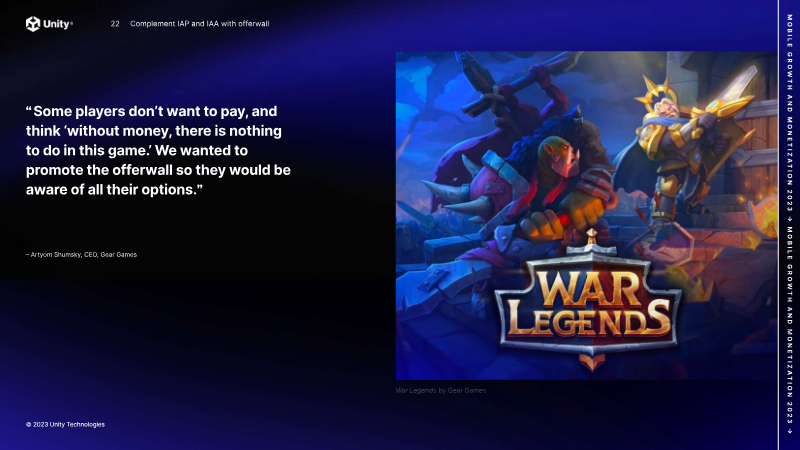
Beyond direct purchases, the integration of rewarded video ads and offerwalls has become essential for sustaining non-paying user bases. Strategic ad placement between levels or within game lobbies yields the highest engagement, particularly when incentivized by currency or gacha mechanics. Offerwalls, in particular, represent a significant growth lever, contributing 33% of total ad revenue for games utilizing multi-faceted monetization. These tools also serve as powerful retention drivers; players engaging with offerwalls demonstrate a 14% retention rate at Day 90, vastly outperforming the 3% rate seen among non-converters.
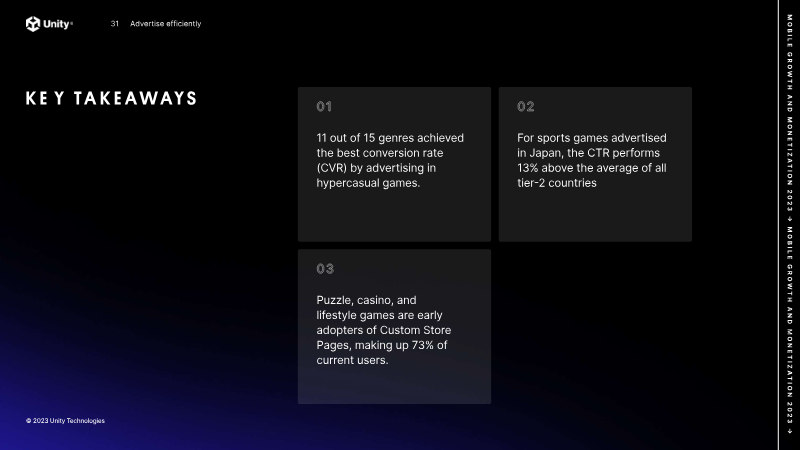
From a global marketing perspective, hypercasual advertising remains the most effective conversion engine across the majority of gaming genres. Advertisers are increasingly looking toward high-value Tier-2 markets, noting exceptional click-through rates for sports titles in Japan and trivia games in South Korea. Furthermore, the adoption of Custom Store Pages is emerging as a vital tactic for improving return on investment, particularly within the puzzle, casino, and lifestyle segments. These findings underscore a broader industry trend toward data-driven personalization and diversified revenue streams to maintain long-term player lifetime value.
Pages

Insights
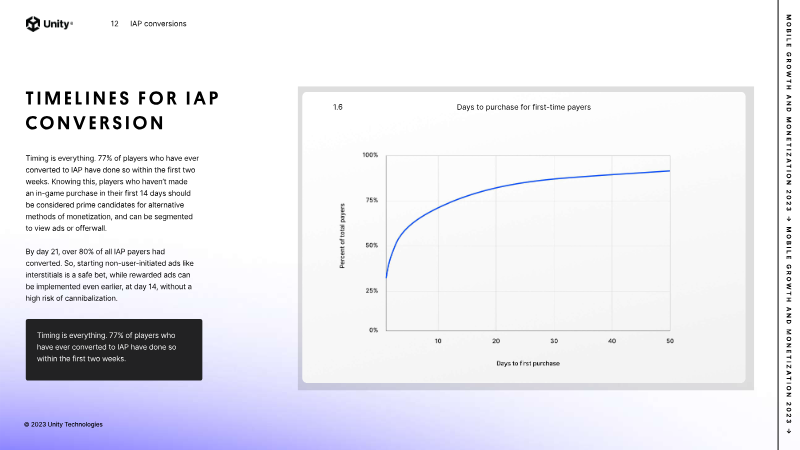
- 77% of all player conversions occur within the first 14 days, making this initial window the most critical period for monetization.
- Low-friction price points between $1.01 and $5.00 are the primary drivers of in-app purchase revenue, with virtual currencies and limited-time bundles accounting for over 56% of total IAP income.
- Offerwalls are a major retention driver, as players who engage with them exhibit a 14% retention rate at Day 90 compared to only 3% for non-converters.
- Offerwalls contribute 33% of total ad revenue for games that employ a multi-faceted monetization strategy.
- Rewarded video ads and offerwalls are essential for sustaining non-paying users, with the highest engagement occurring when ads are placed between levels or within game lobbies.
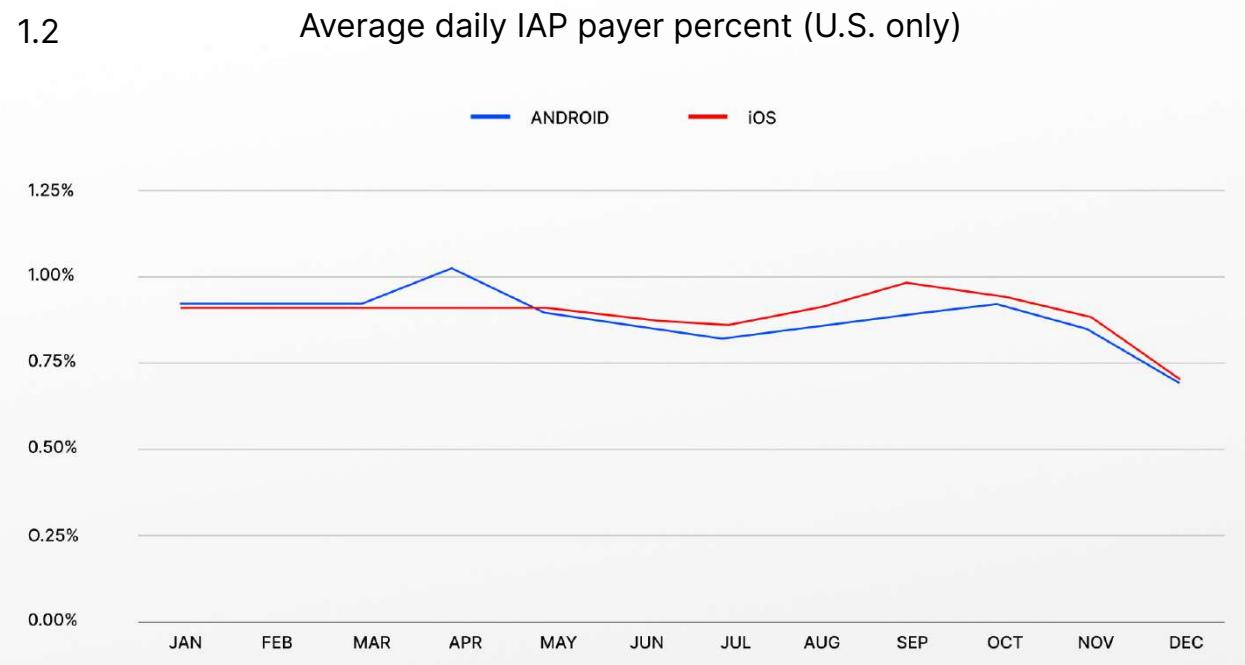
This line graph illustrates the average daily in-app purchase (IAP) payer percentage in the U.S. for both Android and iOS platforms over a year, showing how these percentages fluctuate monthly and compare between the two operating systems.