Showing 30 of 463 results · 0.69s
2010 Interim Report: Tencent Holdings Limited
Tencent
Despite rising operating costs and marketing investments, the firm maintains a stable financial structure and a clear governance framework, with MIH China (BVI) Limited continuing as the primary
Financial94 pages
Jan 2020
Global Video Game Deals Report 2020
InvestGame
offerings. The United States and China emerged as the primary geographical drivers, collectively representing 63% of the total deal value. The market demonstrated significant resilience, recovering from
Report28 pages
Aug 2021
Player Two Enters the Game
SuperJoost
development technology. In the public markets, Krafton experienced a 20% share price drop following its IPO due to regulatory scrutiny in China, despite strong performance in India with
Article
Jan 2023
From Hyper to Hybrid: 2023 Follow-up
Tenjin
Germany gained prominence, displacing China and Saudi Arabia from the top five rankings. These shifts highlight the evolving importance of Western markets for iOS-based mobile game developers
Report11 pages
Mar 2024
Brutally Honest #96: UA in the Post-IDFA World
Matej Lancaric
specific commentary on the Chinese market and the recent volatility surrounding proposed F2P regulations. Observations indicate a period of regulatory cooling in China following the withdrawal of restrictive
Article
Aug 2025
How The King Is Watching Sold Over 200k in a Couple of Weeks
GameDiscoverCo
robust international strategy, particularly in China, where early localization of assets, dedicated influencer partnerships, and region-specific pricing contributed to the market accounting for 39% of total unit
Article1 pages
Mar 2023
The Mobile Economy and Digital Ad Space in 2022 and Beyond: An Analysis of the Global Trends Shaping the Mobile and Digital Advertising Industry
Sensor Tower
across North America and major European markets in the fourth quarter of 2022. While established platforms like Facebook maintain the largest market share, TikTok has emerged
Report20 pages
Aug 2023
Unity 10‑Q – Q2 FY2023
Unity
scale internal systems. Market‑opportunity uncertainty is amplified by regulatory shifts in privacy, AI, and export controls across the U.S., EU, China, and other jurisdictions. Operational vulnerabilities include
Article1 pages
Jan 2019
Friendly Fraud: Facebook's Unwillingness to Err on the Side of the Consumer
SuperJoost
North America, Europe, and China. It covers industry segments such as subscription-based streaming (Viacom’s acquisition of Pluto TV), the esports market (Blizzard’s price cuts
Article
Jun 2021
Q2 2021: Store Intelligence Data Digest
Sensor Tower
space. Geographically, the market exhibited a clear divide in platform influence. Chinese firms like Tencent and ByteDance dominated the App Store in Asia, where China alone accounted
Report71 pages
Jan 2026
China WeChat Mini Games Industry Report 2026
Meridian Play, Jinke
Mini Games industry in China has emerged as a dominant, high-growth sector within the broader digital ecosystem. As of 2026, the market is characterized by a rapid
Report24 pages
May 2026
Mobile Market: Q1 2026
Sensor Tower, PWN Games
European markets show robust growth, notably the UK (+20 % YoY), though the US’s sheer size still dominates absolute revenue. China data reflects iOS only, and India, Indonesia
Article1 pages
Jan 2023
State of the Market 2023
Apptica
spending. Geographically, while emerging markets like India and Brazil are driving significant download growth, global revenue remains highly concentrated, with the United States, China, and Japan collectively generating
Report40 pages
Aug 2026
Weekly Gaming Reports Recap: August 10 – August 14, 2026
GameDev Reports
minimal $200 marketing budget. In contrast, the experimental title This Game Costs 200 Dollars saw high initial sales volume—primarily from China—that were almost entirely negated
Article1 pages
Jan 2018
The Data Behind 10 Years of the iOS App Store – 2018
data.ai
global iOS revenue. China, in particular, experienced a meteoric rise, overtaking the United States in 2016 to become the world’s largest market for both downloads and spending
Report35 pages
Jan 2025
Dynamics of Gaming Deals
The GGames Fund
market and higher expected returns despite lingering marketing and user‑acquisition challenges. Geographically, investors increasingly target emerging regions such as South America, Eastern Europe, Southeast Asia and China
Report8 pages
Sep 2023
Store Intelligence Data Digest: Q3 2023
Sensor Tower
most significant momentum in the U.S. market with 44% quarter-over-quarter growth. Regionally, India remained the largest market by volume with 6.6 billion total downloads, more than
Report29 pages
Oct 2023
Global Apps in September: September 2023 Market Analysis
SocialPeta
market. Download activity mirrored these patterns, with Top Widgets+ and Google Classroom experiencing 36 % and 47 % growth respectively, dominated by China, the U.S., India, and Spain. The data
Article1 pages
Oct 2021
The Surprising Things Escape Simulator Did to Become a Hit
GameDiscoverCo
costs with a crowded market where entry-level competition is nearly free. Geographically, the report focuses on the precarious state of Steam in China. While the platform remains
Article
NetEase 1Q26 Investor Presentation
NetEase
licensed titles in China, it remains cognizant of potential risks, including regulatory shifts, geopolitical tensions, and the competitive nature of the global gaming market. Operational highlights include
Financial13 pages
Feb 2024
PC Game Discovery in China
GameDiscoverCo
The primary objective of this analysis is to demystify the mechanisms of PC game discovery
Article
Consolidated Financial Results: 3rd Quarter Fiscal Year Ending March 2023
GameVault System
market and a slower-than-anticipated recovery in automotive manufacturing, exacerbated by semiconductor shortages and COVID-19-related lockdowns in China. While the Materials and Engineering Plastics segments
Financial22 pages
Sep 2026
The New Tebex: New Fees, New Features
Overwolf
specific geographic markets. Furthermore, the platform has expanded its payment infrastructure to support recurring subscriptions for five major regional payment methods: AliPay in China, UPI in India
Article1 pages
Jul 2025
Steam's Top New Games for June 2025
GameDiscoverCo
adjusted for market variables. The analysis also incorporates qualitative observations regarding regional pricing strategies, such as the premium pricing of Stellar Blade in China, and the impact
Article1 pages
Interim Report 2009: Tencent Holdings Limited
Tencent
shareholders like MIH China (BVI) Limited providing stable backing, the company concluded the first half of 2009 in a strong position to navigate future market demands
Financial92 pages
Jan 2023
Peak Play: Trends in East Asian Videogame Streaming H1 2023
Niko Partners
scale. In China, Honor of Kings remains the undisputed leader with 5.67 billion views, while VALORANT and Apex Legends dominate the Japanese and Korean markets, each surpassing
Report23 pages
May 2024
Global Games Market Report 2023
Newzoo
respondents in 36 key markets, supplemented by partner‑provided transaction figures and updated each quarter. Geographically, the Asia‑Pacific region remains the dominant market, accounting
Report52 pages
Bushiroad Strengthens Global Expansion: Overseas TCG Sales Ratio Projected to Exceed 50%
Bushiroad
Malaysia and China. The Malaysian entity will leverage existing regional expertise to optimize distribution, while the Shanghai-based operation will transition the Chinese market to a local manufacturing
Article4 pages
Nov 2022
Shannon's Newsletter Issue #1 (Chinese Edition)
Shannon Liao
Chinese gaming market and the regulatory challenges facing major Western publishers. The scope is international, with a specific emphasis on the United States and China during early
Article
Mar 2026
Rising in the East
SuperJoost
these emerging market players is their proactive adoption of artificial intelligence. Unlike Western counterparts, which often view AI with caution, firms in India and China increasingly utilize
Article1 pages
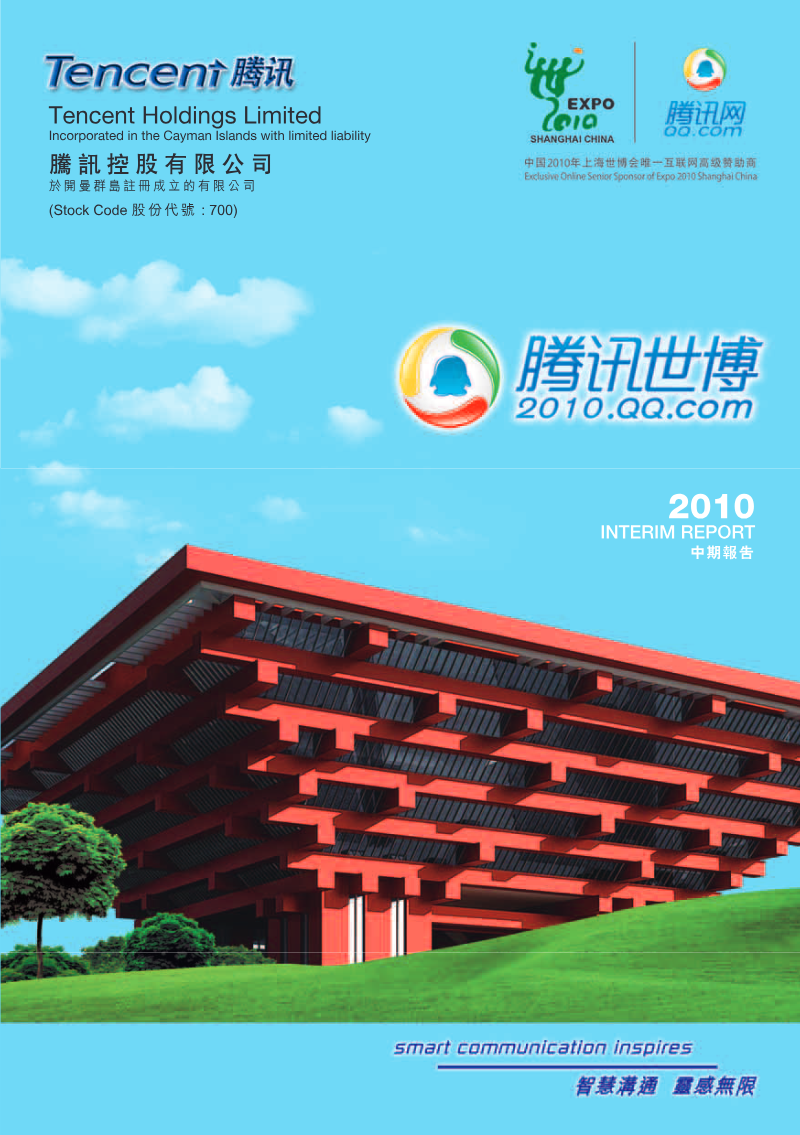
2010 Interim Report: Tencent Holdings Limited
94 pages25k words
Summary
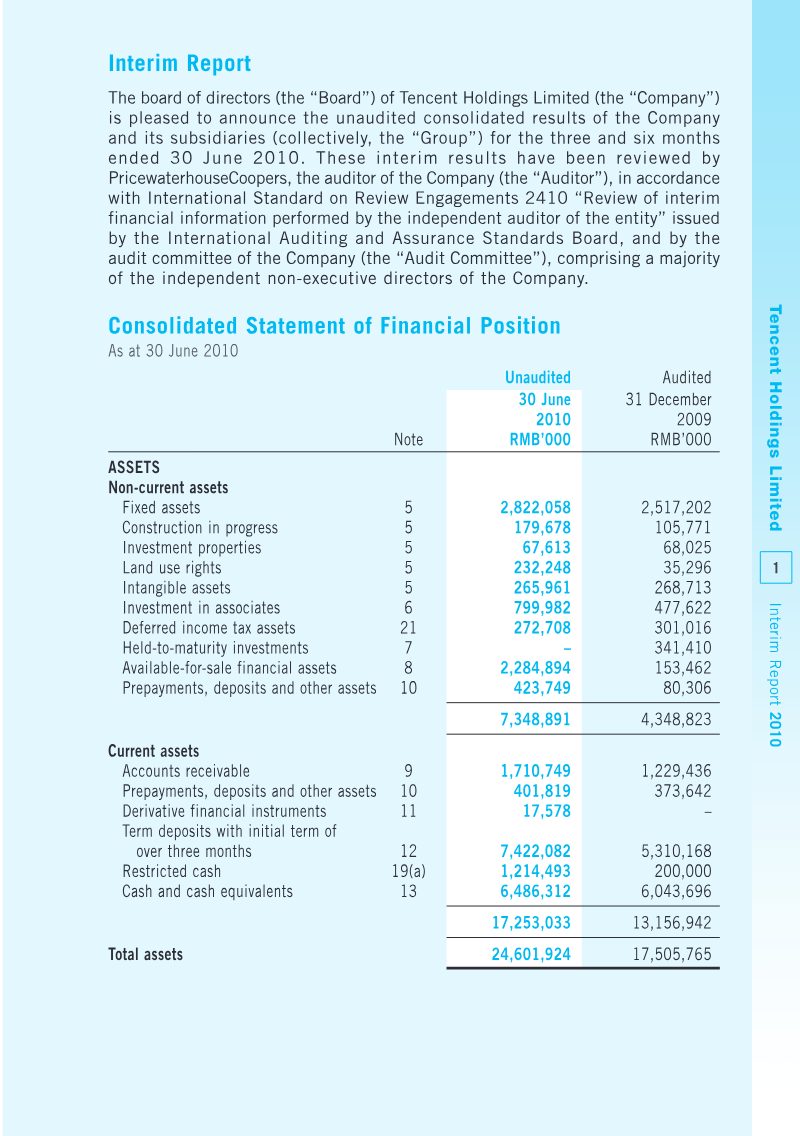
Tencent Holdings Limited demonstrated robust financial performance during the first half of 2010, characterized by a 65.3% year-over-year revenue increase to RMB 8.895 billion. This growth was underpinned by strong expansion across its core business segments, including Internet value-added services, mobile and telecommunications services, and online advertising. The latter segment experienced a notable surge, bolstered by high-profile global events such as the World Cup and the World Expo. Profit attributable to equity holders rose significantly to RMB 3.699 billion, reflecting the company’s ability to scale its IM and Qzone platforms while maintaining a solid asset base of RMB 24.6 billion.
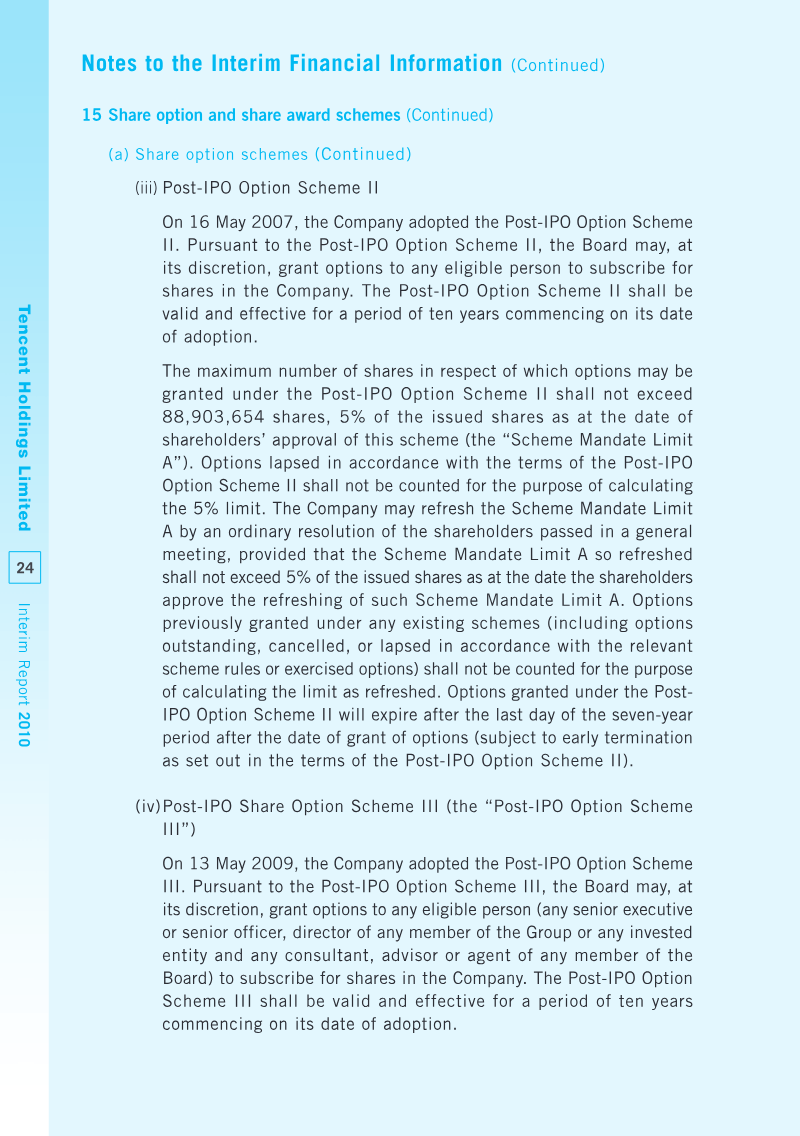
The company’s strategic trajectory during this period focused on aggressive market expansion and talent retention. Research and development expenditures climbed to RMB 758 million, signaling a commitment to technological innovation, while the workforce expanded to 8,687 employees. To align employee interests with long-term growth, Tencent utilized comprehensive share option and award schemes, governed by strict mandate limits and valuation models. Furthermore, the company pursued international growth through strategic investments, most notably acquiring a stake in Digital Sky Technologies, while simultaneously managing financial risks through foreign exchange forward contracts and the consolidation of equity in subsidiaries like Shenzhen Domain.
Looking toward the future, the company remains positioned to navigate an increasingly competitive and regulated landscape by prioritizing mobile internet development and enhancing its online gaming portfolio. Despite rising operating costs and marketing investments, the firm maintains a stable financial structure and a clear governance framework, with MIH China (BVI) Limited continuing as the primary shareholder. These results confirm a period of rapid scaling and operational maturity for the organization as it solidified its dominance within the Chinese internet sector throughout the first half of 2010.
Pages
Insights
- Tencent reported a 65.3% year-over-year revenue increase to RMB 8.895 billion for the first half of 2010, with profit attributable to equity holders reaching RMB 3.699 billion.
- Growth was driven by strong performance across Internet value-added services, mobile and telecommunications services, and a surge in online advertising fueled by the World Cup and World Expo.
- The company increased its commitment to technological innovation by raising research and development expenditures to RMB 758 million.
- Tencent expanded its workforce to 8,687 employees and implemented share option and award schemes to align staff interests with long-term growth.
- International expansion strategy included the acquisition of a stake in Digital Sky Technologies alongside the consolidation of equity in subsidiaries like Shenzhen Domain.
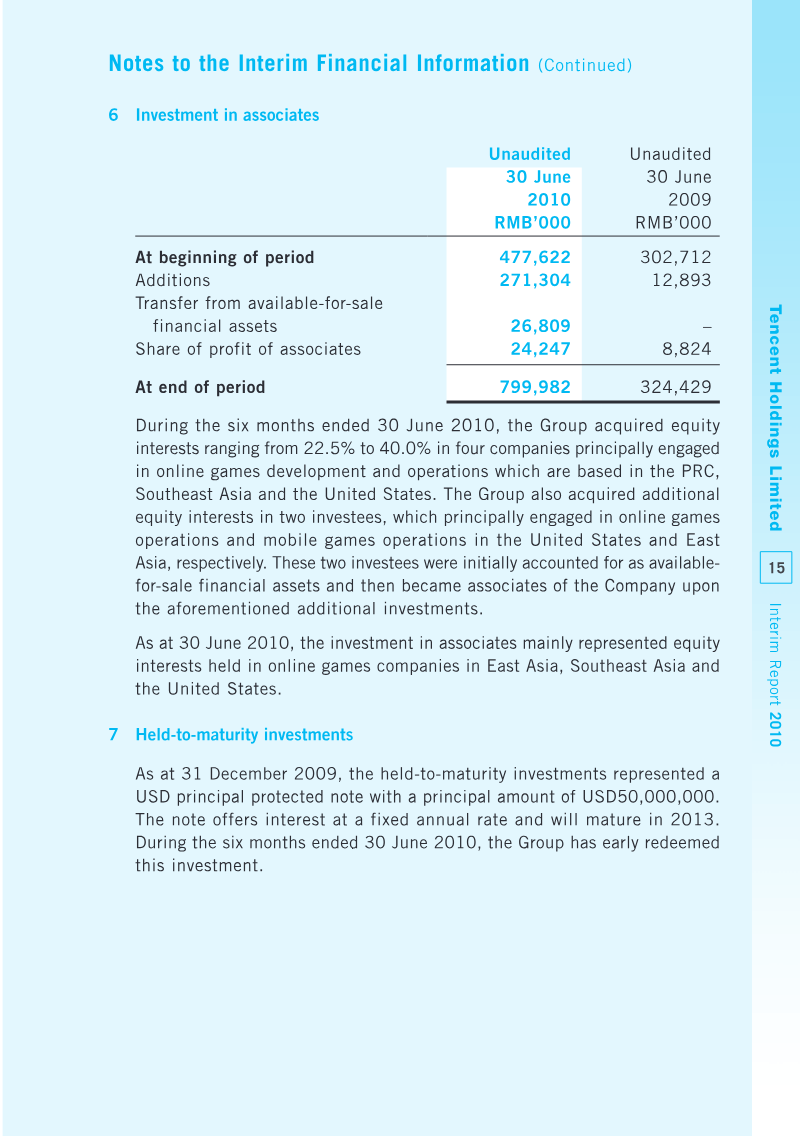
Investment in associates