Showing 30 of 406 results · 0.62s
Jan 2018
FY2018 4Q Financial Results Presentation Transcript
GREE
declining sales to a growth phase driven by a three-pillar strategy: mobile gaming, advertising and media, and the emerging live entertainment sector. For the full fiscal year
Financial7 pages
Nov 2019
Consolidated Financial Results for the Third Quarter of the Fiscal Year Ending December 31, 2019
KLab
September 30, 2019. The data reveals a period of contraction for the Japanese mobile gaming company, with revenue declining 10.3% year-over-year to 22.37 billion
Financial9 pages
Jan 2019
Financial Results for the Second Quarter of FY2019: Transcript
GREE
funplex is withdrawing from unprofitable titles to improve the overall portfolio health. Beyond mobile gaming, the strategy includes multi-platform expansion and diversification into live entertainment and media
Financial6 pages
Nov 2023
Summary of Financial Results for Third Quarter of Fiscal Year Ended December 31, 2023
KLab
billion yen, suggesting ongoing development investments. Due to the volatility of the mobile gaming market, the company has declined to provide a consolidated operating performance forecast
Financial9 pages
Aug 2023
Form 10-Q: Playstudios Q2 2023
Playstudios
class action securities litigation and disputes regarding gambling statutes. Operating within the global mobile gaming sector, Playstudios faces significant concentration risk, with Apple and Google accounting
Financial1 pages
Feb 2026
Summary of Financial Results for Fiscal Year Ended December 31, 2025 (Japanese GAAP)
KLab
GlobalGear Co. Ltd. These actions aim to mitigate the volatility of the traditional mobile gaming segment, which saw profits drop from ¥1.13 billion to ¥830.5 million over
Financial19 pages
Aug 2022
Form 10-Q: Q2 2022
Playstudios
undrawn $81 million revolving credit facility. The company’s business model centers on mobile games integrated with its proprietary playAWARDS loyalty program. While the introduction of new titles
Financial1 pages
Nov 2025
Consolidated Financial Results for the Six Months Ended September 30, 2025
mixi
Performance varied significantly across industry segments. The Digital Entertainment Business, anchored by the mobile game Monster Strike, saw an 11.1% decline in sales due to lower monthly active
Financial15 pages
Feb 2025
Consolidated Financial Results for the Nine Months Ended December 31, 2024
mixi, Koei Tecmo
Digital Entertainment Business remains the primary revenue driver, largely supported by the mobile game Monster Strike, contributing ¥65,455 million in sales and ¥28,479 million in segment
Financial12 pages
Aug 2018
Summary of Financial Results for First Half of Fiscal Year Ending December 31, 2018
KLab
remains primarily on the Japanese market, though the company operates globally within the mobile gaming segment. Looking ahead, KLab provided a range-based forecast for the full fiscal
Financial11 pages
Feb 2020
Summary of Financial Results for Fiscal Year Ending December 31, 2019 (Japanese GAAP) (Consolidated)
KLab
releases. While the 2019 results highlight the volatility inherent in the mobile gaming sector and the impact of high development costs on margins, the expansion of software assets
Financial17 pages
Jun 2015
FY2015 Business Report
mixi
previous year’s net loss, driven primarily by the global success of the mobile game Monster Strike, which surpassed 30 million cumulative unique device downloads
Financial2 pages
Nov 2025
Investor Presentation: November 2025
Take-Two Interactive
billion by 2028, fueled by a 4% compound annual growth rate in mobile gaming and the continued maturation of ninth-generation console install bases. The company’s competitive
Financial35 pages
Aug 2018
Summary of Main Questions and Answers at the FY2018 Fourth Quarter GREE Results Briefing Held on August 2, 2018
GREE
with an eye toward global distribution, the briefing outlines a transition from traditional mobile gaming toward a diversified portfolio of digital media and next-generation connectivity. The methodology
Financial1 pages
Financial Results: First Half of the Fiscal Year Ending March 2022
Koei Tecmo
million‑copy console titles, annual releases of 2‑million‑copy titles, and mobile games with monthly sales of ¥2 billion. The company also plans to expand IP licensing
Financial30 pages
Jan 2015
Fiscal Year Ending March 2016: 1st Half Financial Results
Koei Tecmo
North America, Europe, and Asia, with a specific focus on the Game Software and Online & Mobile segments. Although Japan remains the primary market, accounting for 74.9% of sales
Financial34 pages
Nov 2011
Financial Results for the First Quarter of the Fiscal Year Ending on June 30, 2012
GREE
primary thesis highlights the company’s rapid transition into a global mobile social gaming platform, driven by the integration of OpenFeint and aggressive expansion into international markets. During
Financial25 pages
May 2021
Take-Two Interactive Annual Report: FY 2021
Take-Two Interactive
channel, accounting for 86–87 % of revenue and driving a shift toward mobile, online gaming, and micro‑transactions. International operations contribute roughly 40 % of sales, with significant exposure
Financial1 pages
Summary of Financial Results for First Quarter of Fiscal Year Ended December 31, 2025: KLab Inc.
KLab
losses and a breach of financial covenants. Management emphasizes continued investment in mobile online games, particularly the EA SPORTS FC™ TACTICAL title and new IP collaborations, while pursuing
Financial13 pages
Consolidated Financial Results: Fiscal Year Ending December 2025
Aiming
while short‑term borrowing increased modestly. The company’s single operating segment—mobile online gaming—remains the core driver, with strategic collaborations (e.g., Square Enix
Financial13 pages
Summary of First Quarter Financial Results: December 2014 Fiscal Term
KLab
income of ¥141 million for the 2014 fiscal term. Management notes that mobile online game performance is highly volatile and that future results depend on hit titles
Financial10 pages
Nov 2021
Quarterly Report of 11 Bit Studios S.A. for the Nine Months Ended September 30th 2021
11 bit studios
Beyond core development, the studio is diversifying the Frostpunk intellectual property into mobile, board game, and literary markets while actively seeking minority acquisitions to bolster its long-term
Financial51 pages
May 2022
Take-Two Interactive Annual Report: Fiscal Year 2021
Take-Two Interactive
financed with $2.7 billion of senior notes, represented a strategic pivot toward mobile and online gaming, while the earlier purchase of Nordeus added €51.7 million in net revenue
Financial1 pages
Aug 2015
FY2015 Fourth Quarter Financial Results
GREE
dividend to mark its tenth anniversary. The strategic transition from web-based games to native mobile applications reached completion during this period, yielding a 30% improvement in retention
Financial45 pages
PLAYSTUDIOS, Inc. Second Quarter 2025 Financial Results
Playstudios
align with guidance. The report covers the United States market, focusing on mobile and social gaming segments, and relies on unaudited financial statements and non‑GAAP reconciliations
Financial12 pages
Aug 2025
IGG Inc. 2025 Interim Report
IGG
such as a historical complex in Italy, to focus on its primary mobile internet and gaming interests
Financial101 pages
Sep 2012
Namco Bandai Holdings Annual Report 2012
Bandai Namco
management in Europe and the United States. Expansion into adult‑focused products, mobile and social gaming, and segmented amusement‑facility marketing complements the core
Financial70 pages
Apr 2020
Gravity Co., Ltd. Annual Report 2019
Gravity Co.
higher revenue‑sharing with app stores and lower margins on mobile titles compared with online games. Net income reached KRW 39,876 million (US$34 m), supported
Financial1 pages
Annual Report and Consolidated Financial Statements: 2025
tinyBuild
influencer marketing. The firm continues to diversify its portfolio by exploring games‑as‑a‑service, mobile, and alternative platforms while maintaining a lean, risk‑mitigated growth model. Overall
Financial75 pages
Feb 2014
FY2014 Second Quarter Financial Results
GREE
decisive move away from legacy feature phone platforms toward modern mobile ecosystems. The native game segment reached a critical milestone by achieving monthly profitability in overseas operations
Financial36 pages
FY2018 4Q Financial Results Presentation Transcript
Jan 20187 pages3k words
Summary
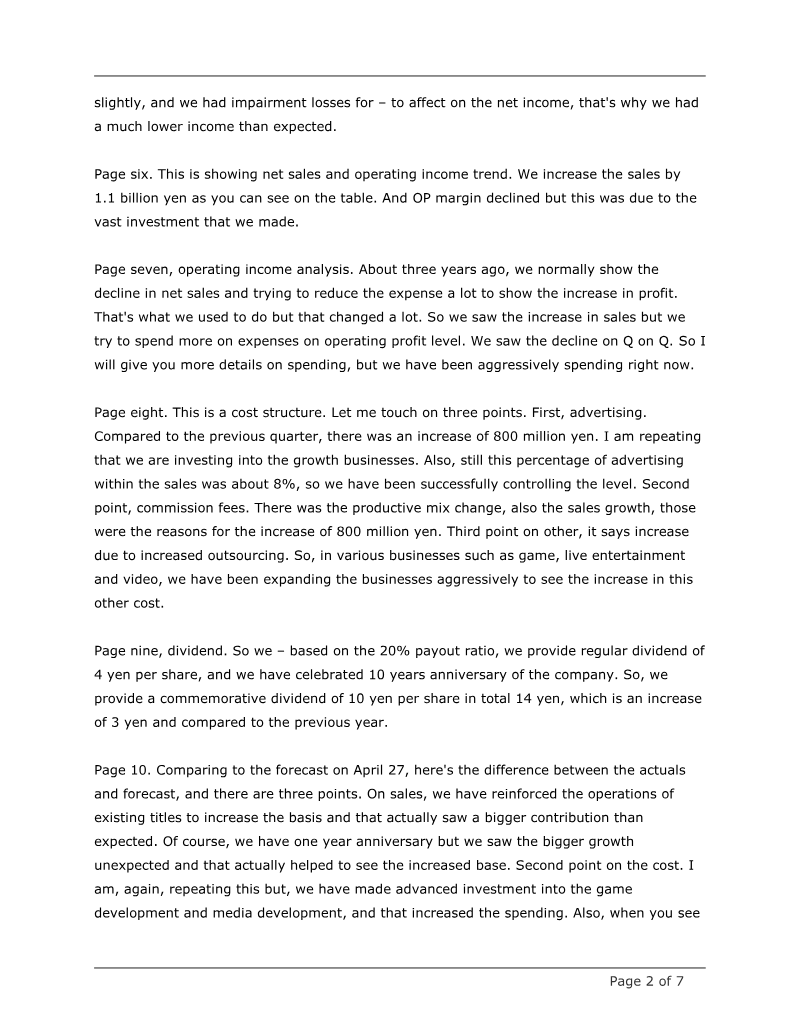
This transcript details the financial results for GREE, Inc. for the fourth quarter and full fiscal year ending in 2018. The primary thesis of the presentation is that the company has successfully transitioned from a period of declining sales to a growth phase driven by a three-pillar strategy: mobile gaming, advertising and media, and the emerging live entertainment sector.
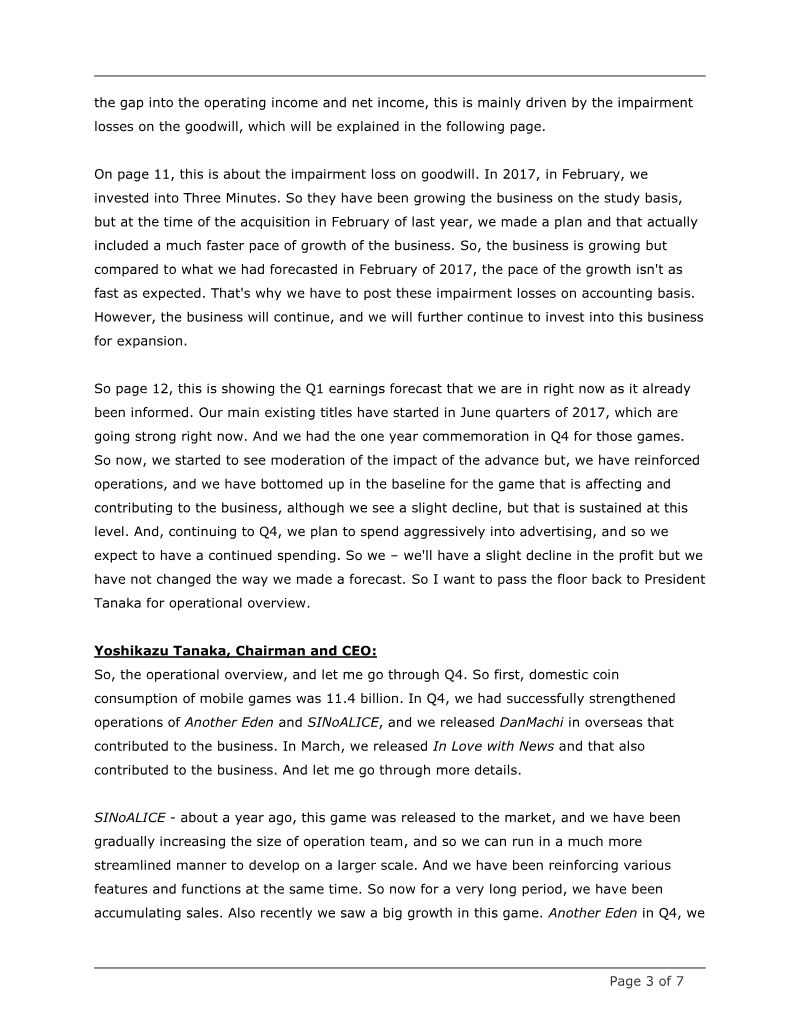
For the full fiscal year 2018, the company reported net sales of 77.9 billion yen and an operating income of 9.4 billion yen, marking the first increase in both sales and profit in six years. Fourth-quarter sales reached 19 billion yen with an operating income of 1.6 billion yen. While sales grew quarter-on-quarter, operating income was impacted by aggressive investments in growth businesses and an impairment loss on goodwill related to the acquisition of Three Minutes. To celebrate its 10th anniversary and reflect this return to growth, the company issued a commemorative dividend, bringing the total annual dividend to 14 yen per share.
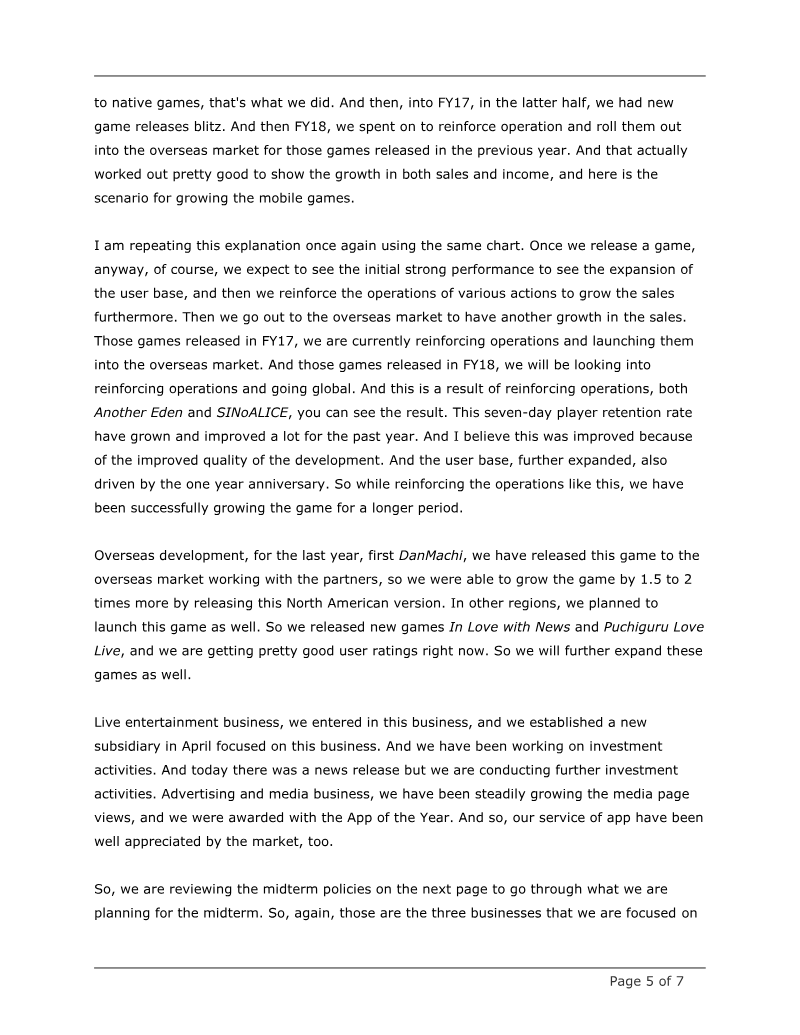
The game business remains the company's foundation, with key titles like SINoALICE and Another Eden showing strong performance through reinforced operations and one-year anniversary events. A significant portion of the growth strategy involves global expansion; for example, the North American release of DanMachi increased its business scale by 1.5 to 2 times. Looking toward FY2019 and beyond, the company plans to release four to five titles annually and expand existing IPs into multi-platform environments, including Nintendo Switch and Facebook Instant Games.
The company is also heavily prioritizing its new live entertainment pillar, specifically focusing on the Virtual YouTuber (VTuber) ecosystem. This includes a planned 10-billion-yen investment and the establishment of a dedicated subsidiary, Wright Flyer Live Entertainment. Simultaneously, the advertising and media segment is being developed to create one of Japan’s largest vertical media portfolios. The geographic scope is primarily Japan, with increasing emphasis on North American, European, and Chinese markets.
Pages
Insights
- GREE, Inc. achieved its first year-over-year increase in sales and profit in six years, reporting 77.9 billion yen in net sales and 9.4 billion yen in operating income for FY2018.
- The company is launching a 10-billion-yen investment strategy into the live entertainment sector, specifically targeting the Virtual YouTuber (VTuber) ecosystem through a new subsidiary, Wright Flyer Live Entertainment.
- Mobile gaming remains the core revenue driver, supported by strong performance from titles like SINoALICE and Another Eden and a successful North American expansion of DanMachi that increased its business scale by 1.5 to 2 times.
- Future growth plans include releasing four to five new game titles annually and expanding existing IPs to multi-platform environments such as Nintendo Switch and Facebook Instant Games.
- Fourth-quarter operating income of 1.6 billion yen was impacted by aggressive growth investments and an impairment loss on goodwill following the acquisition of Three Minutes.