Showing 30 of 654 results · 0.96s
Jan 2022
Global Esports & Live Streaming Market Report
Newzoo
dominance in Western markets for PC and console gaming, while YouTube Gaming and Facebook Gaming have successfully captured the mobile-centric audiences of emerging regions. To challenge established
Report51 pages
Jan 2021
Audio Ad Engagement in Mobile Games
AudioMob
intrusive alternative to traditional video and banner formats within the mobile gaming industry. The primary thesis posits that audio ads maintain player engagement and retention by allowing gameplay
Report7 pages
Jan 2025
Understanding Audiences and Designing Better Mobile Games
Newzoo
analysis establishes that genre is the primary driver of mobile‑game discovery, influencing 49 % of players across nine major markets and outweighing recommendations and advertising. Within this framework
Report87 pages
Mar 2024
Turkey Game Market 2023 Report
Gaming in Turkey
Mobile gaming remains the cornerstone of the ecosystem, with Turkish developers achieving international acclaim. Notably, Dream Games’ Royal Match became the world’s highest-grossing mobile title
Report351 pages
Jan 2024
The Xsolla Report: State of Play (Autumn 2024 Edition)
Xsolla
Mobile gaming is now the dominant segment of the global video‑games market, generating $98.7 billion in 2024, of which roughly two‑thirds ($65 billion) originates from Asian
Report47 pages
Jan 2025
Japan Game Market Insights 2025
Sensor Tower
analysis demonstrates that Japan’s mobile gaming sector has reached a mature equilibrium, with download volumes stabilising after 2020 while in‑app purchase (IAP) revenue continues to grow
Report46 pages
Jan 2023
State of the Market: Puzzle Games Q1 2023
Apptica
continued maturity and high monetization potential of the puzzle genre within the global mobile gaming ecosystem
Report16 pages
Jan 2026
Reconnecting with Gen Z Mobile Gamers: UK
Bryter
high engagement levels but increasing volatility. While 79% of this cohort plays mobile games at least several times a week, their overall time investment is declining, dropping
Report10 pages
Jan 2021
Games Marketing Insights for 2021
King
mobile gamers across nine markets, including the United States, United Kingdom, Germany, and South Korea. Data indicates that the mobile gaming audience grew by 28 million
Report24 pages
Jan 2023
SensorTower The State of Mobile Gaming 2023
Sensor Tower
SensorTower analysis demonstrates a pronounced shift in mobile gaming dynamics, with hyper‑casual titles experiencing a 24 % year‑over‑year decline in Q4 2022, while hybrid‑casual games
Report68 pages
Jun 2025
Q2 2025 Gaming Ad Snapshot
MarketIQ
snapshot presents a mid‑year overview of mobile gaming advertising activity, emphasizing the scale of creative assets, audience composition, and platform performance in the second quarter
Report9 pages
Jan 2024
State of Play: Winter 2024
Xsolla
based experiences, and evolving consumer habits that favour direct‑to‑consumer commerce. A mobile‑gaming platform that enables web‑store sales has become a major revenue source, positioning
Report55 pages
Jan 2023
The State of Mobile Gaming in India: A Look at India's Casual, Hyper-Casual, and Real Money Gaming App Industry Trends
MoEngage
This analysis examines the rapid expansion and evolving user behavior within the Indian mobile gaming market, focusing on the casual, hyper-casual, and real-money gaming (RMG) segments
Report25 pages
Jan 2025
Mobile Gamer 2021: Gen Z Edition
Tapjoy
games, and Instagram ads. Advertising engagement shows a strong preference for rewarded mobile game ads (61 % enjoy offerwalls) and short, creative content such as memes (50.4 %) and humor
Report19 pages
Mar 2024
Africa Games Industry Report
Games Industry Africa
into digital entertainment. This evolution is supported by a complex value chain where mobile gaming accounts for the vast majority of engagement, mirroring global trends where mobile platforms
Report72 pages
Jan 2024
Mobile Gaming Benchmarks for Q1 2024
GameAnalytics
benchmark study presents a comprehensive snapshot of mobile gaming performance during Q1 2024, focusing on key engagement metrics—retention, session length, and session count—across North America, Europe
Report24 pages
Jun 2026
Vietnam Game Industry Monthly Report: May 2026
Gamota
Game Industry Monthly Report for May 2026 provides a comprehensive analysis of the mobile gaming landscape, highlighting a shift in market dynamics from pure volume-based acquisition
Report23 pages
May 2022
Gaming Spotlight: 2022 Review
International Data Corporation
Mobile gaming has emerged as the primary engine of the global games market, projected to reach $136 billion in 2022 and accounting for over 60% of the industry
Report32 pages
Jan 2021
Global Games Market Report 2021: The VR & Metaverse Edition
Newzoo
releases, which have disproportionately impacted the console and PC segments. Despite these challenges, mobile gaming continues to expand, accounting for $90.7$ billion or 51% of total market revenue
Report38 pages
Jan 2021
In-Game Events Snapshot
GameRefinery, Vungle
snapshot presents a comprehensive overview of in‑game event strategies across the global mobile gaming market, focusing on seasonal and promotional collaboration events. It establishes that
Report24 pages
Jun 2025
Southeast Asia: Mobile Game Market Insights 2025
Sensor Tower
Southeast Asia solidified its position as the world’s second-largest mobile gaming market by downloads in early 2025, reaching 1.93 billion installs. While the region currently ranks
Report37 pages
Jan 2022
Newzoo IP-Based Mobile Games Report (2022)
Newzoo
Intellectual property has emerged as a primary driver of success in the mobile gaming landscape, particularly as privacy changes like Apple’s IDFA have complicated traditional user acquisition
Report39 pages
Jun 2022
The Highest-Grossing Mobile Games on iOS & Android: Q2 2022
Apptica
analysis set out to pinpoint the highest‑grossing mobile games of the second quarter of 2022, evaluating performance across Android and iOS markets. Data were drawn exclusively from
Report16 pages
Jan 2022
The State of Mobile Gaming 2022: Market Trends and Top Titles in the U.S., Europe, and Asia
Sensor Tower
Global mobile gaming revenue experienced its first historical year-over-year decline in the first quarter of 2022, falling 6% to $21.2 billion. This contraction follows a period
Report67 pages
Jan 2021
Gaming Spotlight 2021 Review
data.ai
mobile and console experiences, as mobile devices increasingly offer console-quality graphics and cross-platform social features. Data indicates that global consumers downloaded over 1 billion games
Report26 pages
Jan 2025
Gaming App Insights Report: 2025 Edition
Adjust
analysis tracks the state of the global mobile‑gaming market through 2024 and projects its trajectory toward 2025, emphasizing how emerging AI‑driven personalization will shape growth
Report40 pages
Jan 2021
The State of MOBA Mobile Games 2021
Sensor Tower
This analysis explores the Multiplayer Online Battle Arena (MOBA) sub-genre within the mobile gaming market, focusing on its rapid financial growth and competitive landscape. Leveraging data from
Report39 pages
Jan 2019
Serbian Gaming Industry Report 2018
SGA
producing titles ranging from cyber‑punk point‑and‑click adventures to hyper‑casual mobile games. Studios like Munzesky Games, Oraharo Entertainment, PWN.RS, Stargazer, Superverse Industries, Tummy Games
Report42 pages
Nov 2021
In-Game Events Snapshot: November 2021
GameRefinery
game events have become a cornerstone of mobile game monetization and player retention, with 90% of the top 100 grossing mobile titles utilizing seasonal events. This analysis examines
Report24 pages
Feb 2026
Vietnam Mobile Gaming 2025: The Next Billion-Dollar Frontier in Southeast Asia
InvestGame
report argues that Vietnam’s mobile gaming sector will reach a billion‑dollar valuation by 2025, driven by an expanding user base and high spending per download
Report18 pages
Global Esports & Live Streaming Market Report
Jan 202251 pages6k words
Summary
The global esports market is projected to reach $1.38 billion in revenue and an audience of 532 million by the end of 2022, signaling a period of robust expansion and structural evolution. China remains the dominant regional player, contributing nearly one-third of total global revenue. While sponsorships continue to serve as the industry’s financial backbone, accounting for approximately 60% of income, organizations are increasingly diversifying into direct-to-fan models. These new revenue streams include lifestyle apparel, blockchain-integrated loyalty programs, and educational platforms, reflecting a strategic shift toward positioning esports as a broader lifestyle brand.
The live-streaming ecosystem is experiencing even more rapid growth, with the audience expected to reach 1.41 billion by 2025 at a compound annual growth rate of 16.3%. This surge is fueled by the rise of non-gaming content and the explosive popularity of mobile esports in emerging markets such as Southeast Asia, Latin America, and the Middle East. Demographically, the esports audience represents a high-value target for advertisers, as nearly three-quarters of enthusiasts are employed full-time and 44% belong to high-income brackets.
Platform dynamics reveal a clear geographic and technological divide. Twitch maintains its dominance in Western markets for PC and console gaming, while YouTube Gaming and Facebook Gaming have successfully captured the mobile-centric audiences of emerging regions. To challenge established leaders, platforms are leveraging massive video-on-demand audiences and exclusivity deals to convert passive viewers into live participants. Despite this growth, the industry faces potential volatility from the fluctuating cryptocurrency sector and the possible migration of audiences toward emerging metaverse events.
Pages

Insights
- The global esports market is projected to reach $1.38 billion in revenue with 532 million viewers by the end of 2022, with China accounting for nearly one-third of total global revenue.
- The live-streaming audience is forecast to grow at a 16.3% compound annual growth rate, reaching 1.41 billion users by 2025.
- Sponsorships remain the primary financial driver at 60% of total income, though organizations are diversifying into lifestyle apparel, blockchain loyalty programs, and educational platforms.
- The esports demographic is highly attractive to advertisers, with 75% of enthusiasts employed full-time and 44% falling into high-income brackets.
- Platform dominance is split geographically, with Twitch leading Western PC and console markets while YouTube Gaming and Facebook Gaming capture mobile-centric audiences in Southeast Asia, Latin America, and the Middle East.
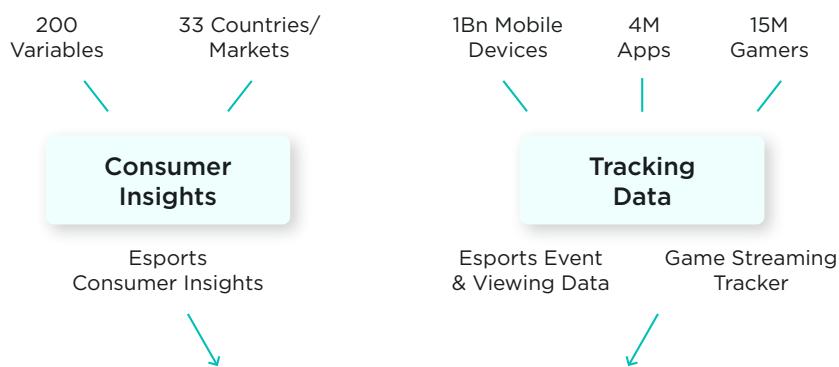
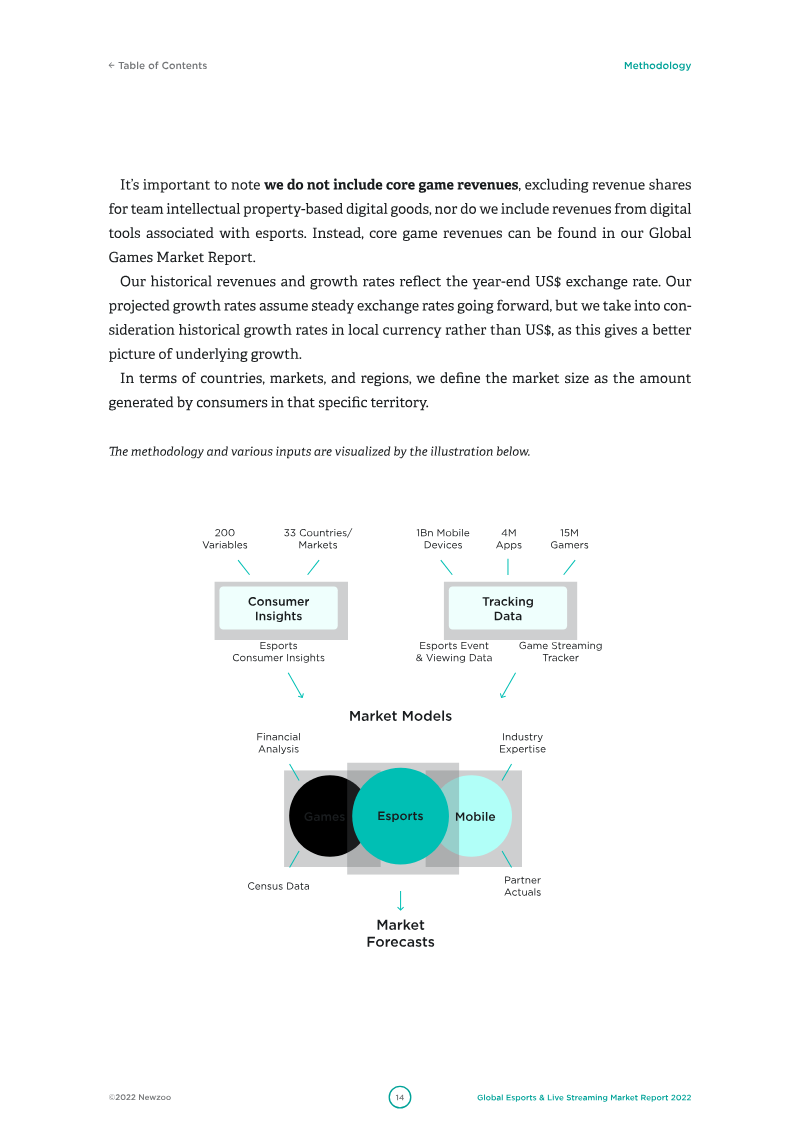
This image from a game industry report illustrates two main categories of data: "Consumer Insights" and "Tracking Data." Consumer Insights are derived from 200 variables across 33 countries/markets, leading to "Esports Consumer Insights." Tracking Data is gathered from 1 billion mobile devices, 4 million apps, and 15 million gamers, contributing to "Esports Event & Viewing Data" and "Game Streaming Tracker."