Showing 30 of 654 results · 0.87s
Jan 2023
Gaming Spotlight 2023
IDC
Mobile gaming continues to dominate the industry’s growth trajectory, yet recent regulatory tightening and rising acquisition costs are poised to curb spend by roughly
Report33 pages
Jan 2023
Mobile Games: State of the Market & Playtime Q3 2023
Apptica, Gamelight
Mobile games: state of the market & playtime Joint report of Apptica & Gamelight The purpose of this study is to analyse the state of gaming category
Report36 pages
Dec 2024
CESA Game Industry Report 2024
CESA – Computer Entertainment Supplier's Association
effect post‑2022, continued expansion of mobile gaming, and rising PC‑gaming share (thanks to Steam). Platform share (2024) – Mobile: dominant share (≈ 60 % of global revenue). Console
Report3 pages
Mar 2024
The Gaming App Insights Report: Unlocking Growth Opportunities for Mobile Marketers
Adjust
mobile gaming industry is entering a period of stabilization and renewed growth following recent volatility, characterized by a 7% year-over-year increase in global installs during late
Report43 pages
Jan 2021
Mobile Game Genre Report: Comparing & Contrasting Eastern and Western Markets
Newzoo
Role-playing games emerged as the dominant force in the mobile gaming industry in 2020, generating $18.5 billion in revenue and capturing over 21% of the global market
Report30 pages
Jan 2019
Mobile Benchmarks Report GameAnalytics
GameAnalytics
mobile gaming landscape in the first half of 2019 reflects a significant structural shift as developers increasingly pivot from in-app purchases toward ad-based monetization models. Analysis
Report34 pages
Apr 2026
State of Gaming 2026
Sensor Tower
State of Gaming analysis demonstrates a shifting landscape in which mobile gaming remains the largest driver of downloads—approximately 50 billion in 2025—but its growth rate
Report69 pages
Game Analytics 100: The Retention Curve
East Side Games
analysis demonstrates that player retention in mobile games can be accurately modeled with a power‑law curve, expressed either
Report23 pages
Jan 2022
The State of Mobile Game and App Markets
AdQuantum
analysis demonstrates that mobile app and game advertising in the first half of 2022 experienced a notable contraction, with a 6.24 % year‑over‑year decline in app advertisers
Report43 pages
Jan 2022
State of Anime Gaming 2022
data.ai
revenue trends, and regional dynamics. Anime‑themed titles generated one‑fifth of all mobile‑game spend in 2021 while capturing only about one percent of overall usage, highlighting
Report19 pages
Jan 2012
Essential Facts 2012: Canada
ESAC – Entertainment Software Association of Canada
computer, computer usage for gaming dropped by 12% since 2010. Conversely, mobile gaming has surged, with 80% of households owning a mobile device and 25% of Canadians citing
Report18 pages
Mobile Gaming by Genre: Midcore
InvestGame
analysis demonstrates that midcore mobile games—those offering depth while remaining accessible on handheld devices—are experiencing a post‑pandemic rebound, with Q1 2025 downloads and revenue surpassing
Report23 pages
Jan 2021
The State of Mobile Gaming 2021: U.S., Europe, and Asia
Sensor Tower
global mobile gaming market experienced an unprecedented surge during the 2020–2021 period, fueled by pandemic-related shifts in consumer behavior that accelerated both spending and engagement
Report78 pages
Jan 2019
Mobile Gaming Apps Report: 2019 User Acquisition Trends & Benchmarks
Newzoo
mobile gaming landscape is defined by a period of unprecedented consumer spending, with gaming apps accounting for 74% of total app store revenue. While the market continues
Report52 pages
Jan 2021
Games Marketing Insights 2021
Meta
Germany, and South Korea—the findings highlight a permanent expansion of the mobile gaming audience. These "new gamers," who began playing after the initial outbreak, are generally younger
Report24 pages
Jan 2025
Mobile Game Market Insights: India 2025
Sensor Tower
India is the world’s largest mobile gaming market by volume, reaching 8.45 billion downloads in the 2024-25 fiscal year. Despite this massive scale, which is more
Report29 pages
Feb 2026
Vietnam Gaming Outlook 2026: Building Sustainable Growth
InvestGame
Vietnam’s mobile gaming landscape is rapidly evolving from a download‑centric, ad‑driven model to a hybrid ecosystem that prioritizes in‑app purchases (IAP) and subscription revenue
Report82 pages
Jan 2022
Market Outlook 2022
Sensor Tower
analysis outlines a 2022 outlook for the global mobile‑gaming market, emphasizing that quarterly installs have plateaued at roughly 14 billion after a pandemic‑driven surge, with casual
Report48 pages
Jan 2024
The State of Gaming 2024
Sensor Tower
global mobile gaming market underwent a significant correction in 2023, characterized by a 10% decline in downloads and a 2% dip in overall revenue. This downturn was primarily
Report46 pages
May 2024
Global Games Market Report 2023
Newzoo
titles such as Valorant, Counter‑Strike, Payday 3 and S.T.A.L.K.E.R. 2. On mobile, role‑playing games hold the largest share at 23.1 % of mobile revenue, but they
Report52 pages
Jan 2020
Czech Video Game PC, Console and Mobile Game Developers in Czech Republic 2020
GDACZ – Czech Game Developers Association
The study maps the structure and dynamics of the Czech video‑game industry as of
Report45 pages
Jan 2025
Cross-Platform Gaming: Bridging Mobile and PC/Console
Sensor Tower
gaming landscape is defined by the convergence of mobile accessibility and PC/console depth. The primary thesis suggests that while mobile serves as a global discovery engine
Report34 pages
Jan 2025
Intelligence Top Mobile Games Challenges: A User Acquisition, Ad & Product Monetization Report
AppLovin
mobile gaming landscape heading into 2025 is defined by the critical difficulty of performing within an increasingly crowded market space. Approximately 41% of user acquisition managers identify market
Report36 pages
Jun 2024
Insights into Global Mobile Game Marketing & Ad Spend Trends for H1 2024
SocialPeta
global mobile gaming landscape in the first half of 2024 is defined by a strategic pivot toward hybrid-casual and subscription-based models as developers seek stable revenue
Report71 pages
Mobile Gaming by Genre: Hypercasual
Gamesforum
hypercasual segment continues to dominate mobile gaming revenue, with the top 100 titles achieving 5.48 billion downloads and $345 million in in‑app purchase (IAP) revenue during
Report28 pages
Jan 2025
Mobile Games in 2025: Trends & Strategies Supercharging Revenue Growth
AppFigures
global mobile gaming market entered a phase of intensified monetization and efficiency in 2024, characterized by a 3.8% increase in consumer spending to $65.7 billion despite
Report47 pages
Jan 2021
Mobile App Trends 2021: A Focus on APAC
Adjust
year. APAC currently accounts for 64% of global mobile app downloads and 60% of global mobile gaming revenue. Fintech emerged as a standout performer, seeing a 36% increase
Report30 pages
Aug 2025
Digital Market Index: Q2 2025
Sensor Tower
economy, with non-gaming applications accounting for 52% of total consumer spending, surpassing mobile games for the first time. While total downloads stabilized at 37 billion, the market
Report46 pages
Jan 2022
2022 Casual Gaming Report
GameRefinery
Casual Gaming Report demonstrates that mobile gaming dominates the global market, accounting for more than sixty percent of total industry revenue. Despite this dominance, overall user spend declined
Report34 pages
Jan 2022
Global Esports & Live Streaming Market Report
Newzoo
dominance in Western markets for PC and console gaming, while YouTube Gaming and Facebook Gaming have successfully captured the mobile-centric audiences of emerging regions. To challenge established
Report51 pages

Gaming Spotlight 2023
Jan 202333 pages7k words
Summary
Mobile gaming continues to dominate the industry’s growth trajectory, yet recent regulatory tightening and rising acquisition costs are poised to curb spend by roughly 2 % in 2023. The analysis underscores that creative optimization, diversified monetization models—including ads, subscriptions, and battle‑passes—and data‑driven partner insights are essential to counter ad fatigue and maintain daily active users, stickiness, and revenue in an increasingly fragmented market. Contextual market data is highlighted as a critical tool for staying ahead of evolving consumer preferences and macroeconomic headwinds.
First‑half 2023 data reveal that free‑to‑play titles remain the most influential drivers of downloads and in‑app purchase (IAP) revenue. “Monopoly GO” led mobile downloads with over 45 million installs and $232 million in IAP, attracting a slightly higher female audience and players aged 25‑34. “Honkai: Star Rail” achieved 62 million downloads and $457 million in spend, largely fueled by a high‑price bundle that accounted for 61 % of May revenue; it appeals more to male players but enjoys strong traction among Gen‑Z gamers. “Royal Match” secured the second spot in global spend with $1.7 billion, driven by a 20 % female skew and significant engagement from players aged 45 and older. These findings illustrate a demographic shift: match‑3 games are increasingly monetized by female and older players, while high‑ticket RPGs continue to attract Gen‑Z consumers.
Survey results indicate a sharp decline in U.S. mobile gamers’ positive sentiment toward in‑game video ads—from 50 % “like” in Q3 2020 to 30 % by Q3 2022—while rewarded‑video ads maintain a more favorable reception at around 40 %. The drop aligns with the rollout of Apple’s ATT framework, yet ad fatigue and oversaturation are identified as primary drivers rather than regulatory causation. The recommendation is to diversify ad formats, prioritizing rewarded videos and playable ads, and to tailor these experiences to specific demographic segments to mitigate fatigue and sustain growth.
Pages


Insights
- Mobile gaming spending is projected to decline by approximately 2% in 2023 due to rising acquisition costs and increased regulatory pressure.
- High-performing titles demonstrate distinct demographic trends: 'Royal Match' generated $1.7 billion in revenue with a strong base of players aged 45+, while 'Honkai: Star Rail' captured $457 million by targeting Gen-Z with high-price bundles.
- Consumer sentiment toward standard in-game video ads has dropped significantly, falling from 50% positive in Q3 2020 to 30% by Q3 2022, largely due to ad fatigue and market oversaturation.
- Rewarded video ads remain more effective than standard video ads, maintaining a 40% favorability rating among U.S. mobile gamers.
- 'Monopoly GO' emerged as a top performer in early 2023, securing 45 million installs and $232 million in IAP revenue, particularly among the 25-34 age demographic.
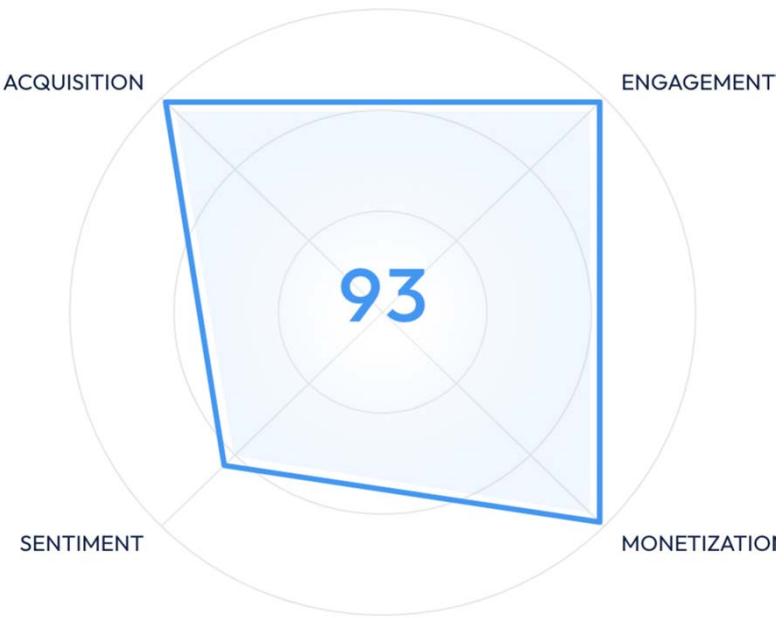
This radar chart displays a high-level performance score of 93, visualizing a game's relative strengths across four key business metrics: Acquisition, Engagement, Monetization, and Sentiment. The shape indicates that the game is performing exceptionally well in acquisition, engagement, and monetization, while sentiment is slightly lower by comparison.