Showing 30 of 463 results · 0.69s
Jun 2014
FY2014 Business Report
mixi
Geographically, the company is focused on the Japanese market while aggressively expanding into Greater China. Following a May 2014 launch in Taiwan, mixi established a partnership with Tencent
Financial2 pages
Jan 2021
Store Intelligence Data Digest: Q4 2020
Sensor Tower
growth with a 28% increase, the United States notably overtook China as the leading App Store market. India remained the global leader in total volume, contributing over
Report77 pages
Jan 2025
Gaming 2025 (Epyllion)
Epyllion
SteamOS. Furthermore, the rise of high-quality AAA titles from China and localized media in emerging markets is successfully challenging Western dominance by prioritizing domestic cultural themes
Report224 pages
Jan 2025
Access for All: Expanding Opportunities for Players and Publishers Worldwide
Niko Partners
channels account for 21% of mobile game revenue, while in China, they represent 53% of the market. Data from 2023 highlights that in the "SEA-6" countries (Indonesia
Report15 pages
Nov 2020
The SuperJoost Playlist: Musk Gets into Gaming
SuperJoost
content creators. The scope of the analysis is global, covering market shifts in the United States, China, and Australia. Key data points include Sony’s confirmation
Article
Mar 2026
Where Are Steam, Xbox and PlayStation's Players Located?
GameDiscoverCo
player base. Additionally, the data suggests a growing gray market for PlayStation hardware in mainland China, often reflected through Hong Kong profiles. In contrast, the Xbox ecosystem
Article
Dec 2024
From Hits to Misses: Why Some Games Thrive While Others Disappear
Sparkers
that reached over 82,000. The analysis covers the global market, referencing North America, Europe, and China, and spans the period from early 2024 to December 2024. Methodologically
Article1 pages
Jan 2021
PaaS for Mobile Cloud Gaming
Niko Partners
draws on proprietary consumer panels of over 4 million in China and millions across other Asian markets, supplemented by industry interviews. The conclusion posits that mobile cloud PaaS
Report23 pages
Mar 2024
TikTok: Time's Up — Clocking Foreign Influence in Domestic Media and Entertainment
SuperJoost
scope of the analysis covers the global interactive entertainment market with specific focus on U.S.-China relations, the 2023-2024 fiscal periods, and the intersection of social media
Article
FY2019 Fourth Quarter Financial Results Briefing
GREE
million. Geographically, the firm expanded into key Asian markets—including Hong Kong, Taiwan, and China—while launching titles in North America and Europe. Distribution strategy emphasizes self‑distribution
Financial5 pages
Apr 2026
How Hozy Went Cozy to Sell 100k on Steam in 4 Days
GameDiscoverCo
diverse revenue split, with the United States, Germany, and China emerging as the top three markets. Beyond the specific case study of Hozy, the analysis emphasizes the importance
Article1 pages
Jul 2026
Micro-Horror Games in Vietnam (Part 2): User Acquisition, Localization, and Expansion
SocialPeta
place. Geographically, the focus is on Vietnam’s domestic market, with comparative insights drawn from China’s micro‑horror wave. The document cites local success stories such
Article1 pages
Jan 2020
Tower Defense Games: Deconstructing the Superstars (2020 Industry Snapshot)
GameAnalytics
records the highest average daily playtime at 210 minutes. However, China emerges as the most effective market for monetization, achieving a conversion rate of 8.7%, nearly double that
Report8 pages
Mar 2023
Contraband Police: How It Hit Big and Why Game Hook Matters
GameDiscoverCo
launch wishlist of 306,000. Geographic data shows the primary markets as the United States (19%), China (16%), and Germany (11%). The scope also covers broader Steam ecosystem
Article
Jun 2019
Global Market Trends: Mobile Gaming Benchmarks (H1 2019)
GameAnalytics
conversion rates nearly four times higher than other categories. Geographically, China has emerged as a formidable market, with eCPM rates reaching $3.90, effectively rivaling the United States
Report34 pages
Jul 2026
Palworld 1.0 Pushes the Hit Over 30M Copies Sold
Alinea Analytics
total unit sales, with the United States and China serving as the two largest markets, each representing roughly 27% of the Steam user base. The 1.0 update, supported
Article1 pages
2008 Annual Report
Tencent
Overall, Tencent’s 2008 performance underscored its dominant position in China’s internet and mobile services market, delivering robust revenue growth, profitability, and shareholder returns amid a challenging
Financial170 pages
Mar 2017
Annual Report of 11 bit studios S.A. for 2016
11 bit studios
revenue generated outside Poland. The United States remains the primary market at 77.8% of sales, while China has emerged as the second-largest region. The Group maintained
Financial86 pages
Mar 2026
FY 2025 Results Presentation
tinyBuild
disposal of Red Cerberus. Geographically, the company targets global markets with a particular emphasis on China, where localisation contributed to roughly 40 % of sales. The pipeline includes seven
Financial27 pages
Oct 2024
Financial Results for the First Half of the Fiscal Year Ending March 2025
Koei Tecmo
focus, with strengthened publishing infrastructures in North America, Europe, and China, alongside targeted entry into emerging markets in Southeast Asia and India. While domestic Japanese revenue is expected
Financial51 pages
Jan 2025
Mobile Games in 2025: Trends & Strategies Supercharging Revenue Growth
AppFigures
like Tencent and Scopely maintain their dominance, new entries from China and Japan are capturing substantial global market share. Growth is also accelerating in emerging markets, with Brazil
Report47 pages
Jan 2021
Tower Defense Games 2020 Industry Snapshot
GameAnalytics
while France records the highest average playtime at 210 minutes. China stands out as the most effective market for monetization, boasting a conversion rate of 8.7%, nearly double
Report8 pages
May 2026
007 First Light: Estimating Steam Market Performance
Alinea Analytics
year. The data also reveals a notable regional performance, with China emerging as the second-largest market for the game, accounting for 18% of Steam players. This success
Article1 pages
Apr 2023
Mobile Game Market Review October 2023
GameRefinery
bolster revenue. Geographically, the review focuses on major global markets, specifically the United States, Japan, and China, highlighting how regional preferences dictate event structures, such as the prevalence
Report10 pages
May 2022
Mobile Gaming Market Outlook 2022
Sensor Tower
Real-Time Strategy sector is seeing a geographic shift, with China overtaking the U.S. as the top market for the sub-genre. Future expansion across these segments will
Report48 pages
Mar 2026
Weekly Gaming Reports Recap: March 2 – March 6, 2026
GameDev Reports
fees and taxes, excluding Chinese Android store data. The Chinese market analysis utilizes information prepared by the China Audio-video and Digital Publishing Association (CADPA), providing a high
Article1 pages
Nov 2021
Riding the Brake: Indecision is Always the Wrong Decision
SuperJoost
since its IPO following regulatory crackdowns on minor playtimes in China. These findings suggest that while the market remains lucrative, the lack of decisive leadership
Article
Aug 2021
Raport Bieżący ESPI Nr 19/2021
PlayWay
with the remaining volume spread across various international markets including the United Kingdom, France, and China. Strategic management of the franchise includes a higher retail price point
Legal2 pages
Dec 2024
Brutally Honest #148: User Acquisition in the Post IDFA World
Brutally Honest
scope of the coverage is global, with specific mentions of market dynamics in the United States and China, and performance data from late 2024 through early
Article
Tencent 2026 First Quarter Results Presentation
Tencent
transition toward AI-centric operations while maintaining leadership in China’s mobile community and digital content markets
Financial25 pages
FY2014 Business Report
Jun 20142 pages2k words
Summary
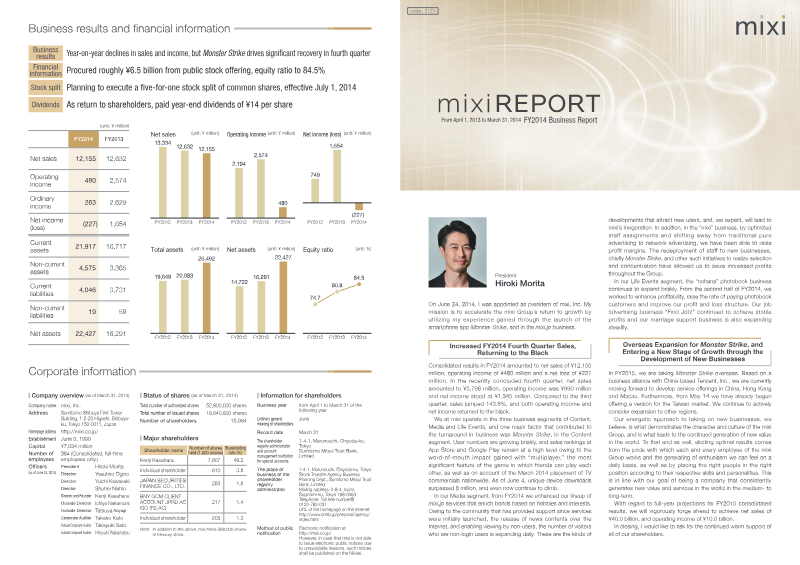
This business report details the financial performance and strategic pivot of mixi, Inc. for the fiscal year ending March 31, 2014. While the company experienced year-on-year declines in annual sales and income—reporting net sales of ¥12.1 billion and a net loss of ¥227 million—the fourth quarter marked a significant turnaround. Driven by the explosive success of the mobile game Monster Strike, fourth-quarter sales jumped 143.8% compared to the third quarter, returning the company to profitability.
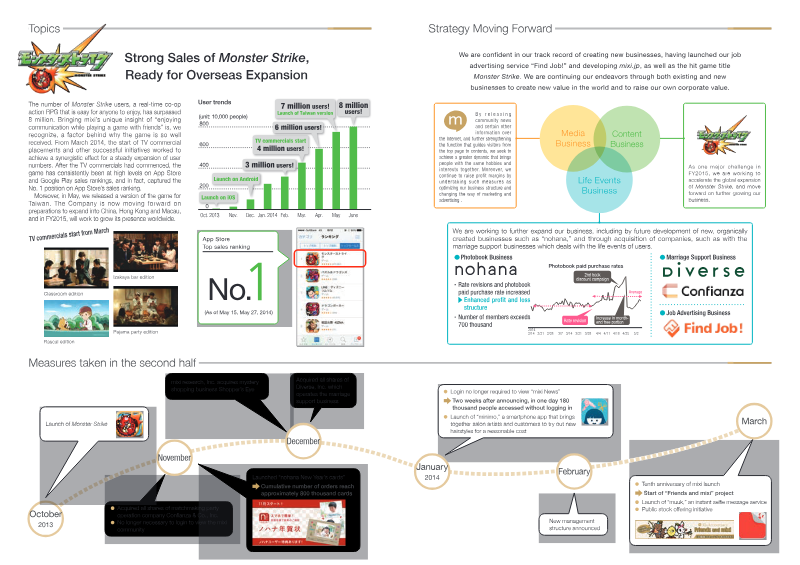
The primary catalyst for this recovery was the Content segment, specifically Monster Strike, which surpassed 8 million users by June 2014. The game achieved the top sales ranking on the App Store following a nationwide television advertising campaign. Beyond gaming, the company optimized its Media segment by shifting from pure advertising to network advertising and removing login requirements for certain services to increase traffic. The Life Events segment also saw growth through the "nohana" photobook service and the acquisition of marriage support businesses like Diverse, Inc. and Confianza & Co., Inc.
Geographically, the company is focused on the Japanese market while aggressively expanding into Greater China. Following a May 2014 launch in Taiwan, mixi established a partnership with Tencent to enter China, Hong Kong, and Macau. Financially, the company strengthened its position by procuring ¥6.5 billion through a public stock offering, raising its equity ratio to 84.5%. Looking forward to FY2015, leadership has set ambitious targets of ¥40.0 billion in net sales and ¥10.0 billion in operating income, supported by a five-for-one stock split to enhance shareholder liquidity.
Pages
Insights
- Driven by the success of Monster Strike, mixi achieved a 143.8% quarter-over-quarter sales increase in Q4 FY2014, successfully returning the company to profitability after a net loss of ¥227 million for the full fiscal year.
- Monster Strike became the primary revenue driver for the Content segment, reaching over 8 million users by June 2014 and securing the top sales ranking on the App Store following a national TV advertising campaign.
- The company set aggressive growth targets for FY2015, aiming for ¥40.0 billion in net sales and ¥10.0 billion in operating income.
- mixi strengthened its balance sheet by raising ¥6.5 billion through a public stock offering, resulting in an equity ratio of 84.5%.
- International expansion is centered on Greater China, supported by a May 2014 launch in Taiwan and a strategic partnership with Tencent to enter China, Hong Kong, and Macau.