Showing 30 of 463 results · 0.78s
Tencent Holdings Limited Annual Report 2006
Tencent
holds 35.6 % of issued shares. Geographically, operations are concentrated in mainland China (≈70 % of segment assets), with subsidiaries and customers spread across Asia, Africa, and the Mediterranean under
Financial122 pages
Oct 2021
Supply Chain Battle Royale: What Do You Mean It's on a Boat?
SuperJoost
sector—including consoles, accessories, and peripherals—faces a critical bottleneck. Shipping times from China have nearly tripled from 37 to 110 days, while container costs have increased tenfold
Article
Jul 2020
Game Discoverabilityland: The Season of Discovery
GameDiscoverCo
visibility for smaller titles. Conversely, the mobile sector faces increased regulatory hurdles in China, where new ISBN requirements for paid games have created significant barriers to entry
Article1 pages
Oct 2024
Roblox 10-Q — Q3 FY2024 (October 2024)
Roblox
jurisdictions, including child‑protection laws in the U.S., EU Digital Services Act, and China’s PIPL. Compliance costs could reach 10 % of global revenue, with potential fines
Financial1 pages
Aug 2024
How Rusty's Retirement Idle-Farmed Its Way to 300k+ Steam Sales
GameDiscoverCo
International reach was also a significant factor, with 26% of sales originating from China, followed by Japan, Korea, and Taiwan. The methodology behind this success involved a combination
Article1 pages
Aug 2020
2020 Interim Report
IGG
schemes and corporate governance structures. Operational presence within the People’s Republic of China remains managed through structured contracts, which allow for the consolidation of Fuzhou Tianmeng
Financial71 pages
Jul 2025
How Peak Sold 4.5m Copies in Less than a Month
GameDiscoverCo
launch, the title relied on post-release momentum rather than traditional pre-release marketing. Key design choices, such as procedural mountain generation and the integration of proximity voice
Article1 pages
Jun 2026
Retailer Warns of GTA Console Stock Shock
The Game Business
away from physical media, which collectively signal a volatile period for the consumer market. Beyond hardware, the industry is undergoing a structural shift in investment strategy. New initiatives
Article1 pages
Jul 2022
Top 20 Mobile Games by Revenue, Downloads, and Advertising: June 2022
SocialPeta
PUBG Mobile and Garena Free Fire. Dessert DIY exploded in the U.S., China, and UK with a 486 % month‑over‑month download surge after an icon refresh. Master
Article1 pages
Aug 2021
Turtle Beach 10-Q: Q2 FY2021
Turtle Beach
million, and operating income reached $12.7 million, reflecting higher sales‑and‑marketing spend that supported the revenue lift. Net income more than doubled to $10.6 million, translating into
Financial1 pages
Nov 2024
Nexon Q3 2024 Earnings Release
NEXON Co.
overall franchise) | • Launch of DnF Mobile in China (May 21) • New updates & “New Year” content for both mobile & PC in China (Q4 2024 / Q1 2025) • Upcoming titles
Financial5 pages
Apr 2025
Huya Inc. Form 20‑F FY2024
Huya
were cut by 22 % to RMB 1.04 billion, reflecting reduced R&D and marketing spend. The company posted an operating loss of RMB 189 million
Financial1 pages
Fiscal Year Ended March 2026: Results Presentation
Sega Sammy Holdings
Birds IP through film and licensing initiatives, and launching additional mobile games in China to restore earnings. Operational improvements, trans‑media expansion, and targeted IP development underpin
Financial62 pages
Feb 2026
Take Rates in China
Niko Partners
analysis evaluates how take‑rate structures shape mobile game monetisation in China and whether higher‑quality development can outweigh the pressure of traditional distribution fees. It contrasts Apple
Report10 pages
China Ruyi FY2025 Q4 Earnings Release
InvestGame
China Ruyi achieved a substantial financial turnaround in fiscal year 2025, transitioning from a net loss of RMB 206.6 million in the previous year to a net profit
Financial1 pages
Apr 2026
Annual Report Pursuant to Section 13 or 15(d) of the Securities Exchange Act of 1934: Form 20-F
NetEase
NetEase, Inc.’s 2025 Form 20-F annual report provides a comprehensive disclosure of the
Article1 pages
Jun 2009
NetEase 20-F: FY2008
NetEase
with an overall margin of 81.9 %. Operating expenses grew modestly, while selling and marketing costs fell 5.9 %, resulting in a net profit after
Financial1 pages
Sep 2021
Start Rolling for Initiative: Sobering Market Signals Trigger Video Game Industry Reality Check
SuperJoost
The video game industry is currently undergoing a significant "reality check" as pandemic-era hypergrowth
Article
Annual Report 2007: Tencent Holdings Limited
Tencent Holdings Limited
profit to the consolidated results. Tencent maintained a concentrated geographic focus on mainland China, with modest international revenue streams from the United States, Hong Kong, and Europe. Governance
Financial146 pages
Apr 2025
How Cloverpit Added 100k Steam Wishlists in a Week
GameDiscoverCo
unreleased title Cloverpit serves as a case study in effective game marketing through strategic demo releases and influencer engagement. Developed by Panik Arcade and published by Future Friends
Article1 pages
Jan 2021
In-Game Events Snapshot
GameRefinery, Vungle
comprehensive overview of in‑game event strategies across the global mobile gaming market, focusing on seasonal and promotional collaboration events. It establishes that 90 % of the top‑grossing
Report24 pages
Summary of main supplementary explanations questions and answers at the FY2021 Second Quarter GREE results briefing held on February 12, 2021
GREE
some segments, companywide earnings were not materially affected. Distribution of app games in China was described as meeting expectations, though profit sharing with local partners reduces
Report1 pages
Apr 2021
Form 20-F: FY 2020
NetEase
Operating expenses rose 33 % to RMB 24.4 billion, driven by heightened marketing and R&D spend that supports new titles and international studio openings. Net income from continuing
Financial1 pages
Jul 2026
Hero Esports CEO Uses Cannes Lions Stage to Pitch Esports’ Global Brand Appeal
The Esports Advocate
Festival of Creativity to advocate for the integration of esports into mainstream global marketing and entertainment strategies. The core thesis posits that esports has evolved beyond niche competitive
Article1 pages
Mar 2020
Fact Book 2020
Bandai Namco
Bandai Namco’s 2020 performance reflects a modest contraction in consolidated net sales to ¥723.99
Financial32 pages
May 2021
What Do Devs Really Think of Game Platform Cut?
GameDiscoverCo
The 2021 State of the Game Industry survey, conducted by the Game Developers Conference (GDC
Article
May 2011
Financial Results for the Third Quarter of the Fiscal Year Ending on June 30, 2011
GREE
This financial report details the performance of GREE, Inc. for the third quarter of the
Financial28 pages
Jan 2022
Two & a Half Gamers Session #34: Low Budget UA and Sheep a Sheep
Two & a Half Gamers
The mobile gaming landscape is currently defined by a shift toward hyper-viral social mechanics
Article
Apr 2013
Form 20‑F: Fiscal Year Ended December 31, 2012
Gravity Co.
Gravity Co., Ltd. filed a Form 20‑F for the fiscal year ending December 31
Financial1 pages
Dread Hunger: Lessons from Success in the Social Deduction Genre
GameDiscoverCo
The interview outlines how Digital Confectioners’ hybrid social‑deduction survival game, conceived in late 2019
Article
Tencent Holdings Limited Annual Report 2006
122 pages44k words
Summary
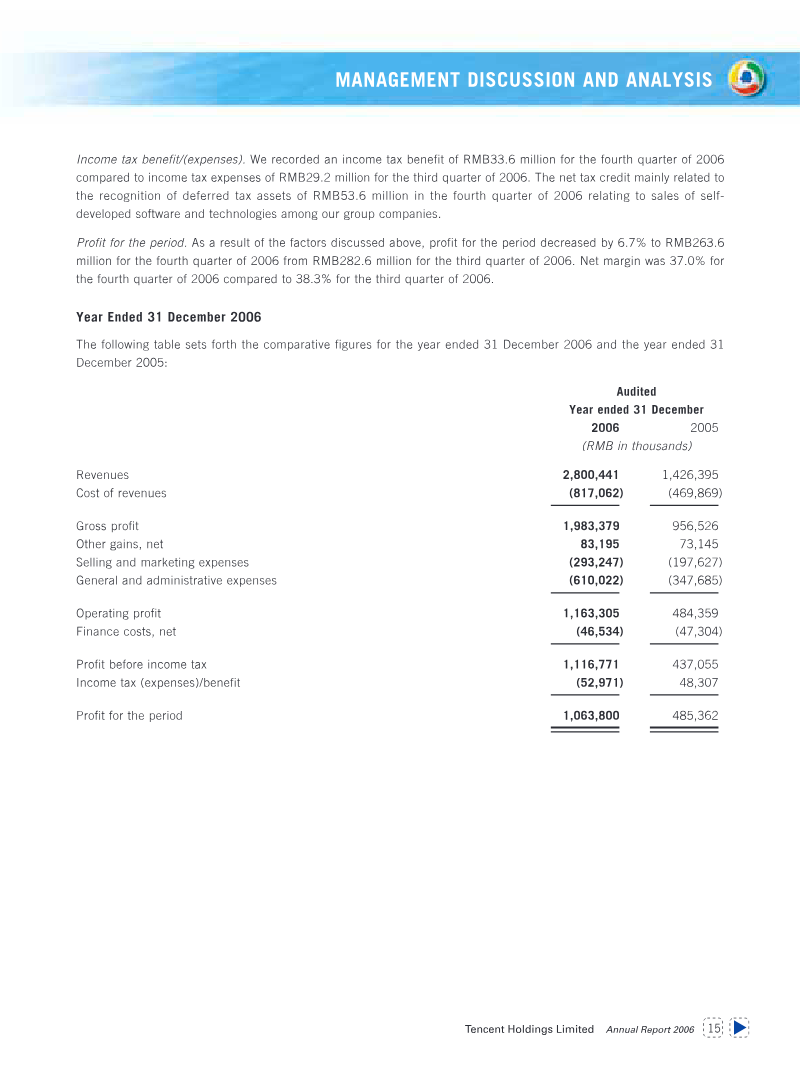
Tencent Holdings Limited’s 2006 annual report demonstrates a dramatic expansion of its internet‑based business, with total revenues rising 96.3 % to RMB 2,800 million and net profit increasing 119 % to RMB 1.06 billion. Growth is driven primarily by a 132 % increase in Internet value‑added services and a 136 % jump in online advertising, while mobile/telecom services also contributed significantly. Operating profit surged to RMB 1.16 billion, and the net margin improved from 34 % to 38 %. Cash and investments totaled RMB 3.22 billion, largely in U.S. dollar‑denominated assets that expose the group to Renminbi appreciation risk.
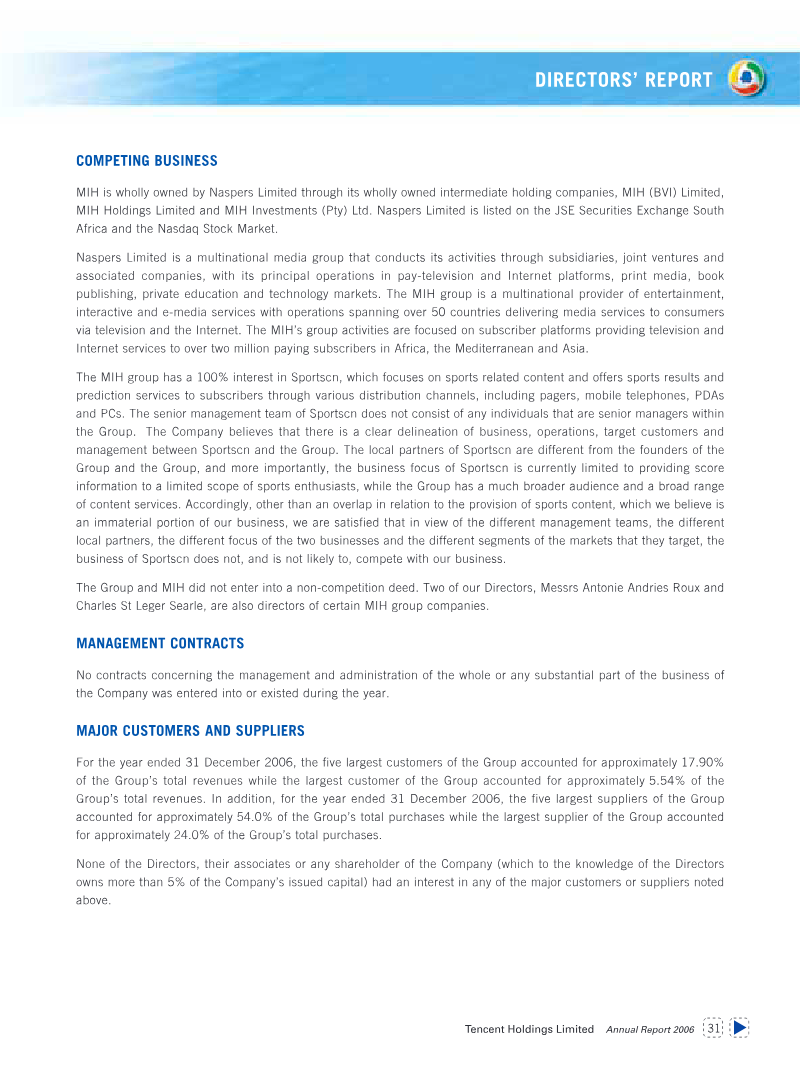
The company’s financial health is reinforced by a strong balance sheet: total assets rose to RMB 1.77 billion, and the group maintained no interest‑bearing borrowings as of year‑end. Shareholder value initiatives included a final dividend of HKD 0.12 per share, the repurchase and cancellation of 18.4 million shares during 2006, and a cumulative share buyback of over 32 million shares since its IPO. Governance structures feature a board with executive, non‑executive and independent directors, audit and remuneration committees, and compliance with Hong Kong listing rules. Key executives hold significant share positions through BVI entities, while Naspers‑controlled MIH QQ holds 35.6 % of issued shares.
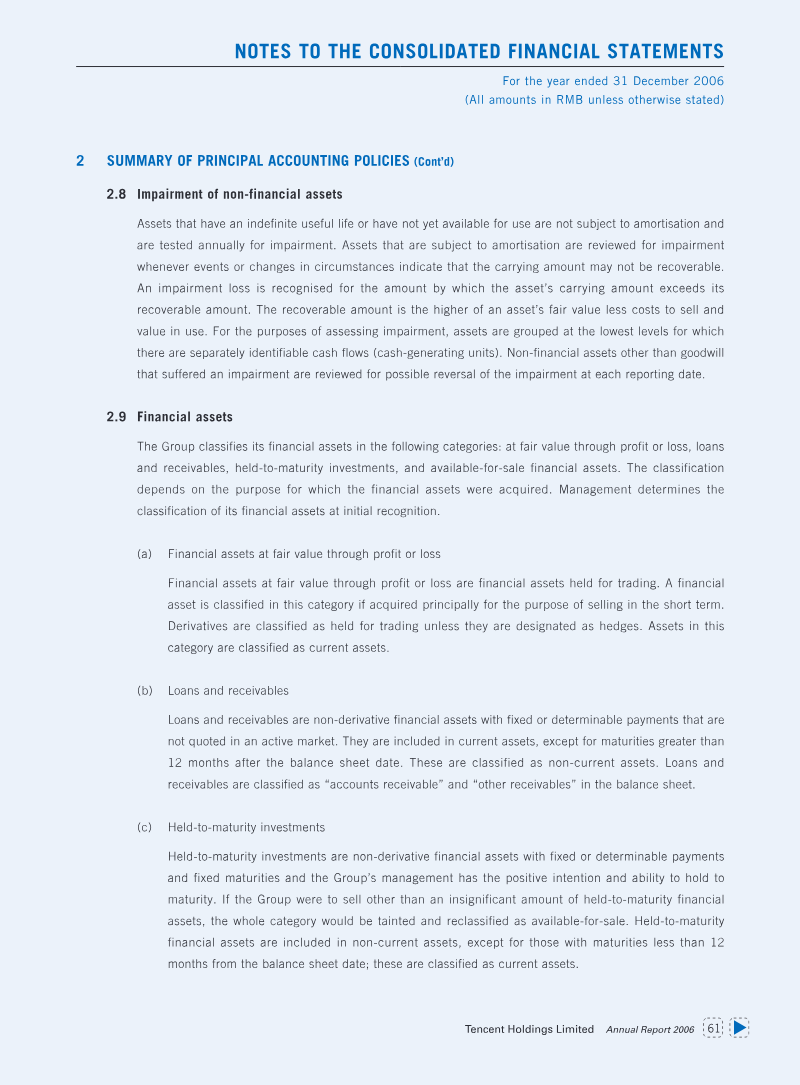
Geographically, operations are concentrated in mainland China (≈70 % of segment assets), with subsidiaries and customers spread across Asia, Africa, and the Mediterranean under Naspers’ umbrella. The report covers fiscal year 2006, detailing revenue streams from internet services, mobile telecoms, and online advertising, and outlines accounting policies such as IAS 39 adoption, fair‑value measurement for available‑for‑sale securities, and share‑based compensation recognition. Overall, Tencent’s 2006 performance reflects rapid scaling of core digital services, robust profitability, and a commitment to shareholder returns within a growing but still low‑penetration Chinese internet market.
Pages
Insights
- Tencent experienced rapid financial growth in 2006, with total revenues rising 96.3% to RMB 2,800 million and net profit increasing 119% to RMB 1.06 billion.
- Revenue expansion was primarily driven by a 132% increase in Internet value-added services and a 136% surge in online advertising.
- The company maintained a strong financial position with no interest-bearing borrowings and a net profit margin that improved from 34% to 38%.
- Tencent prioritized shareholder returns in 2006 by issuing a final dividend of HKD 0.12 per share and repurchasing 18.4 million shares.
- MIH QQ, controlled by Naspers, remained the largest shareholder with a 35.6% stake in the company.
Year Ended 31 December 2006