Showing 30 of 654 results · 1.03s
Jan 2024
State of Mobile 2024
data.ai
billion and daily engagement surpassing five hours per user in leading markets. While mobile gaming faced a slight 2% contraction in spending due to economic headwinds
Report103 pages
Dec 2024
Digital Market Index: Q4 2024
Sensor Tower
three-quarters of the 34.1 billion global downloads recorded during the period. The mobile gaming landscape underwent a notable structural shift as consumer preferences migrated from traditional RPGs
Report46 pages
Jun 2010
El Futuro del Videojuego: Informe de Resultados (España)
AEVI
genre development, social dimensions, technological advances, and the role of online and mobile gaming. It surveyed internet users aged 14‑44 who play at least once a month
Report24 pages
Jan 2020
Store Intelligence Data Digest: Q1 2020
Sensor Tower
immediate shift, with an 89% increase in game downloads following its initial surge in cases. While gaming drove volume, non-gaming categories underwent the most radical structural changes
Report65 pages
Feb 2026
Let’s Play! 2024: The Esports Market in Southeast Asia
Deloitte
about half of those regular viewers watch more than seven hours per week. Mobile gaming dominates, accounting for roughly 55 % of esports consumption and driving the shift toward
Report25 pages
Jan 2021
The Game Industry of Finland 2020
Finnish Game Developer Studios Association
Tampere, Oulu, and Turku provide specialized support through incubators and university programs. While mobile gaming remains the dominant sector—anchored by global giants like Rovio and Fingersoft—there
Report152 pages
Jan 2022
Gaming Deals Activity 2021
InvestGame
primary engine for growth, accounting for $34.5 billion in closed deal value. Mobile gaming remained the most targeted sub-segment for acquisitions, representing 49% of M&A value
Report27 pages
Rovio Sustainability Report 2025
Rovio
into daily operations to ensure long-term, sustainable growth across its transmedia and mobile gaming portfolio
Report27 pages
Jan 2023
Creative Industries in the UK Report
ERA
billion. Digital software sales account for 90% of this spend, led by mobile gaming and console downloadable content. Although hardware sales faced challenges due to global supply chain
Report108 pages
Jan 2025
State of Gaming & Influencer Marketing 2025
AAA Agency
billion and a projected player base of 4 billion by 2027. While mobile gaming remains the dominant sector, accounting for nearly half of all revenue at $92.6 billion
Report117 pages
Jan 2024
Essential Facts About the U.S. Video Game Industry
Entertainment Software Association
gaming parents playing alongside their children to strengthen bonds and improve communication. Technological advancements have fundamentally altered how and where Americans engage with games. Mobile devices
Report17 pages
Jan 2024
Q1 2024 Gaming Deals Report
InvestGame
independent studios and sustained engagement on digital storefronts like Steam. In contrast, the mobile gaming market is undergoing a necessary contraction following post-pandemic volatility and the persistent
Report33 pages
Video Game Market Update: Q2 2026
Aream & Co
Switch 2 balanced out declines in PlayStation and Xbox hardware sales. Conversely, the mobile gaming segment faced significant headwinds, marked by a 4 percent contraction in gross revenue
Report43 pages
Jan 2021
The Gaming Playbook: Everything You Need to Know About the Gaming Audience
GWI
internet users across 15 global markets engaging in play as of 2020. While mobile gaming serves as the primary driver for accessibility and broad demographic expansion—particularly among
Report39 pages
Apr 2023
Turkey Game Market 2022 Report
Gaming in Turkey
base expanded to over 44 million users—with 81% of adults engaging in mobile gaming—total market revenue saw a sharp correction, falling from $1.2 billion
Report230 pages
Jan 2021
Casual Gaming Apps Report: The State of Play in 2021
Liftoff
driven largely by shifting consumer habits during the COVID-19 pandemic. While mobile gaming spend surged to nearly triple that of PC and console platforms, the market became
Report28 pages
Jan 2024
Xsolla Report: State of Play – Winter 2024 Edition
Xsolla
underpinned by a global player base expanding to 3.79 billion people, with mobile gaming remaining the dominant force, accounting for nearly half of all consumer spending. Despite
Report55 pages
Jan 2020
Las Mujeres Juegan, Consumen, Participan: Contribución a la Industria de Videojuegos en 2020
AEVI
with console sessions increasing by roughly one hour compared with the previous year. Mobile gaming proved especially important, as smartphone and tablet usage among women grew 3 % between
Report14 pages
Jan 2024
Türkiye Game Market Report: 2024
Gaming in Turkey
engagement, with 76 million internet users spending nearly seven hours online daily. While mobile gaming remains the dominant segment—accounting for $490 million in revenue—the industry
Report372 pages
Jan 2023
Games & Interactive Salary & Satisfaction Survey 2023
Skillsearch
that financial compensation has emerged as the primary catalyst for professional mobility within the global gaming industry. Driven largely by the prevailing cost of living crisis, employees
Report61 pages
Jan 2023
5 Mobile App Predictions for 2024
data.ai
fueled by the rapid adoption of chatbots and photo-editing tools. Simultaneously, the mobile gaming sector is projected to recover from recent declines, with consumer spending expected
Report14 pages
FY2015 Annual Business Report: MIXI
mixi
FY2015 annual report demonstrates that mixi, Inc.’s core revenue engine remains the mobile game Monster Strike, which generated ¥112.9 billion in net sales and ¥52.7 billion
Report2 pages
Jan 2022
Key Insights Into UK Gamers
Newzoo
game enthusiasts. This engagement is split between active play and content viewership, with 36% of the population exclusively playing games and another 35% both playing and viewing gaming
Report18 pages
Jan 2023
5 Mobile App Forecasts: 2023
data.ai
this ad spend, helping to offset a decline in performance marketing budgets. Conversely, mobile gaming is facing a downturn, with consumer spending forecasted to drop to $107 billion
Report13 pages
Summary of main supplementary explanations questions and answers at the FY2026 First Quarter GREE Holdings, Inc. results briefing held on November 6, 2025
GREE
titles while still leveraging external contractors to bridge current expertise gaps. In the mobile game segment, outside‑app payment methods have been fully deployed across all major titles
Report3 pages
Q4 2023 Gaming Industry Report: Global & MENAP Outlook
Shorooq Partners
experiencing a 30% quarter‑over‑quarter rise in both gamers and investment activity. Mobile gaming remains the dominant platform, accounting for 46% of the global player base, while
Report30 pages
Jan 2023
Mobile App Trends: 2023 Edition
Adjust
supported by record-breaking revenue peaks in late 2022. Conversely, the mobile gaming industry faced its most challenging year on record in 2022, marked by a 12% decline
Report50 pages
Apr 2021
Market Snapshot: Q1 2021 US, China & Japan
GameRefinery
mobile gaming market in the first quarter of 2021 demonstrated regional divergence in genre performance, with the United States remaining relatively stable while China and Japan experienced notable
Report21 pages
Jan 2023
Gaming Report 2023
Unity
generated content to streamline workflows and deepen engagement. The rise of "hybrid-casual" mobile games reflects a broader trend of blending accessible mechanics with sophisticated retention loops. Success
Report57 pages
Jan 2020
Tower Defense Games: Deconstructing the Superstars (2020 Industry Snapshot)
GameAnalytics
category, characterized by strong monetization potential and deep player engagement. Analysis of global mobile gaming data from 2020 reveals that tower defense titles significantly outperform related genres like
Report8 pages
State of Mobile 2024
Jan 2024103 pages25k words
Summary
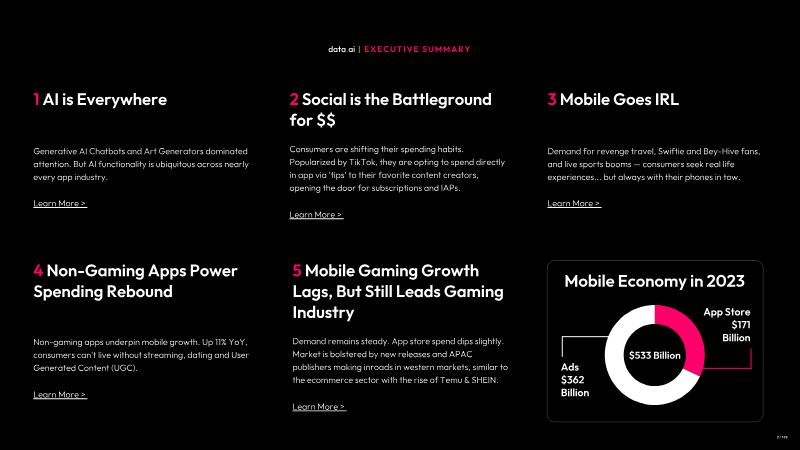
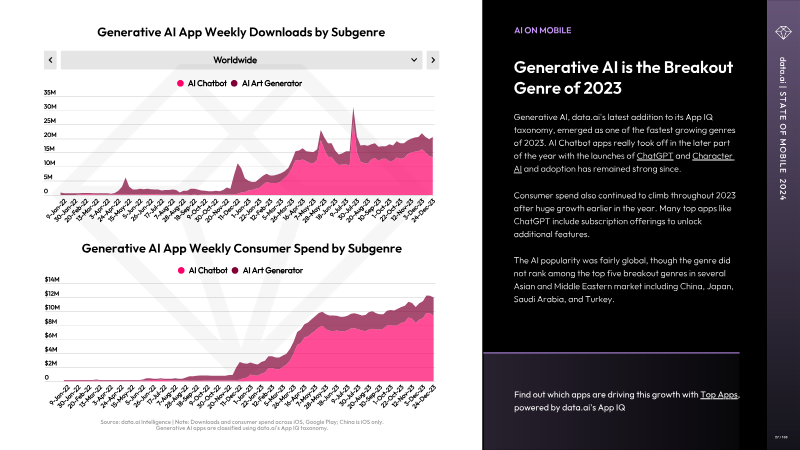
The global mobile economy experienced a significant recovery in 2023, with consumer spending rising 3% to $171 billion and daily engagement surpassing five hours per user in leading markets. While mobile gaming faced a slight 2% contraction in spending due to economic headwinds and a shift toward longer title life cycles, the broader industry was bolstered by a resilient non-gaming sector. This growth was primarily driven by social media "tipping," video streaming subscriptions, and the rapid emergence of generative AI. Mobile advertising also remained a cornerstone of the ecosystem, reaching $362 billion with projections to exceed $400 billion in the coming year.
The landscape is increasingly defined by a shift in consumer behavior and monetization strategies. Non-gaming apps reached a record $64 billion in spend, led by TikTok, which became the first non-game app to surpass $10 billion in lifetime revenue. In contrast, the gaming market saw a decline in new hit releases, with the industry consolidating around established high-fidelity IPs and social multiplayer genres like Creative Sandbox and Battle Royale. Despite this consolidation, breakout successes like Monopoly GO and Honkai: Star Rail demonstrated that high-quality debuts can still disrupt saturated markets.
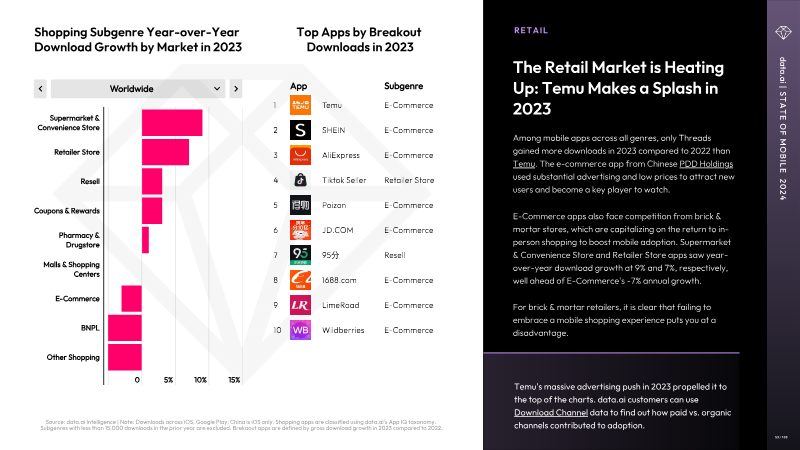
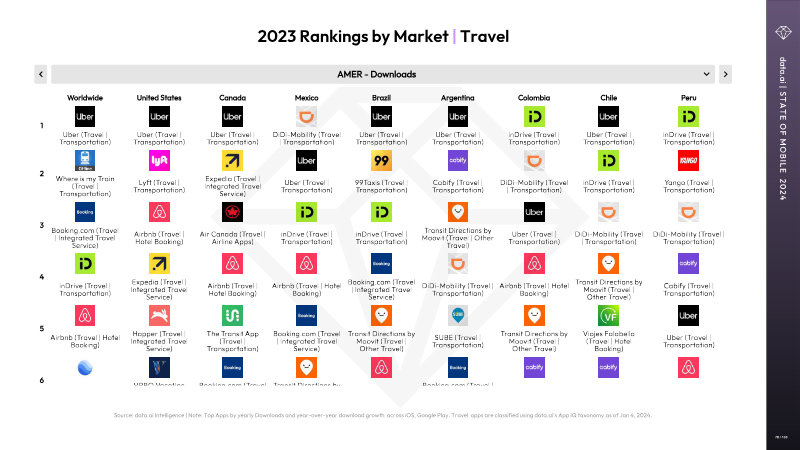
Across various sectors, mobile integration has reached unprecedented levels. Travel and ticketing apps saw record-breaking demand as consumers returned to in-person events, while the finance sector experienced a surge in personal loan apps and "Super Apps" amid global inflation. Retail also underwent a structural shift as China-based platforms like Temu gained significant global market share. Ultimately, the 2023 data reflects a mature mobile market where growth is increasingly tied to sophisticated AI integration, creator-driven economies, and the transition of traditional services into comprehensive digital hubs.
Pages

Insights
- The global mobile economy grew 3% to $171 billion in 2023, supported by a $362 billion advertising market projected to exceed $400 billion in the coming year.
- Mobile gaming spending contracted by 2% as the industry consolidated around established high-fidelity IPs and social multiplayer genres, though titles like Monopoly GO and Honkai: Star Rail proved that high-quality debuts remain viable.
- Non-gaming apps reached a record $64 billion in consumer spend, highlighted by TikTok becoming the first non-game app to surpass $10 billion in lifetime revenue.
- Daily user engagement in leading markets surpassed five hours, driven by social media tipping, video streaming subscriptions, and the rapid integration of generative AI.
- The finance sector saw a surge in personal loan apps and 'Super Apps' as a response to global inflation, while travel and ticketing apps experienced record-breaking demand.
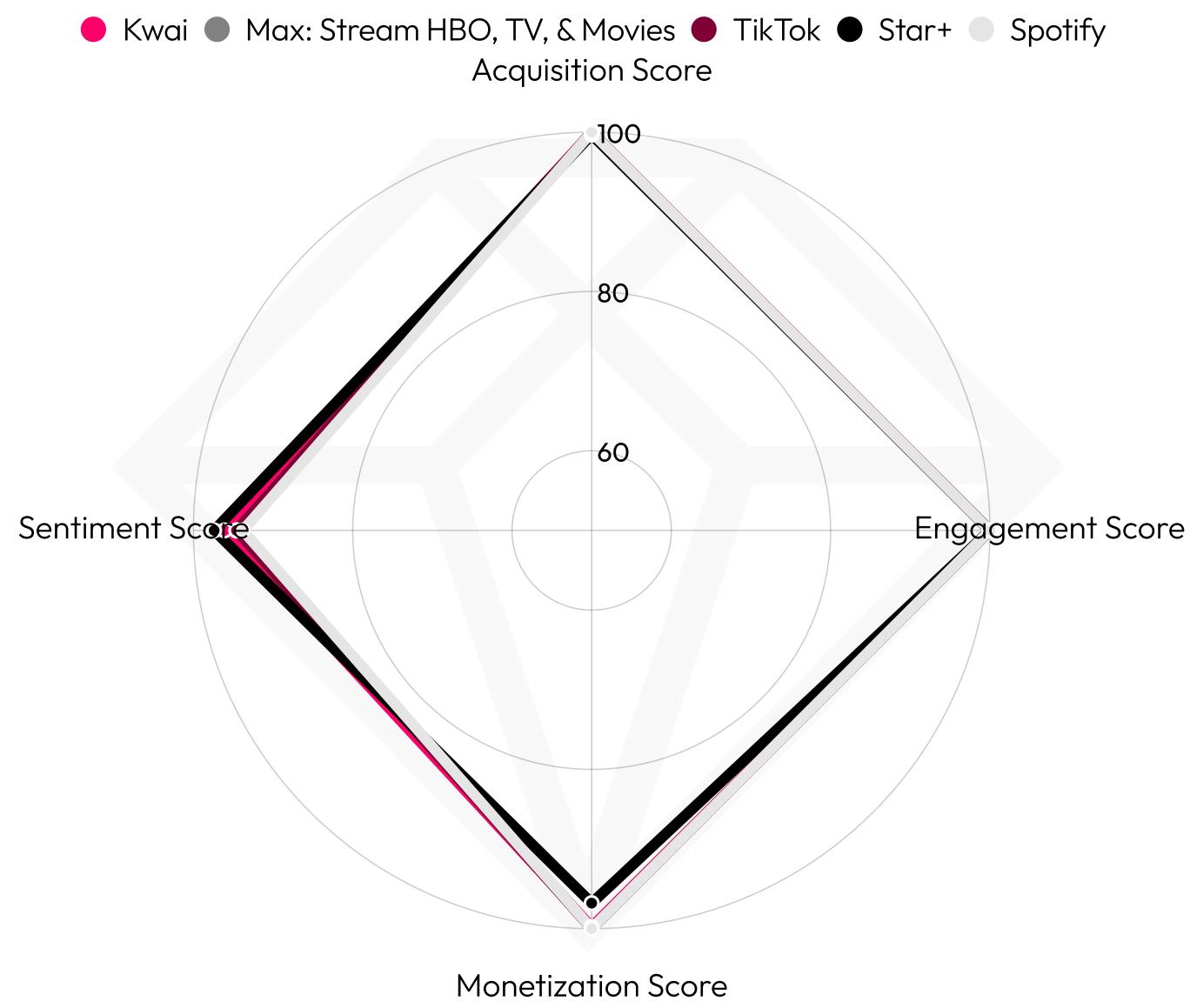
This radar chart from a game industry report compares five different platforms (Kwai, Max, TikTok, Star+, Spotify) across four key metrics: Acquisition Score, Engagement Score, Monetization Score, and Sentiment Score. It visually represents each platform's performance in these areas, with higher scores indicating better performance.