Showing 30 of 406 results · 0.62s
Aug 2021
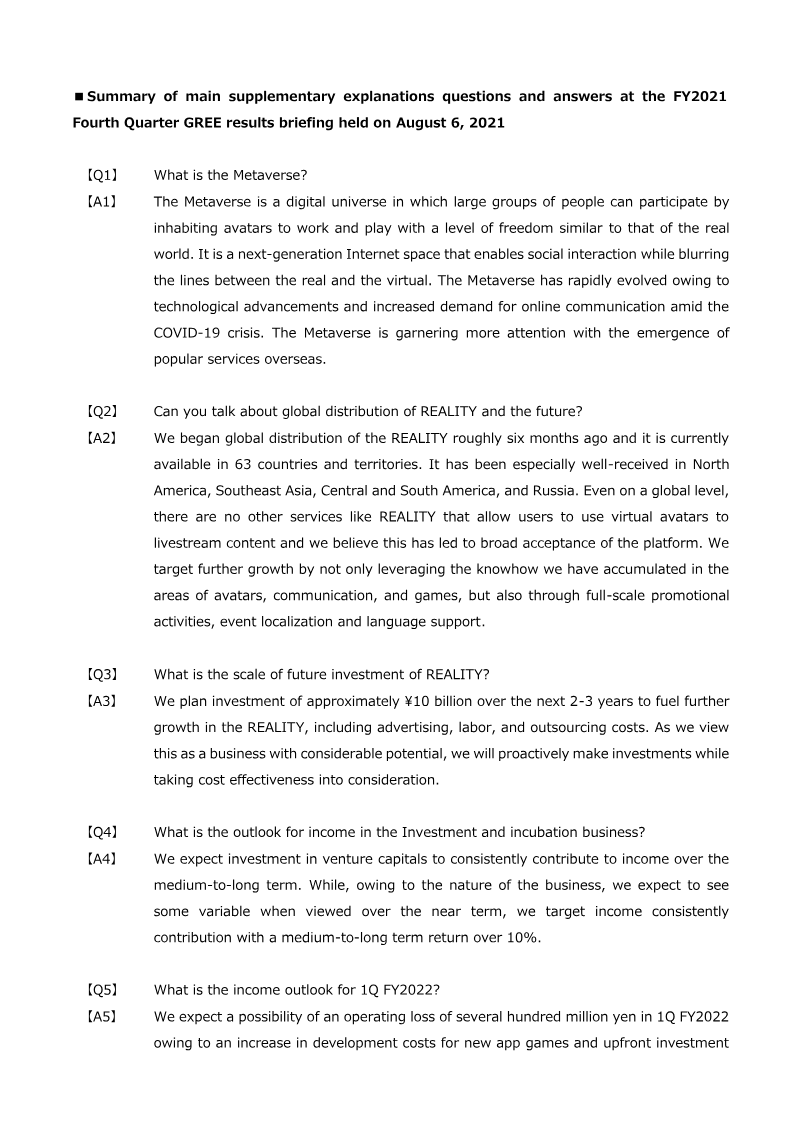
Summary of Main Supplementary Explanations: FY2021 Fourth Quarter Results Briefing
GREE
gaming while implementing localized events and expanded language support. Despite this long-term optimism, the heavy upfront investment in the Metaverse and development costs for new mobile titles
Financial2 pages
May 2023
Summary of Main Supplementary Explanations Questions and Answers at the FY2023 Third Quarter GREE Results Briefing Held on May 11, 2023
GREE
gaming profitability while aggressively scaling a monetized metaverse ecosystem for a global audience. The geographic scope emphasizes a shift toward international markets, particularly as the domestic Japanese mobile
Financial2 pages
Mar 2015
Financial Highlights for the 1st Quarter of the Fiscal Year Ending March 2015 (FY2014)
Koei Tecmo
Game Software division experienced a 14.4% drop in sales and a 33.1% decline in operating income, reflecting the cyclical nature of major title releases. Conversely, the Online & Mobile
Financial2 pages
GDEV Results for the First Quarter of 2026
GDev
Asia, which was offset by growth in Europe and other regions. Additionally, the mobile platform’s share of total bookings expanded to 64%, up from
Financial3 pages
Feb 2025
Financial Results Explanatory Material: 3rd Quarter of Fiscal Year Ending March 2025
Nintendo
Category (FY 24 Q1‑Q3) | FY 25 Q1‑Q3 | YoY Δ | |------------------------|------------|-------| | Dedicated video‑game platform (hardware + software + accessories) | ¥895.5 bn | ‑31.7 % | | – Hardware
Financial25 pages
Jun 2007
NetEase Annual Report FY2006
NetEase
billion (≈US$159 m), driven by strong gross margins in the gaming segment and controlled cost growth, despite a 39 % increase in operating expenses largely attributable to higher
Financial1 pages
Jul 2023
Financial Results for the First Quarter of the Fiscal Year Ending March 2024
Koei Tecmo
releases and relied on repeat sales of existing titles. Conversely, the online and mobile sector achieved record quarterly sales of 10.9 billion yen, a 31.7% increase driven
Financial13 pages
Jan 2016
Financial Highlights for the Fiscal Year Ending March 2016 (FY2015)
Koei Tecmo
fiscal year predicting continued expansion across all major financial metrics. The game software segment remains the primary driver of the company’s portfolio, contributing 25.2 billion
Financial2 pages
Nov 2025
Take-Two Interactive Q2 Fiscal Year 2026 Conference Call
Take-Two Interactive
report covers Take-Two’s global operations across its primary labels: Rockstar Games, 2K, and Zynga. Financial data is presented on a GAAP basis with year-over-year
Financial7 pages
Aug 2020
Half-Year Report of 11 Bit Studios S.A. for the First Half of 2020
11 bit studios
Warsaw headquarters and finalized a partnership with NetEase to develop a mobile version of Frostpunk. With strong operating cash flows and no identified impairment risks to its intangible
Financial85 pages
First Half 2023/24 Sales: Nacon Financial Results
Nacon
million in the same period a year earlier. Sales fell across all segments: gaming revenue dropped 5.7 % to €44.3 million, catalogue sales fell 9.0 % to €23.1 million, back
Financial2 pages
Jul 2014
Square Enix Annual Report FY2014
Square Enix
Realm Reborn, strong performance from high-definition remasters, and the rapid growth of mobile titles such as Dragon Quest Monsters Super Light. While the Amusement and Merchandising segments
Financial74 pages
Sep 2024
Global Gaming Deals Report: Q4 & FY 2024
InvestGame
gaming industry’s merger‑and‑acquisition environment in 2024 evolved from primarily financial arbitrage toward transactions driven by clear strategic objectives. Activity levels remained above the pre‑COVID
Financial29 pages
Annual Report 2010: Tencent Holdings Limited
Tencent
billion, up 56% year‑on‑year. Growth was driven primarily by the online gaming segment, which generated RMB 15.48 billion in revenue (up 62%) and by a rapidly
Financial193 pages
Nov 2014
Summary of Financial Results for First Three Quarters of Fiscal Year Ending December 2014
KLab
surge in revenue was primarily driven by the strong performance of mobile titles, specifically Love Live! School Idol Festival and Celestial Craft Fleet. While the company saw increased
Financial12 pages
Jul 2024
Electronic Arts Inc. Q1 FY25 Results
Electronic Arts
year‑over‑year to $1.262 billion, driven by a 58 % decline in full‑game sales and a modest 7 % drop in live‑services revenue. Platform‑level data show
Financial18 pages
Nov 2021
Take-Two 10-Q — Q3 FY2021 (November 2021)
Take-Two Interactive
digital and mobile titles, with 90.8 % of six‑month revenue generated through digital online channels and recurring consumer spending accounting for 65.7 % of total sales. Mobile revenue grew
Financial1 pages
Nexon FY2026 Q1 Earnings Release
InvestGame
first‑quarter fiscal 2026 results demonstrate a robust expansion of its core gaming portfolio, with revenue reaching ¥152.2 billion—a 34 % year‑over‑year increase that is largely
Financial1 pages
FY2023 Second Quarter Financial Results Briefing
GREE
operating income, exceeding forecasts largely due to the strong performance of the mobile title Heaven Burns Red. The company highlighted continued global rollout of this IP, including Korean
Financial4 pages
Oct 2024
Gaming IPOs Through the Years: Platform Shifts and Regional Growth Explored
AACL Invest
sole notable recent listing. Asia remains the primary global hub for public gaming entities, accounting for 46% of the total market share, while Europe has seen its number
Financial9 pages
Jan 2011
Financial Highlights for the 3rd Quarter of Fiscal Year Ending March 2011 (FY2010)
Koei Tecmo
suggesting improved cost management or more favorable non-operating conditions. The core Game Software segment remained the primary revenue driver but saw a 13.1% decline in sales
Financial1 pages
Jan 2023
DDM Games Investment Review Q4 2023 Executive Summary Report
Digital Development Management
Digital Development Management (DDM) provides a comprehensive analysis of global video game investments, mergers and acquisitions (M&A), and initial public offerings (IPOs) for the full year
Financial26 pages
Sep 2019
Integrated Report 2019
Bandai Namco
clearer performance accountability. | | Flagship IP Portfolio | • THE IDOLM@STER, IDOLiSH 7, Ultraman, Mobile Suit Gundam, Kamen Rider, Super Sentai, Anpanman, PAC‑MAN, Tamagotchi, PRETTY CURE • Gundam & Dragon Ball
Financial114 pages
Jan 2010
Financial Highlights for the 1st Quarter of FY2010
Koei Tecmo
reflecting a period of contraction compared to the prior year’s performance. The Game Software segment, the company’s largest division, was the primary driver of this decline
Financial1 pages
May 2025
Consolidated Financial Results for the Year Ended March 31, 2025
Konami
revenue within this division, fueled by the robust performance of key console and mobile titles, solidified its position as the company’s primary financial engine. Operating profit reached
Financial19 pages
Mar 2021
Global Video Game Deals Report Q1 2021
InvestGame
activity was driven primarily by massive consolidation and public market entries, with the gaming segment accounting for nearly all merger and acquisition value. Mergers and acquisitions emerged
Financial22 pages
Jan 2021
FY2020 3rd Quarter Presentation Materials
Koei Tecmo
revenue. The primary drivers of this performance were major console releases and successful mobile IP licensing. Hyrule Warriors: Age of Calamity emerged as a significant hit, selling over
Financial14 pages
Consolidated Financial Results: Q1 FY2026
Sony Group Corporation
previous year. The company’s diverse portfolio showed varied performance, with the Game and Network Services segment maintaining steady sales while achieving a significant 54.1 billion yen increase
Financial20 pages
Jan 2011
Financial Highlights for the 1st Half of Fiscal Year Ending March 2011 (FY2010)
Koei Tecmo
deepening the deficits recorded during the first half of fiscal year 2009. The game software segment, the company’s largest division, was the primary driver of this decline
Financial1 pages
Nexon 2026 Capital Markets Briefing: Transformation Plan
NEXON Co.
audience by modernizing its development workflows. By utilizing AI to provide context for game design and live service support, the company aims to empower developers rather than replace
Financial3 pages
Summary of Main Supplementary Explanations: FY2021 Fourth Quarter Results Briefing
Aug 20212 pages0k words
Summary
GREE’s strategic focus for the 2022 fiscal year centers on the aggressive expansion of the Metaverse through its REALITY platform and the stabilization of its investment and incubation business. The Metaverse is defined as a next-generation internet space where avatars facilitate social interaction, work, and play, bridging the gap between physical and virtual realities. This sector has seen accelerated growth due to technological shifts and increased demand for digital communication during the COVID-19 pandemic. To capitalize on this momentum, the company plans to invest approximately ¥10 billion over the next two to three years, specifically targeting advertising, labor, and outsourcing to scale the platform globally.
The REALITY platform has already established a presence in 63 countries and territories, showing significant traction in North America, Southeast Asia, Central and South America, and Russia. Management attributes this success to a lack of direct global competitors offering similar avatar-based livestreaming services. Future growth strategies involve leveraging existing expertise in communication and gaming while implementing localized events and expanded language support. Despite this long-term optimism, the heavy upfront investment in the Metaverse and development costs for new mobile titles are expected to result in an operating loss of several hundred million yen for the first quarter of fiscal year 2022.
Beyond the Metaverse, the investment and incubation segment is positioned as a consistent contributor to medium-to-long-term income. While short-term returns may fluctuate due to the nature of venture capital, the company targets a consistent return of over 10%. This dual approach seeks to balance the high-growth potential of emerging virtual spaces with the steady financial contributions of a diversified investment portfolio, ensuring the company remains competitive as digital social interactions continue to evolve.
Pages

Insights
- GREE is committing approximately ¥10 billion over the next two to three years to scale its REALITY Metaverse platform globally through increased spending on advertising, labor, and outsourcing.
- The REALITY platform currently operates in 63 countries and territories, with significant traction in North America, Southeast Asia, Central and South America, and Russia.
- Heavy upfront investment in the Metaverse and new mobile game development is projected to cause an operating loss of several hundred million yen in the first quarter of fiscal year 2022.
- The company’s investment and incubation segment is managed to provide a consistent medium-to-long-term return of over 10%.
- GREE’s core strategy for fiscal year 2022 balances the high-growth potential of the Metaverse with the steady financial contributions of its diversified investment portfolio.