Report86 pages
2023 Annual Report
Corporate Philosophyby providing unforgettable experiences This represents company's and the beliefs for which we stand. To spread happiness across the globe by providing unforgettable experiences This philosophy represents our company’s mission and the beliefs for which we stand. Each of ourcustomers or her of happiness.
- The "DRAGON QUEST" series has sold over 88 million units worldwide as of the end of June 2023, celebrating its 35th anniversary in 2021.
- Square Enix Group's corporate philosophy is to spread happiness globally by providing unforgettable experiences through high-quality content, services, and products.
- The company faces challenges in game development, including increased difficulty and prolonged timelines due to console advancements, intense competition for talent, and a diminishing number of external partners for large-scale projects.
- Square Enix is focusing on structural transformation of its internal development organization, including strengthening development processes, recruiting talent, and establishing training capabilities.
- The company is investing in new growth domains: AI, cloud technology, and blockchain games, alongside its existing Digital Entertainment, Amusement, Publication, and Merchandising segments.
Square Enix

Report74 pages
2016 Annual Report
To spread happiness across the globe by providing unforgettable experiences To spread happiness across the globe by providing unforgettable experiences This philosophy represents our company’s mission and the beliefs for which we stand. The Square Enix Group provides high-quality content, services, and products to help those customers create their own Each of our customers has his or her own definition of happiness.
- Net sales for the fiscal year ended March 31, 2016, exceeded ¥200 billion for the first time, reaching ¥214,101 million, a 27.5% increase from the prior fiscal year, and operating income increased by 58.4% to ¥26,018 million.
- The MMO domain, specifically "DRAGON QUEST X" and "FINAL FANTASY XIV," generated stable earnings, with new content and expansion packs released in the fiscal year ended March 2016 successfully retaining and attracting players.
- The Amusement Business Segment saw brisk performance with year-on-year existing revenue topping 100%, driven by strong demand from foreign tourists, especially from Asia, and the successful rollout of an e-money system.
- The company plans to expand localization efforts beyond EFIGS (English, French, Italian, German, Spanish) to include Chinese (simplified), Arabic, and Portuguese to access growing consumer markets in China, the Middle East, and Latin America.
- Capital expenditures decreased by ¥176 million to ¥5,872 million in the fiscal year ended March 31, 2016, primarily due to the relocation of subsidiaries' offices.
+1
Square Enix
Report2 pages
Dragon Quest: Reimagined
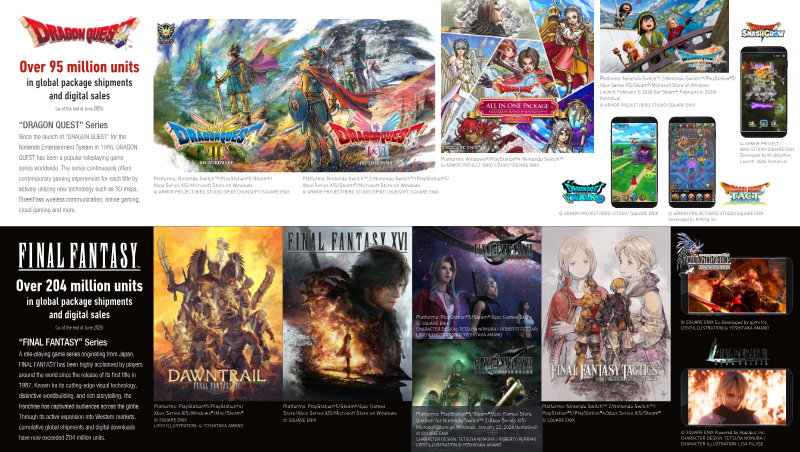
The document presents a comprehensive overview of several flagship role‑playing franchises, focusing on recent releases and cumulative sales achievements. It highlights the launch of “Dragon Quest: Reimagined” on February 5, 2026, available in a bundled package across Nintendo Switch 2, PlayStation 5, Xbox Series X|S, Steam, and Microsoft Store. The title is positioned as a high‑definition 2D remake developed by KLabGames, with a projected global shipment of over 95 million units as of June 2025. The text also references the broader “Dragon Quest” series, noting its continuous evolution since 1986 and its adoption of modern technologies such as 3D mapping, cloud gaming, and cross‑platform connectivity.
The “Final Fantasy” section cites cumulative sales of 204 million units for the series, emphasizing its long‑standing appeal since 1987 and its expansion into Western markets. Platforms listed include PlayStation 5, Steam, Epic Games Store, and Nintendo Switch 2, with a focus on the franchise’s visual innovation and narrative depth. The document underscores the series’ global reach, with sales data aggregated across multiple regions.
Additionally, the “Kingdom Hearts” entry reports 38 million units shipped worldwide by June 2025, noting its collaborative origin with Disney and Square Enix. The overview includes platform details for the original PlayStation 2 release and mentions forthcoming titles slated for various consoles. Overall, the document serves as a market snapshot of key RPG franchises, detailing launch dates, platform coverage, sales milestones, and development partnerships across the industry.
- The Final Fantasy series has reached 204 million units in cumulative global sales since its 1987 debut.
- Dragon Quest: Reimagined, a high-definition 2D remake developed by KLabGames, launched on February 5, 2026, for Nintendo Switch 2, PlayStation 5, Xbox Series X|S, Steam, and Microsoft Store.
- The Dragon Quest franchise reported a projected global shipment of over 95 million units as of June 2025.
- The Kingdom Hearts franchise, a collaboration between Disney and Square Enix, has shipped 38 million units worldwide as of June 2025.
- Major RPG franchises are increasingly utilizing modern technologies including 3D mapping, cloud gaming, and cross-platform connectivity to maintain market relevance.
+2
Square Enix

Report39 pages
2025 Annual Report
Purpose C O N T E N T S Creating New Worlds With Boundless Imagination 03 Financial Highlights Creating New Worlds With Boundless Imagination 03 Financial Highlights 04 A Message to Our Stakeholders to Enhance People’s Lives.
- In the fiscal year ended March 2025, Square Enix Holdings recorded net sales of ¥324.5 billion (a decline from the previous fiscal year) but an increase in profit, with operating income at ¥40.5 billion, ordinary income at ¥40.9 billion, and profit attributable to owners of parent at ¥24.4 billion.
- The Game sub-segment saw increased net sales and profit due to the release of "FINAL FANTASY XIV: Dawntrail" and "The Apothecary Diaries" series, despite a decline in the Games for Smart Devices/PC Browsers sub-segment due to weak existing titles and the absence of prior year royalty income.
- The Merchandising segment reported net sales of ¥19.0 billion (up 0.8% from the prior fiscal year) and operating income of ¥6.0 billion (up 7.2%), driven by strong sales of new character merchandise related to popular Group IP.
- Square Enix Holdings is collaborating with the Matsuo Lab at the University of Tokyo’s School of Engineering on a sponsored course focused on simulations and deep learning, and with the Graduate School of Film and New Media at Tokyo University of the Arts on a joint research project.
- The company has an alliance with gumi Inc. for the development and distribution of mobile online and blockchain games, and another alliance to study establishing a dedicated platform for blockchain games.
+1
Square Enix
Report19 pages
Results: What's Next - Focus on Cash Flow
The analysis outlines a strategic pivot toward cash‑flow optimization for the company, driven by recent shifts in the VR market and a need to secure additional financing. Revenue growth in 2024 reached PLN 190.4 million, largely supported by the launches of Project Maverick and Project Echo, as well as the January 2024 release of Bulletstorm VR. However, profitability suffered due to write‑offs of the Red and Bifrost projects and a decline in 2Q revenues linked to Gemini negotiations, resulting in an EBITDA of PLN 12.9 million and a net loss of PLN 175.3 million.
Operationally, the organization is trimming non‑essential spend and restructuring office space and team composition to reduce overhead. The workforce, which expanded from 612 employees in 2020 to 756 by the end of 2024, is being realigned with a focus on critical projects. The company has ceased further investment in VR development following the 2024 platform subsidy withdrawal, redirecting resources toward AAA and compact‑AAA titles.
Future initiatives include two new work‑from‑home projects with Sony Interactive Entertainment, the self‑publishing of Project Bison (the final VR title from PCF Group) slated for Q4 2025, and an early‑access release of Lost Rift in 2025. Krafton’s waiver of ROFO/ROFR rights for Bifrost and Victoria frees the company to seek external publishers. Scenario analysis is underway to identify additional funding sources, ensuring liquidity while maintaining a lean operational model across global studios in Warsaw, Montreal, Newcastle, Dublin, Katowice, and Rzeszów.
- The company reported 2024 revenue of PLN 190.4 million, but incurred a net loss of PLN 175.3 million and an EBITDA of PLN 12.9 million due to project write-offs and revenue declines.
- Management is pivoting away from VR development following the withdrawal of platform subsidies, shifting focus toward AAA and compact-AAA titles.
- The organization is implementing a cost-reduction strategy that includes restructuring office space and realigning the workforce, which had grown to 756 employees by the end of 2024.
- Krafton has waived its ROFO/ROFR rights for the Bifrost and Victoria projects, allowing the company to pursue external publishing partners for these titles.
- Future production includes two new projects with Sony Interactive Entertainment, the self-publishing of the final VR title Project Bison in Q4 2025, and an early-access release of Lost Rift in 2025.
+3
PCF Group
Report66 pages
Półroczne sprawozdanie zarządu z działalności Grupy Kapitałowej: H1 2021
WARSZAWA, 29 WRZ ŚNIA 2021 ROKU sp ółka akcyjna ~~2 1~~ Za okres 1.01.2021 – 30.06.2021 r. 29 WRZE ŚNIA PCF Półroczne sprawozdanie z działalności Grupy Kapitałowej PCF Group Spółka Akcyjna 2 0 oraz spółki PCF Group Spółka Akcyjna za okres 1.01.2021 – 30.06.2021 r. GROUP (dane w tys. zł, chyba że zaznaczono inaczej) ~~2 1~~ Niniejsze Półroczne sprawozdanie Zarządu z działalności Grupy Kapitałowej PCF Group S.A.
- PCF Group S.A. acquired 100% of Game On Creative Inc. for PLN 29,369,385.59 on April 27, 2021, and indirectly acquired the Phosphor Games, LLC development team (now People Can Fly Chicago, LLC) on April 23, 2021, which began operations on May 1, 2021.
- The company increased its share capital by PLN 7,754.28 to PLN 599,004.52 through the issuance of 387,714 Series D ordinary bearer shares at an issue price of PLN 75.75 per share, with the subscription agreement signed on May 31, 2021.
- PCF Group S.A. began developing a new self-published game using new intellectual property in May 2021, following the strengthening of its development team and acquisition of production and publishing competencies in April 2021.
- The game 'Outriders', released on April 1, 2021, did not generate royalty payments for PCF Group S.A. from Square Enix Limited for the period of April 1 to June 30, 2021, indicating that net sales did not cover the publisher's costs, and the game did not achieve a Metacritic score high enough for increased royalty percentages.
- Tangible fixed assets increased by PLN 5.8 million to PLN 9.1 million by June 30, 2021, and right-of-use assets increased by PLN 13.9 million to PLN 25.5 million, primarily due to the acquisition of Game On Creative Inc. and the recognition of a new office lease in Montreal.
+1
PCF Group
Report40 pages
Śródroczne skonsolidowane sprawozdanie finansowe: Q1 2022
(dane w tys. zł, chyba że zaznaczone inaczej) AL. SOLIDARNOCI 171 TEL +48 22 887 34 30 (dane w tys. zł, chyba że zaznaczone inaczej) Grupa Kapitałowa PCF Group Spółka Akcyjna – wybrane dane w przeliczeniu na EUR PLN EUR od 01.01 do od 01.01 do od 01.01 do od 01.01 do 31.03.2022 r. 31.03.2021 r. 31.03.2022 r. 31.03.2021 r.
- PCF Group's net profit for Q1 2022 was 13,931 thousand PLN, a significant increase from 7,818 thousand PLN in Q1 2021.
- Total revenues for Q1 2022 reached 50,354 thousand PLN, up from 30,871 thousand PLN in Q1 2021, primarily driven by 'Produkcja na zlecenie' (production for hire) segment.
- The company's equity increased to 275,995 thousand PLN as of March 31, 2022, from 259,542 thousand PLN on December 31, 2021.
- Basic and diluted earnings per share (EPS) rose to 0.47 PLN in Q1 2022, compared to 0.27 PLN in Q1 2021.
- PCF Group's core business is video game production, and its operations do not exhibit seasonality or cyclicality in the interim period.
+1
PCF Group
Report51 pages
Półroczne sprawozdanie Zarządu z działalności Grupy Kapitałowej PCF Group S.A.: 1 stycznia 2024 – 30 czerwca 2024
WARSZAWA | 30 WRZENIA 2024 ROKU PEOPLE PÓEROCZNE SPRAWOZDANIE ZARZADU Z DZIAEALNOSCI GRUPY KAPITALOWEJ PCF GROUP S.A. ORAZ SPÓEKI PCF GROUP S.A. ZA 0KRES 01.01.2024 - 30.06.2024 za okres 01.01.2024 – 30.06.2024 r. (dane w tys. zł, chyba że zaznaczono inaczej) Niniejsze półroczne sprawozdanie z działalności Grupy Kapitałowej PCF Group S.A. i spółki PCF Group S.A. za okres 01.01.2024 – 30.06.2024 r. zostało sporządzone na podstawie § 70 ust. 1 pkt 4, 6, 7 oraz § 71 ust.
- PCF Group S.A. reported a 29% increase in sales revenue, reaching PLN 70.1 million in H1 2024, up from PLN 54.3 million in H1 2023, driven by the release of Bulletstorm VR and revenue from Project Maverick, despite a decrease in revenue from Project Gemini.
- The cost of services sold increased by 134% to PLN 84.4 million in H1 2024 (from PLN 36.0 million in H1 2023), primarily due to increased costs associated with Project Maverick and Bulletstorm VR production.
- PCF Group S.A. terminated two revolving credit agreements with Bank Pekao S.A. totaling PLN 30 million and EUR 4.426 million, effective September 2024, without having utilized any of the credit.
- The company signed a short-term executive agreement on January 30, 2024, with Square Enix Limited to continue development on Project Gemini, following the expiration of the previous agreement, to finalize strategic discussions.
- PCF Group S.A. faces significant revenue concentration risk, with ongoing production and publishing agreements for Project Gemini (Square Enix Limited), Project Maverick (Microsoft Corporation), and Project Echo (Krafton Inc.).
+2
PCF Group
Report86 pages
Annual Financial Report: PCF Group 2024
ZA ROK OBROTOWY ZAKONCZONY 31 GRUDNIA 2024 ROKU wybrane dane w przeliczeniu na EUR PLN EUR 31.12.2024 r. 31.12.2023 r. 31.12.2024 r. 31.12.2023 r. Sprawozdanie z sytuacji finansowej Aktywa 315 161 502 508 73 756 115 572 Zobowiązania długoterminowe 7 303 12 382 1 709 2 848 Zobowiązania krótkoterminowe ...
- PCF Group experienced a significant net loss of EUR 53,106 in 2024, worsening from a loss of EUR 14,277 in 2023.
- The company's operating loss also substantially increased to EUR 55,351 in 2024 from EUR 18,395 in 2023.
- Despite the losses, sales revenue grew from EUR 26,585 in 2023 to EUR 38,673 in 2024.
- Net cash flow from operating activities increased significantly to EUR 12,146 in 2024 from EUR 4,873 in 2023.
- PCF Group is exposed to currency risk as most costs are in PLN while most revenues are in EUR and USD, though a contract with Square Enix Limited for "Project Gemini" includes provisions against EUR/PLN exchange rate changes.
+1
PCF Group
Report6 pages
Letter to Shareholders: 2024
The letter explains that 2024 was a challenging year for the video‑game industry and for PCF Group S.A., prompting decisive actions to protect financial stability. In April, the company discontinued the Dagger project after a partner withdrawal and recorded a 100 % write‑off of its costs, followed by the cancellation of Red in September. These decisions reduced consolidated earnings for the first half of 2024 and lowered fixed‑asset values by PLN 7.7 million. The board also halted work on Victoria and Bifrost in December, laying off over 120 employees; a PLN 154.964 million impairment was booked for Bifrost, while Victoria’s costs were retained due to an upcoming early‑access release.
To counter market headwinds, the board launched a strategic options review in August aimed at securing external investment or restructuring. The effort failed, leaving the group to reassess short‑ and long‑term plans. Concurrently, the company tightened its self‑publishing pipeline, focusing on work‑for‑hire (WFH) contracts. In early 2024, a short‑term agreement with Square Enix for Gemini led to a workforce reduction of 30 staff, yet the project’s revenue only covered direct costs. New WFH deals were secured with Krafton (Echo), Sony Interactive Entertainment (Delta), and Microsoft (Project Maverick), bolstering revenue streams.
The VR segment was largely exited, with Incuvo’s Bison slated as the final title. Game On, another subsidiary, saw limited improvement in 2024‑25. Overall, the letter acknowledges losses and staff cuts but stresses a commitment to rebuilding through strategic partnerships, focused development on AAA action titles, and continued investment in high‑quality games for a global audience.
- PCF Group S.A. underwent a massive restructuring in 2024, cancelling four major projects (Dagger, Red, Victoria, and Bifrost) and recording a PLN 154.964 million impairment for Bifrost alone.
- The company significantly reduced its workforce, laying off over 120 employees in December following the cancellation of Victoria and Bifrost, in addition to 30 staff cuts earlier in the year related to the Gemini project.
- Financial stability was severely impacted by project cancellations, including a 100% write-off of Dagger costs and a PLN 7.7 million reduction in fixed-asset values during the first half of 2024.
- The company has pivoted its business model toward work-for-hire (WFH) contracts, securing new partnerships with Krafton (Echo), Sony Interactive Entertainment (Delta), and Microsoft (Project Maverick) to stabilize revenue.
- A strategic review initiated in August to seek external investment or restructuring failed, forcing the company to abandon its VR segment and narrow its focus to AAA action titles.
+2
PCF Group
Report1 pages
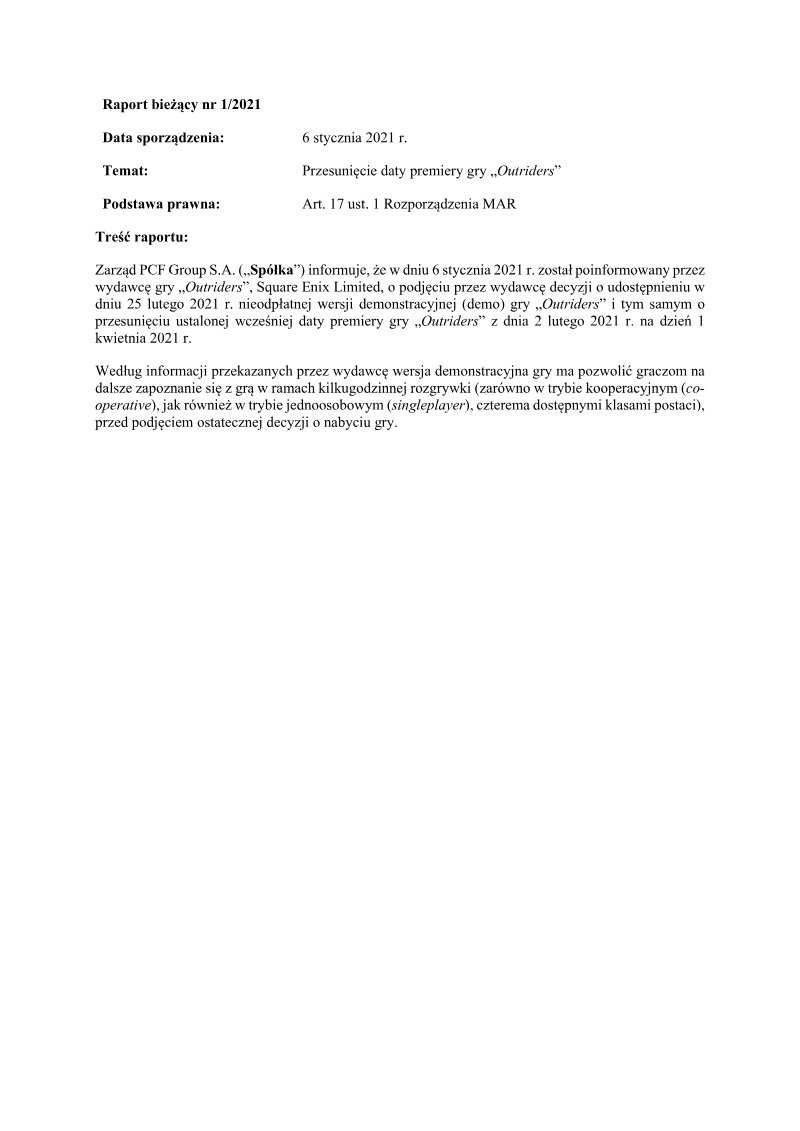
Raport Bieżący Nr 1/2021: Przesunięcie Daty Premiery Gry Outriders
The report informs stakeholders that Square Enix Limited has postponed the release of its title “Outriders.” The publisher announced that a free demo will be available on 25 February 2021, and the official launch date has been moved from 2 February to 1 April 2021. The demo is intended to provide players with several hours of gameplay, covering both cooperative and single‑player modes across all four character classes, to aid in purchase decisions. The information was received by the board of PCF Group S.A. on 6 January 2021, and the notice is issued under Article 17(1) of the MAR regulation. The scope covers the Polish market and pertains exclusively to the “Outriders” title, with no broader industry implications noted. No survey or statistical methodology is described; the update relies solely on publisher communication. The key outcome is a two‑month delay in launch, accompanied by an early demo release aimed at maintaining consumer interest and supporting sales conversion.
- Square Enix Limited has postponed the official release date of the game 'Outriders' from 2 February 2021 to 1 April 2021.
- A free demo for 'Outriders' will be released on 25 February 2021 to assist consumer purchase decisions.
- The demo will feature several hours of gameplay, supporting both single-player and cooperative modes across all four character classes.
- The board of PCF Group S.A. received official notification of the delay on 6 January 2021.
- This disclosure was issued in compliance with Article 17(1) of the MAR regulation.
+3
PCF Group
Report1 pages
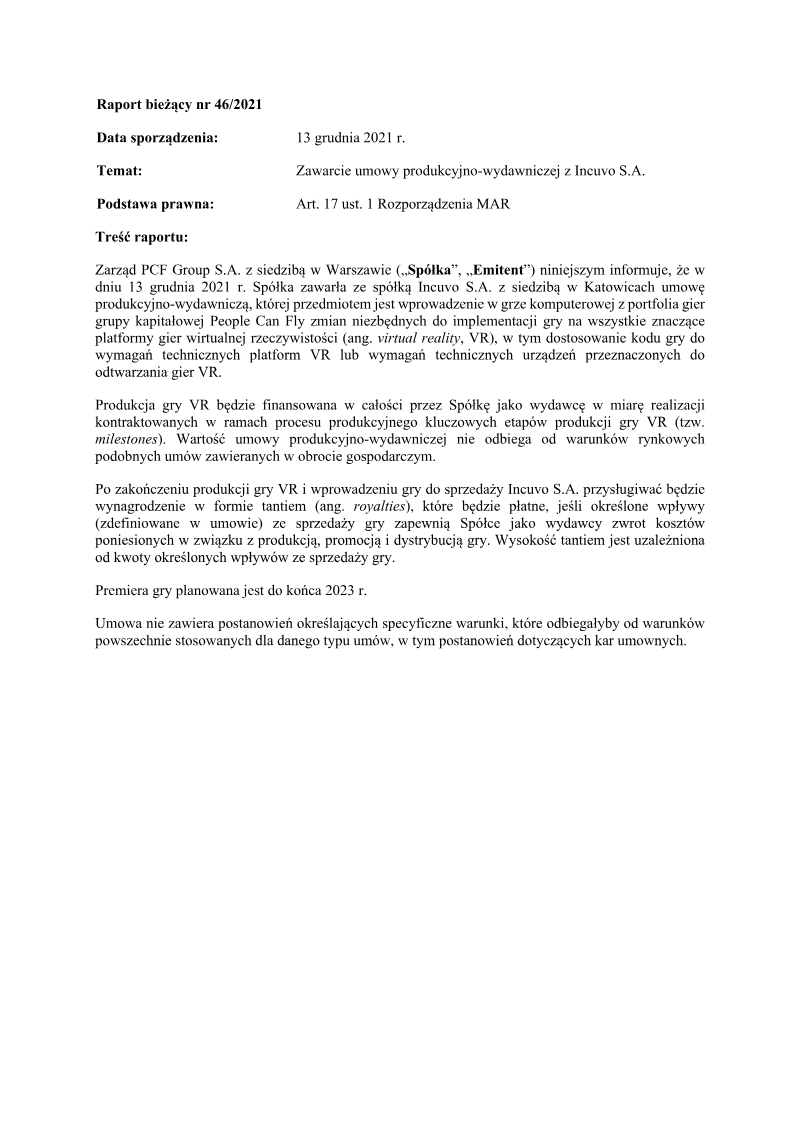
Zawarcie umowy produkcyjno-wydawniczej z Incuvo S.A.
The report announces that on 13 December 2021 PCF Group S.A., a Warsaw‑based company, entered into a production and publishing agreement with Incuvo S.A. of Katowice. The contract focuses on adapting a title from the People Can Fly portfolio for all major virtual‑reality platforms, including code adjustments to meet VR hardware specifications. PCF Group will finance the entire VR production through milestone payments tied to key development stages, with contract terms aligned to market standards for similar agreements. Upon completion and launch of the VR game, Incuvo will receive royalties contingent on sales revenue that covers PCF Group’s production, marketing, and distribution costs; the royalty rate depends on the defined sales thresholds. The game’s release is targeted for late 2023. No special contractual clauses or penalty provisions deviate from common practice for this type of agreement, ensuring standard industry compliance.
- PCF Group S.A. and Incuvo S.A. signed a production and publishing agreement on 13 December 2021 to adapt a title from the People Can Fly portfolio for virtual reality.
- Incuvo S.A. is responsible for all code adjustments and technical adaptations required to meet the hardware specifications of all major VR platforms.
- PCF Group S.A. will fully fund the VR production through milestone-based payments tied to specific development stages.
- Incuvo S.A. will receive royalties based on sales revenue only after PCF Group S.A. has recouped all production, marketing, and distribution costs.
- The royalty rates for Incuvo S.A. are structured according to defined sales thresholds, with a targeted game release date of late 2023.
+2
PCF Group
Report2 pages
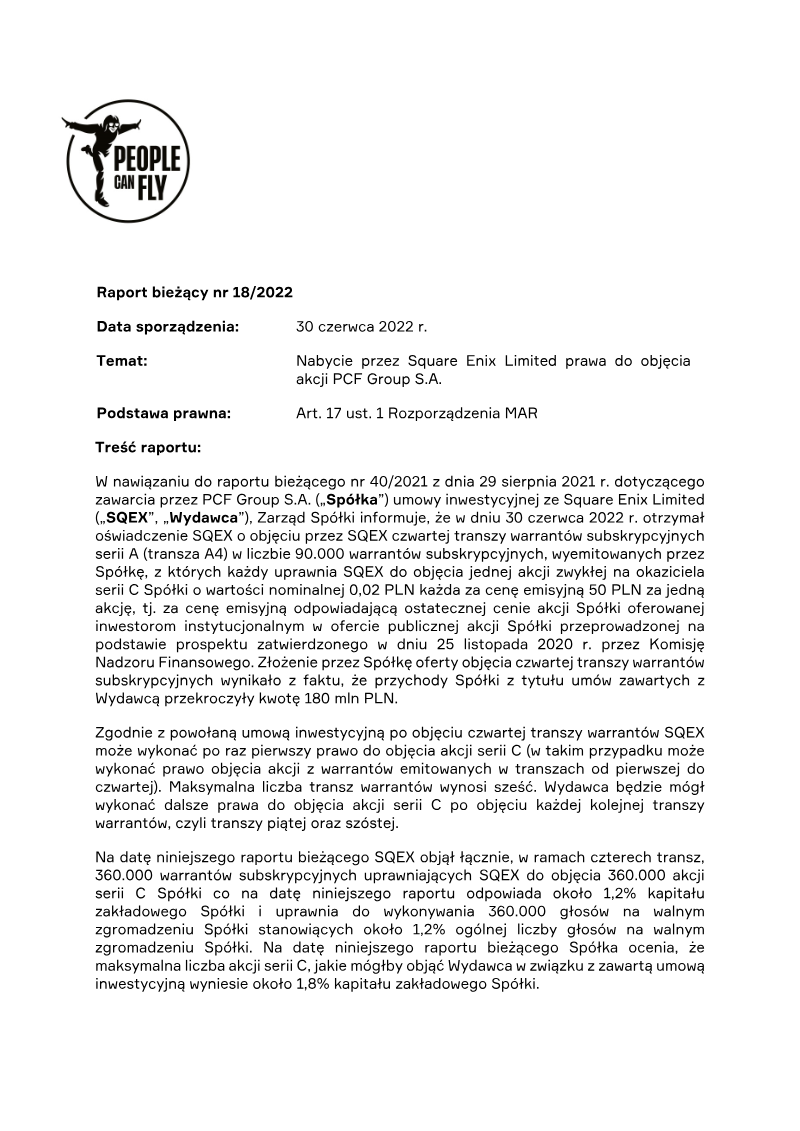
Raport Bieżący Nr 18/2022: Nabycie przez Square Enix Limited Prawa do Objecia Akcji PCF Group S.A.
The report informs that on 30 June 2022 Square Enix Limited (SQEX) exercised its right to acquire the fourth tranche of 90,000 subscription warrants (Series A4) issued by PCF Group S.A. Each warrant entitles SQEX to purchase one ordinary Series C share at an issue price of 50 PLN, matching the final public offering price approved by the Polish Financial Supervision Authority on 25 November 2020. The issuance of this tranche was triggered by PCF’s revenue from contracts with SQEX exceeding 180 million PLN.
Under the investment agreement, SQEX may exercise its option to acquire Series C shares for each tranche received, up to a maximum of six tranches. By the date of this report, SQEX had accumulated 360 000 warrants across four tranches, allowing the purchase of an equivalent number of Series C shares. This represents roughly 1.2 % of PCF’s share capital and confers the same proportion of voting rights at general meetings. The company estimates that, if all six tranches were exercised, SQEX could ultimately acquire about 1.8 % of the share capital.
The warrants can be exercised until 31 December 2025. PCF currently lacks information on SQEX’s intentions regarding the exercise of these rights. The report is dated 30 June 2022 and follows a prior disclosure (report no. 40/2021) concerning the initial investment agreement between PCF and SQEX.
- Square Enix Limited exercised its right to acquire the fourth tranche of 90,000 subscription warrants from PCF Group S.A. on 30 June 2022.
- The issuance of this fourth tranche was triggered by PCF Group S.A. generating over 180 million PLN in revenue from contracts with Square Enix.
- Each warrant allows Square Enix to purchase one Series C share at a fixed price of 50 PLN, consistent with the 2020 public offering price.
- Square Enix has accumulated 360,000 warrants across four tranches, representing approximately 1.2% of PCF Group S.A.’s total share capital and voting rights.
- The investment agreement allows for a maximum of six tranches, which would result in Square Enix holding approximately 1.8% of PCF Group S.A.’s share capital.
+1
PCF Group
Report2 pages
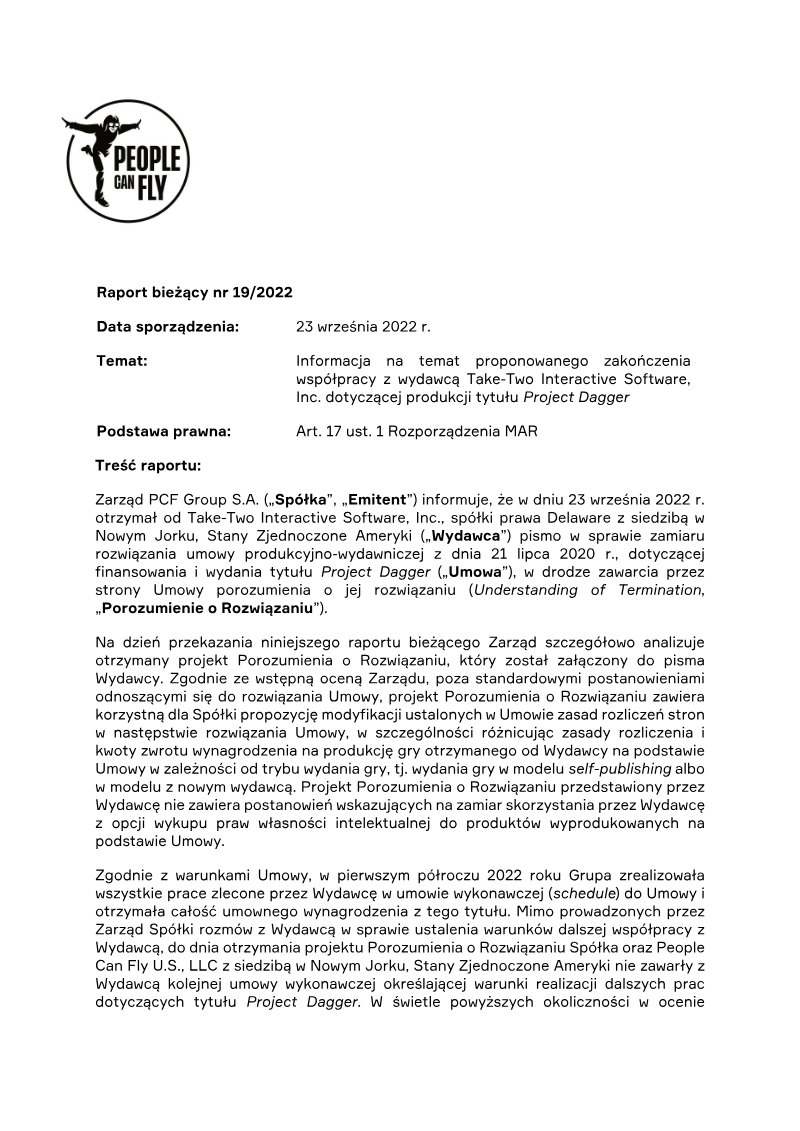
Current Report No. 19/2022: Termination of Collaboration with Take-Two Interactive Software, Inc.
The report informs that on 23 September 2022 the board of PCF Group S.A. received a letter from Take‑Two Interactive Software, Inc., indicating its intention to terminate the production‑publishing agreement dated 21 July 2020 for the title Project Dagger. The board has reviewed the proposed termination agreement, which includes a favourable modification of settlement terms for the parties. The proposal differentiates repayment amounts based on whether the game will be released via self‑publishing or through a new publisher, and it does not contain any clause suggesting that Take‑Two intends to exercise an intellectual‑property buy‑out option.
During the first half of 2022, PCF Group completed all work specified in the original contract’s schedule and received full contractual remuneration. Despite ongoing negotiations, no new execution agreement has been signed to continue development of Project Dagger. Consequently, the board expects the contract to be terminated under terms essentially matching those in the proposed agreement.
Under International Financial Reporting Standard 38, costs incurred for further development of Project Dagger will be capitalised as intangible assets. This accounting treatment is projected to materially affect the group’s financial results for the first half of 2022 and will continue to influence subsequent reporting periods as development proceeds under a self‑publishing model. The group remains committed to continuing Project Dagger’s development using internal funds, with the possibility of debt financing or partnership with a new publisher. The board will provide additional updates on the termination in accordance with applicable legal requirements.
- Take-Two Interactive Software, Inc. notified PCF Group S.A. on 23 September 2022 of its intent to terminate the July 2020 production-publishing agreement for Project Dagger.
- PCF Group retains full intellectual property rights for Project Dagger, as the proposed termination agreement contains no buy-out clause for Take-Two.
- PCF Group completed all contractual work and received full remuneration for Project Dagger through the first half of 2022.
- The termination agreement includes tiered repayment terms that vary depending on whether PCF Group chooses to self-publish or secure a new publishing partner.
- PCF Group intends to continue developing Project Dagger using internal funds, with potential future support from debt financing or a new publishing partner.
+1
PCF Group
Report2 pages
Current Report No. 22/2022: Agreement on Termination of Production and Publishing Agreement
The report announces that on October 1, 2022, People Can Fly U.S., LLC and its parent PCF Group S.A. entered into a termination agreement with Take‑Two Interactive Software, Inc., ending the 2020 production and publishing contract for Project Dagger. The termination agreement specifies how financial obligations will be settled depending on the eventual release model of the title. If Project Dagger is released through self‑publishing by People Can Fly U.S., the company will pay royalties to Take‑Two on a quarterly basis until cumulative payments equal a predetermined repayment amount of $20 million. If the game is released with a new publisher, People Can Fly U.S. will repay the same $20 million in two equal installments due six and twelve months after launch. No repayment is required if the game never reaches commercial release, regardless of model.
The agreement also confirms that Take‑Two did not exercise its option to acquire intellectual property rights under the original contract, and that the license granted to Take‑Two has expired. Consequently, People Can Fly U.S. retains exclusive ownership of Project Dagger’s intellectual property. Standard termination provisions accompany the agreement, covering general legal and procedural matters. The report covers a single geographic jurisdiction—both parties are headquartered in New York, USA—and pertains exclusively to the Project Dagger title within the video‑game development and publishing sector. No survey or external data sources are cited; the document is a straightforward corporate disclosure of contractual termination and financial settlement terms.
- People Can Fly U.S., LLC and Take-Two Interactive Software, Inc. terminated their 2020 production and publishing agreement for Project Dagger, effective October 1, 2022.
- People Can Fly retains exclusive ownership of the Project Dagger intellectual property, as Take-Two did not exercise its option to acquire the rights and its license has expired.
- If People Can Fly self-publishes Project Dagger, they must pay royalties to Take-Two on a quarterly basis until a total of $20 million is repaid.
- If Project Dagger is released via a new publisher, People Can Fly is obligated to repay the $20 million in two equal installments due six and twelve months after the game's launch.
- No financial repayment to Take-Two is required if Project Dagger fails to reach a commercial release.
+1
PCF Group
Report2 pages
Current Report No. 14/2023: Initiation of Negotiations for a Development and Publishing Agreement
The report announces that PCF Group S.A., a Warsaw‑based developer, has decided to enter negotiations for a Development and Publishing Agreement with a well‑known publisher. The decision follows receipt of the publisher’s proposal on 19 May 2023 and a detailed review conducted by the board. It aligns with the company’s strategy update issued on 31 January 2023, which states that the group will pursue attractive work‑for‑hire collaborations with reputable partners.
The proposed agreement is a framework contract, with detailed terms to be set out in an accompanying execution contract. This secondary document will outline the product description, production schedule, and payment terms for the developer. The work‑for‑hire model means PCF Group will develop the video game on behalf of the publisher in exchange for agreed remuneration. The terms are described as standard for similar projects and do not deviate significantly from typical industry practices.
The board clarifies that initiating negotiations does not guarantee a final agreement. Public disclosure of any eventual contract will be provided in a separate report. The scope is limited to the Polish market, covering the PCF Group’s development activities and its partnership with the identified publisher. No survey or external data sources are cited, as the announcement is based solely on internal board deliberations.
- PCF Group S.A. has entered formal negotiations for a development and publishing agreement with a prominent industry publisher following a proposal received on 19 May 2023.
- The proposed partnership follows a work-for-hire model, where PCF Group will develop a video game for the publisher in exchange for agreed remuneration.
- This initiative aligns with the company's strategic update from 31 January 2023, which prioritizes securing work-for-hire collaborations with reputable partners.
- The agreement is structured as a framework contract, with a secondary execution contract intended to define specific product descriptions, production schedules, and payment terms.
- The board has characterized the proposed terms as standard for the industry, noting they do not deviate significantly from typical market practices.
+1
PCF Group
Report1 pages
Wyznaczenie daty premiery gry Bulletstorm VR
The report announces the official release date for the virtual‑reality title “Bulletstorm VR,” previously known by its code name “Thunder.” The announcement, issued by the board of PCF Group S.A. on 22 August 2023, confirms that the game will launch on 14 December 2023. Distribution channels include the META Oculus Store, Sony PlayStation Store, and Steam, ensuring multi‑platform availability across major VR ecosystems. The release decision follows a prior interim report dated 13 December 2021, indicating that the company has maintained a consistent communication cadence regarding its VR portfolio. The document cites Article 17(1) of the MAR Regulation as the legal basis for the disclosure, underscoring compliance with regulatory reporting requirements. No additional data on sales projections, target demographics, or regional rollout specifics are provided; the focus remains strictly on the release date and platform distribution. The concise nature of the communication suggests that the primary objective is to inform stakeholders, regulators, and potential consumers of the finalized launch schedule. The report’s brevity and formal tone reflect standard corporate disclosure practices for product release announcements within the gaming industry.
- Bulletstorm VR (formerly codenamed "Thunder") is scheduled for official release on 14 December 2023.
- The title will be available across three major VR platforms: META Oculus Store, Sony PlayStation Store, and Steam.
- The release announcement was issued by the board of PCF Group S.A. on 22 August 2023.
- This disclosure was filed in accordance with Article 17(1) of the MAR Regulation to ensure regulatory compliance.
- The announcement follows a previous project update provided by the company on 13 December 2021.
+4
PCF Group
Report1 pages
Raport Bieżący Nr 56/2023: Przesunięcie Daty Premiery Gry Bulletstorm VR
The report announces a postponement of the release date for the virtual‑reality title “Bulletstorm VR.” Originally slated for 14 December 2023, the launch has been rescheduled to 18 January 2024. The decision was taken by the board of PCF Group S.A., Warsaw, on 17 November 2023, following consultations with the development team at Incuvo S.A. and the company’s publishing staff. The primary rationale for the delay is to grant additional development time, ensuring that the final product meets player expectations and maximizes commercial potential. The announcement is framed within the legal context of Article 17(1) of Regulation MAR, underscoring compliance with regulatory reporting requirements. The scope is limited to the Polish market and pertains specifically to the VR gaming segment, with no broader geographic or temporal coverage indicated. No quantitative data or survey methodology is provided; the communication focuses solely on the administrative decision and its intended impact on product quality and sales prospects.
- The release date for Bulletstorm VR has been rescheduled from 14 December 2023 to 18 January 2024.
- The decision to delay the launch was finalized by the board of PCF Group S.A. on 17 November 2023.
- The postponement follows consultations between PCF Group S.A., the development team at Incuvo S.A., and internal publishing staff.
- The primary objective of the delay is to provide additional development time to ensure the final product meets player expectations and maximizes commercial potential.
- This announcement was issued in compliance with Article 17(1) of the Market Abuse Regulation (MAR) regarding regulatory reporting requirements.
+3
PCF Group
Report1 pages
Raport Bieżący Nr 58/2023: Podjęcie Strategicznych Rozmów na Temat Projektu Gemini
The report announces that PCF Group S.A.’s board has entered strategic discussions with long‑time publisher Square Enix Limited regarding the shape of the “Project Gemini” game and the terms of cooperation for a hire‑model project to be developed in Europe. Current work on Project Gemini continues under the existing contractual framework, but board members assess a high probability that future execution of the project will not follow the present commercial terms. The negotiations have yet to determine a definitive direction or scope for potential changes in collaboration.
Simultaneously, the board is conducting an impact analysis of various scenarios emerging from these talks on the Group’s development plans, aligned with the updated strategy released in the January 2023 current report. Findings on the outcomes of the Project Gemini discussions and any subsequent adjustments to development plans will be communicated in separate future current reports. The document serves as a status update on ongoing negotiations and internal strategic assessment, with no quantitative data or statistical findings presented.
- PCF Group S.A. has entered formal strategic negotiations with Square Enix Limited to redefine the scope and commercial terms of the 'Project Gemini' game.
- The board of PCF Group S.A. considers it highly probable that the future execution of Project Gemini will deviate from the existing contractual framework.
- Current development work on Project Gemini remains active and continues under the terms of the original agreement while negotiations proceed.
- The project is currently structured as a hire-model development initiative to be executed within Europe.
- PCF Group S.A. is conducting an internal impact analysis to determine how potential changes to the project will affect the development plans outlined in its January 2023 strategy.
PCF Group
Report1 pages
Current Report No. 2/2024: Conclusion of a Short-Term Executive Agreement for Project Gemini
PCF Group S.A. has entered into a short-term executive agreement with Square Enix Limited to continue development on Project Gemini. This agreement follows the expiration of the previous content rider on January 29, 2024, and serves as a bridge while both parties engage in strategic negotiations regarding the project’s future scope and production parameters. The collaboration remains focused on a work-for-hire model within the European gaming sector, specifically targeting the AAA segment.
The ongoing strategic discussions necessitate a realignment of the project’s development plan, which involves modifying and refocusing specific production areas. While such adjustments are common in high-budget game development, the immediate operational impact includes a significant reduction in the dedicated development team. To manage this transition, the company is reassigning some personnel to other internal projects, while simultaneously implementing a workforce reduction that affects more than 30 employees.
This update clarifies the current status of Project Gemini as of January 30, 2024, following previous disclosures regarding the project's development trajectory. The company intends to maintain confidentiality regarding future routine content riders unless legal requirements dictate otherwise. Further updates concerning the final outcomes of the strategic negotiations with the publisher will be provided as they become available.
- PCF Group S.A. has signed a short-term executive agreement with Square Enix Limited to continue development on Project Gemini following the expiration of their previous contract on January 29, 2024.
- The project is undergoing a strategic realignment that includes a reduction of more than 30 employees within the development team.
- The current agreement serves as a bridge while both companies negotiate the future scope and production parameters of the AAA title.
- PCF Group S.A. is reassigning some affected personnel to other internal projects to manage the transition resulting from the project's modified development plan.
- The collaboration continues to operate under a work-for-hire model within the European AAA gaming sector.
PCF Group