
Report65 pages
Slovak Game Industry Report 2022
Dear friends, I am proud to present the brand new Slovak also see the post-IDFA peak making game Game Industry 2022 report by the Slovak Game marketing more challenging than ever. Plus Developers Association. Firstly, allow me to give spiralling inflation and low availability of free some perspective about our small yet thriving capital will ratchet up the difficulty to hell mode industry in the larger context. with perma-death.
- The Slovak game industry experienced significant growth in 2021, both in terms of developers and revenue, despite global challenges like the COVID-19 pandemic and the post-IDFA period.
- The top 10% of Slovak game companies generated EUR 69.4 million in turnover in 2021.
- Foreign employees constitute 7% (79 individuals) of the Slovak game industry workforce, with Czechia (16%), Ukraine (12%), and the USA (9%) being the primary countries of origin.
- Self-funding is the dominant funding source for Slovak game developers at 80%, followed by public funding at 37% and international publishers at 24%.
- The Nintendo Switch is the most targeted platform for Slovak game development (30%), closely followed by PC (29%) and PlayStation (27%).
Slovak Game Developers AssociationJan 2022
Report31 pages
Annual Report of the German Games Industry 2022
01 Players in Germany 8 02 German market for computer 14 03 The games industry in Germany 26 .1 Employment figures and companies .3 The ten demands of the games industry 04 Esports 40 05 esports player foundation 42 06 gamescom and devcom 44 07 German Computer Games Awards 48 08 Entertainment Software 50 09 Foundation for Digital Games 52 10 About game –...
- The German games market grew by 19% in 2021, reaching €5.448 billion, following strong growth in 2020. In-game and in-app purchases were major growth drivers, increasing by 30% to €4.239 billion.
- 59% of Germans play computer and video games, a 6% increase since 2019, with 48% of players being women and 52% men. This indicates sustained engagement even after the pandemic-related surge in 2020.
- The German games industry is experiencing an upward trend, with increases in both companies and employees in 2021 and 2022. This growth is partly attributed to increased games-related study programs at universities.
- Germany has introduced a games funding scheme and its first federal games strategy, which aims to make Germany a globally competitive location for the games industry. Regional funding has also increased, with new schemes launched in Rhineland-Palatinate and plans in Mecklenburg-Vorpommern and Schleswig-Holstein.
- Esports has become a mass movement in Germany, with a growing number of hobby players, clubs, and professional esports players. The esports player foundation provides comprehensive support for aspiring professionals, including sports psychology, nutrition, and financial coaching.
Game – Verband der deutschen Games-Branche e.V.Jan 2022
Report81 pages
2022 European Video Games Industry Insight Report
By European Game Developers Federation (EGDF) Supported by Video Games Europe European Video Games Industry Data 5 Number of game developer studios 7 Number of service providers 8 Number of people working in the video games industry 9 Percentage of women working in the industry ...
- France and Germany have a significant number of game development service providers, with 261 companies reported in 2022, indicating their importance in the industry.
- Poland had 494 game developer studios in 2022, a notable increase from 412 in 2018, and its industry employed 15,000 people in 2022, up from 9,710 in 2018.
- Spain's video game industry has shown consistent growth, with 447 developer studios in 2022, an increase from 375 in 2018, and employed 9,621 people in 2022, up from 6,900 in 2018.
- Italy had 160 game developer studios in 2022, a rise from 90 in 2018, and its industry employed 2,400 people in 2022, up from 1,100 in 2018.
- Estonia's game development sector in 2020 comprised 37 studios, employed 304 people, and generated 37.2 million euro in turnover.
+2
European Games Developer FederationJan 2022

Report69 pages
Dutch Games Monitor 2022
TEXT AND ANALYSIS DESIGN All rights reserved NEO Observatory COVER IMAGE This publication is made possible with Walter Manshanden Horizon Forbidden West the support of Province of Utrecht, by Guerrilla Games Gemeente Utrecht, HKU: University of PROOFREADING AND the Arts Utrecht, Breda University of GENERAL SUPPORT SPECIAL THANKS TO Applied Sciences (BUAS), Hanze Marilla Valente ...
- The Dutch video game industry generated €420-€440 million in revenue in 2021, growing almost 18% annually between 2018 and 2021. The number of companies with over €1 million in revenue increased from 18% in 2018 to 24% in 2021.
- The industry employs 4560 people across 630 companies, with approximately 700 graduates annually. Companies with more than 50 employees doubled from 6 to 12 between 2018 and 2021, indicating significant scaling.
- The Dutch games industry is maturing, with a majority of companies having existed for over 7 years. The largest potential for scaling up is seen in companies with 4 to 12 years of experience.
- Dutch game developers utilize a multi-platform, multi-distribution, and multi-monetization strategy. While Unity remains the most popular game engine, Unreal Engine's usage grew significantly from 8% in 2018 to 25% in 2021.
- Growth is expected across various market segments, with the console/PC market (68% agree/strongly agree) and subscription services showing the most positive outlook. Expectations for the VR market are also more positive than three years ago.
+2
Dutch Games AssociationJan 2022
Report6 pages
Dutch Games Monitor 2022: Factsheet
The Dutch Games Monitor 2022 provides a comprehensive analysis of the Netherlands' video game industry, covering the period from 2018 to 2021. The primary objective is to evaluate the sector's growth, maturity, and structural evolution. The research methodology incorporates desk research, roundtable discussions, and a survey of approximately 500 companies, yielding nearly 200 responses. The analysis focuses on two distinct domains: entertainment games and applied (serious) games, which serve sectors such as healthcare and education.
The industry demonstrates significant maturation, characterized by a shift from an initial increase in the number of companies to a more recent surge in revenue and employment. By the end of 2021, the sector comprised 630 companies, generating between €420 million and €440 million in annual revenue. This represents an average annual revenue growth of nearly 18%, outpacing global industry averages. Employment also expanded, reaching 4,560 jobs with an annual growth rate exceeding 5%. This job creation is particularly concentrated in larger organizations, with the number of scale-ups employing over 50 people doubling to 12 companies over the three-year period.
Geographically, the Greater Amsterdam region leads in total employment, while Utrecht maintains the highest concentration of applied game developers. Although the number of dedicated game education programs has slightly decreased, the industry is seeing a rise in diversity, with the percentage of women in the workforce reaching 23% by 2021. Furthermore, the sector is increasingly characterized by international expansion, a rise in external investments, and a growing number of mergers and acquisitions, signaling that the Dutch games industry is successfully transitioning into a more mature and globally competitive market.
- The Dutch games industry generated between €420 million and €440 million in annual revenue by the end of 2021, achieving an average annual growth rate of nearly 18%.
- Total employment in the sector reached 4,560 jobs by 2021, reflecting an annual growth rate of over 5%.
- The industry is scaling up, with the number of companies employing more than 50 people doubling to 12 firms between 2018 and 2021.
- The sector comprised 630 companies by the end of 2021, with the Greater Amsterdam region leading in total employment and Utrecht hosting the highest concentration of applied game developers.
- Workforce diversity has improved, with women accounting for 23% of the industry's employees by 2021.
+2
Dutch Games AssociationJan 2022
Report15 pages
Video Game Streaming Trends: 2022 Second Quarter Report
The second quarter of 2022 marked a period of stabilization for the live streaming industry as the rapid growth spurred by pandemic lockdowns began to cool. Total hours watched across major platforms fell 15% year-over-year to 8.1 billion hours. This decline is attributed in part to creator fatigue, evidenced by a 20% drop in unique channels and a 16% decrease in total hours broadcast. Despite this contraction, the industry remains significantly larger than its pre-pandemic state in 2019.
Twitch continues to dominate the market with a 68% share of total hours watched, followed by YouTube at 14%. Facebook Gaming saw a significant 50% decline in watch time compared to the previous year. Conversely, disruptor platforms like Trovo experienced a 127% increase in viewership, largely driven by Russian streamers migrating from Twitch. While the broader market slowed, the esports segment grew by 8%, with major events like the League of Legends Mid-Season Invitational and the PGL Major Antwerp driving significant engagement.
The data highlights a strategic shift among esports organizations, which are increasingly relying on content creators to reach broader audiences. For example, 98% of the hours watched for Luminosity were generated by its affiliated creators rather than competitive matches. Top-tier games like Grand Theft Auto V and League of Legends maintained their dominance, while new releases like The Quarry demonstrated the potential for narrative-driven titles to capture short-term viewership peaks. Non-gaming content also made an impact, as the Johnny Depp vs. Amber Heard trial boosted the Just Chatting category by over 7% during the quarter.
This analysis covers global streaming trends across nearly 20 platforms, including Twitch, YouTube, and Facebook Gaming, for the period of April through June 2022. The findings are based on proprietary data aggregation and business intelligence from Stream Hatchet.
- Total hours watched across live streaming platforms fell 15% year-over-year to 8.1 billion in Q2 2022, signaling a post-pandemic market stabilization.
- Twitch maintains a dominant 68% market share of total hours watched, while YouTube holds 14% and Facebook Gaming experienced a 50% decline in viewership.
- The esports segment grew by 8% during the quarter, bolstered by major events like the League of Legends Mid-Season Invitational and the PGL Major Antwerp.
- Creator activity contracted significantly, with a 20% drop in unique channels and a 16% decrease in total hours broadcast compared to the previous year.
- Esports organizations are increasingly reliant on content creators for reach, as evidenced by 98% of Luminosity’s total watch time being generated by affiliated creators rather than competitive matches.
+1
Stream HatchetJan 2022
Report4 pages
Southeast Asia’s Games Market
Southeast Asia represents one of the world’s fastest-growing video game markets, characterized by a young population, improving infrastructure, and a rapidly expanding digital economy. Data indicates that the six major countries in the region—Indonesia, Malaysia, the Philippines, Singapore, Thailand, and Vietnam—account for approximately $5 billion in market size and 270 million gamers. While this represents 6% of total Asian games revenue, the region is projected to maintain a compound annual growth rate of 8.6% through 2025.
Esports serves as a primary driver for this growth, with over 200 million viewers and gamers in the region. Approximately 60% of Southeast Asian gamers are strongly drawn to esports, and 42% are classified as competitive arena gamers. This interest has led to the integration of esports into major regional athletic events like the SEA Games. Furthermore, the audience is becoming increasingly diverse; female gamers now make up 40% of the total gaming population, with growth rates in this demographic outpacing the general market average. In specific markets like Indonesia and Singapore, women comprise nearly half of the gaming audience.
The region has also emerged as a pioneer in blockchain and play-to-earn gaming, exemplified by the success of titles like Axie Infinity, which reached over one million daily active users. However, the market faces unique challenges, including parental skepticism, fluctuating government regulations regarding game approvals and bans, and complex cultural sensitivities. Successful expansion requires navigating diverse religious and social landscapes, as localized content can significantly boost revenue while cultural oversights can lead to public backlash or censorship. Ultimately, Southeast Asia offers significant opportunities for global stakeholders, provided they adopt localized strategies rather than a one-size-fits-all approach.
- The Southeast Asian games market across six major countries generates approximately $5 billion in revenue from 270 million gamers and is projected to grow at a compound annual rate of 8.6% through 2025.
- Esports is a primary market driver, with over 200 million viewers and 60% of the regional gaming population expressing a strong interest in competitive play.
- Female gamers represent 40% of the total gaming population, with growth in this demographic outpacing the general market and reaching nearly 50% in Indonesia and Singapore.
- The region has pioneered blockchain and play-to-earn gaming, evidenced by titles like Axie Infinity achieving over one million daily active users.
- Market expansion requires localized strategies to navigate complex religious and social landscapes, as cultural oversights frequently lead to censorship or public backlash.
Niko PartnersJan 2022
Report31 pages
App Marketer Survey
The global app marketing landscape is currently defined by a paradox of rising performance expectations and diminishing data visibility. While nearly 60% of marketing professionals face more aggressive key performance indicators than in previous years, approximately half are struggling to meet these targets. This friction is primarily driven by the implementation of Apple’s App Tracking Transparency framework, which has negatively impacted 64% of user acquisition campaigns. The resulting data scarcity has complicated decision-making for 73% of marketers and led to increased costs for 72% of respondents, forcing a heavy daily focus on manual campaign analysis to compensate for the loss of granular tracking.
In response to these privacy-centric shifts, the industry is undergoing a strategic pivot toward diversification and alternative platforms. Marketers are increasingly reallocating budgets toward Android and exploring less trackable channels, with over half of professionals prioritizing influencer marketing and organic social media. Despite the challenges posed by rising costs and low familiarity with upcoming privacy updates like SKAN 4 and the deprecation of Google Advertising ID, the outlook for the sector remains growth-oriented. Fifty-two percent of marketers intend to increase their advertising spend in 2023, focusing on expanding their network of partners to navigate the post-ATT environment.
This transition is supported by a global infrastructure of programmatic user acquisition and monetization tools designed to scale revenue across sectors such as gaming, finance, and e-commerce. By leveraging creator-led campaigns and advanced game data analytics, businesses across 74 countries are attempting to offset the limitations of the current privacy era. The overarching trend indicates that while privacy regulations have fundamentally disrupted traditional acquisition models, the industry is responding through increased investment and a broader, multi-channel approach to mobile growth.
- Apple’s App Tracking Transparency (ATT) framework has negatively impacted 64% of user acquisition campaigns, leading to increased costs for 72% of marketers and complicating decision-making for 73%.
- Nearly 60% of marketing professionals report facing more aggressive KPIs than in previous years, yet approximately half are currently struggling to meet these targets.
- To combat data scarcity, 52% of marketers plan to increase their 2023 advertising budgets while diversifying into influencer marketing and organic social media.
- Marketers are shifting strategies away from traditional tracking by reallocating budgets toward Android and prioritizing alternative, less trackable channels.
- Industry professionals are currently navigating significant knowledge gaps regarding upcoming privacy changes, specifically the deprecation of Google Advertising ID and the implementation of SKAN 4.
+1
LiftoffJan 2022
Report73 pages
State of Mobile 2022
The global mobile economy experienced unprecedented expansion in 2021, characterized by a 19% year-over-year increase in app store spending to $170 billion and a 23% rise in mobile advertising to $295 billion. This growth was underpinned by a fundamental shift in consumer behavior, as users in leading markets now average 4.8 hours daily on mobile devices. Social, photo, and video applications dominate this engagement, accounting for 70% of time spent. The ecosystem's vitality is further evidenced by the release of 2 million new apps and the emergence of 233 individual titles that each surpassed $100 million in annual consumer spend.
Mobile gaming remains the primary engine of monetization, reaching a record $116 billion in spend. While hypercasual titles drive download volume, core gaming experiences like 4X March-Battle strategy and creative sandboxes drive the highest revenue. Beyond gaming, the finance sector saw a 28% increase in downloads, propelled by the rise of neobanks in emerging markets and a surge in cryptocurrency adoption. Similarly, retail engagement surpassed 100 billion hours, while the food and drink sector reached record sessions through the rapid expansion of ultra-fast delivery services.
The landscape also reflects a recovery in travel and sports, with engagement returning to pre-pandemic levels alongside a 95% increase in dating app spend since 2018. Emerging trends such as live streaming and avatar-based social platforms indicate growing consumer interest in the metaverse, with live streaming engagement outpacing the general market by nine times. Geographically and corporately, the market is led by U.S. giants like Google and Meta in general utility, while Chinese firms like Tencent dominate the gaming sector. This data illustrates a mature yet diversifying mobile industry that has become the central platform for finance, entertainment, and social interaction globally.
- The global mobile economy saw massive growth in 2021, with app store spending rising 19% to $170 billion and mobile advertising increasing 23% to $295 billion.
- Mobile gaming remains the primary revenue driver, reaching a record $116 billion in consumer spend, with 4X March-Battle strategy and creative sandbox titles generating the highest returns.
- Daily mobile usage in leading markets reached 4.8 hours, with social, photo, and video applications capturing 70% of that time.
- The mobile ecosystem demonstrated high-level commercial success with 233 individual titles surpassing $100 million in annual consumer spend.
- Finance app downloads grew by 28% in 2021, fueled by the expansion of neobanks in emerging markets and increased cryptocurrency adoption.
+1
data.aiJan 2022
Report21 pages
Global Gaming Report Q1 2022
The global gaming industry experienced a historic surge in financial activity during the first quarter of 2022, recording a record-breaking $98.7 billion in total deal value. This figure represents a significant milestone, as the capital movement in these three months alone surpassed the entirety of the previous year. The primary catalyst for this growth was unprecedented industry consolidation, headlined by Microsoft’s $68.9 billion acquisition of Activision Blizzard and Take-Two’s $11.8 billion purchase of Zynga. These massive transactions signal a strategic shift toward cross-platform diversification, particularly as traditional PC and console giants seek to integrate mobile gaming expertise and established intellectual properties into their portfolios.
Private investment also reached new heights, with venture capitalists and strategic investors contributing $3.4 billion across 287 deals. Blockchain and NFT gaming emerged as a dominant sub-sector, securing $1.2 billion in funding led by substantial rounds for Animoca Brands and Immutable. The venture landscape remained highly competitive, supported by the launch of massive new funds from entities like FTX and Griffin Gaming Partners. While public market valuations faced a period of correction, private company valuations continued an upward trajectory, fueled by high-profile leaders such as Dream Games and a robust pipeline of anticipated public offerings for major players like Discord and Epic Games.
Looking forward, the industry is positioned for a transformative year with total deal volume projected to exceed $150 billion. Key trends driving this momentum include increased acquisition activity from Asian firms targeting Western studios and the continued expansion of decentralized gaming technologies. Despite broader economic shifts, the aggressive pace of M&A activity and the influx of private capital suggest a long-term commitment to scaling gaming ecosystems across mobile, console, and emerging digital platforms.
- The global gaming industry reached a record $98.7 billion in total deal value in Q1 2022, surpassing the total deal value of the entire previous year.
- Industry consolidation was driven by major acquisitions, including Microsoft’s $68.9 billion purchase of Activision Blizzard and Take-Two’s $11.8 billion acquisition of Zynga.
- Strategic M&A activity is currently focused on cross-platform diversification, with PC and console giants aggressively acquiring mobile gaming expertise and established intellectual property.
- Private investment reached $3.4 billion across 287 deals, with blockchain and NFT gaming securing $1.2 billion of that total, led by funding for Animoca Brands and Immutable.
- Industry projections estimate that total deal volume for 2022 will exceed $150 billion, fueled by continued interest from Asian firms in Western studios and the expansion of decentralized gaming.
+1
Drake Star PartnersJan 2022
Report24 pages
Global Gaming Report 2021
The global gaming industry experienced an unprecedented surge in financial activity during 2021, reaching a landmark $85 billion in total deal value across 1,159 transactions. This performance nearly tripled the previous year's figures, signaling a period of aggressive consolidation and capital infusion. Mergers and acquisitions accounted for $38 billion of this total, while private placements reached a record $13 billion. This growth was largely propelled by strategic acquisitions from major players such as Tencent and Embracer Group, alongside a significant emergence of blockchain and NFT-based gaming, which secured $3.6 billion in financing.
Investment trends shifted toward high-growth platforms and mobile gaming, exemplified by substantial private rounds for companies like Epic Games and Jam City. While the broader public markets exhibited volatility, specific segments such as hardware and development tools demonstrated robust health, averaging 47% revenue growth. Large-scale entities including NVIDIA, Sony, and Tencent continued to dominate the landscape by market capitalization, even as valuations for some established publishers began to cool toward the end of the year.
The geographic and sectoral scope of this activity was global, with a particularly strong finish in the fourth quarter where private companies raised $4.1 billion. The rapid maturation of the blockchain segment, which accounted for nearly half of all fourth-quarter financing, suggests a fundamental shift in investor interest toward decentralized gaming technologies. Ultimately, the industry transitioned into a high-stakes environment characterized by massive strategic buyouts and a diversifying ecosystem of hardware, mobile platforms, and emerging digital assets.
- The global gaming industry reached a landmark $85 billion in total deal value across 1,159 transactions in 2021, nearly tripling the previous year's figures.
- Mergers and acquisitions totaled $38 billion, driven by strategic activity from major players like Tencent and Embracer Group, while private placements hit a record $13 billion.
- Blockchain and NFT-based gaming emerged as a significant sector, securing $3.6 billion in total financing and accounting for nearly half of all private investment in the fourth quarter.
- Hardware and development tools segments demonstrated robust financial health, averaging 47% revenue growth throughout the year.
- Investment focus shifted toward high-growth platforms and mobile gaming, highlighted by substantial private funding rounds for companies including Epic Games and Jam City.
+1
Drake Star PartnersJan 2022
Report18 pages
Key Insights Into German Gamers
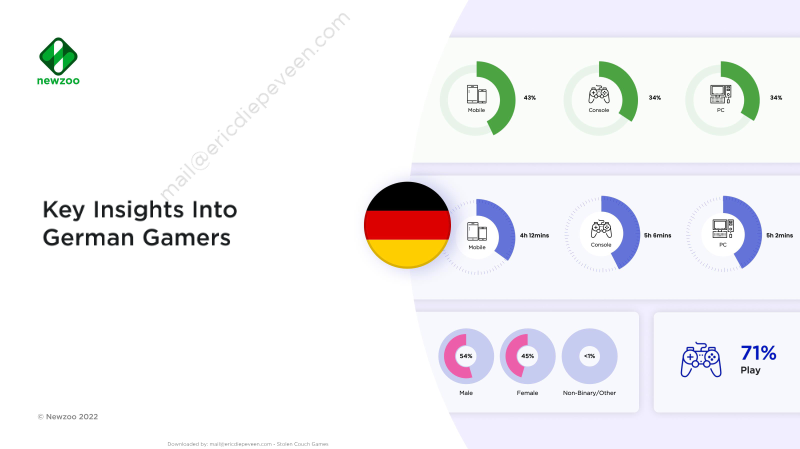
Germany represents a significant pillar of the global gaming industry, ranking as the largest games market in the European Union and the fifth largest worldwide by revenue. As of 2022, the German gaming landscape is characterized by a high level of engagement, with 71% of the online population aged 10 to 65 identifying as game enthusiasts. This engagement extends beyond active play to include viewing gaming video content, social interaction, and community participation.
The demographic profile of German players is nearly balanced by gender, consisting of 52% males and 48% females. While gaming is popular across all age groups, the 21-35 age bracket represents the largest segment at 31%. Motivation for play is primarily driven by the desire to relax and unwind, followed by the pursuit of achievement and social connection. Among the various gamer personas, Time Fillers and Mainstream Gamers are the most prevalent, reflecting a mix of casual mobile play and more dedicated multi-platform engagement.
Platform preferences show that mobile gaming has the highest reach, utilized by 43% of the online population, followed by console and PC at 34% each. Despite the higher reach of mobile, PC and console players demonstrate higher average weekly play times, exceeding five hours. Popular titles in the market include Minecraft, Roblox, and Grand Theft Auto V, with Adventure and Action genres leading in popularity.
Monetization remains strong, with 63% of players spending money on games. The primary driver for spending is the availability of sales or special offers, though a significant portion of consumers also pays to unlock exclusive content or to personalize their in-game experience. These findings are based on a 2022 survey of 2,057 online consumers in Germany, forming part of a broader global research initiative covering 36 markets.
- Germany is the largest gaming market in the EU and the fifth largest globally, with 71% of the online population aged 10 to 65 identifying as game enthusiasts as of 2022.
- Mobile gaming has the highest market reach at 43%, though PC and console players demonstrate higher engagement with average weekly play times exceeding five hours.
- The German gaming demographic is nearly gender-balanced at 52% male and 48% female, with the 21-35 age bracket serving as the largest segment at 31%.
- Monetization is robust, as 63% of players spend money on games, primarily driven by sales, special offers, and the desire to unlock exclusive content or personalization options.
- Adventure and Action are the leading genres in the market, with Minecraft, Roblox, and Grand Theft Auto V identified as popular titles.
+1
NewzooJan 2022
Report39 pages
Newzoo IP-Based Mobile Games Report (2022)
Intellectual property has emerged as a primary driver of success in the mobile gaming landscape, particularly as privacy changes like Apple’s IDFA have complicated traditional user acquisition. In 2021, the dominance of established franchises was underscored by the fact that only one non-IP title reached the top ten global downloads. High-spending players, defined as those investing over $25 per month, demonstrate a significantly higher propensity to download games based on familiar franchises compared to low spenders. This trend translates into superior long-term value and revenue potential for developers who leverage recognized brands to bypass rising marketing costs.
The global market exhibits distinct regional dynamics regarding IP performance. While Western properties such as Disney and Marvel achieve massive download volumes worldwide, Eastern IPs—specifically those originating from Japanese manga and Chinese literature—consistently lead the top-grossing charts. This financial success is driven by the integration of deep monetization mechanics, such as gacha systems, and a strong cultural fit within Asian markets. However, the mere presence of a popular brand does not guarantee longevity. Success requires a "fan-first" approach where game mechanics align seamlessly with the source material. Titles like Umamusume: Pretty Derby illustrate how high-quality simulation and immersive character work drive retention, whereas technical shortcomings or a poor fit between the genre and the IP can lead to rapid player churn.
Long-term profitability in the IP-based mobile sector depends on deep collaboration between developers and licensors to create exclusive content that expands the franchise's universe. Experts emphasize that localized cultural optimization and high production values are essential for maintaining engagement. By utilizing comprehensive market data and consumer research, industry stakeholders can better navigate these trends, sizing global opportunities and identifying the specific franchise-mechanic combinations that resonate most effectively with high-value audiences.
- Established intellectual property is now a primary driver of mobile success, evidenced by the fact that only one non-IP title reached the top ten global downloads in 2021.
- High-spending players, defined as those investing over $25 per month, show a significantly higher propensity to download games based on familiar franchises than low spenders.
- While Western IPs like Disney and Marvel drive high global download volumes, Eastern IPs from Japanese manga and Chinese literature dominate top-grossing charts due to deep monetization mechanics like gacha systems.
- Leveraging recognized brands serves as a critical strategy to bypass rising user acquisition costs caused by privacy changes such as Apple’s IDFA.
- Long-term retention requires a 'fan-first' approach where game mechanics, such as the high-quality simulation found in Umamusume: Pretty Derby, align seamlessly with the source material.
+1
NewzooJan 2022
Report15 pages
Mobile Games on iOS: Winter Results and Forecasts for Spring 2022
This analysis examines the performance and distribution of iOS mobile applications during the winter of 2021–2022 while providing a strategic forecast for the spring 2022 season. The primary objective is to identify market trends by comparing pre-order data with actual release statistics. The scope is global, focusing specifically on the iOS App Store ecosystem across various categories and gaming genres. Data was sourced exclusively from the Apptica platform, utilizing its pre-orders section to gauge developer intent and market direction.
Findings indicate that while games were expected to dominate the winter release cycle at 81% of all upcoming apps, the actual market composition was more diversified. By the end of winter, games represented 11.3% of total new releases, followed closely by Lifestyle and Utilities at 10% each. Within the gaming sector, over 12,400 titles were launched. Although Simulation games were predicted to lead, Puzzle games emerged as the most frequent release, totaling approximately 2,200 titles and accounting for 17.1% of new games. Other significant genres included Action and Adventure, while Role-playing and Sports categories saw fewer releases than initially projected based on pre-order volume.
The forecast for spring 2022 suggests continued dominance for the gaming category, which accounts for 82.4% of apps currently in the pre-order phase. Simulation and Role-playing games are tied as the most anticipated genres, each representing 26.5% of upcoming titles. The analysis also notes a shift in non-gaming categories, with an increase in Productivity, Dating, and Medical apps, while Food and Drink applications have disappeared from the spring pre-order list. Key takeaways emphasize that Puzzle, Role-playing, and Simulation genres remain the primary drivers of the iOS market, maintaining steady growth and developer interest moving into the next quarter.
- Games accounted for 11.3% of all new iOS releases during the winter 2021–2022 period, significantly lower than the 81% share initially anticipated by pre-order data.
- Puzzle games were the most active gaming genre in winter 2021–2022, with approximately 2,200 new titles representing 17.1% of all game releases.
- Gaming is projected to dominate the spring 2022 release cycle, currently accounting for 82.4% of all apps in the pre-order phase.
- Simulation and Role-playing games are the most anticipated genres for spring 2022, each comprising 26.5% of upcoming titles.
- Over 12,400 new game titles were launched on the iOS App Store during the winter 2021–2022 season.
+1
AppticaJan 2022
Report44 pages
Newzoo Trend Report 2022: An Overview and Outlook of Virtual Reality
The global virtual reality market is undergoing a significant resurgence, transitioning from a niche hardware segment into a sustainable ecosystem. This evolution is primarily driven by the proliferation of affordable standalone 6DoF devices, such as the Meta Quest and Pico 4, which have lowered barriers to entry for mainstream consumers. While these standalone units may lack the raw performance of high-end PC VR setups, their accessibility has catalyzed rapid growth in the active install base. Data indicates that nearly 60% of VR gamers engage with their headsets at least once a week, signaling high retention and a shift toward consistent usage patterns.
Gaming remains the primary gateway for consumer adoption, bolstered by the emergence of high-quality "killer apps" and the popularity of adventure and shooter genres. The market is also seeing a shift toward hybrid monetization models, including downloadable content and subscriptions, alongside an increase in social and fitness-oriented virtual environments. Beyond entertainment, VR technology is becoming increasingly essential for industrial applications. Powerful 3D engines like Unreal and Unity are facilitating the expansion of immersive technology into healthcare simulations, remote architectural planning, and education.
The global active VR hardware install base is projected to reach 46 million units by the end of 2024, reflecting a compound annual growth rate of 42.0% since 2019. This sustained momentum is supported by continuous advancements in motion tracking and haptic feedback, as well as substantial investments from major software and hardware firms. As the technology matures, the integration of VR into both consumer lifestyles and professional workflows suggests a long-term trajectory toward widespread cross-industry utility.
- The global active VR hardware install base is projected to reach 46 million units by the end of 2024, representing a 42.0% compound annual growth rate since 2019.
- Market growth is primarily driven by the transition to affordable standalone 6DoF devices, such as the Meta Quest and Pico 4, which have significantly lowered barriers to mainstream entry.
- VR gaming shows strong user retention, with nearly 60% of gamers engaging with their headsets at least once a week.
- Gaming serves as the primary consumer gateway, with market monetization shifting toward hybrid models including subscriptions and downloadable content alongside social and fitness-oriented environments.
- Immersive technology is expanding beyond entertainment into industrial sectors like healthcare, architecture, and education, facilitated by 3D engines such as Unreal and Unity.
+1
NewzooJan 2022
Report46 pages
The Metaverse, Blockchain Gaming, and NFTs: Navigating the Internet’s Uncharted Waters
The metaverse represents a fundamental shift from a two-dimensional internet toward a persistent, three-dimensional social ecosystem driven by gamified virtual spaces. This evolution is currently led by "game as a platform" models, most notably Roblox, which leverages tens of millions of daily active users to host diverse commercial and social experiences. While major global brands in fashion, luxury, and finance are increasingly investing in "direct-to-avatar" economies and digital real estate to reach younger, digital-native demographics, the sector faces significant economic and technical hurdles. High developer take rates, consistent net losses among platform leaders, and networking limitations that prevent massive simultaneous user scaling remain primary obstacles to long-term growth.
The integration of blockchain technology and non-fungible tokens (NFTs) has introduced new economic paradigms, such as the "Play-to-Earn" model. Although these games accounted for nearly half of all decentralized application wallet activity by late 2021, their growth is largely concentrated in emerging markets where users treat gaming as an income-generating activity. The sustainability of these ecosystems is currently challenged by high entry barriers and a prioritization of financial speculation over core gameplay quality. For the industry to mature, it must transition toward higher-quality experiences and more robust virtual economies that offer genuine utility beyond profile-picture status symbols.
Mass adoption of these decentralized virtual worlds is currently constrained by technical and regulatory friction. Interoperability across different platforms remains a theoretical goal rather than a functional reality, while high transaction fees on networks like Ethereum and environmental concerns create additional barriers. Furthermore, the industry must navigate complex legal landscapes regarding digital privacy, content moderation, and the protection of intellectual property. Despite a cooling of initial market hype following a crypto correction in 2022, the long-term trajectory points toward a transmedia future where digital assets and virtual identities are central to global commerce and social interaction.
- The metaverse is evolving into a 3D social ecosystem led by 'game as a platform' models like Roblox, which currently sustains tens of millions of daily active users.
- Blockchain-based 'Play-to-Earn' games represented nearly 50% of all decentralized application wallet activity by late 2021, though growth is primarily driven by emerging markets seeking income rather than gameplay.
- Long-term growth for virtual platforms is hindered by high developer take rates, persistent net losses among industry leaders, and technical limitations preventing massive simultaneous user scaling.
- The sector faces significant friction from a lack of platform interoperability, high transaction fees on networks like Ethereum, and unresolved regulatory challenges regarding digital privacy and intellectual property.
- The industry must shift from speculative financial models and profile-picture NFTs toward higher-quality gaming experiences and virtual economies that provide genuine utility.
+3
NewzooJan 2022

Report22 pages
Newzoo Gamer Insights: The Future of Gaming
The Gamer Generations Report 2022 examines the evolving relationship between younger consumers and the video game industry, asserting that gaming has become an integral, multi-dimensional pillar of daily life for Gen Alpha and Gen Z. The analysis highlights a shift where gaming serves not just as entertainment, but as a primary venue for socialization, self-expression, and immersion. This trend is positioning these generations as the primary drivers of future virtual worlds and the emerging metaverse.
Data for this study was collected between February and April 2022 via Computer Assisted Web Interviewing, surveying 75,930 respondents across 36 global markets. The scope covers Gen Alpha (ages 10-12) and Gen Z (ages 13-27), comparing their behaviors against the total online population. Key findings indicate that 90% of Gen Alpha and Gen Z are "game enthusiasts" who engage through playing, viewing, or social interaction, compared to 79% of the general population. Furthermore, these groups spend significantly more leisure time on gaming than older cohorts; it is the top entertainment source for Gen Alpha and a top-three source for Gen Z, rivaling social networks and video streaming.
Economic engagement is also high, with 52% of Gen Alpha and 48% of Gen Z spending money on games, primarily on mobile platforms. The top spending motivators include unlocking exclusive content and personalizing in-game experiences through currencies and gear. Socially, 70% of Gen Z expresses interest in using game worlds for non-gaming gatherings, such as concerts or virtual hangouts. The report concludes that as gaming becomes a ubiquitous social platform, brands and developers must adapt to these generations' preferences for multiplayer connectivity, character customization, and diverse content consumption.
- 90% of Gen Alpha and Gen Z are active game enthusiasts, significantly higher than the 79% engagement rate seen in the general online population.
- Gaming is the primary entertainment source for Gen Alpha and a top-three source for Gen Z, competing directly with social media and video streaming platforms.
- Economic engagement is high, with 52% of Gen Alpha and 48% of Gen Z spending money on games, primarily driven by mobile platform purchases for exclusive content and personalization.
- 70% of Gen Z respondents express interest in utilizing virtual game worlds for non-gaming social activities, including concerts and virtual hangouts.
- The shift toward gaming as a multi-dimensional social platform requires developers to prioritize multiplayer connectivity, deep character customization, and diverse content consumption to remain relevant to younger cohorts.
+1
NewzooJan 2022

Report68 pages
Mobile App Trends 2022: A Global Benchmark of App Performance
The global mobile ecosystem experienced significant expansion throughout 2021 and into 2022, characterized by record-breaking consumer spending of $170 billion and a projected ad spend of $336 billion. Despite initial concerns regarding privacy changes following the release of iOS 14.5, the industry demonstrated remarkable resilience as App Tracking Transparency opt-in rates reached 25% globally, far exceeding early market expectations. This growth was distributed across key verticals including fintech, e-commerce, and gaming, with mobile e-commerce sales alone reaching $3.56 trillion.
The fintech sector emerged as a primary driver of engagement, with installs and sessions rising by 34% and 53% respectively. While traditional banking and payment apps maintain the highest market share, cryptocurrency and stock trading platforms saw the most intense user activity, with session lengths nearly doubling. However, this heightened interest triggered a sharp increase in acquisition costs, with fintech eCPIs rising from $1.05 to $3.40 over the course of a year. Similarly, e-commerce apps saw a 46% surge in in-app revenue despite rising costs and declining retention, signaling a shift where users are spending more money and time per session even as new user acquisition becomes more expensive.
Mobile gaming remains the dominant force in the app economy, accounting for 52% of total consumer spend. Global game installs grew by 32%, led by the hyper-casual subvertical, though action and adventure titles commanded the highest levels of engagement and session frequency. While Day 30 retention rates for games nearly doubled to 9%, the industry faces a growing divide between high-volume downloads and long-term stickiness. As user acquisition costs continue to climb across all regions—particularly in LATAM and EMEA—the focus for developers has shifted from pure volume to maximizing lifetime value and implementing sophisticated re-engagement strategies to sustain growth in an increasingly competitive landscape.
- Mobile gaming remains the dominant sector, capturing 52% of total consumer spend and seeing a 32% increase in global installs.
- The mobile economy reached record-breaking scale with $170 billion in consumer spending and $336 billion in projected ad spend.
- Fintech experienced significant growth with a 34% rise in installs and 53% increase in sessions, though acquisition costs (eCPI) spiked from $1.05 to $3.40.
- E-commerce apps achieved a 46% surge in in-app revenue, despite facing the dual challenges of rising acquisition costs and declining user retention.
- App Tracking Transparency opt-in rates reached 25% globally, demonstrating greater industry resilience to iOS 14.5 privacy changes than initially anticipated.
+2
AppLovinJan 2022
Report29 pages
Gaming Deals Activity Report: Q1–Q3 2022
The gaming investment landscape in the first three quarters of 2022 reflects a significant market correction following a record-breaking 2021. While the total value of closed and announced deals reached $124.5 billion—nearly double the previous year's volume—this figure is heavily skewed by Microsoft’s pending $69 billion acquisition of Activision Blizzard. Excluding that single transaction, the market shows clear signs of cooling due to macroeconomic instability, post-pandemic shifts in user engagement, and increased regulatory scrutiny.
Strategic mergers and acquisitions (M&A) remain the primary driver of deal value, reaching a record $101.4 billion year-to-date, despite a 40% decline in the number of closed transactions. Major players like Embracer Group, Sony, and Saudi Arabia’s Public Investment Fund (PIF) dominated this activity. Conversely, public offerings have nearly collapsed, reaching their lowest point since early 2020, with deal values shrinking fivefold compared to 2021. Private investments also saw a sharp decline in the third quarter, dropping 69% from the previous quarter, signaling that the "soured" economic climate has finally impacted venture capital and corporate rounds.
The report highlights a notable shift in the blockchain and Web3 gaming sectors. While early-stage investment in this space previously drove market growth, the third quarter of 2022 marked the first period of negative growth for blockchain-related investments, with total deal value falling 14% year-over-year. Investors are becoming more selective, moving away from infrastructure platforms toward studios capable of producing engaging content. Geographically, the United States remains the most active market for gaming investments, followed by the United Kingdom and Turkey. Gender diversity remains a challenge for the industry, as 89% of companies receiving investment are male-led, with women-led entities representing only 2% of the total.
- The $124.5 billion total deal value for Q1–Q3 2022 is heavily skewed by Microsoft’s $69 billion acquisition of Activision Blizzard, masking a broader market cooling driven by macroeconomic instability and regulatory pressure.
- Strategic M&A activity reached a record $101.4 billion despite a 40% decline in the number of closed transactions, with major activity led by Embracer Group, Sony, and Saudi Arabia’s Public Investment Fund.
- Public offerings have nearly collapsed to their lowest point since early 2020, with deal values shrinking fivefold compared to 2021 levels.
- Private investment experienced a sharp downturn in Q3 2022, dropping 69% from the previous quarter as the economic climate impacted venture capital and corporate funding rounds.
- Blockchain and Web3 gaming investments saw their first period of negative growth in Q3 2022, with total deal value falling 14% year-over-year as investors shifted focus from infrastructure to content-focused studios.
+1
InvestGameJan 2022

Report21 pages
Newzoo’s Global Gamer Study 2022
Gaming has evolved into a multi-dimensional entertainment ecosystem that extends far beyond traditional play, encompassing viewing, socializing, and content creation. Research conducted between February and April 2022 across 36 global markets reveals that 79% of the online population are game enthusiasts. This engagement is most profound among younger generations; for Gen Alpha, gaming has surpassed social media and streaming as the primary source of entertainment. The study utilized a representative sample of 75,930 respondents aged 10 to 65 to analyze behaviors across five distinct generational cohorts.
Data indicates that gaming is increasingly a platform for social connection, with 75% of players engaging in game worlds for social purposes without playing the primary game. This trend is a significant driver of the emerging metaverse. Financial engagement is also high, with approximately half of Gen Alpha, Gen Z, and Millennials spending money on games. Total consumer spending in the sector was projected to exceed $200 billion in 2023. Furthermore, the rise of blockchain gaming and play-to-earn models shows significant future potential, with 34% of players in the United States expressing interest in these technologies.
The findings emphasize that gamers are a highly attractive demographic for brands, as players generally hold 36% more positive attitudes toward brands compared to non-players. However, the diversity of the audience necessitates a nuanced approach to engagement. Using a proprietary segmentation model, the research identifies various personas ranging from Ultimate Gamers to Time Fillers. For instance, while both Apex Legends and Fortnite are battle royale titles, their player bases differ significantly in age, gender, and brand preferences, illustrating that effective marketing requires deep insights into specific game communities and generational motivations.
- Gaming has become a primary entertainment ecosystem for 79% of the global online population, with Gen Alpha prioritizing gaming over social media and streaming.
- The gaming sector reached a projected consumer spend exceeding $200 billion in 2023, with approximately 50% of Millennials, Gen Z, and Gen Alpha actively spending money on games.
- Gaming is increasingly used as a social platform, as 75% of players engage in game worlds for social interaction rather than playing the primary game mechanics.
- Gamers represent a high-value demographic for advertisers, holding 36% more positive attitudes toward brands than non-players.
- Interest in blockchain and play-to-earn gaming models is significant, with 34% of U.S. players expressing interest in these technologies.
+1
NewzooJan 2022