The gaming investment landscape in the first three quarters of 2022 reflects a significant market correction following a record-breaking 2021. While the total value of closed and announced deals reached $124.5 billion—nearly double the previous year's volume—this figure is heavily skewed by Microsoft’s pending $69 billion acquisition of Activision Blizzard. Excluding that single transaction, the market shows clear signs of cooling due to macroeconomic instability, post-pandemic shifts in user engagement, and increased regulatory scrutiny.
Strategic mergers and acquisitions (M&A) remain the primary driver of deal value, reaching a record $101.4 billion year-to-date, despite a 40% decline in the number of closed transactions. Major players like Embracer Group, Sony, and Saudi Arabia’s Public Investment Fund (PIF) dominated this activity. Conversely, public offerings have nearly collapsed, reaching their lowest point since early 2020, with deal values shrinking fivefold compared to 2021. Private investments also saw a sharp decline in the third quarter, dropping 69% from the previous quarter, signaling that the "soured" economic climate has finally impacted venture capital and corporate rounds.
The report highlights a notable shift in the blockchain and Web3 gaming sectors. While early-stage investment in this space previously drove market growth, the third quarter of 2022 marked the first period of negative growth for blockchain-related investments, with total deal value falling 14% year-over-year. Investors are becoming more selective, moving away from infrastructure platforms toward studios capable of producing engaging content. Geographically, the United States remains the most active market for gaming investments, followed by the United Kingdom and Turkey. Gender diversity remains a challenge for the industry, as 89% of companies receiving investment are male-led, with women-led entities representing only 2% of the total.

InvestGame · 2026
InvestGame · 2026

InvestGame · 2026
InvestGame · 2026
InvestGame · 2026

InvestGame · 2026

InvestGame · 2026
InvestGame · 2026

InvestGame · 2026

InvestGame · 2025
InvestGame · 2025
InvestGame · 2025
Aream & Co · 2026
Drake Star Partners · 2026
Modern Times Group · 2026
Drake Star Partners · 2025
Drake Star Partners · 2025
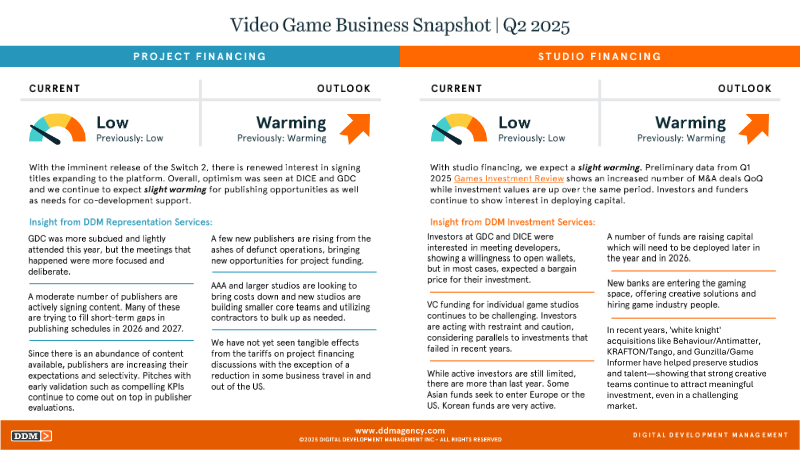
DDM · 2025
Drake Star Partners · 2025
Digital Development Management · 2025
DDM · 2025

Thunderful · 2025
DDM · 2025
Aream & Co · 2025