
Wolfenstein
GameBy Raven Software · Released Aug 18, 2009
Documents about Wolfenstein
Report9 pages
History of Digital Games in Turkey
This paper, a DiGRA 2005 conference study by Erdal Yılmaz and Kürşat Çağıltay of Middle East Technical University, traces the history of digital games in Turkey and assesses the state of its game development industry.
- Turkish players' habits and play durations parallel global averages, but domestic game development has been extremely limited and poorly documented.
- Digital games reached Turkey in the early 1980s via arcade-style "Atari Salonu" halls, which prompted a 1985 regulatory response requiring local permits.
- Turkish home game development passed through three phases: an amateur 1980s period built on the Commodore 64 and magazine-published source code, a semi-professional 1990s period centered on Amiga and PC groups like Siliconworx and Compuphiliacs, and a professional stage from 2000 onward.
DiGRAJan 2005
Whitepaper15 pages
Apocalypse the Spielberg Way: Representations of Death and Ethics in Saving Private Ryan, Band of Brothers and the Videogame Medal of Honor: Frontline
Kingsepp's paper compares how death and ethics are represented in Steven Spielberg's Saving Private Ryan and Band of Brothers and in the 2002 video game Medal of Honor: Frontline.
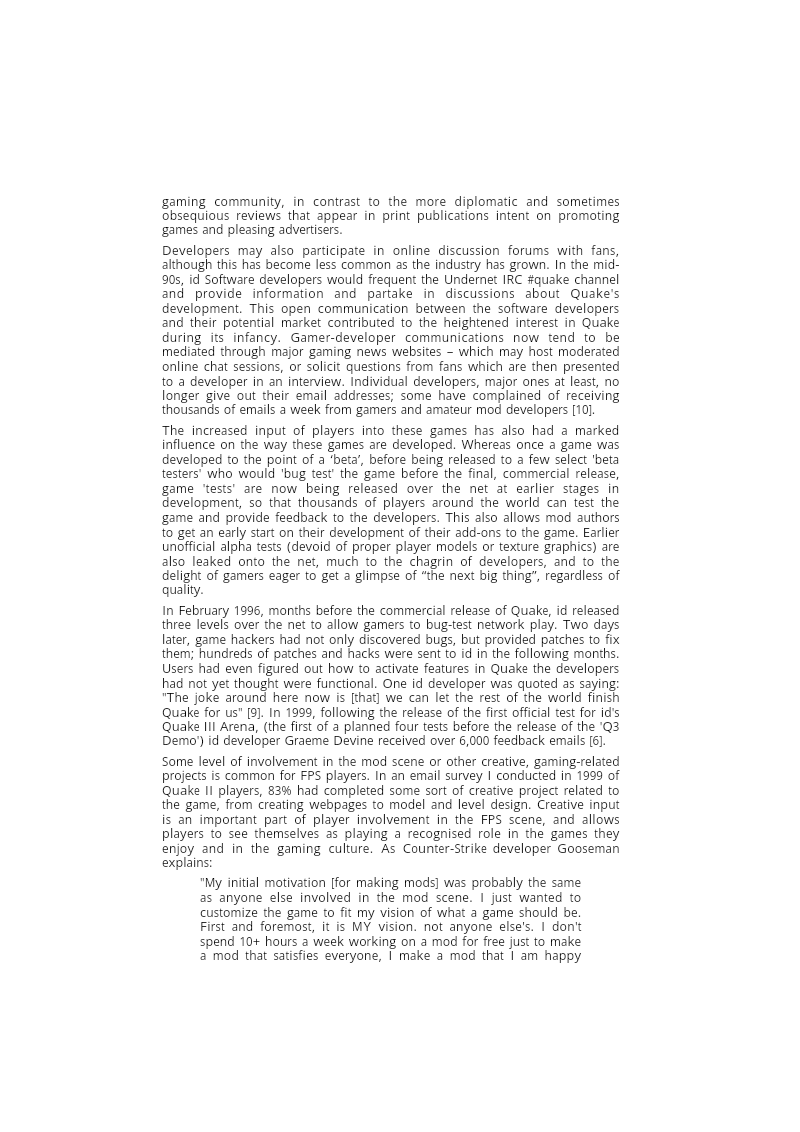
- The paper argues that Spielberg's Saving Private Ryan and Band of Brothers depict death in hyperrealistic, emotionally intimate ways that invite viewers to reflect on mortality and moral ambiguity, whereas Medal of Honor: Frontline (2002) adopts a postmodern model in which enemy corpses vanish.
- The game's vanishing corpses are read as a symbolic ritual of conquering death, casting enemies as an abundant, disease-like threat to be continually exterminated in pursuit of heroic reward.
- The author suggests the disappearing corpses may partly stem from technical constraints such as limited memory ('byte economy'), noting that the earlier game Return to Castle Wolfenstein shows corpses can be preserved.
DiGRAJan 2003
Whitepaper10 pages
WADs, Bots and Mods: Multiplayer FPS Games as Co-creative Media
Sue Morris's paper examines multiplayer first-person shooter (FPS) games such as Quake, Half-Life, and Counter-Strike as "co-creative media," arguing that these games are not produced solely by developers or solely by players, but through the combined input of both.
- The paper argues that multiplayer FPS games such as Quake, Half-Life and Counter-Strike are 'co-creative media,' shaped jointly by developers and players rather than by either alone, extending beyond the participatory-media framing common in fan studies.
- Wolfenstein 3-D (1992) and Doom (1993) set the foundation for the genre, and Doom's source-code release and multiplayer capabilities enabled a durable mod scene.
- Player contributions materially influenced development: early public betas and leaked alphas produced bug reports and patches, volunteer-built anti-cheat tool PunkBuster was later adopted by publishers, and mod authors behind ThreeWave CTF and Counter-Strike were hired or commercially acquired.
DiGRAJan 2003