Octodad
Game
Documents about Octodad
Article
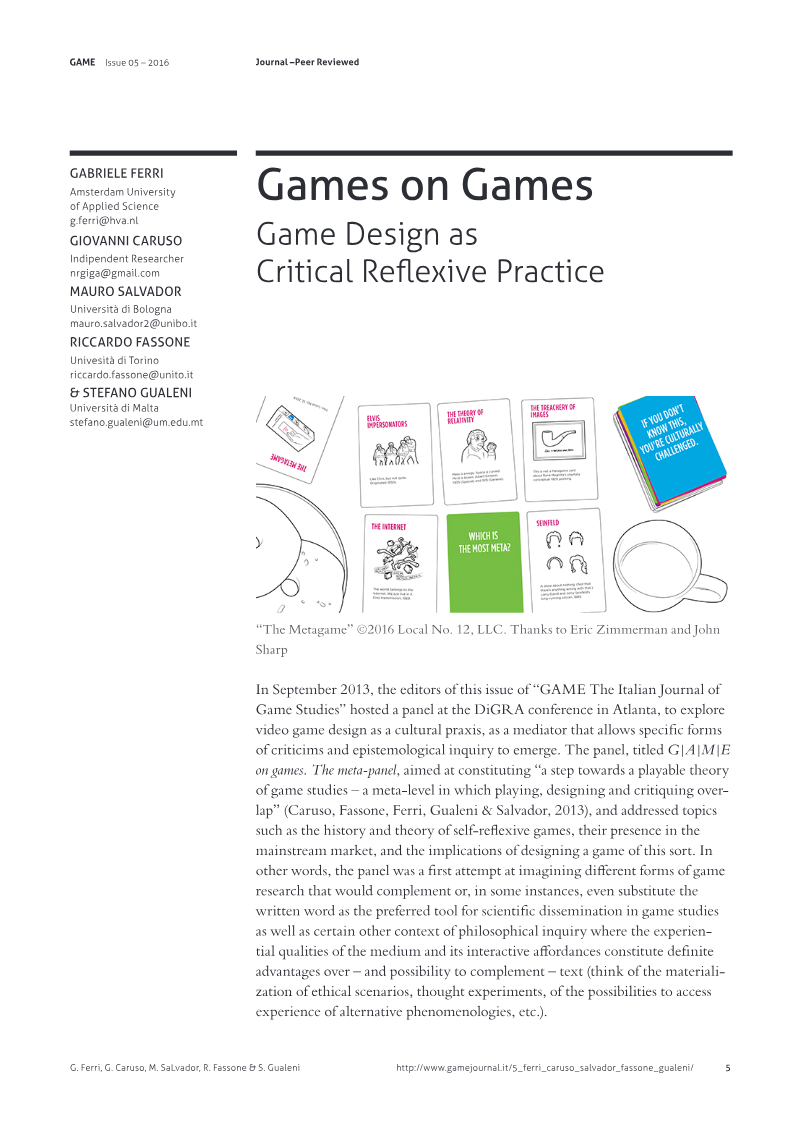
Games on Games: Game Design as Critical Reflexive Practice
This editorial introduction to Issue 05 of GAME, The Italian Journal of Game Studies (2016), argues that video game design can function as a legitimate form of critical and scholarly inquiry, a practice the authors term "research through design" or "critical making."
- The editorial argues that video game design can function as legitimate scholarly inquiry, termed "research through design" or "critical making," with games positioned as a possible epistemological vehicle comparable to papers, books, and conference presentations.
- The issue grows out of a 2013 DiGRA panel in Atlanta that explored self-reflexive games as a "playable theory" of game studies, and the editors present the publication as a provisional outcome of an ongoing informal research network.
- The authors document a marked rise in self-reflexive games in the three years after the 2013 panel, with independent designers producing games-on-games that critique design, development, and distribution practices.
G|A|M|E – The Italian Journal of Game StudiesOct 2016
Article
Critical Jostling
Pippin Barr's essay examines how videogames can function as critical objects by reconfiguring the design elements of existing games, arguing that this approach offers a distinctive form of critique within videogame criticism.
- Pippin Barr proposes "reconfiguring the remainder" as a critical method: shifting conventional design standards to expose what games omit or take for granted, while keeping the work functional and playable, drawing on Dunne and Raby's critical design and DiSalvo's adversarial design.
- Barr's Jostle Bastard reworks Hotline Miami by replacing killing with non-fatal "jostling" and adding social consequences such as arrest, job loss, eviction, and victim revenge, plus a mundane non-violent life option that makes violence feel unnecessary.
- Jostle Parent reworks the comic parenting scenario of Octodad: Dadliest Catch into an emotionally serious game by letting the player's children die permanently, recorded via gravestones and named children, removing the source's linear, consequence-free narrative.
G|A|M|E – The Italian Journal of Game StudiesOct 2016