Metal Wolf Chaos
Game
2 documents in the library are about Metal Wolf Chaos, from writers such as Game Discovery Now and Thompson River University. Each has a summary and key insights with the page they come from.
Connections
Each row is a game or company named alongside Metal Wolf Chaos, each column a document, oldest first. A mark means that document names it. Select a row to see those documents.
Documents about Metal Wolf Chaos
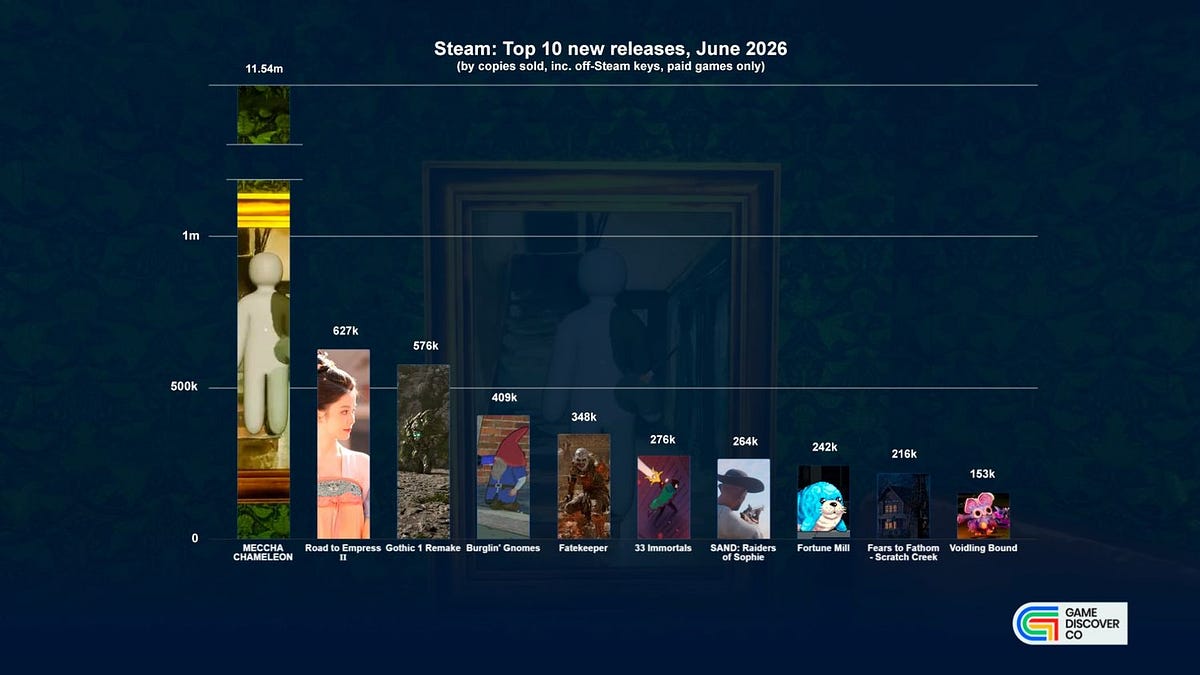
June 2026's Top New PC & Console Games
GameDiscoverCo's July 2026 newsletter reviews the top new PC and console releases of June 2026, drawing on its Pro data for Steam, console, Switch eShop and, newly, Twitch.
- Sony will end physical disc production for new PlayStation games in January 2028, impacting third-party publishers and disc rental services, and increasing the importance of Switch as a physical format.
- June 2026 was a quiet month for top-grossing new Steam releases, with only two games exceeding $10 million in revenue compared to six in May 2026, likely due to release shifts around Next Fest and the Summer Sale.
- Meccha Chameleon, a $6 multiplayer game, was the breakout new title in June 2026, selling 11.5 million copies and significantly outperforming other new releases.
Arcade Soldiers: Early Japanese Shooters in Dialogue with Hollywood Militarism
This analysis argues that early Japanese arcade shooters from the 1970s and 1980s, featuring human protagonists and settings like jungles, engaged in a dialogue with American Cold War-era social imaginaries and Hollywood militarism, rather than solely reflecting financial motivations for international market appeal (mukokuseki).
- The paper argues that 1980s Japanese arcade shooters such as Front Line, Commando, Ikari Warriors, Contra, and Metal Gear were not merely market-driven mukokuseki (culturally odorless) products, but engaged in an ideological dialogue with Cold War American culture and post-Vietnam Hollywood ambivalence toward militarism.
- Japanese developers, lacking a domestic tradition of celebratory war narratives after the 1945 defeat, drew on American war films introduced during the postwar Occupation, especially Hollywood action films set in Southeast Asia and Central America.
- Rambo was a key model: his disillusioned, retributive hero, victimized by his own government, offered Japanese audiences a template for processing a 'bad' war in which flawed protagonists are betrayed by the state.
Companies behind it

As the documents state it.