Hellish Quart
Game
4 documents in the library are about Hellish Quart, from writers such as DiGRA, Humanities and Jagiellonian University. Each has a summary and key insights with the page they come from.
Connections
Each row is a game or company named alongside Hellish Quart, each column a document, oldest first. A mark means that document names it. Select a row to see those documents.
Documents about Hellish Quart
The Name of Janosik Will Never Perish: Górals Tradition in Game Culture
This paper examines a corpus of independent video games that feature Janosik, the folk hero of the Polish-Slovak borderlands, and considers how these works draw on Góral (Highlander) cultural tradition in the northern Carpathians.
- The paper is a qualitative, game-language analysis of independent video games featuring Janosik, the Polish-Slovak folk hero, and Góral (Highlander) tradition in the northern Carpathians, rather than a quantitative study.
- The authors argue that game portrayals of Janosik and Góral culture are shaped by nearly two centuries of appropriation by surrounding nation-states, including Polish, Slovak, Austro-Hungarian, and Third Reich discourses.
- The corpus includes Mirage (1994), Retrovibe (2020, with a 2024 sequel), Juro Janosik (2021, Slovak), and Hellish Quart (2021), which uses a Janosik analogue named Yendrek, alongside tabletop RPGs Corny Groń and Beyond Corny Groń.
(Semi-)Peripheral Gameplay in Video Games
The document explores how gameplay in video games developed in "semi-peripheral" regions, particularly Central and Eastern Europe (CEE), can be influenced by local circumstances, challenging the notion that gameplay conventions are rigid external forms.
- Stanisław Krawczyk argues that gameplay in video games from semi-peripheral and peripheral industries can be shaped by local circumstances, not only by the content and worlds that scholars usually analyze, challenging the view of gameplay conventions as a rigid external form.
- The central thesis is supported mainly with examples from Central and Eastern Europe, a region increasingly visible in game studies since the mid-2010s alongside growing scholarly attention to European, Asian, and Latin American game production.
- Many CEE developers built their own game engines, and Czech developers favored personal computers, which encouraged complex, stat-based, and realism-oriented game designs.
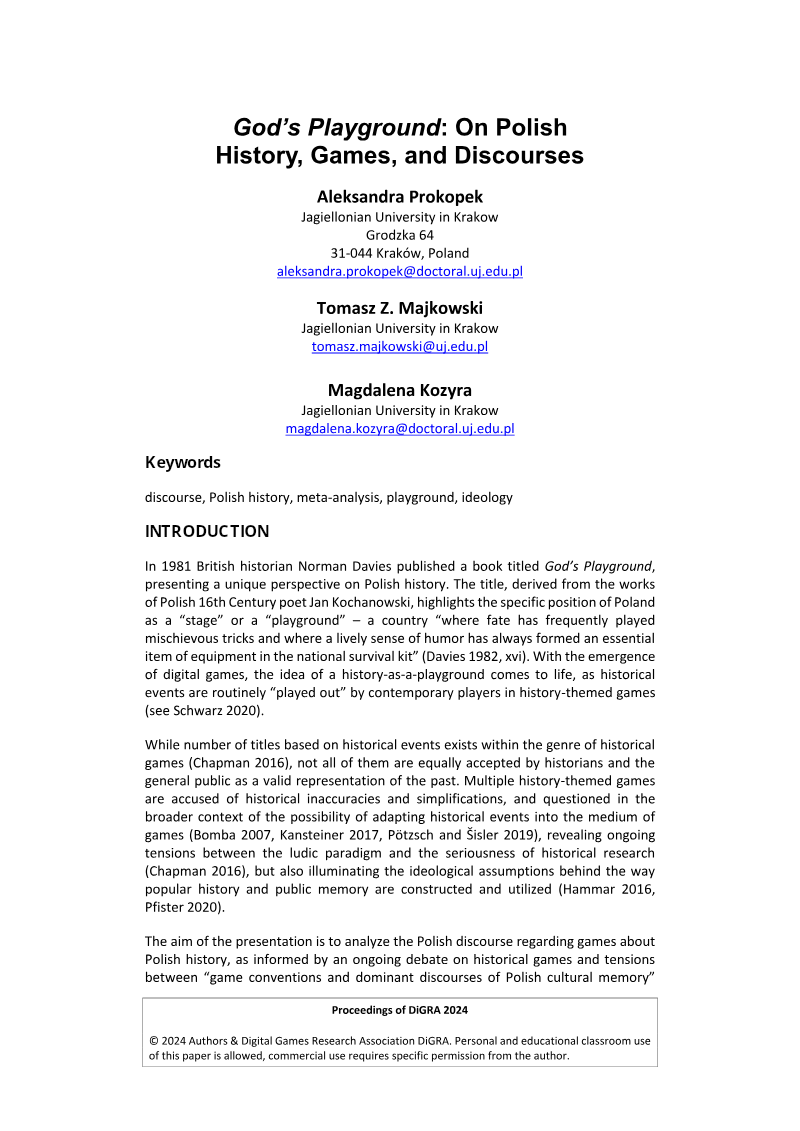
God's Playground: On Polish History, Games, and Discourses
The document analyzes the Polish discourse surrounding games about Polish history, examining the tensions between game conventions and dominant narratives of Polish cultural memory.
- The paper is a meta-study based on preliminary research and analysis of critical commentary and existing scholarship, not a large-scale empirical survey, so its findings are interpretive rather than statistically grounded.
- Polish debates on historical accuracy in games centre on two periods: the seventeenth-century Polish-Lithuanian Commonwealth (e.g., Medieval II: Total War, Mount & Blade: With Fire & Sword, Hellish Quart) and the Second World War, especially the 1944 Warsaw Uprising.
- Critics praise the seventeenth-century games for accurate events, maps of real Polish cities, and atmosphere, but the authors argue this praise overlooks how the vision draws on romanticized literature such as Henryk Sienkiewicz and nostalgic 'retrotopia' that sustains national myths.
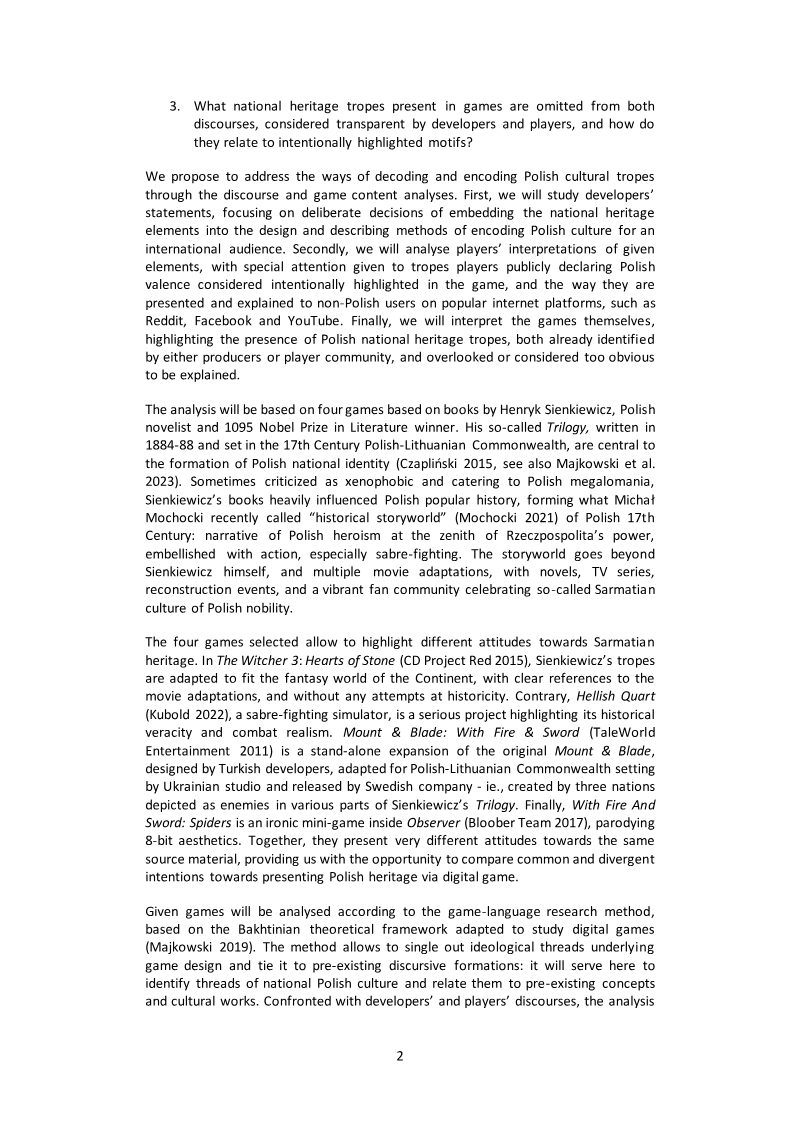
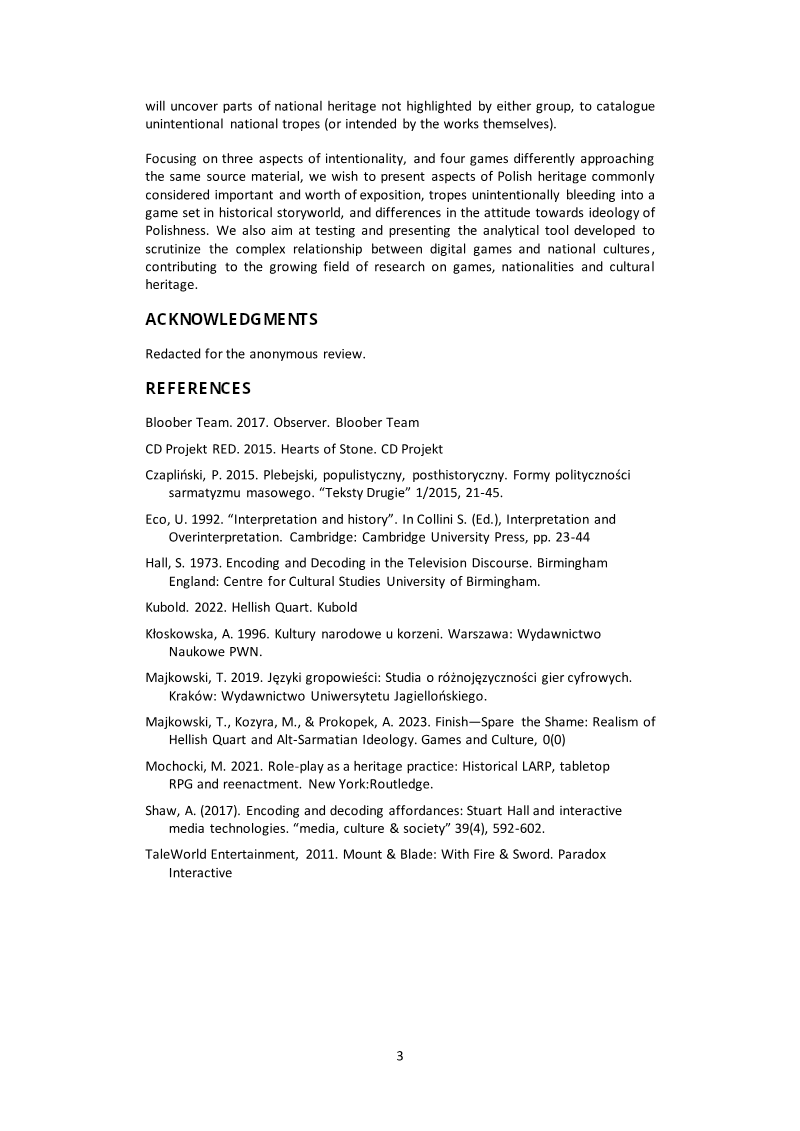
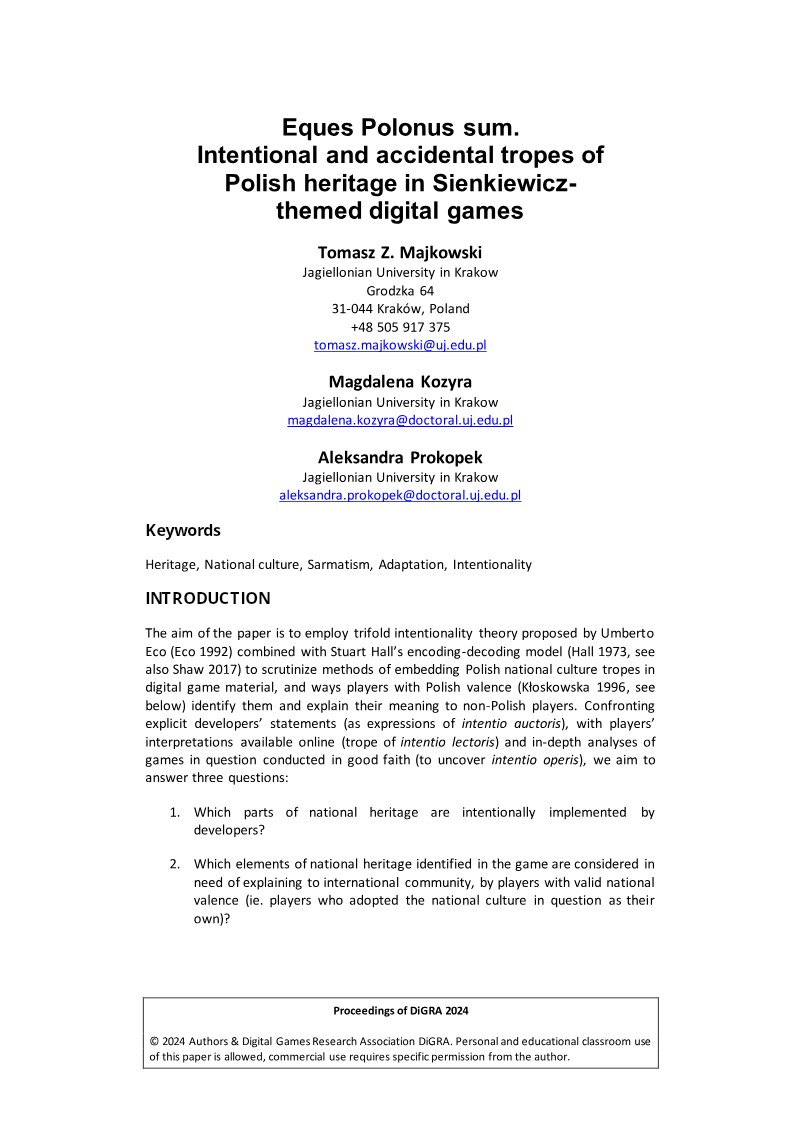
Intentional and Accidental Tropes of Polish Heritage in Sienkiewicz-Themed Digital Games
This paper investigates the intentional and accidental incorporation of Polish national heritage tropes in digital games based on the works of Henryk Sienkiewicz, particularly his "Trilogy."
- The paper analyses how Polish national heritage is embedded in digital games adapted from Henryk Sienkiewicz's historical novels, combining Umberto Eco's tripartite model of intentionality with Stuart Hall's encoding-decoding framework.
- Its central questions are which national-heritage elements developers deliberately implement, which elements Polish-affiliated players feel must be explained to international audiences, and which tropes are treated as transparent or too obvious to mention.
- The corpus comprises four games tied to Sienkiewicz's Trilogy, set in the seventeenth-century Polish-Lithuanian Commonwealth: The Witcher 3: Hearts of Stone, Hellish Quart, Mount & Blade: With Fire & Sword, and the ironic 8-bit mini-game With Fire and Sword: Spiders within Observer.