
Jagiellonian University
Jagiellonian University is a public research university in Kraków, Poland. In this context it is the source of an academic article on the tabletop role-playing game Werewolf: The Apocalypse and its Heart of the Forest scenario.
Documents
The Name of Janosik Will Never Perish: Górals Tradition in Game Culture
This paper examines a corpus of independent video games that feature Janosik, the folk hero of the Polish-Slovak borderlands, and considers how these works draw on Góral (Highlander) cultural tradition in the northern Carpathians.
- The paper is a qualitative, game-language analysis of independent video games featuring Janosik, the Polish-Slovak folk hero, and Góral (Highlander) tradition in the northern Carpathians, rather than a quantitative study.
- The authors argue that game portrayals of Janosik and Góral culture are shaped by nearly two centuries of appropriation by surrounding nation-states, including Polish, Slovak, Austro-Hungarian, and Third Reich discourses.
- The corpus includes Mirage (1994), Retrovibe (2020, with a 2024 sequel), Juro Janosik (2021, Slovak), and Hellish Quart (2021), which uses a Janosik analogue named Yendrek, alongside tabletop RPGs Corny Groń and Beyond Corny Groń.
By the Law of the Wolf: Werewolf: The Apocalypse, Heart of the Forest Between Global, National and Fictional
The document analyzes Werewolf: The Apocalypse – Heart of the Forest, a 2020 visual novel by Polish studio Different Tales, focusing on how it uses the Werewolf: The Apocalypse tabletop RPG framework to address contemporary Polish political and cultural tensions.
- The study treats Werewolf: The Apocalypse, and specifically the 2020 visual novel Heart of the Forest by Polish studio Different Tales, as a framework for political and cultural analysis rather than as simple fantasy.
- The game ties its fictional werewolf tribal system to real Polish issues, including the 2017 protests and the contested legacy of the anti-communist "Cursed Soldiers."
- The narrative is set in a village in Eastern Poland, a contact zone between Polish and Belarusian cultures, following a protagonist of mixed national and ethnic heritage.
Ludonarrative Dissonance and Metanarrative Dissonance: Case Studies of Selected Examples
Michał Figoń's article sets out to provide a coherent definition of ludonarrative dissonance, building on Clint Hocking's 2007 coinage, and to distinguish it from a new concept the author proposes, metanarrative dissonance.
- Ludonarrative dissonance describes a conflict between what a game's mechanics reward and what its story asks players to feel or believe, with BioShock's altruistic narrative clashing against its selfish, reward-driven combat as the foundational example.
- Metanarrative dissonance is proposed as a distinct concept in which a player's prior expectations, shaped by marketing promises, promotional material, or real-world knowledge of depicted locations, clash with what a game delivers, undermining immersion even when the internal logic is consistent.
- The article's central case study is CD Projekt RED's The Witcher adaptations, compared against Andrzej Sapkowski's novels, including altered characterizations of Triss Merigold and a redesigned gwint card minigame whose polished cards clash with the impoverished, war-torn economy of the source material.
(Un)known Polish Places: Strategies of Foreignization and Domestication in Polish Video Games
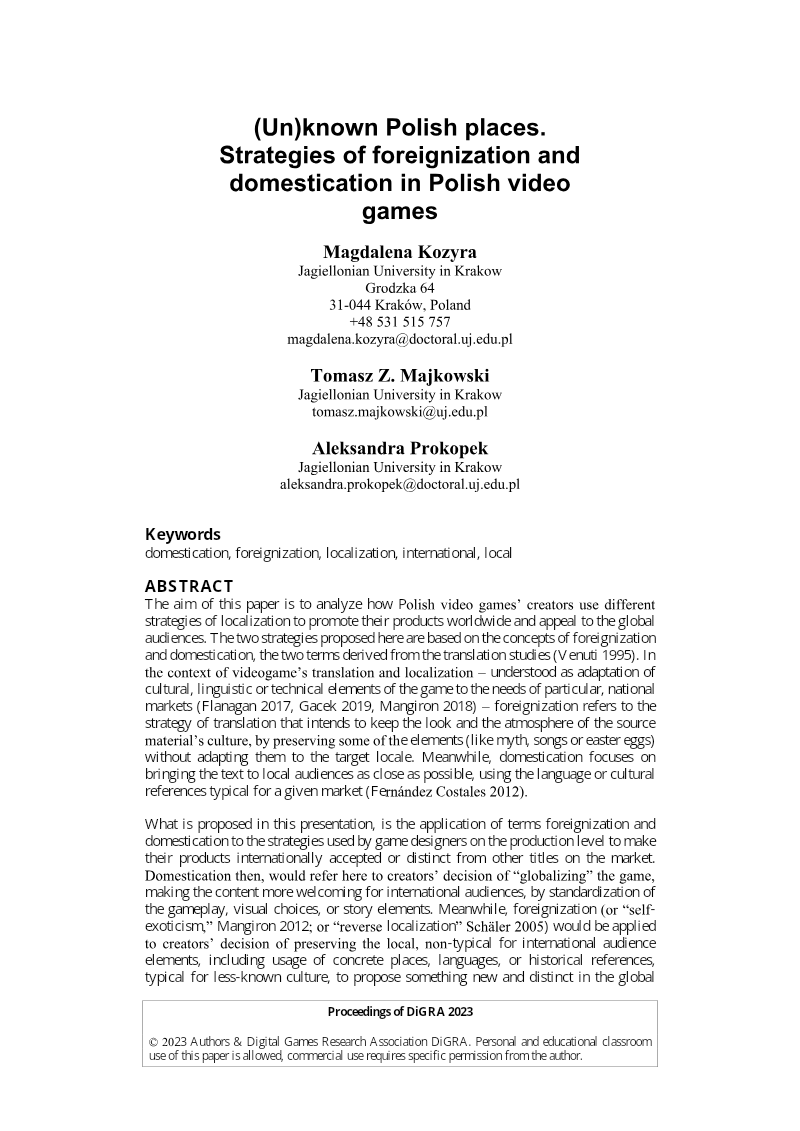
This paper examines how Polish video game developers deploy two localization strategies, foreignization and domestication, borrowed from translation studies, to position their products for international markets.
- Polish video game developers use two localization strategies borrowed from translation studies: domestication (standardizing gameplay, visuals, and narrative for global accessibility) and foreignization (preserving local places, languages, and historical references to stand out).
- A 2020 industry report indicated that roughly 97% of Polish studios' revenues came from foreign players, giving domestication considerable economic weight.
- The authors treat these strategies as production-level design decisions rather than purely linguistic ones, reflecting a tension between local cultural identity and a globalized digital market.