City of Heroes
Game
4 documents in the library are about City of Heroes, from writers such as DiGRA and Extra Credits. Each has a summary and key insights with the page they come from.
Connections
Each row is a game or company named alongside City of Heroes, each column a document, oldest first. A mark means that document names it. Select a row to see those documents.
Documents about City of Heroes

Design Club: Why We Need Skill Based matchmaking
Skill-based matchmaking serves as a critical infrastructure for modern multiplayer gaming, functioning as the primary mechanism to ensure competitive integrity and player retention.
- Skill-based matchmaking (SBMM) is essential in modern multiplayer games to prevent 'smurfing' and the negative experience of high-skill players dominating novices, which is critical for player retention in free-to-play and refund-eligible titles.
- A petition calling for the removal of SBMM from Call of Duty has garnered over 16,410 verified signatures, reflecting a community desire for the 'casual' and unpredictable nature of classic multiplayer experiences.
- Matchmaking systems face significant transparency challenges because complex metrics—such as individual contribution in team-based MOBAs or asymmetrical point gains in racing games—are difficult to communicate clearly to players.
Information Behavior and the Formation and Maintenance of Peer Cultures in Massive Multiplayer Online Role-Playing Games: A Case Study of City of Heroes
This paper offers a conceptual framework for a planned study of how players in Massive Multiplayer Online Role-Playing Games (MMORPGs) form and sustain small peer groups such as guilds, clans, and teams, using the massively multiplayer game City of Heroes as its case.
- The paper is an early-stage conceptual framework for a planned study, not a report of empirical results; its claims rest mainly on existing literature rather than new data.
- It proposes that play theory and information behavior theory (especially meaning-making) together can explain how MMORPG players form and sustain guilds, clans, and teams with their own rules and mores despite anonymity and missing offline social cues.
- The framework treats MMORPGs three ways: as games, as 'virtual sandbox' play spaces, and as cultures where knowledge, behavior, and artifacts are learned and negotiated.
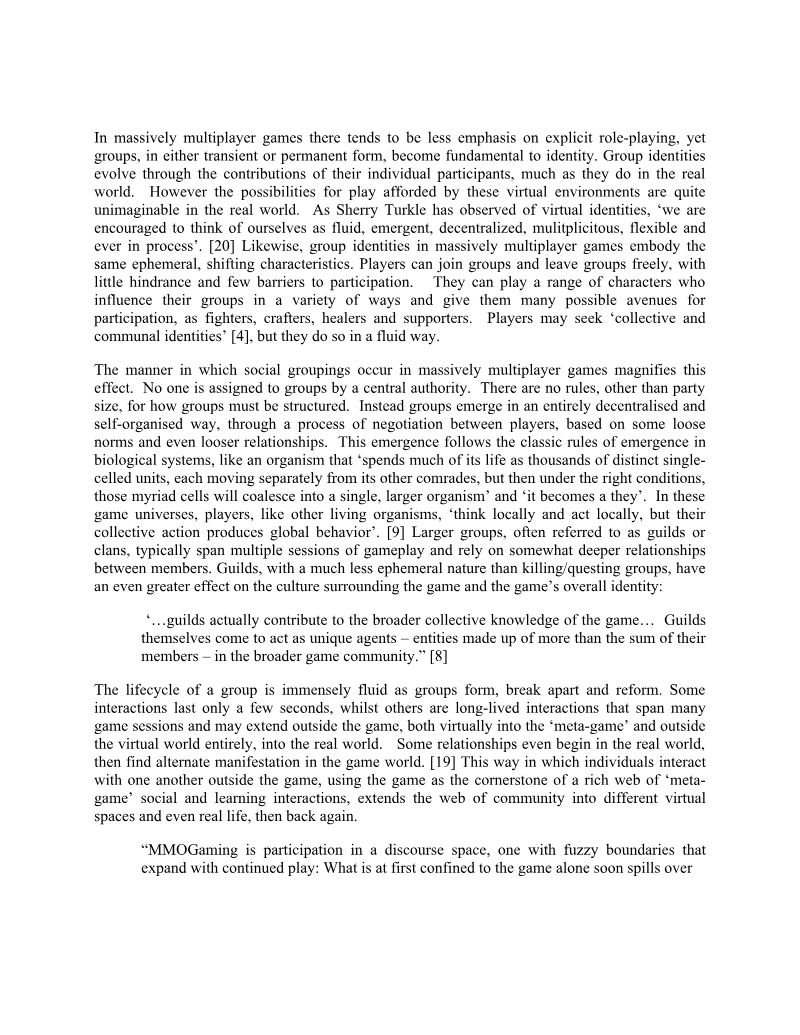
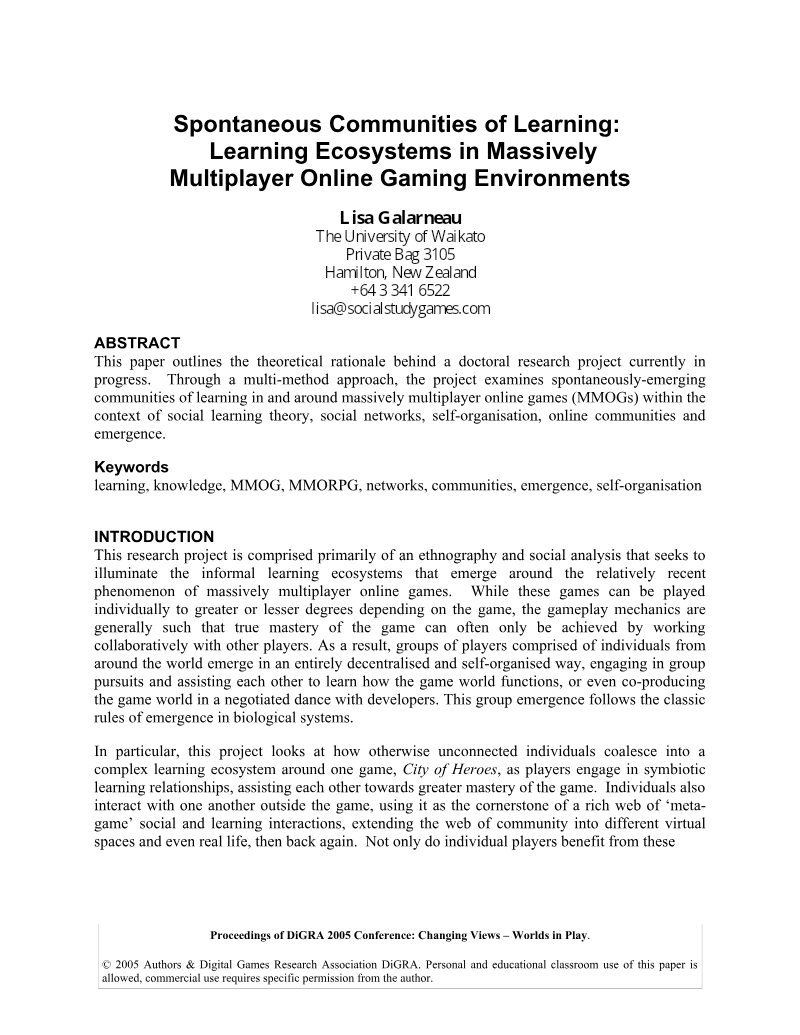
Spontaneous Communities of Learning: Learning Ecosystems in Massively Multiplayer Online Gaming Environments
This doctoral research proposal examines how spontaneous communities of learning emerge within massively multiplayer online games (MMOGs), using City of Heroes as its primary case.
- Massively multiplayer online games such as City of Heroes act as informal learning ecosystems where globally dispersed players self-organise to master complex environments.
- The authors argue that because mastery typically requires collaboration, players form symbiotic learning relationships that extend beyond the game into forums, chat channels, and face-to-face meetings.
- The framework draws on legitimate peripheral participation (Lave and Wenger), connectivism (Siemens), and distributed intelligence (Levy), positing that learning is best studied in naturally occurring contexts rather than formal classrooms.
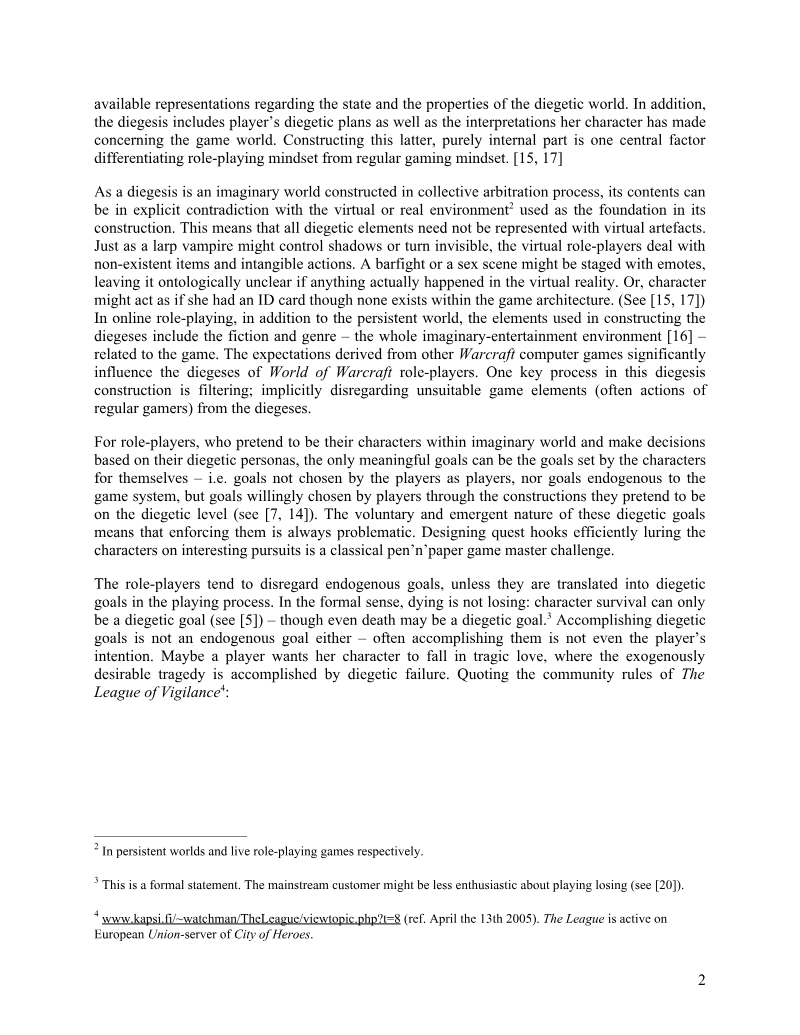
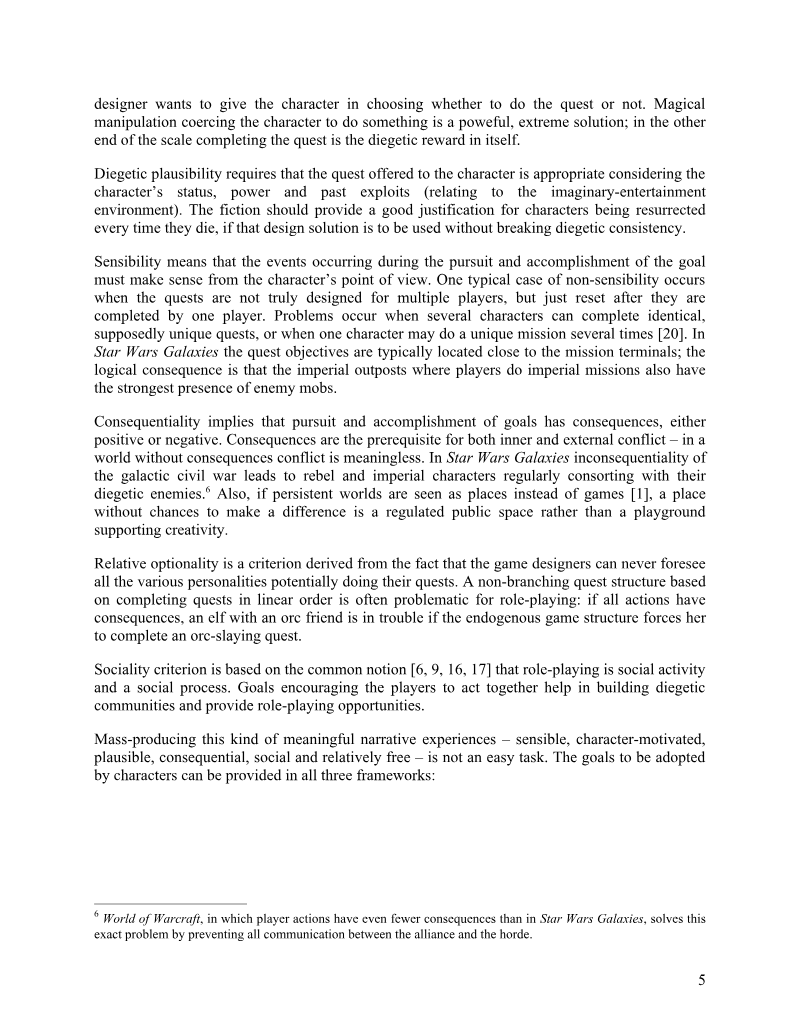
Designing Goals for Online Role-Players
This paper, by Markus Montola of the University of Tampere, examines how persistent online worlds can be designed to serve role-players, a growing audience whose motivations differ from those of regular gamers.
- Role-players construct subjective fictional worlds (diegeses) and pursue goals chosen by their characters rather than goals encoded in game rules, and they often treat winning or losing as meaningless.
- The paper distinguishes exogenous goals (the player's own reasons), endogenous goals (built into game rules), and diegetic goals (belonging to the character's imagined world), arguing role-players largely disregard endogenous goals.
- It proposes six criteria for effective online role-playing goals: diegetic desirability, plausibility, sensibility, consequentiality, relative optionality, and sociality.