1 free read left. Create a free account for unlimited reading + AI research.
Create free accountArticle G|A|M|E – The Italian Journal of Game Studies
1 free read left. Create a free account for unlimited reading + AI research.
Create free accountArticleG|A|M|E – The Italian Journal of Game Studies
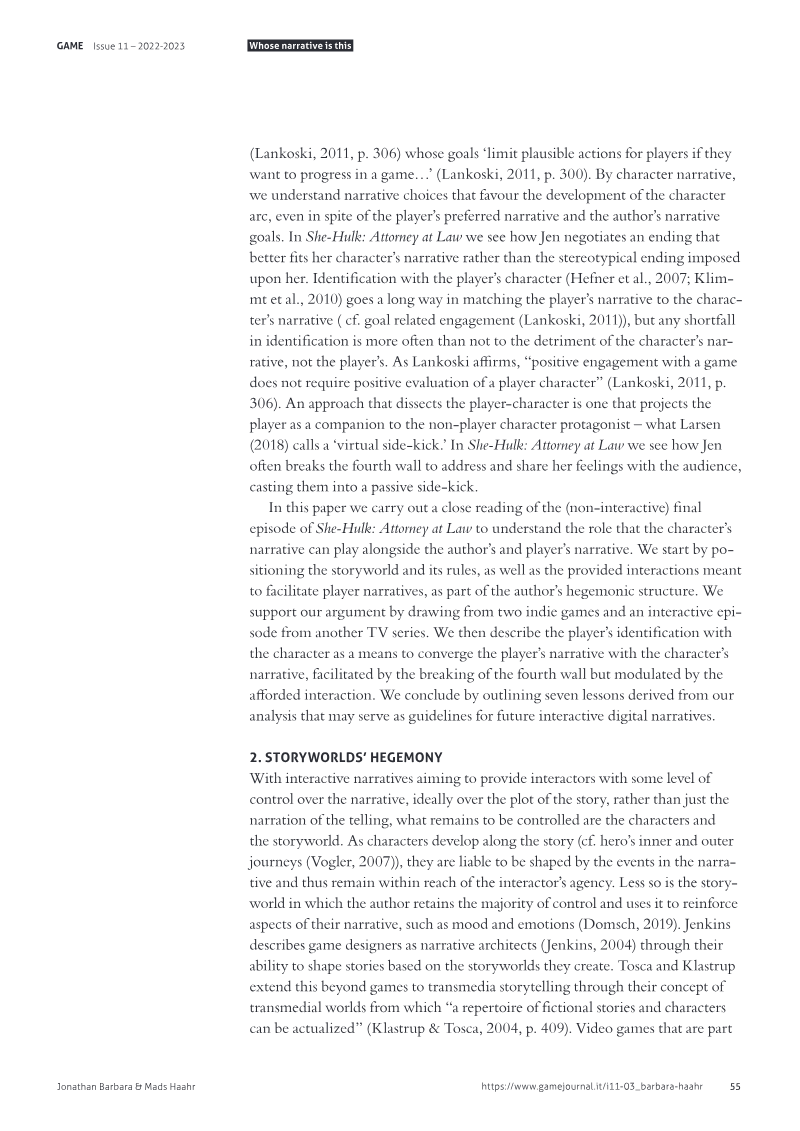
Interactive digital narratives frequently subordinate the protagonist's own story to author-imposed storyworld rules and player agency. The result can leave the character's arc unresolved or hollowed out.
This paper argues that interactive digital narratives frequently subordinate the protagonist's own story to the competing demands of author-imposed storyworld rules and the player's agency, leaving the character's arc unresolved or hollowed out. Its central thesis is that a character can and should assert a distinct "character narrative" that negotiates with both the author's hegemonic control and the player's choices, and that interactive works should be designed to give characters closure on their own terms alongside the narratives of author and player.
The argument is developed through a close comparative analysis of five works: the final episode of the serial She-Hulk: Attorney at Law, in which Jen Walters breaks the fourth wall and negotiates with her production team to reclaim control of her story; the indie games Papers, Please and The Stanley Parable; and the interactive film Black Mirror: Bandersnatch. Across these cases, the authors show how player agency can be constrained, how interactions can be inconsistently applied, and how fourth-wall breaking can build rapport between character and audience. The scope is thus focused on contemporary narrative games and interactive and serial television, with attention to how authorship, player freedom, and character identity interact.
The paper's most significant conclusion is a set of seven design guidelines for interactive digital narratives intended to give protagonists a genuine character narrative. These guidelines hold that player agency should not be overridden by forced options, that interactions should be consonant with the story being told, and that characters must be well defined and identifiable. They also caution against strong narrators that overshadow the protagonist. A further recommendation is that casting the player as a sidekick can allow the character's identity to come forward. Taken together, these lessons constitute a call for interactive narratives that move beyond borrowed non-interactive tropes toward forms built around the protagonist's own sense of self.
G|A|M|E – The Italian Journal of Game Studies · 2026
DiGRA · 2018