1 free read left. Create a free account for unlimited reading + AI research.
Create free account
Where to tap next? Unlocking global potential for your mobile game
Key insights
5 takeaways- 01Western markets are experiencing high saturation and rising user acquisition costs, necessitating a shift toward emerging regions like Indonesia, which offer higher projected growth potential.
- 02Cultural receptivity is a critical filter for expansion, as data shows that top-grossing charts in China, Korea, and Japan are dominated by local titles, whereas other regions remain more open to Western-developed games.
- 03Competitive density should be measured by calculating advertising spend per smartphone, which identifies Turkey, India, and Vietnam as markets with lower barriers to entry compared to the United States.
- 04Developers should prioritize market selection by synthesizing macro-level indicators with game-specific ROI metrics, specifically the ratio of lifetime value (LTV) to cost per install (CPI).
- 05Raw market size is an unreliable metric for profitability, particularly in China, where local publishing partnerships and complex distribution layers significantly reduce the developer’s net revenue share.
Ask AI about this video
Transcript
[Music] so thank you very much for coming yeah quite a few feel lack but anyways so yeah once again thank you for coming my name is Tim Orr I'm the co-founder and managing the right to a Freeman mobile and so what we do is essentially we help mobile game companies tap into complex markets we initially started with with the Russian markets pretty pretty complicated then we now we're working in two markets and in Korean and the Russian market and so with with for like one and a half years of our existence with kind of collected some some experience that we want to share that we think would be interesting for you and last time @pg connects Helsinki I was talking about our how to crack the
Russian market and how to make millions there and today we're today I think we're going to I want to talk more but like the global picture and how to choose be the right market for you globally so the question here is why is a global marketing wise internationalization important and there are a few reasons for that they one of the reasons is that mobile gaming business is extremely scalable and not capitalizing on that would be would be deemed criminal so make sure make sure you cover as many markets as you possibly can the user acquisition another reason is that user acquisition on the west is getting super competitive and I think everyone in this room who's done a mobile marketing has experienced at some point for the last few years and then return investment in other markets where you're not your present or where you're not running user acquisition or modeling marketing campaigns could be much higher but you don't you wouldn't
you know it unless you you give it a try so now how to identify your next target market this is a this is the question that at some point comes to consider the one and we are rebound mobile trying to figure out what markets should should be building and interesting to your clients we have identities like with particular we've identified several of comparison criteria two of the markets and we put them together and then the kind of native media charts where we see how where we see which mobile markets are the most interesting and now I'm going to talk about it so the first comparison criterion that we use is the market size if ya like before that just when I would I like to know that there are two things that we have identified for to compare the markets the first one is the market data itself another one is the games data so you have to take the markets
data and the game data such as games revenue together and then and that's how you're going around the little area when I run the comparison so the market data is the market size the market growth the Western content acceptance because your grids were primarily to working with Western games and what's in game companies the competition and the markets were of where you're planning to go and English language proficiency I'm going to talk about all this in more details so the good question is that we put together all this information we've collected all this data and put it together in in one tool that you can use on our website and here's what we've got when we made our research so we the market side was pretty pretty easy to Hana with with we've got like we source the data from different sources and we put it put them together and this is what we got the Chinese market is is the
biggest one obviously the US stage plan Korea or look at the top four and so on it goes on so market sizes is obvious and pretty pretty easy to identify to get the data and then the growth this is important because you don't want to miss out on opportunities within the next few years and Indonesia like so if you look at this chart so you can see that the white lines here represent the so like the conventional or Tier one markets which normally people which normally companies target first and then there are purple lines which represent the tier 2 tier 3 or non-conventional markets which many companies miss out on so as you can see on the growth side the in the non-conventional the tier 2 tier 3 markets or in the in its in at the top so the debt that means that in the next
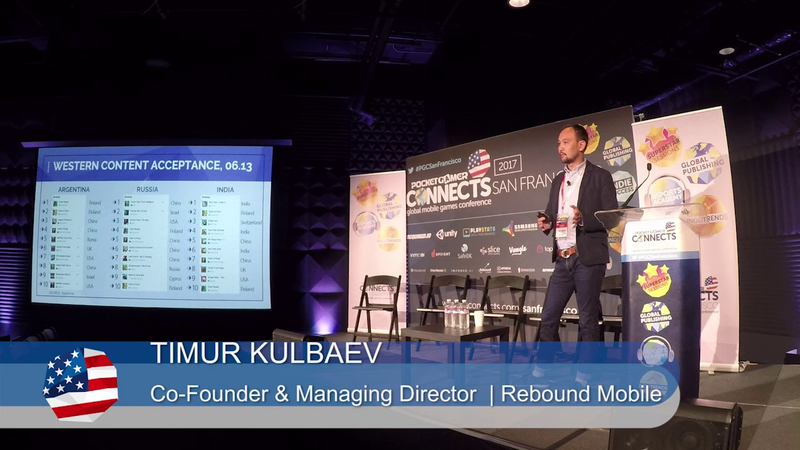
few years they're going to be like they're going to be much bigger than they're now for instance Indonesia is going to grow current 20 percent in the next few years by 2021 so this is the data we've got from sistah the western content acceptance if you look at this at this screenshot from the top grossing ranks in industry markets in China Korea in Japan you can notice there that there is like the top rushing ranks are very unilateral so in China there are like sub the biggest day the most revenue generating games are local ones in Korea there is only one game company from outside of Korea which which is we just come from Europe or from where which is a supercell a few games from Japan but other than that it's pretty much pretty much Korean and on in Japan it's also like Halle dominated by Japanese companies but then there are other markets were you know Western Western
Western games and Western games it became companies and you know agent well I mean the top grossing ranks are pretty pretty diverse and that speaks for that sometimes some markets globally have you know are more more accepting Western Western concept than than the others and you really want to focus on the game on the market which were more welcoming for the Western content and this is this is that these are those more it's obviously the Western markets a you know get a really hard substance wait we've got this chart by going through the top convert ranks and trying in identifying Western identifying games developed by Western game developers and the number over there indicates the amount of game is developed by Western game developers in the top hundred ranks crossing ranks
and the competition this is really interesting we couldn't find these data in open sources so we put it together ourselves we've got the Revit we've got the mobile advertising spending in each particular country and the number of smartphones in the in that particular country and so we divided the amount of the number of advertising spending by the number of smart phones and we've got the average spending per smartphone in each particular market and more the spending is the more the number the number is the higher the competition is and as you can see the American market at the bottom is the most competitive one it's got around 20 to 200 dollars a year spent per smartphone and Turkey Vietnam India are the top three where the competition is the lowest one so you so just keep the data in mind when you're trying to go to to some market
English language proficiency this is more related to or this is more and more related towards working with local companies if you want to if you want to put some marketing effort say in Korea or in Japan it's really difficult to communicate with local local companies so you really want to have English language proficiency on a high level if in some market if you're going there and this is this is these are the results of the overall research that we've made the USA is the top market so for Western game developers if you could put together all the data Turkey and India are are followed followed by the follow the pulling and bear in mind that this this is this chart and this research also includes the data of the prompt like data in the next few years
so just it does necessarily mean that this is like the turkey of India or that you have to go there right now but just this is the markets that will be promising it will be interesting for you maybe in one two years and then we've got the additional comparison criteria which is the game game specific data which is al TV and like L TV data as it is is like doesn't speak for anything what you have to do is you have to compare markets by return investments and return vestments is calculated by dividing LTV to see CPI so return references is the criteria is the criterion that you can use to compare the markets and on our way on our - we've got that we've got that but if you just enter your LTV you can compare we calculate the CPI for for your game in
each market and you can actually compare the markets so this data game specific data is being added to the market data and you can the the tool will give you the results of which markets are the most interesting to you with these two data combines and a few words about like the biggest market in the world which which many think think related so in China the distribution model is not as it is on the west there is the road there is like you cannot publish your game there without a local publisher and each layer of the distribution takes takes its own cuts on the revenue so for every ten dollar spent on so on the monetization side there is also a mobile here the charges a certain amount of revenue so out of ten dollars spent by a user the developer if it's if they're from the West they get around 2.5 dollars so it's
like 20% so that makes the Chinese market shrink from 10 billion dollars to around 2 to 2.5 billion tools which makes the Chinese market not the biggest one and just bear this in mind if you were thinking about going to China maybe it's not worth that and maybe you know there are other markets where you can which are more attractive and appealing so thank you so much that's that's it for now if you have any questions feel free to let me know so here is quite compact however hosen quite ready you guys agree that sounds really interesting I really like the yeah the real value of the market that's kind of interesting so back you're making a availables report without just internal presentation no no it's it's you can actually so here on this slide oh can I go back here on this slide there's a there's a link to that tool the marketer anchor will call it that you can use to
actually like run that that evaluation I'm Janice just type it out you go you finished be so yeah um yeah we've got time for one question maybe he's got a question or we can just going to catch up space and skip ahead is a question as a question of the background all your revenues based off IV do you have anything for eCPM or advertising based revenue mmm well you know the data that we've got for the revenue in markets it I think it includes we've got it from different sources but I think it all includes a in app purchases and advertising revenue all together so there wasn't any and it like the distribution or division on that okay cool and also like bare without this is our first version of the market rancor if it they're going to be more and if it gets if it will be popular I think we're we're going to get it develop more yeah and I think it's a greater I mean like yeah it's just a couple others are great
but you need to how realistic is that right yeah okay thank you very much can I run the force please single at the tumor [Applause] you [Music]
Summary
Mobile game developers face increasing saturation and rising user acquisition costs in Western markets, necessitating a strategic approach to global expansion. To identify lucrative international opportunities, developers must evaluate potential markets using a dual-layered framework that combines broad market data with game-specific performance metrics. This approach moves beyond simple revenue rankings to account for long-term growth potential, cultural receptivity to Western content, and competitive density.
Key market evaluation criteria include market size and projected growth, with emerging regions like Indonesia showing significant expansion potential compared to established Tier 1 markets. Cultural acceptance is a critical filter; data indicates that top-grossing charts in China, Korea, and Japan are heavily dominated by local titles, whereas other regions demonstrate higher openness to Western-developed games. Furthermore, competitive intensity is measured by calculating advertising spend per smartphone, revealing that while the United States is highly saturated, markets such as Turkey, India, and Vietnam offer lower barriers to entry.
Methodologically, the analysis emphasizes that raw market size can be misleading. For instance, the Chinese market requires local publishing partnerships and complex distribution layers that significantly reduce the developer’s net revenue share, effectively shrinking its perceived value. To refine these insights, developers should integrate game-specific data, specifically by calculating the return on investment through the ratio of lifetime value to cost per install. By synthesizing these macro-level market indicators with individual game performance data, developers can objectively prioritize regions that offer the highest potential for sustainable growth and profitability, rather than relying on conventional market assumptions.























Comments