1 free read left. Create a free account for unlimited reading + AI research.
Create free accountWhitepaper DiGRA
1 free read left. Create a free account for unlimited reading + AI research.
Create free accountWhitepaperDiGRA
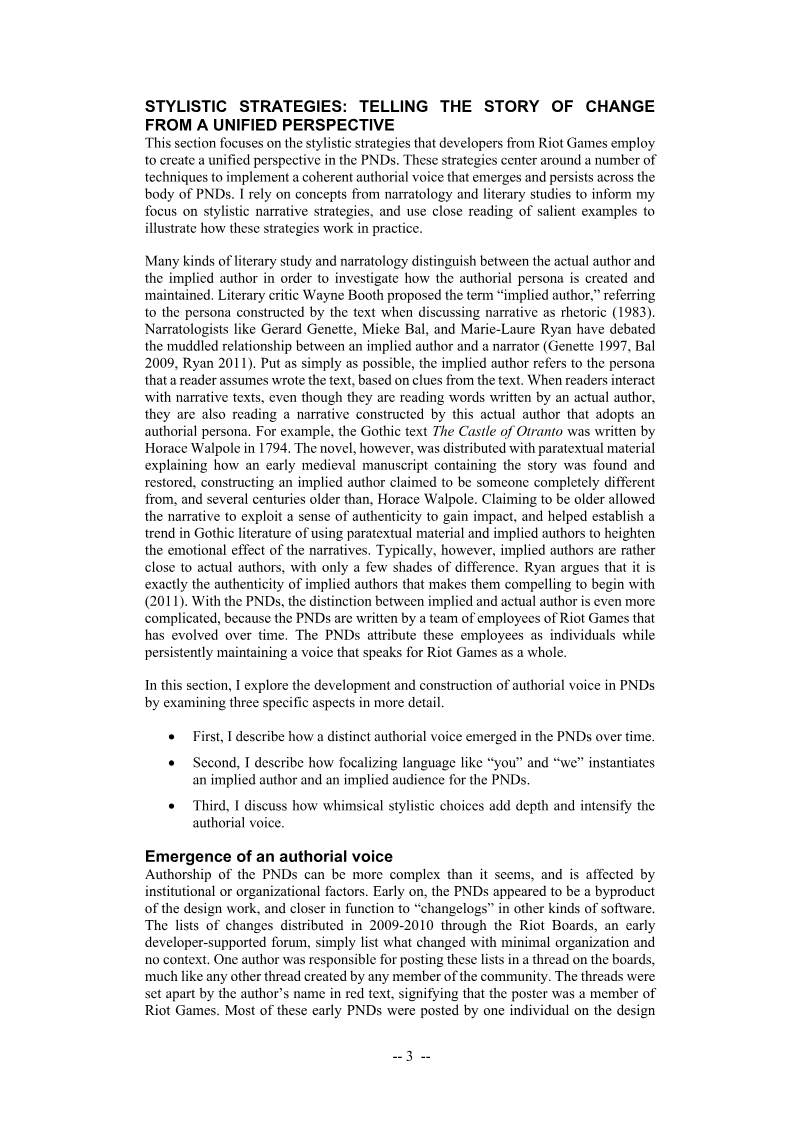
The paper examines how Patch Notes Documents for League of Legends build a coherent authorial voice and a unified account of game evolution.
Ayse Gursoy's paper examines how Patch Notes Documents for League of Legends construct a coherent authorial voice and a unified narrative of game evolution. Drawing on narratology and reader-response theory, the analysis argues that these documents work to detach individual changes from the identities of their writers and attach them instead to Riot Games as a single, intentional organization. Based on a corpus of over 200 patch notes and 23 credited authors, the work suggests that such documents retroactively impose narrative order on a volatile change history, even though player accounts indicate that the lived experience of game changes is often far less coherent than the official record implies.
The study identifies several stylistic strategies that sustain this unified voice. Stylized tone, focalizing "you" and "we" language, and worldbuilding whimsy present a benevolent developer frame and situate changes as continuations of the game's fiction. Language such as "fixed a bug" or "more accurate" casts modifications as natural corrections requiring no justification, while more contentious adjustments demand explicit reader rationale. The paper also traces a structural evolution from early unordered lists, including the navigable sidebar introduced with Patch 4.10 in 2014, to a consistent summary-context-change format that separates justification from the changes themselves.
A notable finding concerns emphasis. Champion changes occupy the bulk of these documents, even though they constitute only a small share of the author's typology of change targets. Taken together, the analysis portrays patch notes as more than informational updates: they are carefully crafted narratives that help players make sense of change while presenting the corporate developer as a unified and deliberate authorial presence.
Each row is a game or company this document names, each column a document, oldest first. A mark means that document names it. Select a row to see those documents.

DiGRA · 2026

DiGRA · 2026



DiGRA · 2026



DiGRA · 2026



DiGRA · 2026



DiGRA · 2026



DiGRA · 2026



DiGRA · 2026

DiGRA · 2026



DiGRA · 2026



DiGRA · 2026

DiGRA · 2026
DiGRA · 2025