1 free read left. Create a free account for unlimited reading + AI research.
Create free account
Video games and public figures: Legal update 2017
Key insights
6 takeaways- 01Developers face significant financial risk for using celebrity likenesses, evidenced by a 60-million-dollar settlement paid to athletes in EA Sports litigation and a 15-million-dollar verdict against a comic book author.
- 02The primary risk factor for litigation is the developer's intent; if the inclusion of a persona is perceived as a strategy to leverage fame for audience attraction, courts are increasingly likely to rule against the developer.
- 03Even when avoiding exact names or physical likenesses, developers remain vulnerable to trademark-related claims of false endorsement and right of publicity litigation.
- 04Courts lack a consistent legal framework for publicity rights, with outcomes ranging from protecting creative expression to massive judgments, such as the 403,000-dollar award against Samsung for a robot depiction of Vanna White.
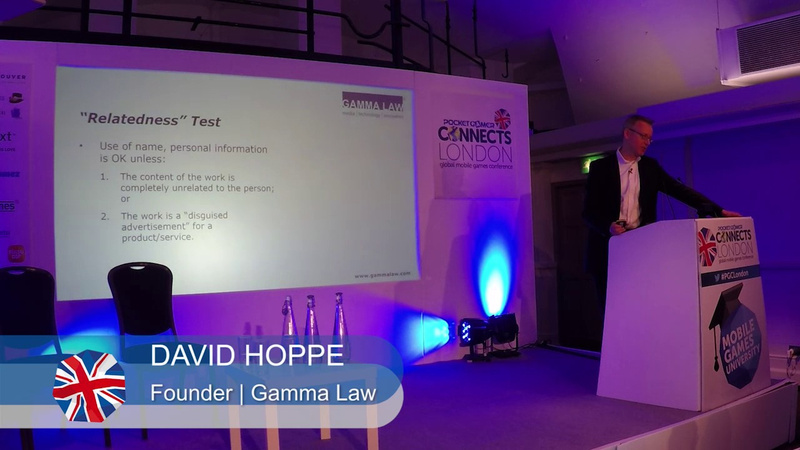
- 05Legal standards for liability vary from the plaintiff-friendly 'transformative' test, which requires significant parody or original content, to the developer-friendly 'relatedness' test, which permits likenesses if they are relevant and do not imply false endorsement.
- 06Some courts have successfully utilized free speech protections to dismiss claims, notably in cases involving public figures like Manuel Noriega and Lindsay Lohan by classifying the depictions as satire or fiction.
Ask AI about this video
Transcript
[Music] all right it will be a short talk assure you and I think a very fast-moving and hopefully kind of fun we're talking about celebrities in games and there is a little bit of law here but it's mostly about looking at all kinds of crazy situations and how the courts have come out in the US and I have to say it's a little bit unpredictable so if you are here looking for some legal guidance and some some queer rules it may be disappointing but let's just in this quick 10 minutes take a look at at what's going on in this area at least in the United States so basically should come as no surprise to anyone if you're a celebrity you know you have there's value attributed to your name to your likeness to your voice to whatever
little tagline that is associated with you and you know if we as the game developers decide to utilize that value then there's an expectation that we have to pay for it and if we don't pay for it then we could have the full wrath of a legion of Hollywood lawyers coming after us there's a couple basis on which celebrities can claim against game developers one is the basic right of publicity which we'll talk more about and then there's a sort of trademark type of cause of action false endorsements we're basically the individual the celebrities image is their trademark and you have to license that from them and if you don't then there's certain trademark legal remedies so we'll look at a number of cases here and just basically these are chronological and you know as you'll see it would be nice if we could say okay
here's three tests they're used there actually are three tests that are used by different courts in the United States in deciding whether or not the developer or the content producer you know could use the celebrity image but as it turns out those three tests have just been sort of randomly applied and mixed up and so it's hard to kind of develop any coherence so I just put these in chronological order maybe you'll see some sort of trend 1983 this is probably the first sort of significant case of its kind in the US here's Johnny of course Johnny Carson and someone decided I mean small company the middle of the country decided that would be good to use on their portable toilets sorry we'll go back and in fact Johnny Carson won that case and the the portable John a service had to rename their service i don't remember i'm actually not aware what the damages were in that case 1993 we had the Vanna White
Samsung case and maybe some of you remember this commercial where Samsung had created this sort of commercial from the future or VR a game show from the future and Vanna White of course the very famous American actress in the 80s and 90s who used to turn the letters on the show was depicted as a robot and of course Samsung would say well this isn't Vanna White this is just a robot rendering of a kind of generic female celebrity figure who's turning the letters on the board but the court felt like it was just close enough to her persona that Samsung had to pay her for the use of those valuable rights that she had built up in her image 403 thousand dollars this is a crazy case this is a jury a
jury trial in in Missouri again sort of the middle of the country and basically there's this hockey player Tony twist le who I think got his name because of his you know his aggressive let's say antics on the rink this comic book author decides to name the mafioso character in his prints comic book Tony twist there he is and the jury finds 15 million dollars of damages which I'm sure is probably hundreds of times the actual revenue that was produced by that comic book but you know scary just a word so as I mentioned there's three different tests that have been used by courts in the US they try to make it sound fancy and like it will allow you to you know apply some predictability to the whole analysis but in fact it just hasn't been
followed by the courts but the first one we'll just go in order from the plaintiff friendly which means you know the celebrity friendly down to the will call game developer friendly so the first step which is most friendly to the celebrity says is the plaintiffs name or other personal information changed or transformed in a parody or is the game just basically copying the plaintiffs personal information is there some kind of original creative content that's added and we'll see a bit more how that's been applied transformative work test takes that same analysis but applies it to the whole work so in that case you have like let's say at the film and let's say a certain celebrity appears for ten seconds in the course of the 90-minute film a courts are more likely to say you know relative to the work this is actually pretty small so we're not going to find liability my
assistant actually put this iconic poster from the Obama campaign in 2008 I think it was actually has nothing whatsoever to do with this but I will briefly say this could have been a right of publicity claim by Barack Obama against the artist and not surprisingly the Obama campaign decided that they were going to pursue that and in fact as you may know this image became a central kind of symbol of his campaign in theory he could have been entitled to some sort of royalties from that which he did not claim however this artist in fact did wind up in court and won the pain hundreds of thousands of dollars in damages because it turned out that the the photo as you may may remember was actually the print was based on a photo from The Associated Press so the third and final tests that have been applied
by courts which is the most friendly to us as the developers and content producers the relatedness test where the court says listen you can use the celebrity's name image whatever you want just so long as you're not kind of like making them endorse your product or something as long as you know the content of the work has like some kind of connection to them here in Kirby so this is uh let's see this is from two thousand six versus the state outside this is uh whoops yeah space channel 5 is the name of her her act and this is a Sega case against Sega and so as you can see there's the actual person on the left and there is the Sega rendering on the right court says you know not close enough no violation there there's sufficient differences that made the character creative and transformative in fact this is not the best picture there
actually is a picture of her that looks a lot more like the the Sega image the EA Sports cases had a lot of attention recently where essentially the athlete statistics were used in the games but not their names or actual you know recognizable physical characteristics 60 million dollar settlement for the players this case got a lot of publicity lindsay lohan and actually just in october the court finally came down and said you know in our opinion sure maybe there's some similarity there i happen to think there's quite a lot of similarity including the name that they used Lacey Jonah's but the New York Court says you know what there's plenty of other stuff in this game you know it's a parody there's a you know it's obviously a work of fiction and satire so we find no liability and finally we
have this case against manual or case filed by Manuel Noriega the course infamous Famer addicted former dictator of Panama whose image was just completely used without any sort of apology or modification in call of duty they did not actually use his name but it was obvious unmistakeably obvious that this is who this was about and to my mind it's difficult to justify that under the cases that we've seen under the existing legal principles but somehow the court felt like you know this is maybe some news value and so you know there's even more reluctance to find liability because of the principles of free speech and special protection that's applied to individuals who are you know an involved in current event the court said you know this again satire parody no creative additions and
we find no liability personally I think it's just because Manuel Noriega is not popular with American courts so anyway probably hard to pull the conclusions from that in such a brief survey but I think basically if there's one conclusion to take away you just got to be careful if there's a you know you can put a clever name you can modify you know their facial characteristics or whatever but if you know if your purpose and using this celebrity in the first place was to you know kind of ring a bell with your audience with your players the court is going to pick up on that and it you know as you can see from these cases it's just not clear which way it could come out so be careful thank you [Music]
you
Summary
The legal landscape regarding the use of celebrity likenesses, names, and personas in video games remains highly unpredictable within the United States. Developers face significant exposure to litigation based on the right of publicity and trademark-related claims of false endorsement. While courts have attempted to establish frameworks for evaluating these disputes, the application of these legal tests lacks consistency, often resulting in divergent outcomes that fluctuate between protecting celebrity intellectual property and upholding creative expression.
Courts generally utilize three primary tests to determine liability, ranging from plaintiff-friendly to developer-friendly standards. The most restrictive approach focuses on whether a celebrity’s persona has been significantly transformed through parody or original creative content. A more moderate test considers the transformative nature of the work as a whole, while the most developer-friendly standard, the relatedness test, permits the use of a celebrity’s likeness provided it is relevant to the content and does not imply a false endorsement. Historically, outcomes have varied wildly, ranging from a 403,000-dollar judgment against Samsung for a robot depiction of Vanna White to a 15-million-dollar verdict against a comic book author for using a hockey player’s name.
Recent industry trends show that even when developers avoid using actual names or exact physical likenesses, they may still face massive settlements, as evidenced by the 60-million-dollar payout to athletes in EA Sports litigation. Conversely, some courts have leaned toward free speech protections, dismissing claims involving public figures like Manuel Noriega or Lindsay Lohan by categorizing the depictions as satire or fiction. Ultimately, the primary risk factor for developers is the intent behind the inclusion; if the goal is to leverage a celebrity’s fame to attract an audience, courts are increasingly likely to identify a violation of publicity rights regardless of minor creative modifications.