1 free read left. Create a free account for unlimited reading + AI research.
Create free account
Trends in AI for UA in Mobile Games - Phil Shpilberg, Head of Gaming at Pixis, GameChangersSF
Key insights
7 takeaways- 01The adoption of AI is a competitive necessity because manual marketing processes can no longer match the speed and analytical depth required to process vast datasets.
- 02Modern AI implementation for UA has transitioned to code-less integration, allowing companies to deploy these systems without requiring extensive internal development resources.
- 03Integrating AI into user acquisition workflows delivers ROAS improvements ranging from 20% to 80% by optimizing budget management and bidding.
- 04AI systems outperform manual analysis by removing human bias and identifying high-value player segments that traditional demographic assumptions often overlook.
- 05AI is shifting the role of human marketers from repetitive data optimization toward high-level strategy, creative direction, and content development for platforms like TikTok.
- 06The industry is moving toward creative AI, which aims to automate ad testing by simulating consumer responses and generating high-impact gameplay content.
- 07Current AI marketing tools are primarily effective on platforms with API accessibility, such as Google and Facebook, which collectively represent 70% of total mobile game ad spend.
Ask AI about this video
Transcript
To kick off the global trends track, global trends we look at all the different developments and uh opportunities and issues going on. We're going to kick off looking at two big trends, really. We're going to be looking at the ever-changing world of of UA and how AI can help with that. So, please welcome to stage uh Phil Spielberg. Spielberg. Yeah, it's Phil Spielberg. Um I think you're you're good. You're miked up. I'm going to let you go and do your thing and I'm going to sit down here and come up and join at the end. Thank you. So, um I'm Phil Spielberg. I'm from a company called GameChanger SF. Uh we were recently acquired by an AI company called Pixis, and I'm here to talk to you about um the kind of trends we're seeing in artificial intelligence in uh
user acquisition. But before I get started, I just wanted to thank the organizers and everybody that showed up. Uh we've been flying all over the world doing presentations, and this is probably the you know, the biggest room um and one of the best organized conferences I've seen to date. So, thank you and give yourselves a big round of applause. So, um I'm a big chess nerd. Um I love to play chess. I've learned to play chess when I was a little kid, and um I you know, I I think that um the way that AI has developed in chess is a really interesting thing to look at because there's a lot of parallels between what happens in chess and what we're doing these days. Um and what's interesting about chess is that we've been trying to get machines to outperform humans for a long time, probably 50 years. And back in 1997, we crossed an interesting threshold where IBM's Deep Blue finally beat a world champion. It bit Kasparov. And this was like a huge achievement in um in the way that computers thought,
right? The way they thought about chess. And what was really interesting about that that AI is it was very rules-based. You taught it the game, you fed a huge database of games of like the top players, all the openings, kind of closing theory. You They taught it to play like a human until they could finally beat a human. Well, what's interesting is more recently we've taken a completely different track with AI. All we do is we teach a computer the rules of chess and we let it play itself for about 3-4 hours. After that, it just crushes everything out there. It crushes all previous machines. Humans can't you know even come close to playing with it. So, this is like the evolution. First, we we taught computers how to try to think like humans and then we realized that humans actually have a bunch of bias, right? We simplify things to to the way that a human thinks and actually letting machines do the thinking in a completely different way leads to much better outcomes. So, just to give you an idea,
the chess Elo rating system is how you rate players. It's a really interesting system. Like two players can play each other, one's better than the other, they get a score and when this happens enough, you could actually sort everybody from beginning to end. So, chess novice is like up to 1200, an amateur, which is kind of where I am at the high end of the amateur scale, up to 2000, then you get experts. Finally, you get a the world chess champion, Magnus Carlsen. This guy is probably the greatest player ever. A machine, today's champion, sits like in another stratosphere. If anybody asked you to play this thing, you probably shouldn't. It's like getting into a foot race with a Ferrari. Like you wouldn't want to do it. So, that all brings us to why am I talking about this? So, I'm in a really interesting position to think about AI. I started a company called GameChanger SF and we were a marketing agency working on getting users for games for user acquisition among other things. So, you know, making ads, you know, doing data science, kind of all the services
around that. Um we were acquired by a AI company about 6 months ago and we started to blend AI into our work and we have a very interesting comparison of like how humans work and how do machines work in this area of getting users into games, user acquisition. So, interestingly AI in user acquisition is a lot like AI in chess. A lot of it is mathematically solvable, right? But in a in a different way than than it is for humans. So, early AI was exactly like chess AI. We set some rules like this is the maximum CPI, this is the budget, this is where we want to spend it, these are the countries and then the machine kind of worked within these limitations. Well, today, you know, we still put in a few rules. We don't want it to go spending a million dollars in a day. You know, we set some boundaries, but we largely let it the AI figure out what it can do. So, the more freedom you give it, the more interesting results it comes up with. And so, today's AI is very much self-learning. It just starts with the minimal information it needs to
function and then from that it starts thinking about things by itself. So, what do I want you to to walk away with today? If you get nothing else, these are the three things I want you to know. So, first of all, in marketing today, you should be absolutely implementing some kind of artificial intelligence because that's what the top companies are doing these days. So, if you're doing everything manually, it's like you're racing Ferraris on foot. You don't want to be doing that. But this doesn't mean that humans aren't involved. In fact, I think the human work now is much more interesting. We get to think about creative, we get to think about strategy. I'll talk about it a little bit later. But I think it makes the marketing work much more interesting than it was when we were just doing kind of math. And then finally, I'm going to talk a little bit about where I think AI is going in the future because we're getting into some really, really interesting things and what I think is going to be happening in the next 5 years. So, little bit of, you know, why do I think AI right now is is why is now the time to get into AI? Well, first of all,
um it used to be that whenever you put in technology into your games, you needed SDKs. It was like the development team had to get involved. Um there were kind of trade-offs and things like that. Now, it's completely code-less. Like ours, for example, is a uh a web like a Chrome plugin. So, you don't really have to put anything in the game. It just sits above your marketing stack. Um so, it's pretty easy. Um next, you know, Sorry, I'm what This Does this go only one way? Oh, no. There's another button. Okay. Um so, we're getting a 20 to 80% ROAS improvement. So, I'll get into this a little bit later, but on channels where we can implement AI, which isn't every channel. These are channels where you can control uh networks via API. This is where um AI shines, right? And here, we're just seeing a huge improvement over what humans can do. And I'll tell you a little bit about why that is. And then finally, as in chess, right? In chess, we found out that if we program a bunch of rules and then let computers play, they actually played with a human
bias. Once we take away that human bias, they actually, you know, play chess completely differently. They make moves that we thought for centuries were bad moves, but they turn out they're actually pretty good moves. It's just humans needed to simplify things. That actually happens all the time in marketing. We, you know, in games for years, I've been in games for long enough where we thought, "Oh, our games are played by 18 to 45-year-old males, right?" We know now that's completely, you know, that's nonsense, right? It's just we were being lazy or we were simplifying. So, that's not that's not really how we want to do things. So, just as an example, this is one game that we took. We had an 8-year-old RPG game. Um and we were we were do having one of the best you you um user acquisition teams uh in the in kind of the industry working on it doing a really good job doing everything the way you're supposed to. We took a few channels away from it Google and Facebook and we plugged in AI and let the AI manage it. Well, the results looking at 30 days prior, 30 days after 3-day ROAS, they improved by 62% which
was like you know, at the time it was pretty impressive but that's you know, we've been doing it with a bunch of games and we're seeing this is pretty typical. And I'll tell you why that is in a second. Finally, um you know, again our games are played by a lot bigger audiences than we initially thought but it was very hard to analyze this data. So now our AI is looking for these new audiences. It's looking at behavioral data and finding those gamer grandmas that we know are out there but they're actually pretty difficult for us to target without some kind of AI assistance. Um So so what does this all mean for humans, right? Is this the end of marketing jobs and user acquisition in games? The good news is it isn't. We've actually grown our team and the work has gotten a lot more interesting. So where AI is much better than humans is looking at huge data sets and making sense of them. Humans are much better at being creative at the moment at least. Um Humans are better at thinking about the
overall strategy. Like you're not just going to tell you know, AI to go make a marketing plan and figure out how to do PR, you know, how to make good use you know, how to make content for TikTok for example. Like these are the kind of things we want our marketing teams thinking about. We don't want them thinking about oh, should I be you know, should I be acquiring users in Jordan or England, you know, these are the kind of things that you just a computer can look at the numbers and figure out where the arbitrage opportunities are. Humans think creatively and strategically. So separating that work along those lines is is really where uh I think the future is. So this is why you can't beat a computer. This is why you're not going to get into a foot race with a Ferrari. They can look at over a million data points. Like, that's no problem for a machine. Imagine having a human do it. We We thought about what it would take for a human to do this kind of work. It would take 400 hours just to do that kind of analysis. Um to take 20,000 actions on your campaign in 30 days, that like it's just not possible. You'd need a huge team and they would
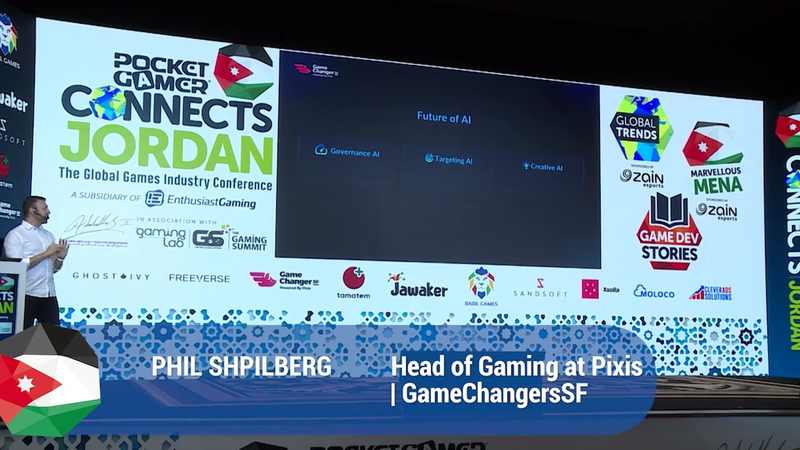
really not like you very much if you had them do this kind of work. So, this is where Let Let machines do machine machine work. Humans, right? Better strategy. Like, who you know, how should we be positioning the game? What are the main messages? How do we attack new channels like TikTok and Snapchat and whatever else is going to emerge in the next couple of years. Um you know, how do we make better ads? You know, we're not going to use the same ads for Facebook as we are with TikTok. These are the things we want our marketers thinking about while the machines are crunching all those crazy numbers. So, that's where I think we are today. Um where are we going, right? So, today um Pixalate, for example, we have these uh three AI modules. Most of what I'm talking about is actually called governance AI. This is what figures out like where, you know, which channel should we be spending money and how much. Uh which audience uh should we be spending money on. So, if it does kind of that day-to-day budget allocation, bid uh management, like how much should
we bidding. It does a great job of that. Targeting AI is, you know, finding the gamer grandmas. So, it looks at behavioral data and figures out what the audience does look like and where, you know, where we should be going. Creative AI, it's actually very interesting. It's pretty new. It's It's um in retail, it's being used quite a bit. We can generate interesting images using product images. It's not really ready for primetime in games because we're much more video-based. So, we AI is not really creating uh that stuff yet. And it's not capturing gameplay and things like that. So, creative AI is kind of part of gaming's future, but we're starting to see it. But, here's what, you know, I think is going to is going to happen. So, when we make creative, for example, today, we have to spend a lot of money testing that creative. We show a bunch of ads to a bunch of users and we figure out which ones are performing the best. It's very expensive and it's very time-consuming. Um I actually think where we're going is AI that's going to mimic consumers. So, we could show AI ads and they could figure out the AI can
figure out which ads are going to perform best. We're obviously going to, you know, do test the AI, put it in the market, and see how it works. But, think about the amount of money uh saved on testing creative and of time saved not having to wait a week, 2 weeks to figure out which of your creative is doing the best job. I think that's, you know, something I'm really excited about. And, you know, you know it's coming, ad creation, right? We're already seeing uh things like DALL-E uh making some really cool static images, but, you know, it's not games are much more complicated. So, we're not quite there yet. But, imagine you plug in um AI into your game engine. It can cop uh and it can figure out exactly which moments are the best in the game to show consumers. Like, what's the emotional choice? What's the emotional content? Right now, when I make ads, you know, we have somebody capture gameplay, we show it to the development team. They go, "Oh, that's not really the best. Like, why don't you capture this?" It's very inefficient. So, we can we can be really smart about implementing AI to figure
out exactly what are the most impactful and meaningful parts of our games. So, I think we're going to see very sophisticated AI ad creation. And again, I still think it's going to be collaboration between humans and machines, but, you know, maybe you won't need the development team to capture gameplay for you anymore. You could have AI do it. Like, I know for marketers, this is one of the biggest challenges. Like, is the team going to work on capturing stuff for marketing or they're going to work on the game? Well, the answer is always work on the game, right? And the marketers are just kind of doing the best they can with what they get. I think AI is going to be pretty powerful in changing that. So, almost every image you see in this presentation was generated by creative AI. I didn't have artists come up with any of it. And you know, you could see you get you know, gamer grandma's probably my favorite. That was completely created based on text input. The one that I didn't get was I wanted Remember that pyramid of chess players? I asked that the AI to make, you know, a pyramid of chess and it just came up
with some nonsensical stuff. So, you could see we're not we're not 100% of the way there, but we're probably with with static stuff, we're about 95% of the way there. That was the That was the thing I had a humans create because otherwise I'd be showing you I'd be showing you this. All right. So, let me just come back to the three takeaways. So, now is the time to be dabbling in some kind of AI to help you do your job because you're going to be competing with AI AI out there if you don't. Make you know, AI is making work for humans much more interesting, much more rewarding, and much, you know, higher value for companies. And finally, the future is really exciting in AI. I think we're going to do some really interesting things. So, that's that's my presentation. If you guys want to come talk to us about this in more detail, we have a booth out there. You can come tell me I'm crazy or you can come find out. Tell me what you're working on. I'd love to hear it. Thank you, Sashi. Thank you very much.
Is there some Do you have Does anybody have a question? Does anybody have We have microphones. Does anybody have a question about AI? There's a question there. Where's my lovely assistants with microphones? Mike, there's a man here with a question. Hello. There we go. You got it. Can you get a mic to him? There we go. Over here. There we go. Cool. You got time for a couple of questions, then we'll crack on. Uh first of all, thank you for what you've said. Uh second, I want to ask, won't that take our jobs as a game developers? Like making the AI make the game. Will will we will they take over jobs as game developers? He's worried about employment. That's a very good question. This is always the first question. You know, marketers ask that, so I completely understand. My So, I'm not you know, I'm from a game development background, but I'm not in game development today, but I'll give you my opinion on that. I actually think you'll be doing more interesting work and giving the AI like lower-level busy
work. That is going to be the first stage. That's how it looks in marketing. We're not taking jobs away. We're usually adding jobs. So, I think and I hope that your job will actually be more interesting. Okay, thank you. That's good. Got one more question. Is there another question? Yeah, behind. Just There we go. What was another It's not going to decrease the amount of jobs? Huh? Okay. Yeah, I I can hear you. Go ahead. If it's not going to decrease the amount of jobs, I would imagine that there's going to be a flood of content from everybody, since everybody's going to be using AI, which is kind of scary to me, cuz I can't imagine how fierce that competition will be. Can you tell us more about what you think of that? So, first of all, um we've had a shortage of qualified people in user acquisition work for a long time. Most companies that we work with have three or four positions open in any given time. So, actually being more efficient um is going to come closer to filling that. So, we're nowhere near where we've like topped out in jobs. Um on the
content flooding, that's an interesting question. I I've thought about this, too. Um you know, the number of impressions, right? The number of ads we can show is somewhat fixed. Um and and unless, you know, we have robots viewing ads, which we don't want, right? Um I think the amount of content ultimately going to have to be roughly the same. I think what's going to happen, and that's why, you know, I was talking about AI to test stuff before you put it in the market. I hope what we see is higher quality ads, more relevant to users. But at the same time, Apple and Google are taking away our targeting opportunities, so it's, you know, there's there's some competing things in the market. So, part of it is we're going to see how how that all really, you know, turns out. We don't know yet. You're having to defend AI. That's that's a bit of a tough you having to defend the entire dis- discipline. Can I just ask on that on ads, do you think AI would have created those, you know, the whole sort of not scam ads, but like fake gameplay ads Do you think that's an AI would have made that? Or is that Did that take a
human to make that? That was kind Uh it's an interesting question. Um if you gave AI complete freedom to do whatever, I think it would make some very surprising things. That's what we've seen. Uh I mean, it is up to us to put the guardrails on, so it doesn't do something crazy. But yeah, it might it might make something very weird. Okay, final question. I think there's one more question or not? Yeah, last question. Yeah. Now, the lady in front I'll go I'll go. Okay. Hello, and thank you. Uh I will have a question. You mentioned channels a few times. I didn't quite understand what it meant in this context. The Don't put the mics too close. Don't cross the mics. There you go. Yeah, I think so. That's a good question. So, the place where we're seeing AI um the most active is where we have API connections. So, right now, Facebook, Google, less relevant for us, LinkedIn. These are channels where you could make They're sort of self-service channels and ones that have an API. So, without an API, you really, you know, it's it's much harder to implement AI. So, that's part of why, you know, it's not in all
channels. But we're probably, you know, Facebook and Google really do dominate the ecosystem. So, probably 70% of ad spend out there for mobile games, we can use AI right now. Woo!
Summary
Artificial intelligence is fundamentally transforming user acquisition (UA) in the mobile gaming industry by shifting from rules-based automation to self-learning systems. The primary thesis is that AI, when applied to marketing, acts as a force multiplier that allows companies to process vast datasets and optimize performance far beyond human capacity. By removing human bias—such as outdated assumptions regarding player demographics—AI identifies high-value audiences and arbitrage opportunities that manual analysis often overlooks.
Key findings indicate that integrating AI into UA workflows can yield significant performance gains, with observed return on ad spend (ROAS) improvements ranging from 20% to 80%. These systems excel at governance—managing budgets and bidding—and targeting, which involves analyzing behavioral data to reach non-traditional player segments. While current AI applications are largely limited to channels with API accessibility, such as Google and Facebook, these platforms account for approximately 70% of mobile game ad spend. The implementation process has also evolved to become code-less, allowing for seamless integration without requiring extensive development resources.
The role of the human marketer is not being replaced but rather redefined. While machines handle high-volume data processing and repetitive optimization, human professionals are increasingly focused on high-level strategy, creative direction, and content development for emerging platforms like TikTok. Looking forward, the industry is moving toward creative AI, which promises to automate ad testing by simulating consumer responses and eventually generating high-impact gameplay content. Although concerns regarding job displacement and content saturation persist, the current industry environment is characterized by a talent shortage in UA, suggesting that AI serves to enhance productivity rather than reduce headcount. Ultimately, the adoption of AI is presented as a competitive necessity, as manual marketing efforts are increasingly unable to keep pace with the speed and analytical depth of machine-driven strategies.