1 free read left. Create a free account for unlimited reading + AI research.
Create free accountWhitepaper European Conference on Games Based Learning (ECGBL)
1 free read left. Create a free account for unlimited reading + AI research.
Create free accountWhitepaperEuropean Conference on Games Based Learning (ECGBL)
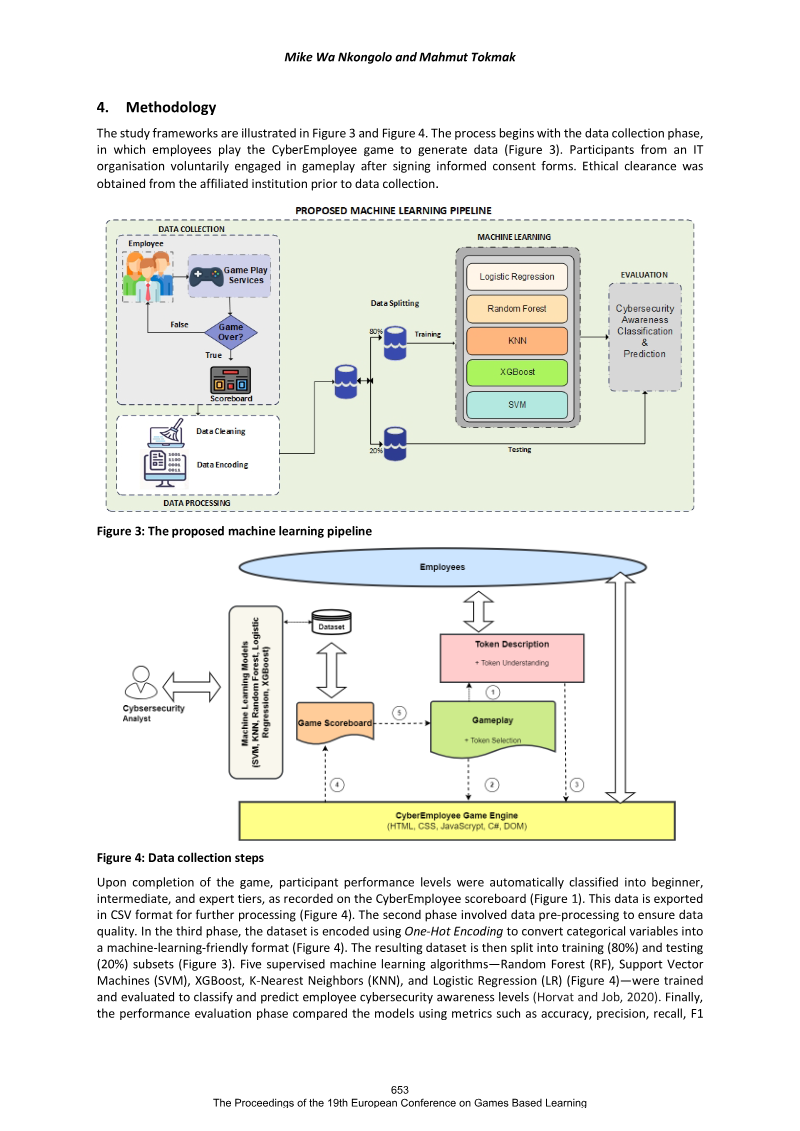
CyberYuruGu draws on Dogon Fox divination and Bachelard's notion of epistemological rupture. Players reconstruct attack and defence narratives from incomplete, post-hoc gameplay traces.
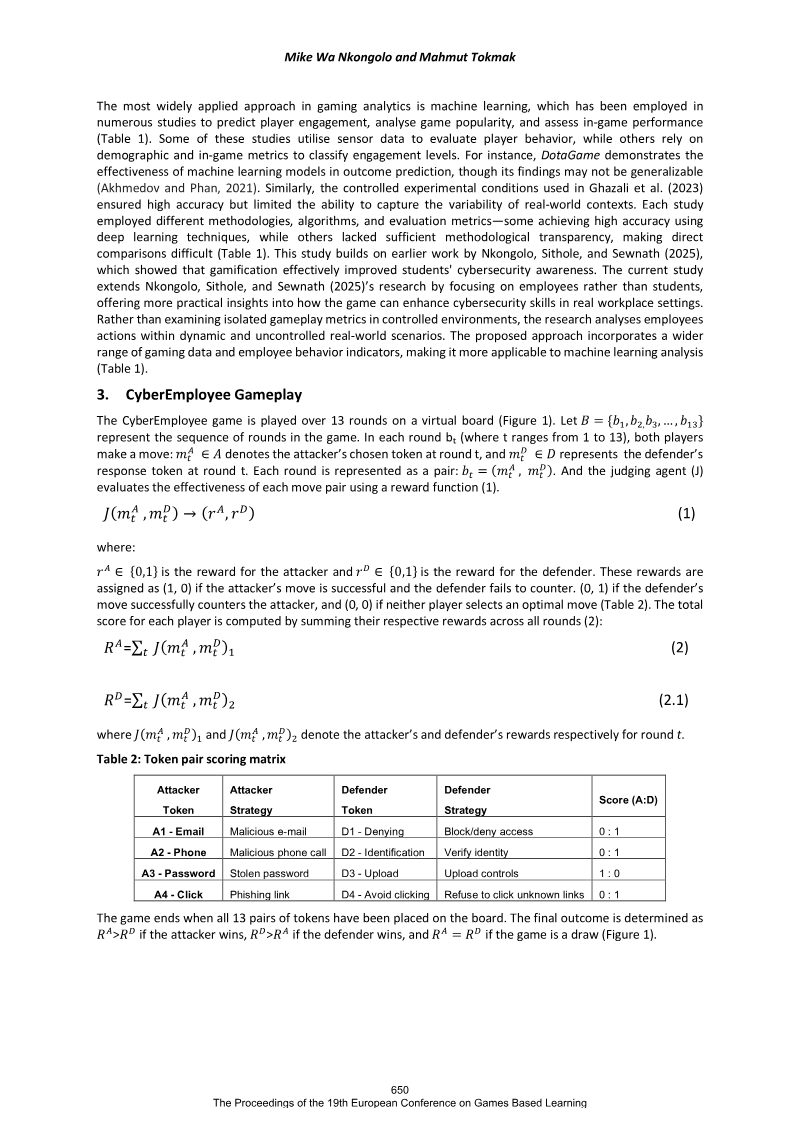
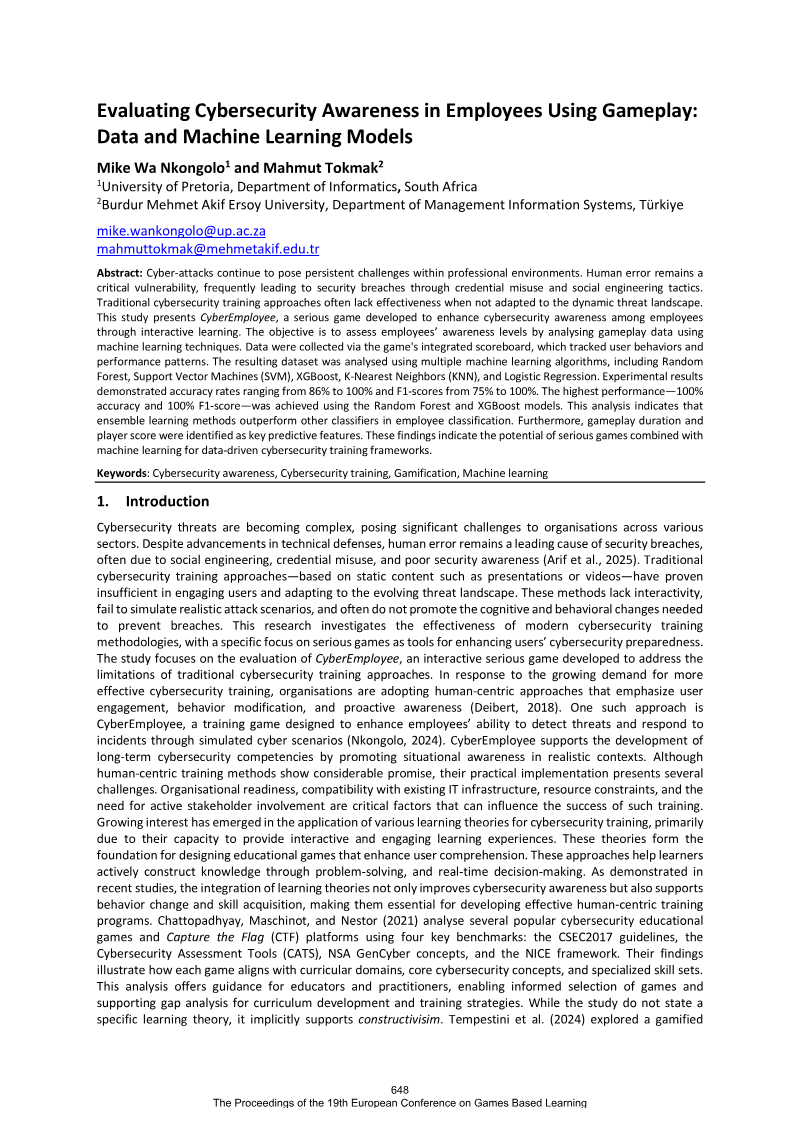
The paper introduces CyberYuruGu, a cybersecurity serious game that draws on Dogon Fox divination from West African cosmology and Bachelard's notion of epistemological rupture to frame uncertainty as a generative source of insight rather than a deficit to be eliminated. Its central argument is that conventional cybersecurity education and forensic reasoning, which rely on abductive inference, Bayesian methods, or deterministic compliance metrics, can be complemented by an interpretative approach in which players reconstruct attack and defence narratives from incomplete, post-hoc gameplay traces. The game is built in Python using Pygame, OpenGL, and WebGL, and integrates a large language model as a judge that maps token placements, layer adjacency, and sequence into heuristic reconstructions of attack paths and defensive disruptions.
The principal empirical finding concerns a cognitive bias toward protective reasoning: defence paths achieved higher cumulative scores (8) than attack paths (5), and defensive reasoning was more consistent and complete across participants. The study reports that a combinatorial analysis yields over 16 billion possible attacker-defender configurations on a 32-cell board, which the authors use to justify LLM-assisted evaluation over exhaustive deterministic computation. Machine learning classifiers reported 100% accuracy, precision, and recall, though the authors themselves attribute this likely to overfitting given the small dataset and the absence of stratified validation.
The evidence base is narrow: thirty IT professionals aged 25 to 48, each playing a single 25-minute session, with data split 80/20 for training and testing. The paper's scope is therefore exploratory, and its claims about cognitive bias and interpretative superiority over conventional models are not established by the sample size or the validation design. Its strongest contribution is conceptual and design-oriented, offering a formal specification and an operationalised cultural framework for explainable cybersecurity education, while its empirical conclusions remain preliminary pending larger and more rigorously validated studies.

European Conference on Games Based Learning (ECGBL) · 2026



European Conference on Games Based Learning (ECGBL) · 2026

European Conference on Games Based Learning (ECGBL) · 2026



European Conference on Games Based Learning (ECGBL) · 2026



European Conference on Games Based Learning (ECGBL) · 2026



European Conference on Games Based Learning (ECGBL) · 2026



European Conference on Games Based Learning (ECGBL) · 2026



European Conference on Games Based Learning (ECGBL) · 2026



European Conference on Games Based Learning (ECGBL) · 2026



European Conference on Games Based Learning (ECGBL) · 2026



European Conference on Games Based Learning (ECGBL) · 2026


European Conference on Games Based Learning (ECGBL) · 2026



European Conference on Games Based Learning (ECGBL) · 2026



European Conference on Games Based Learning (ECGBL) · 2026
European Conference on Games Based Learning (ECGBL) · 2026