1 free read left. Create a free account for unlimited reading + AI research.
Create free account
The State of Mobile Gaming in 2021
Key insights
6 takeaways- 01Mobile gaming solidified its dominance in 2020 with $143 billion in consumer spending, accounting for 70% of all app store revenue and projected to outperform all other gaming platforms combined in 2021.
- 02Daily mobile gaming engagement reached an average of 4.2 hours, representing a multi-year acceleration in consumer behavior that establishes mobile as the primary hub for digital entertainment.
- 03Market dynamics show a split between volume and value, with casual games driving 80% of downloads while core games capture 66% of total consumer spending.
- 04Casino games demonstrate high monetization efficiency, generating 11% of total industry revenue despite accounting for a minimal share of total downloads.
- 05Revenue growth is increasingly driven by strategic initiatives such as in-game events, customization features, and influencer collaborations, alongside emerging subscription and social-integrated models.
- 06The 45-plus demographic in the U.S. and U.K. experienced a 30% increase in time spent on mobile games, marking a sustainable shift toward older player bases.
Ask AI about this video
Transcript
i do believe we have our next speaker coming up and our next speaker is uh lexi from app annie our sponsors so uh you know it's very very good to have uh here with us here comes lexi great to where are you there you are great to have you here thank you for being with us hi thank you for having me no thank you thank you and thank you to affini for helping sponsor this global trends track and making it all possible all these great talks absolutely we are happy to i accidentally matched my background this was truly not intentional but here we are well it's always it always looks nice but um but yeah um
where are you coming from today i'm coming from melbourne australia wow okay so what's that is it are you 12 hours ahead or is it 9 or [Music] oh yeah so it's so it's about 11 hours ahead so well thank you for joining us so late that's fine the night is young yeah nowhere thank you so much for yeah being here with us and i suppose you're all ready you've got everything shared but just before you start i want to obviously say to everyone if you've got any questions for lexi and about the talk um then please throw them into the chat in the q a like you've been doing all morning and i'll be coming back at the end and we'll go through some of the cues and a's but otherwise uh lexi if you're ready to go i think we'll let you get started wonderful thank you so much no worries i'm here in the background if you need me but otherwise i'm looking forward to seeing you talk
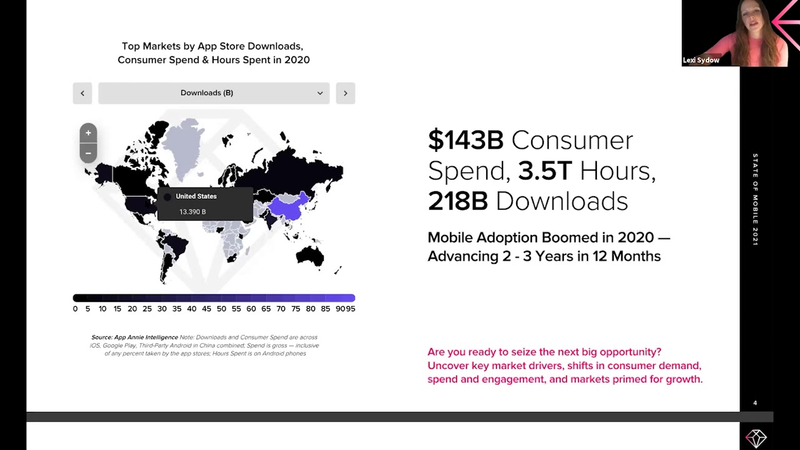
all right we will i'm sure chat very soon yes um and good morning to everyone or good evening or afternoon wherever you're tuning in from i'm welcome to our talk track we're talking about um the state of mobile gaming in 2021 so i'll take you through some key analyses that we've done and then happy to answer questions as well so we'll start with a quick look at the kind of landscape in 2020 so we kind of want to leave you with a couple of stats that are really key and in my mind personally these are the ones that you know if you remember nothing else from the presentation these would be the ones that i would really take home so in 2020 we saw uh 218 billion app downloads apps and games across the app stores globally so this is ios google play and third-party android stores in china um and this is to note this is completely new app download so this means
um you've downloaded it for the first time it's not an app update and it's not an app that you have previously deleted and then re-downloaded this is completely net new downloads so this was up seven percent year of year which is really compelling um and it shows really strong growth in the industry and what it speaks to to me is that it sort of dispels this myth that people aren't you know looking for new apps and games that there's this myth that you know app habits are established and ingrained but in reality they're actually people are really hungry for content and hungry for new apps and games and as well as new people coming into into the market owning devices and so this is a really good figure to show kind of how robust um the app economy is the second stat i would like to kind of leave you with um well we'll start with and something to take away is 143 billion dollars were spent through the app stores global globally so this is again ios google play and third-party android stores in
china and that's 20 growth year every year so this is purely app store spend so that's in-app purchases of in-games and app subscriptions largely in apps and then any paid app or game downloads paid upper games tend to represent a very small portion of overall spend uh but this still is reflected uh the majority is that kind of freemium model and to be clear this does not include mobile commerce or in-app ads that um in games or maps the next stat we'd like to leave you with is uh 4.2 hours were spent on average each day per user globally um and this is kind of a weighted average across the markets analyzed and we'll have a chart that we'll touch on this soon but this is pretty huge um if we look at how much time we spend you know let's say everyone's sleeping around eight hours a day um which may be a pipe room for some of us but if they are
um then this 4.2 hours is roughly 25 over 25 of your waking hours being spent on mobile this is pretty big right this is um you know streaming for the american people who might be in the call it's streaming things like the super bowl in real time or it's those micro moments right not that concerted i'm i'm watching my phone for an hour it's a lot of that micro moment time where you're checking emails you're playing a game here and there you're responding to messages you're looking at the weather the news it's those micro moments that also kind of add up and compound so we're seeing both those areas expand also globally we saw 240 billion dollars being spent on mobile ads so this is a really big uh key figure for us so that's 26 growth year every year um and this is set to hit 290 billion in 2021. so we did see a softening of advertising and marketing budgets generally in 2020
as we expected um with a pandemic with economic headwinds that many were facing and uncertainty in the market however mobile ad spend was what kind of bolstered the digital ad industry overall and helped to it actually was one of the main drivers of growth um and so we really saw that that was a really strong part of 2020 especially with more people's being on their phones doing more things with their phones spending 4.2 hours a day this was really key and we expect this mobile ads to be a very key factor in the ad industry's overall rebound um especially in 2021 and beyond and then mobile mobile tag companies saw 73 billion dollars in venture capital funding so we we also looked at the kind of the equation of where are uh where is funding happening and how has this grown year over year and we did see that it saw 27 growth year over year
and a quick note about app annie for those of you who are not familiar with us um the rest of the data and this presentation and the insights and estimates are from app annie's platform so i wanted to give you a little bit of an indication of who we are um for those of you who may not be as familiar with us so we are the mobile performance standard through our mobile data and insights platform we create winning mobile experiences for our customers aspiring to achieve excellence we provide the industry's most trusted and comprehensive app market data and insights and then all of the insights today come directly from our platform so if you're interested in learning more you can head to appending.com visit our blog we publish many articles a week on new insights we're surfacing about the mobile app economy and the mobile game economy and you can also sign up for a free account at baby.com if you want to dig in a little bit deeper okay so when we're looking at this is something we kind of went through right before but i do want to call it a few
more key indications here so we saw like we said 143 billion dollars through the app stores um and i will tell you that seven out of every ten dollars um spent in the app stores was on games so we're on track to see that mobile gaming surpasses 120 billion dollars in 2021 which would make it about one and a half 1.5 x the size of the rest of the global uh gaming industry inclusive of pc mac gaming handheld consoles as well as console gaming um and just looking at consumer span some of the heavyweight markets that we see are china um the us and japan and combined those three markets the kind of top three for total consumer spend across apps and games uh represent over 70 percent of the market overall um and then as well for some of our european viewers i also want to call out some of the markets in the uk here i'm excuse me in europe and um the
uk actually ranks in the top five as well for global consumer spend if we look at downloads we also see china is a heavyweight there um so is the u.s as well as india um and actually what's really impressive is that we've seen really strong growth um usually in emerging markets which you would expect so brazil and india close to 35 growth every year we've seen really strong growth there um for downloads as you would expect from new devices coming online and more apps being downloaded per person but we also saw um pretty strong growth in mature markets so um actually in the uk we saw 15 growth in downloads similar in the us around 10 to 15 percent and that's really important because typically with mature markets we see a little bit of a leveling happen where um you know over time there's still a high level of downloads but it's not growing at quite a fast rate because a lot of apps have been downloaded already
um you know the device space penetration is a lot higher so this is still this was a really impressive year overall for them for downloads specifically and games represent between um every six and seven of the ten downloads i'd say um and then we've got hours spent so when we look at time spent again we see some heavyweights based on population like india and china contributing a large portion of time spent and globally we saw around 3.5 trillion hours being spent on android devices globally which is really impressive and that's up 25 year-over-year um in terms of apps and games i do want to kind of call out the spread here so 9 of every 10 minutes being spent on mobile phones is spent in apps or games so one of every 10 minutes is spent in browsers so mobile web is important for some of the strategies especially for non-gaming apps but not as important as the app and game strategy themselves
and in terms of gaming it sits around 10 roughly of global time spent um we see social and contacts dominate around 45 nearly half of the market there but what we really saw was that there was an acceleration in 2020 so more time being spent on mobile deeper engagement per user and we saw that mobile app usage accelerated by around two to three years in terms of what we would have predicted based on the previous years of usage um so that's pretty pretty substantial and what's important to me about this trend is that it's it's it's building on an existing trend it's a catalyst of something we've been watching for years um and we just saw it really ramp up in a meaningful way so that's something to take note of we also wanted to call out you know and this is very true for gaming because games like i said represent around seven of every ten dollars being spent in the app stores um apple announced its app store small business program this year
where you know uh publishers who make less than a million dollars will um they will reduce the fees that they take from 30 to 15. so what we overwhelmingly saw is that publishers across ios and google play around 97 of them make less than a million dollars per annum which is important the thing to note is that this indeed is a published level analysis and there's oftentimes multiple publishers that roll up under a major parent company or a company but this is important because it means that there's meaningful impact happening and then we also saw that there's meaningful movement in those in the upper brackets years so publishers earning over two million dollars per year on either side of either store we saw 25 growth year-over-year and the amount of publishers a quick note on demographics um this is something that we find very interesting um looking at how things shake out we did see time spent so this is time spent in top 50 apps which is inclusive apps or games
um we saw that that time spent in those top 50 acts grew generally across the board for gen z for millennials and for gen x and baby boomers in the u.s we saw the greatest growth in the gen x baby boomer bracket which i found personally pretty fascinating but also i know my grandmother for the first time got an iphone or i think show an iphone but she got a smartphone during this time um for the first time ever so that need to connect and to to be you know familiar with your family and to connect with people is big in terms of the apps most likely to use this was really fascinating um it's notable that you know the u.s um what we what we looked at here is the likelihood of of each demographic to use an app or game relative to the overall market so it's showing you sort of like um the propensity or the affinity to use um and gen z definitely over indexed a lot with sort of um a lot of the you know social apps in a
way snapchat twitch discord tick tock we did see a lot of that across the markets millennials tend to dominate with um more linkedin was big commerce was big and commerce in the sense of both food and drink as well as shopping and gen x and baby boomers tended to have a lot of weather um news apps uh adobe reader et cetera um i will call out roblox was number four for gen z for likely to use and one other example i want to call out is in south korea we saw that roblox actually was in the top five for gen x and baby boomers which might surprise some people but it is something to note especially that you know we all essentially have a gaming console in our pockets now with with our phones and oftentimes casual games are a great introduction um in our way that a lot of people who wouldn't traditionally identify as gamers are actually truly gamers in the sense so this was a really cool example to see surface
okay so we'll take a quick look at the the rest of the slides are mostly on gaming um so i didn't want to give you a lay of the land but now we'll focus heavily on mobile gaming so what we saw in 2020 was that casual games undoubtedly would have dominated the downloads market which makes a lot of sense we see a lot of hyper-casual games and casual games do really well on mass with consumers especially those who like we said may not be um you know gaming on pc or mac or console but but do enter the market here in the mobile sphere around 8 of every 10 games were casual games so that's really notable here in terms of consumer spend though we see that core games do dominate that market at 66 percent of all consumers spend through the app stores through in-app purchases or in-app subscriptions very small amount there but largely enough purchases um through core games what i will call out is casino this is particularly interesting because we saw
casino games represent 11 of total consumers spend yet when you look at downloads only two percent of downloads and around only two percent of time spent so casino games definitely over index in terms of their consumer spend versus uh their relative share of downloads we also see casual and core are more even here for total time spent uh but core definitely does take the majority and we do see that aipac is a really big driver of the time spent as well as the consumer spending core games um some big players we'll get into some breakout apps later um for downloads and spending time spent but some of the big ones are in fact the battle royale games um they had a big 2019 and a big 2020. okay so i wanted to kind of give you guys a uh this is an interesting part where we looked at uh a bit more of where's the growth coming from so to kind of caveat this chart we looked at from top to bottom here
is um the growth and market share of time spent in certain sub-genres of games so at fannie we recently came out with a product called game iq which is a really a much more granular advanced categorization of games and we also have a tagging system as well so we're able to tag characteristics of games but within this what you're able to see um and as an analyst this is a dream being able to kind of segment by these sub genres so one of the things we looked at was where among all of the games is the growth coming from for time spent um we looked at time spent specifically to account for enough ads as well since time spent is a big indicator for potential of the apps that do not monetize the app stores or the in this case the games so in this view from top to bottom we have sandbox which is in the casual kind of overall tuning of things um they were the number one contributor for growth in time spent of the market share of time spent and what market
share it shows is not only how much it grew that 75 percent year over year but how much of the pie it took up how big was the piece they were working from before and how much did they take up in 2020 so we saw that sandbox took up a meaningful amount of time and the largest sort of total new share it took up um and and a lot of this was driven by uh games like roblox that was a big contributor there um some other games that really we did see battle royale still had a very strong year still had kind of the number two in market share growth and a 35 growth year every year so that includes apps like pub g um and fortnite um we also saw other arcade was another big one and among us would factor into this area so among us had a blockbuster year we'll talk about that a little bit more later but that was another big one um also um we did see that puzzle and trivia had a big year as well as other rpg which includes games like arc knights
first person shooter also within the core sector um had another big year too i wanted to call those out but this is sort of the idea that we're seeing both casual and core driving a meaningful amount of growth and time spent this is a quick look at um sort of this is sort of our tagging system in action so what we're looking at here is um sort of gameplay features we're able to like say what are the features that are driving meaningful growth and in this case we're looking at average revenue per user in 2020 so kind of the index average users um on the x-axis here and on the y's consumer spend so what we saw globally and this does vary um in the western markets like the us uk and france and germany it's relatively the same top three um sort of gameplay features but different you know varying orders occasionally or varying intensities um in in apac countries we actually saw
that was where the most difference was occurred but globally we saw events with the number one growth for the number number one contributor of average revenue per user followed by leaderboards and customization so to give an example events would include things such as pokemon go having pokemon go fest um in july where they had um you know it's a big festival and this year was totally virtual um it was a very concerted effort whereas it also includes events like in coinmaster where you have coin crazes where you might be rating or attacking different things but you're earning more coins during this specified period of time so would you include both of those leaderboards pretty self-explanatory but you know being able to compare yourself against other people in the market and how you're performing and customization includes customizing your avatar or your environment so it can be among us where you're choosing a different skin for your shirt or you're having a different hat or it could be a much more
uh much more sort of layered customization such as your avatar say in pubg or fortnite we'll touch on some breakout games so i'm cognizant of the time i'll just touch on a few we basically looked at different uh regions as well as the different metrics so downloads among us had a big year we saw brain test uh tricky puzzles had a big year as well as my talking tom friends which also did particularly well um in some markets like india as well as russia we'll see in a second we also see some examples of some other mark other apps that did particularly well i want to call out ludo games there's one in india that had a big year and we also saw you know the migration not only of core games to mobile but of traditional board games and we'll see that as well on the next here this next slide with um scrabble go being another strong example in in france we see wood turning a hyper casual game
also had another big year here where we saw hyper casuals did particularly well as well in 2019 for downloads on the consumer spend side we really see roblox was big and this is this is a big thing because this is a casual game um you expect a lot of core games to do particularly well in terms of breakout growth which is that kind of aggregate growth year every year and spend coinmaster was particularly big um under the casino bracket we also saw state of survival did particularly well this is the case in many markets um outside of also the americas but then pokemon go and that pokemon go did well as well in uh time spent call of duty is another one in the west that did particularly well and we did see garden escapes emerge um in america's and in in emea um so a quick look at aipac um something to pull out as well japan south korea china tend to have a much more um of a unique uh list uh homegrown apps
often do quite well they're homebrewing games um whereas in india you start to see and same with australia similar apps that might be emerging in other countries as well pubg roblox state of survival in australia so you see here with consumer spend battle royale did well again same anemia uh brawl stars being another one um and i do know pokemon go despite being you know limited on in person interactions pokemon go overall did again very well especially in western markets like the uk and the call of duty as well um gain some traction outside of major markets like the u.s where it has done particularly well um and then the same when we look at time spent we see um sort of a combination here you know casual as well as poor um definitely notable to talk about roblox doing very well in western markets among us again had a huge year um and then i do
want to call out things like scrabble go right that that was a board game adapting to mobile and doing well in france particularly as well as there in canada and again we see some differences occur between markets um and we also see you know some some games emerge like ludo king which was a board game that kind of transitions same as karen poole and the last one we'll leave you quickly with is time spent in in europe so again we see scrabble go on merge brawl stars battle royale game coin masters big which is a casino game and then you see old favorites like candy crush soda saga that have been around for a lot longer but are consistently still doing quite well in markets and then in this case even being a breakout app by time spent in turkey a quick note now on um just a little bit of the marketing focus here so this view we looked at the the power of strategic collaborations in 2020 so this
is something we saw with celebrities and influencers and we wanted to crawl out specifically for the fact that it you know kind of ran the gamut of of different apps there's fortnite pubg palm and dunkin donuts dunkin donuts in the states is like a fast food restaurant chain fortnight and pubg being uh battle royale games and then calm is a meditation act so we saw the use of celebrities to sort of see a natural um sort of spike in downloads um on the app store so a little bit of an aso probably paid depending we don't know you know the details of those agreements but um a bit more of an organic creative way in a sense apart from in-app advertising to sort of gain traction so um fortnight saw the greatest lift at 2.7 x the kind of downloads during the promotional period versus the two weeks prior um and then we saw pub g as well saw stronglift and overall uh roughly you know about 1.5 x minimum
lift from these promotional periods so a really good way to grow your user acquisition in a way that kind of cuts through the noise of some of paid ads or um or beyond your keywords okay and again we are at the annie we help fuel successful mobile experiences monetization um and i do want to leave you with if you liked what you saw here head to appiany.com um you can get a free account you can browse our blog we have multiple blog posts coming out every week um analyses that myself and my team are working on um so i'd take a close look there um as well as if you like what you've seen so far this is taken up an extension of our state of mobile report which you can access at stateofmobile2021.com and you can get a copy and you can work through all the data on your own and take a little bit more time than what we're able to do today and as a quick disclaimer all of the information in today's presentation uh basically we just we like to send
this through um when we basically just you know we don't advise any investment actions being taken on the estimates shown in today's presentation and with that i will i will pause now and i can stop sharing this pose and we can ask some questions yes thank you so much for a really interesting and fascinating talk we've got quite a few questions here so i'm gonna dive straight into these um the first one is do you believe that uh indie developers have a better chance of success uh by focusing on emerging markets is it less noisy at the moment that's a great question it's so layered i would say you know emerging markets are a really strong opportunity for focus but at the same time it's important to note the differences between markets so um some apps and games do better in some markets and some you know even your advertising creatives um we had a case study where we looked at
even just the the um the color of the phone device and the creatives on the app store have an impression on the how likely people were to download the app um and so those are all things to take into account i think this was an analysis we did um i think in south korea where it was the white device performed better than the dark device so these are all things to take into account with all markets it can be very different um from market to market i would say one thing to note is that we have seen a lot of traction with major players um from asia in latin america this year so an example being shoppi did particularly well in brazil so we are seeing an increased focus in other emerging markets um so the competition may be increasing more um so it is something that you know if it's a focus or interest to you um doing the due diligence and making sure you understand what the local players are and what you know the kind of local appetite is and
then what potentially the competition is that might be emerging in those areas um in our report we highlight a lot of the breakout apps which is that kind of they're not maybe the biggest apps of the year but the ones that saw the biggest growth and that's a great place to start to see what might be gaining some initial traction for games and for apps just to get a feel for some of these emerging markets yeah okay great um next question is it seems that the data shows that working with publishers is the best path for developers is that so i suppose that's kind of like a counter to the previous question we've just asked like obviously indies might want to look at new markets and stuff like that but like alternatively it's just working with the publisher easier i think it really depends on the market and and the type of app and game that you're looking at um it's hard to cast that wide net i think i'm so i would be hesitant to say either way on that one i think it
ultimately depends but at the end of the day i really encourage everyone to understand really the lay of the land in that market and that to me is the biggest indicator of of what you might be able to do or what sort of nuanced trends you can pull on and where major publishers might not have seen major movements so i'm definitely depending on the market with that one yeah okay i mean the next question is quite interesting it's something i was considering as you would as as you were doing your presentation is so the the next question is as older people are playing more games do you think developers need to start catering to this audience is it an opportunity and and part of what i was thinking is kind of like do you think that boom in the baby boomer generation in game playing do you think that is just related to covid and we'll see it as a short-term game gain or do you think it's something that's going to continue
i definitely think it's something to watch so i will caveat and say our data a lot we the way we break down demographics is 16 to 24 25 to 44 and then 45 plus and so i know that age brackets you know it casts a wide net there 45 plus is casting very far um so i will say let's caveat it with that but it is particularly interesting i think we've seen really strong growth in the uk and us at nearly 30 in each market for growth and time spent in kind of the top most popular apps among that older demographic um and so it's definitely it's definitely something to pay attention to yeah in terms of games i really recommend again um taking a look deeper at it because what i've seen so far like the most likely to use apps again apps and games combined um tend to be a bit more your productivity your news your your um weather
but that being said it is a strong opportunity and i think that there could be really a good potential there it just depends on what you're looking at and um from the indications we saw i mean in south korea was one example we gave with roblox where a casual game um did particularly well so i think as any sort of if you're targeting any consumer who who may be moving sort of from a less digitally savvy and i would say it's more of the upper end of that age bracket casual games make are a natural area to contin to kind of focus on or a natural sort of entry point you might consider just for the the ease of use factor but we are seeing strong growth there and i i do think things like um you know examples being in in house party or other apps where you're able to combine a social aspect with gaming that's something that's really interesting that i think we're going to see growing and could be a really easy way to tap into that market as well for people who might not play games actively
and then it's like a nice way to kind of um they start to a little bit because they're they're face timing with their loved ones and the games kind of come as part of it so that could be a nice area as well yeah and and we've only got time i'll try and um squeeze in one more question for you and so crit chris of uh pocketgamer has asked uh there was some conversation yesterday about the general trend towards subscription services uh obviously this is most clearly in digital tv but is there any data um or evidence that uh shows that this is get this could work in the in the game space i know notably in mobile we've had apple arcade but we've obviously got game pass on the console front as well and other things like playstation now i mean are you guys seeing any trends in that area or any kind of evidence for subscription yeah this is a really interesting one i would say um so far what our data shows is the bulk of consumer spend is happening
from in-app purchases and core games yes uh it's bigger when you look at asia um casual games do you'll see a bit more of it um but that tends to happen you know like in among us we saw you know a bit more of smaller purchases there but like upgrading skins and things like that and in your your avatar presence we see apple and google definitely have made moves to that right where um having a subscription sort of service and it can make a lot of sense in the sense of um one one thing i would say is important is potentially parental control so if you want to let your kids play games and you want a suite of games that you feel like you can you know know what they are that could be a really strong avenue um we've seen really strong success in consumer spending growth and time spent for youtube kids for instance so that's a definite indication of an appetite that would pay potentially for that type of service um and then i think you just have to have some big names to kind of lure people in
in the subscription space if you're having multiple games it is it is a very interesting area and now subscriptions have grown strongly in the non-gaming space um and i do think we're waiting for some some more breakout examples in the gaming space but it would be something to keep an eye on i would not say to turn your you know the other cheek to it it's definitely something to consider yeah but definitely watching that space yeah and i'm gonna ask one last question because i think it's hopefully a one-word answer but it is um lisa asked does game iq also show genre breakdown by revenue yes there you go that's why i asked yeah perfect right well i tried to get through as many questions as possible but um are you in the discord by chance or anything else like that or can they people reach out to you over email if they've got any extra questions absolutely um i have to i i will join the discord
um and feel free you know follow us on social media at appiany i'm we'll be sure to try to take a look at those things but um you can also reach out to me um i don't know if yeah well my name is showing on the screen it's that um you know on twitter or um feel free to email me that's great as well i'm happy to be a resource oh well perfect and thank you so much for a really fascinating talk and for sticking around for so many questions thank you chorus thank you for having me no thank you for being here and thank you to apani for being our sponsors as well for this track well thank you and uh have a good i want get some rest have a good sleep have a good day [Laughter] thanks
you
Summary
The mobile gaming industry experienced a transformative period in 2020, solidifying its position as the dominant force in global entertainment. With consumer spending reaching $143 billion and mobile gaming accounting for 70% of all app store revenue, the sector is projected to surpass the combined earnings of all other gaming platforms in 2021. This growth is underpinned by a significant acceleration in user engagement, as daily mobile usage climbed to an average of 4.2 hours. This shift represents a multi-year advancement in consumer behavior, establishing mobile devices as the primary hub for digital connectivity and entertainment across all age groups.
Market dynamics reveal a clear distinction between volume and value, as casual games command 80% of total downloads while core games capture 66% of consumer spending. High-engagement genres such as sandbox, battle royale, and arcade titles are the primary drivers of time spent, while casino games demonstrate exceptional monetization efficiency by generating 11% of revenue from a minimal share of downloads. Strategic initiatives, including in-game events, customization features, and high-profile influencer collaborations, have proven essential for maximizing revenue per user and driving significant spikes in user acquisition.
A critical development in this landscape is the expansion of the player base into older demographics. The 45-plus age group in the United States and the United Kingdom has shown a 30% increase in time spent on mobile games, signaling a sustainable shift in market composition rather than a transient trend. While in-app purchases remain the cornerstone of the industry's financial model, the emergence of subscription services and social-integrated platforms offers a promising avenue for long-term growth. These developments suggest that mobile gaming is successfully diversifying its reach, effectively capturing older audiences through accessible, social-first experiences.














Comments