1 free read left. Create a free account for unlimited reading + AI research.
Create free accountReport Entertainment Software Association
1 free read left. Create a free account for unlimited reading + AI research.
Create free accountReportEntertainment Software Association
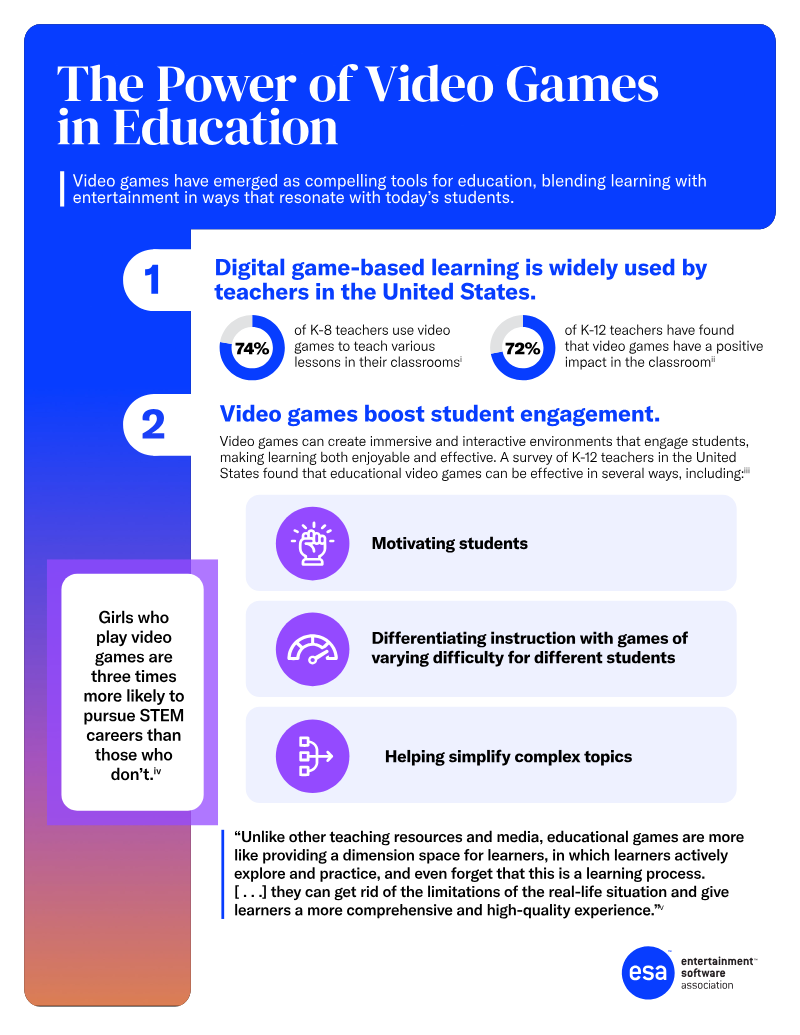
These tools enable differentiated instruction, simplify complex subject matter, and foster meta-learning capabilities. They provide immersive spaces for active exploration.
Like a personalized tutor, games can adapt to each student's pace and style.
Digital game-based learning has become a significant pedagogical tool within the United States K-12 education system, driven by the ability of interactive environments to foster student engagement and academic success. Approximately 74% of K-8 teachers currently integrate video games into their curricula, with 72% of K-12 educators reporting a positive impact on classroom outcomes. By providing immersive spaces that allow for active exploration, these tools effectively motivate students, simplify complex subject matter, and enable the differentiation of instruction to meet diverse learning needs.
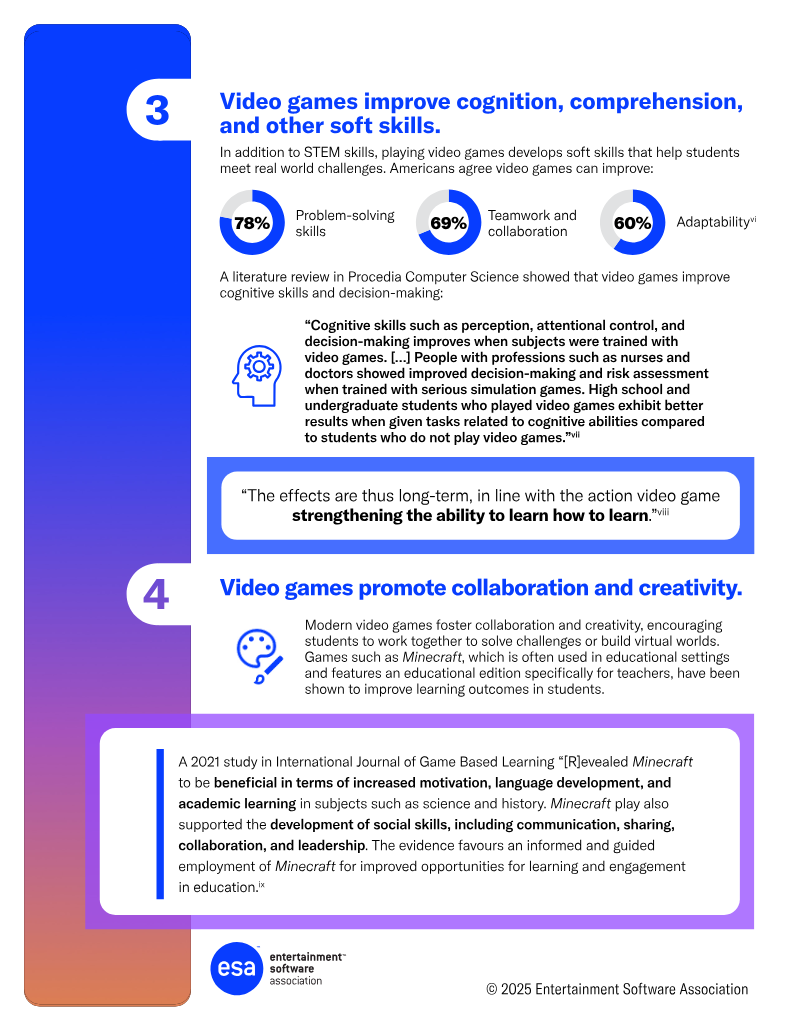
Beyond core academic subjects, video games serve as a catalyst for developing essential cognitive and soft skills. Research indicates that 78% of Americans believe gaming enhances problem-solving abilities, while 69% and 60% recognize improvements in teamwork and adaptability, respectively. Cognitive benefits extend to improved attentional control, perception, and decision-making, with evidence suggesting that training through simulation games enhances performance in high-stakes professions like medicine. Furthermore, gaming experiences are linked to long-term learning benefits, including the development of meta-learning capabilities.
The integration of specific platforms, such as Minecraft, underscores the potential for games to promote creativity and social development. Studies demonstrate that guided use of these virtual environments leads to measurable gains in language development, science and history comprehension, and leadership skills. Additionally, the influence of gaming extends to career development, as girls who engage with video games are three times more likely to pursue careers in STEM fields. Collectively, these findings suggest that when implemented intentionally, video games function as a high-quality educational resource that bridges the gap between entertainment and rigorous academic and social-emotional growth.

Entertainment Software Association · 2026

Entertainment Software Association · 2026

Entertainment Software Association · 2025
Entertainment Software Association · 2025

Entertainment Software Association · 2025

Entertainment Software Association · 2025

Entertainment Software Association · 2025


Entertainment Software Association · 2025

Entertainment Software Association · 2024
Entertainment Software Association · 2024

Entertainment Software Association · 2024



Entertainment Software Association · 2024