1 free read left. Create a free account for unlimited reading + AI research.
Create free accountReport gamevironments
1 free read left. Create a free account for unlimited reading + AI research.
Create free accountReportgamevironments
The report argues that game history is shaped by interpretive choices made in the present, by the constraints of digital media, and by the demands of play.
"Gamevironments of the Past" examines how digital strategy games translate historical content into interactive experiences, arguing that history in games is never a neutral transcription of the past but a product of interpretive choices shaped by the present, by the constraints of digital media, and by the demands of play. The work introduces and tests the History-Game Relations (HGR) framework, a semiotic model built around three historiographic procedures (setting, modelling, and representing) and three simultaneous translations (perspectival, digital, and ludic). Drawing on a definition of historical discourse as the selecting, ordering, and narrating of elements, the authors offer scholars and designers a tool for analyzing how these layers interact, whether coherently or contradictorily, within specific titles.
The analysis centers on two 4X "god games," Sid Meier's Civilization V and Total War: Rome II, which are treated as contrasting case studies. Civilization V presents history as a linear, positivistic race toward development, with civilizations, leaders, and events loosely anchored to time and place and freely recombined into a counterfactual, "u-chronic" history. Its digital and ludic translations reduce units, cities, and leaders to fixed quantifiable variables, and its Roman faction is distinguished largely by a single AI personality and a bonus, framing the player as a godlike actor reclaiming Rome's glory. Total War: Rome II, by contrast, functions as a hybrid of real-time and turn-based strategy that places Rome at the center of history and emphasizes an "evenemential" view in which war, politics, and economics dominate while daily life, law, and religion are largely reduced or omitted.
Taken together, the findings suggest that the two games differ less in their fidelity to the past than in the kinds of historical arguments they make: Civilization V offers a playful sandbox of recombinable civilizations, while Rome II offers a faithful-seeming, event-driven re-enactment. The authors conclude that the HGR framework is most valuable as a comparative method for understanding how representations of history emerge from interpretive choices, medium, and mechanics, rather than as a measure of historical accuracy, and that such games can still foreground contingency and the complexity of historical processes when their models are carefully designed.
Each row is a game or company this document names, each column a document, oldest first. A mark means that document names it. Select a row to see those documents.
gamevironments · 2026
gamevironments · 2026
gamevironments · 2026
gamevironments · 2026
gamevironments · 2026
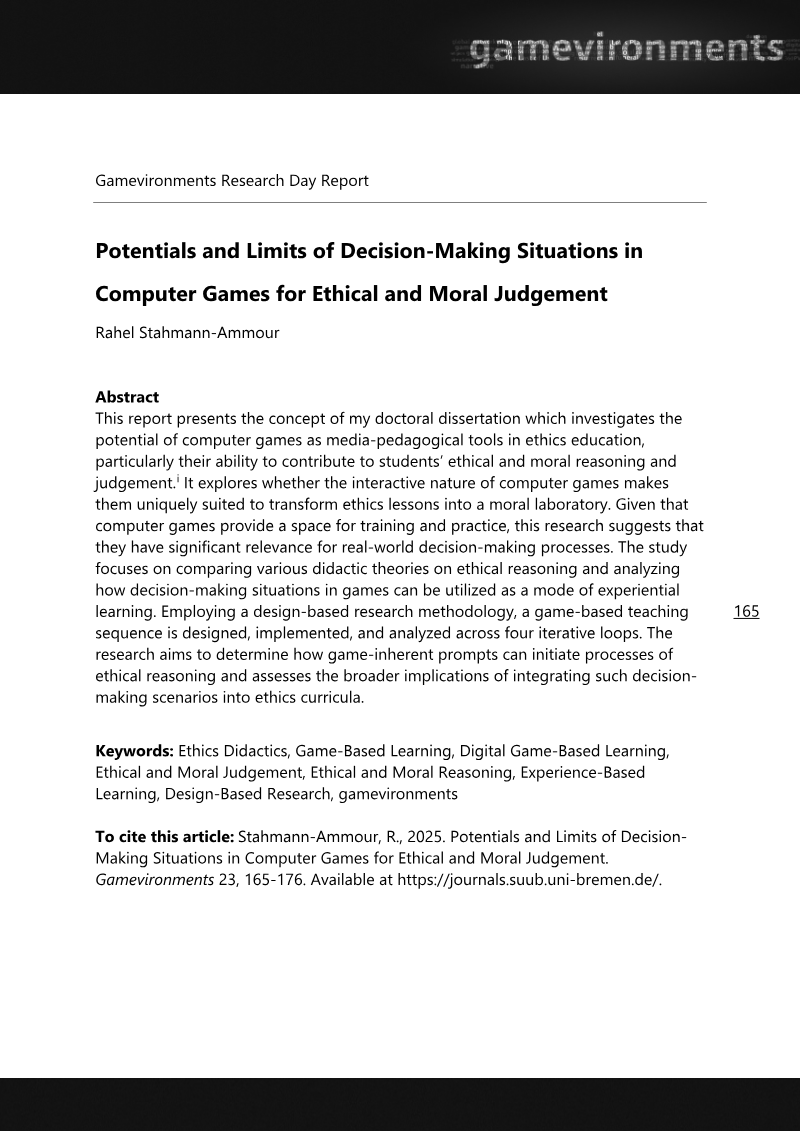

gamevironments · 2025

gamevironments · 2025
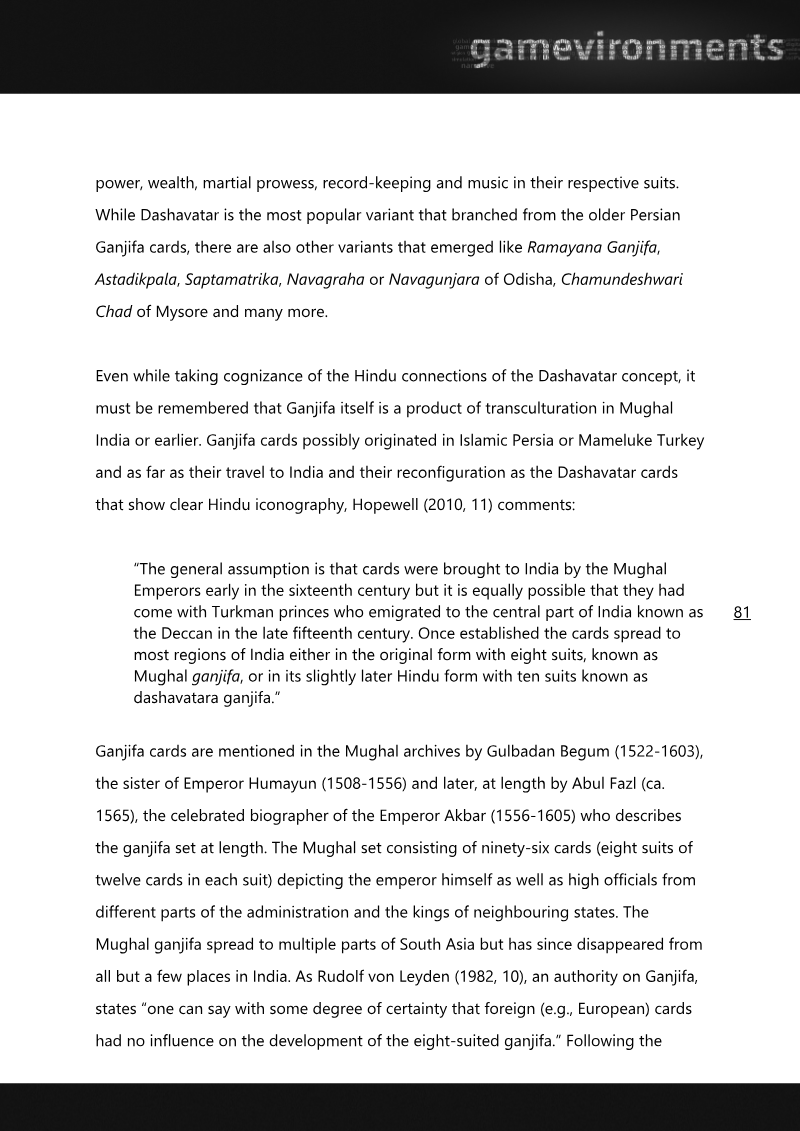

gamevironments · 2025

gamevironments · 2025

gamevironments · 2025

gamevironments · 2025
gamevironments · 2025

gamevironments · 2024
European Conference on Games Based Learning (ECGBL) · 2026



European Conference on Games Based Learning (ECGBL) · 2026