VideoTwo & a Half Gamers
🎯 The DEFINITIVE Guide to D2C in 2026: Real Numbers from 8 Studios
15 Jun 202644 min video
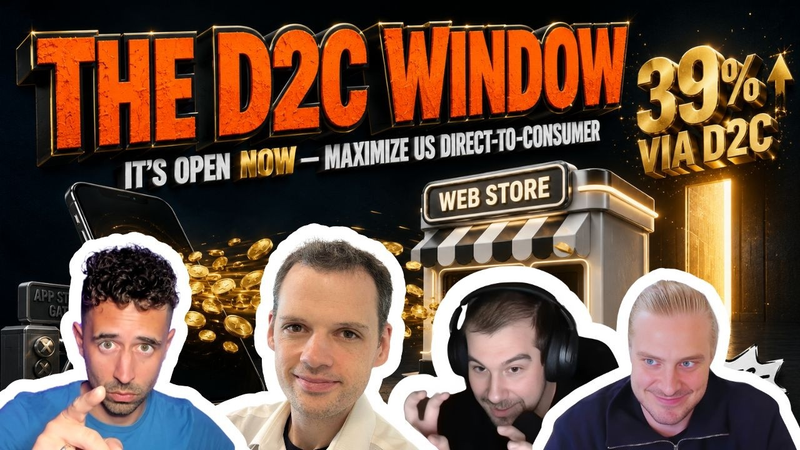
what I would do, right, in this scenario. The most immediate thing, you know, said it before, I'm going to say it again, maximize United States direct-to-consumer traffic today. Like, limited window, closing soon, drive as much traffic over as you can. And I would do that with a mix of direct checkout links and web store links, right? I would want players to be aware of the web store and have a be habituated to the web store, so they know to come
[music] [music] [music] [music] [music]
[music] [music]
Oh, hello everybody. Welcome Welcome to three and a half gamers, which means we have our third host. Well, not third, fourth, actually. Well, I don't know.
I already screwed up. Anyway, my name is Mate Lancharic.
I'm Felix Braberg.
I'm Yakov Gremiar.
I'm Chip Thurston.
And we are your hosts. Okay, this was great. Way better than what we did before. Anyway, so which means we are talking about D2C. We are going to go through the Pocket Gamer report that was flying around LinkedIn with all the D2C and the data and and the growth. Then the latest Epic versus Apple, epic versus Google and then maybe we are
going to talk about like what does the best in class D2C look like right now and something else as well lot of numbers. So where do we want to start? Where do we want to start with like how everything is growing that's always a great start. Oh no no. Would you say I have one question or would you agree Chip if I want to start a new web store or replace a current D2C setup? Would I go to fastspring.gg or call you directly?
Both great options. Yes, I think fastspring.gg has your answers, right? You can find me on LinkedIn and happy to talk about that. But yeah, I think overall just exciting time exciting time indeed to see I think this Pocket Gamer reports a great great place to for us to start.
I mean Felix always is all talking about like how big the pie is always like every quarter.
Huge.
I mean but I think we did
Sorry with Playtika when we start talking about D2C like they were the first one that kind of showing the
actual numbers.
I think they were the first one they were the first one they were the first one to report it. They were the first one to report it.
yes that's what I was going to say.
No, I don't think so they were the first ones but yeah.
Just to report yes.
I looked it up before and I'm going to steal Chip's thunder here. So last time we had Chip on, right? It was a quarter ago, right? We should do these once a quarter. Then now drum roll 8% of Playtika's IAP revenues through D2C.
Okay. Seems platforms are getting more relevant than the others.
Yeah, so well come on. I saw Okay, maybe that's a specific genre. I saw in the report that 39% of D2C of revenue for Playtika was D2C. I want to make sure we're we're looking at the right numbers.
The Robert the CEO he was bragging about but maybe it was the the old social casino titles that he was talking about for that because he was saying it was like a thing.
[snorts]
It might have been that and also the revenue grew 63% year over year.
So
Yeah, it did grow.
Okay.
They just accounted for 39.2% of the
Yeah.
Okay. Sorry.
No, no, but it is all right. I don't want to undercut the point here. Let's let's reset.
Yeah.
Let's reset. So this this report, right? Let's let's frame the report we're talking about, I think first, right? So on pocketgamer.biz, shout out to the folks at Pocket Gamer and especially Craig Chapple, their head of content cuz he put together this report on D2C and it is awesome because what it does is it aggregates publicly published earnings reports where they actually talk about the percentage of revenue being driven D2C. And this is something we haven't really seen before. So like Felix said, we've been seeing this from Playtika. I think we actually talked about them on a previous podcast and now Playtika was just an indicator that we had. Well, now it's not just Playtika. In this report, we have eight different studios including Playtika that have talked about their direct consumer revenue. And so we can talk through these and they're all very interesting different touchpoints whether it's based on their genres, their games, where they're headquartered. But I think at the end of the day, it's
breaking through the noise and resonating as you said, Matt, on LinkedIn because it's the first time direct to consumer is really out of the shadows. It's it's not this like cloak and dagger tactic that we're afraid to talk about anymore. Studios are actually going for and saying, "No, we're doing D2C and not only that, but we're succeeding and we're driving a lot of revenue there and here's how much revenue we're driving." Because to them, it's a really positive story in the earnings report. It's raising the bottom line because they're driving so much through D2C. So
So we have we have Playtika, we have MTG, Stillfront, SciPlay, Play Studios, Ten Square, Huge, G5, Take-Two even.
Yeah, yeah, so When I was looking at this, I I thought of it in three different cohorts and let me know what you guys think of this, but I thought of it as like your social casino cohort, your mid-core cohort, your casual cohort. And that's over simplifying cuz some of these studios stretch multiple genres, but that's trying to to keep it simple here. So, in the social casino cohort, you have
SciPlay, my wonderful former employer, love SciPlay. Uh, you have Play Studios, you have Huge. And actually not listed in this report, but um, Double Down Interactive also publishes their public earnings with D2C percentage. And so, in these studios, you see 27 to 44% of revenue being driven D2C. The 44% comes from Double Down. You can go look up their Q1 earnings report if you want to see their
is this is traditional, no? Like again, we heard these stories about sending biggest players golden tablets all over the place like 10 years ago. At least myself. Like that that's what I heard that like social casino was always this kind of a pioneer in this place.
Yeah. Yeah, I think that's absolutely the case, right? It's social casino is so VIP concentrated in its revenue. And so, you shift over just a small percentage of your players and you can shift over a significant portion of your revenue. So, it's really well positioned to to capitalize on D2C. But I think that explains why we're seeing a lot of success in the D2C space from social casino.
The other interesting part there, too, is the geographic distribution. So, you've got SciPlay and Play Studios in the United States. You've got Huge uh, coming out of Europe. You've got Double Down out of Korea. Like one takeaway for me from this is it doesn't matter where you're headquartered. Um, what matters is where your players are.
Yeah, but come on. Like SciPlay and Play Studios are also Israel.
That's true. That's true. Again, over simplifying, but yes, there absolutely Israeli offices within those companies.
Yeah, yeah, yeah, yeah.
But at the end of the day, yeah, like these are globally distributed companies. And so, you can invest in D2C because one pushback I've heard is for as some regions seem more apprehensive to pursue D2C than others. But at the end of the day, it matters where your players are, right?
Why is Why is Why is that? Because of like colloquial government issues or like or they're scared or why is the like
What's that apprehensive part?
Yeah, yeah, yeah. Exactly.
Yeah, I mean I think the main apprehension is the potential for repercussion. Like that seems to be the
root of it at the end of the day. Um repercussion specifically from Apple and Google. And again
Okay.
I think just some regions it's that seems to be a a greater concern than others. And again, I'm I'm having very broad generalizations here.
Yeah, yeah, yeah, but still I mean it's still people are afraid.
But the bottom line is you don't have to be like a US studio to drive D2C revenue, right? It's it But you do need US players in the current moment because that's where the regulations are impacting how you can access the app stores.
two mafia families have different power globally, right? So it's like some places they're harsher than others, right? It's what you said.
[laughter]
Yeah, that's what I said. Not my words. Well, my words would be different countries will have different appetites for how they will allow or disallow steering and how they will allow or disallow the monopolistic practices of certain platforms. How's that?
My guess is that that that like we we just don't see that much because like this is whole
basically like a little bit of a renaissance, let's be honest, where people start to sharing these numbers.
Stop saying your renaissance because we are feeling scared of the renaissance. I am the renaissance. I am the renaissance.
What I'm saying that for instance, we we know for very long time for instance that like Lilith has their own store with all of their games, even the the latest one, new ones, and which means that this is most probably much more proliferated in China and Asia altogether. We just like don't see the numbers.
Yeah, we just don't see anything.
Because we don't see the numbers even if you want to because this is like on different Android stores and stuff. But still I wouldn't kind of discount this as for like most It's even more proliferated because the users are even more positioned towards higher spenders per lower DAU, which this is the you know thing with it.
me check the 37 37 Entertainment because I did a lot of stuff with their financial report and where they were talking about the the AI usage and I might find like if they have actual like Feb star in there. In the meantime.
point. Um this this report is exciting because we have this insight into direct consumer revenue, but at the end of the day it is only a very small slice, right? Because it's specifically public companies who do publish earnings reports. And so many gaming companies, anything from EA and Activision to Scopely to uh Dream Games or whoever might be privately owned, might be uh private equity owned, might be venture owned, like any of those. There's no need for them to publish their earnings reports and so they don't talk publicly about it, but we know there's a lot of investment across so many different companies that are succeeding in this. So I think basically we have to take the data points that we can get and extrapolate from there, right? Draw broader conclusions until proven otherwise. And so taking this report further, the next cohort for me is the mid-core group, which is your uh MTG, Modern Times Group, uh Stillfront Group, uh you've got Ten Square in there. And of course again, these these stretch into multiple genres sometimes, but there you see revenue ranging up to 44%
of revenue, right? Mid-core lends itself so well to it.
Putting back on what I was saying, this is 37 Entertainment and this is Lilith. So they have it all there themselves. It's like this I know that it's been there since ages and this I just didn't know. We just look it up, but I'm I'm guessing that they can Oh, you know, these are all the 4X bros and they're outside uh in China, so they definitely know what they're doing. It's like not not like waiting for the West.
They only have in their a breakdown revenue by product which means it's mobile games as well as web games or geo. So, it's domestic versus overseas, not by not by the channels.
My education guess is that it's 30% at least.
Yeah. Yeah. Yeah. Yeah.
For sure. Just pure Forex people are like that. Because they're min-maxers.
Yeah, it's like it says like their domestic business is efficiently like D2C because they're they have their own
which we can see.
That's great. It's another good point. The one The one that stood out to me from Midcore was Ten Square because what they did So, they said their D2C percentage is 20%. So, 20% of total revenue coming via D2C from Q1. But, they went a step further and said for Fishing Clash in particular,
it's 33.
33. Yeah.
And this is really interesting to me because it's the first time I've seen a publisher go and say this specific game has this specific percentage, right? Typically, it's been up to us to kind of speculate and triangulate which game is driving the most D2C revenue. But, now we have one we can point to. And so, for me, if I were still working in game development, I'd be like, "Oh, let me go see what Fishing Clash is up to."
He's doing it.
They're driving a third of their revenue through web stores. Like, this is huge. They're really succeeding. Let me learn from that. So, I think there's some really good examples that we can directly point to and say, "Go look at these studios. Go look at these games." And you can figure out what the best practices are.
What do we think is currently the cap that you can hit here? I mean, like not not like technical wise, of course you can go all the way, but like just like, you know, on average. Like, what would you say would be like, I don't know, 3 years down the line? People are working with what, 60% 70% on default?
Anecdotally, I've heard of 70% as like not even long-term future, like this year as a a potential target, right? So, I think it's doable, especially under the current rulings, but I do think right now, we can get into direct checkout linking a little little later, because I think this is a really interesting conversation piece. But basically, there's this really frictionless path to D2C that's available right now, where you can link directly to a checkout page instead of a web store. And if you're using this, you can really push the pedal to the floor and maximize your D2C revenue percentage. But I think some constraints are going to come into
that that might kind of slow things down a little bit in the future, just in terms of that really high ceiling of D2C. But if you're using a direct checkout link and you're driving them through this really frictionless path, I think you can really have over 50% of your revenue through D2C as of today.
You mean like like pushback from the stores later again when this starts hitting critical numbers or
Yeah, yeah. Let's Let's unpack that. So, it's it's a it's a long a bit of a long answer, but so right now, right? The traditional path has been you go from the mobile game into a web store. And then on that store, are different items. You add that item to your cart, make a purchase. That's your your flow, but there's a few clicks to that. What's emerged throughout 2025 and into 2026 are direct checkout linking, which is where instead of that flow, you're cutting out the store. So, say in the game, I tap on I want to buy this package for $9.99, and I want to buy it through the web, so I tap it. It just takes me to a checkout page that's hosted on the web instead of hosted mobile. So, you're skipping the
store entirely. You're just going And then I just Maybe I even have my payment information saved because I've already made a payment there. And so, I just click checkout, then boom, it kicks me right back into the game. Actually, at FastSpring, we have a solution called SteerSafe you can check out that emulates this.
If If these two guys, which are my former friends, would follow my newsletter, it was already there.
You know, I read your newsletter today. What are you talking about?
It was already there. It's already there.
How we're getting at this follow thing?
Yeah.
I had I'm sure everyone is already familiar with this. But, the point is you have this this frictionless path, right? Direct checkout linking. So, what I'm alluding to in the future, the friction that would be introduced to this is what we talked about on the podcast from March. There's this epic Google settlement which will introduce fees on linked payments. And meaning a payment that is linked directly from the mobile game into the web store, you'll have to ship pay a percentage of that revenue to the platforms in the future if the settlement gets approved. And so
in that context, every direct checkout link is inherently a linked payment, right? Because you're linking them from the mobile game into this checkout page to make the purchase. And so, I think in the short term in the immediate term, direct checkout has a lot of potential as a frictionless path. But, longer term I think the web store is more critical to the the future of D2C because that gives your players a destination they can reach where there won't be those 20% fees. It doesn't have to come from a direct link inside the app.
So, more friction for now, but more perspective for this friction later basically because we can just kind of disconnect them from this whole linking stuff.
Yeah. Yeah. Yeah, I think what what's really critical is the habituation of your players to your web store because that's what will last regardless of what happens with these settlements or regulations. You want players to have that destination that they know and trust and are familiar with that they will come back to, right? If you're just entirely relying on direct checkout, that'll be great for your revenue today, but then if this 20% fee
gets introduced, you're going to have to kind of do a reset and either start to cultivate a new player behavior going into your web store or just eat that 20% fee which I think would be pretty unappealing.
If if I were to ask you like right? Like let's say I'm a developer and I start using a payment provider outside of the app stores, right? And I start sending, let's say, 40% of my IAP payments for my widget game and then let's say you're Apple and you come to me. What what do you tell me? Like what what are you hearing? Are they going like you're not going to get organic downloads or are you they're like we're going to sue you or what is it the stores actually say to these publishers?
Exactly. You can't do that.
Yeah, yeah, I'm just wondering, right? Cuz like everyone's so afraid of the stores, right? But like what what is the boogeyman everyone's afraid of?
The the it's kind of a weird position for me because I I'm going to be advocating for how Google would penalize you here, which I don't really have
faith in.
Yeah. But so the fear is that it would be more behind the scenes, right? That I wouldn't even really be privy to how I'm being penalized in the sense of like my game is getting lower visibility on the store than it would have otherwise. My discoverability is lower because I'm driving so much revenue via D2C channels. Now, I've never heard of any concrete example of this. I've heard of it just as a I think outsized fear of what people have. But I'll say in practice what I have heard as Google in particular getting a bit emboldened recently to enforce their external content links policy. So, what is the external content links policy, Chip? Um well, I'm glad you asked. So, they they have this new policy, right? So, Google rolled out this new policy called external content links that they are saying is required if you want to link to content outside of your game or or your mobile app,
right? So, if you're linking to anything, web store or otherwise, you need to be enrolled in this. And if you're not enrolled in this, we're going to disapprove your app. Not delist it, but your updates will be disapproved.
And so this
is this is like the first salvo against that thing we talked last time, which is like just link them somehow, disconnect them, and then keep them there.
Yeah. Yeah, they're laying the foundation with this. Um so, it actually went into effect January 28th, 2026. That's when they said it if you're linking the content, you need to be enrolled in the external content links program. But, enforcement-wise, I don't think they started enforcing it. That was just their kind of flag in the sand saying, "This is in effect now."
But, is it in the store guidelines now, officially?
Yes. So, if if you you can look up the external content links program, and it'll say, "As of January 28th, this is in effect." Caveat, it only applies to the United States. Currently, I think there's a great chance it expands to other countries in the future. As of now, only
long.
[laughter]
Um So,
uh as of what, May? That's the first time I heard of it getting enforced, where I heard from a publisher that they had an app rejected, and Google's response was, "You're linking external content. You need to either enroll in the external content links program, or remove those links inside of your game." And then we'll approve your game.
So, do I understand that if you enroll in it, you can still have it, or they just decide somehow like this is too much or not?
No. Uh all they say is you have to enroll in it. They're not charging any fees because they can't charge fees yet because of the current regulations.
Yeah. But, that's my question. Like, what can they do? Like, they just like still force you to take it out even if you enroll in it?
No. If you enroll in it, you're good to go, right? But, to enroll in it, you have to include the external content links API. Like, it's not a trivial thing, right? There's there's some hoops you have to jump through.
So, it's a little more friction.
It's a little more friction on the development side. On the player side, there's no additional friction. But, as a as a developer, there's there's a
little bit of integration effort here. The other piece is in the external content links guidelines, that's where Google outlines the fees that they intend to charge. So, they say very clearly there were not charging fees today again because they can't. But, they say that we're going to charge a 20% fee on an app purchase revenue with a 24-hour attribution window. This is all what we talked about last time according to the Epic Google settlement once they are allowed to start charging those fees, right? So, be aware that if you're enrolled in this program and those policies go into effect, that then you're going to have this uh revenue share model essentially with
But, there is still a chance that the this judge kind of disapproves this whole thing and puts it back and on like step one or whatever.
Yeah. Yeah, so let's let's go to the Epic Google settlement. So,
All right.
So,
I really love this like it's like telenovela.
Yeah, it's like
Yeah, I was going to say like
We [clears throat] do mean the two companies. It's not an Epic Google settlement, but yeah. All right.
Yes. Capital E Epic.
Yeah.
So, I think of it more as a Goosebumps than a telenovela, but I don't know. Let's go from there. So, Epic and Google just to rehash it. We talked a lot about this on the last podcast back in March, but in Q4 last year Epic and Google went to the court, proposed this settlement, said if like with this we will end our litigation, right? And that's really significant because this started in 2020. It's been going on for almost 6 years now back and forth with Epic Google Google in the courts. And they both said finally
getting really old. We are getting really old.
And some lawyers are getting really rich.
And I think also Epic is getting pretty exhausted. That's the other part of the spectrum here.
Yeah. Yeah. Yeah. So, um so, but they said, right? This will end it. This will end the litigation between us. This doesn't impact Apple. We can talk about where Epic and Apple are separately. But, with Epic and Google, they said, again, Q4 last year this is our settlement. And I thought that would
kind of just get a quick approval and go into effect, but the courts were actually like skeptical. They're like, "What is going on here? Why are you suddenly BFFs?" was what the judge had said, right? famously. And so, since then, the court has been essentially doing due diligence and saying like, "We want to see how you arrived at this conclusion. We want to make sure that this addresses the broader problem of anti-competitive practices by the platforms. We want to make sure this is in the best interest of the industry and not just a sweetheart deal for Epic." And so, all of these questions have been back and forth such that the deal is still the settlement is still not approved uh by the court. And so, without court approval, it won't go into effect because it needs to be approved for this to all resolve. So, that's that's where we are. And what's really interesting about it is in the settlement, Epic and Google, well, Google specifically had said, "This is our policy and we intend to roll this out, have it go into effect on
June 30th, 2026 in the United States and Europe." And then, in other countries, it'll be at a later date.
This month.
Yeah, now we're like 3 weeks away from that date as it is. [laughter] So, it is still not approved. So, what I'm watching for is like, are these dates going to change? Like, is the judge going to approve this and then suddenly like we have to adapt to it? Like, what what what's How's this going to shape out? So,
If I understand correctly, in this kind of a beauty of a settlement, it covers the the topic of like cosmetic items are not taxed as power power items, which literally sounds like a bribing Epic because of the revenue.
Yeah, that's a good point. So, originally,
No, no, no, but yeah. No, no, but yeah, maybe maybe.
Well, okay. So, originally, there was a carve-out for cosmetic and non-cosmetic items, and there was this 20% fee versus this 9% fee, and it got really like suspiciously convoluted. That was eventually like kind of set
aside. And they replaced it earlier this year with a more flat rate where they said the fees will be 20% for linked payments on web stores. And inside the app they now have a different fee structure, which we can talk through, but basically it's decoupling the like the 30% fee that we've had for the last couple of decades is now getting broken into two fees. There's a fee to process your payments and a fee for everything else. So, the fee to process payments through Google Play billing, and this is like a So, this is all under the settlement that is not yet approved and could change. I'm talking about it as under the current terms, right? But based on the judge's feedback, we could see some of these terms change. So, that's the the caveat I'm going to add here. But, under the current settlement, Google Play billing would have a 5% fee. Meaning, if you process a payment inside of your game natively inside the app through Google Play billing, you pay 5% for that. But, the other fee, the we'll call it the platform fee, is 20 to 25% depending on the date of install. And so, if it's
before this settlement goes into effect, it's 25%. If it's after the settlement goes into effect, it's 20%. So, that's a lot of numbers, but let's just say you have an old install, a legacy like an install from last year, and they make a purchase inside the game and it's processed through Google Play billing. Your fee is 25% plus 5%, which is 30, which is unchanged.
Step one.
Yeah, woohoo.
Great.
For future installs, it'll be 25% total because there's a lower rate for future installs after the settlement. Also, there's a carve out for your first million each year will only have a 10% platform fee plus
That's like old though. That's that's that's like old.
Yeah, the subscriptions will have a 10% platform fee plus, you know, 5% for billing, so you're looking at 15% on those. There's a 5% discount available if you enroll in special programs, um but that requires a lot of like Google solution integration stuff. Uh, but you can lower your fee by 5% inside the app if you enroll in those.
Did I get this wrong? Like this whole cosmetic power play item thing got thrown out completely?
Yeah, that's not that's not per to the current terms anymore.
Okay. Okay.
Yeah, they've they've I think there was a lot of pushback to that.
Of course, because policing that would be impossible. But thanks for clarification.
Yeah, yeah, there's not a distinction of cosmetic items. It's more based on the date of install, the revenue per year, you know, under a million or after your first million, subscription versus non-subscription. And also, this is where they have the 20% fee for a linked payment, right? So, that's where D to C gets impacted because now if you link from your mobile game into the store under the first 24 hours, you would pay 20% of that revenue. Google says settlement goes into effect.
Do we do some future predictions? What's next regarding the milestones?
have I have the best thing to add to that. All right. Everyone gets to guess. How much is Epic seeking from Google according to this settlement?
Like them to pay them to cover their legal fees. So, how much did Epic spend on legal fees to fight Google since 2020? I looked it up just now, so I know the number. Yakub, you get to go first.
If you go with something like 300 mil or something like something.
So, you say 300? Matthieu?
150.
Chip?
I abstain.
Matthieu, you win. 170 million in legal fees is what they're getting to go if the settlement goes through from Google.
Cuz it's insane.
I won't help them.
Yeah, but back to the topic, like I would like to do some kind of a usual like looking forward what's what's next in this kind of a again saga. So, as you said, Chip, 30th of June, which is in 20 what? Less than 20 days by the Sorry, by the
than 20 days because it's 19.
Whatever. So, by the time of this recording, it's it's like coming soon. And we still don't know what what's going to happen. And the possibilities
are settlement goes in and industry kind of like let's say panics a little bit or the settlement gets pushed back as for the date and we just like delayed. Like do I get the other possibilities here correctly?
Yeah. Yeah, I think that's fair.
Yeah, okay. And then what what's next regarding either other courts or anything else that's like for this year worth to watch?
Um well, to your first point, as far as a prediction, I mean, I think it's like the courts have been unpredictable to this point, right? So, my answer would be it's a coin flip as like will we see this go into effect by June 30th or not? And so, the way I would mitigate any risk by that if I were to publish a right now would be enrolling in the external content links program. Continue pushing the pedal to the floor until some fees get implemented. Like keep steering, keep maximizing D2C revenue. And then if you see the policy roll out, you don't have to integrate or change anything because you're in the program that's required. What you change is your strategy for monetization inside the
game, how you're navigating players from your mobile game to your store. And so, you start thinking about that. But like yes, this policy could take effect, but you know what it'll require because you can look up the external content links policy today and everything you need to do to enroll in that. And so, that's the part where I wouldn't want to be caught flat-footed. And being caught flat-footed would mean just I'm not going to worry about the external content links policy, this thing isn't in effect yet. Like I'll cross that bridge whenever it rolls out. So, maybe you do that prep and it gets delayed. And if so, that's fine. Keep steering, keep maximizing your D2C revenue. That's that's where I would land as a publisher today. As far as other rulings, we should talk about Apple. You want to talk about Apple? You want to talk about Apple? You want to talk about Apple?
Yeah, it's it's that other platform.
Yeah, quite significant.
So, the the short version on Apple is that they're continuing to appeal the decision from last year, from last April, without success. So, they keep fighting,
keep keep exhausting all their legal options, right? So, what this means in practice is they appealed for a stay, which in legal terms just means a delay for the ruling to go into effect. So, they wanted the courts to pause this until like all their appeals played out. And at first, the courts were like, "Okay, we're going to grant you a stay." And then that got reversed. And the courts actually said, "No, you know what? No stay. Like this ruling stays in effect." So, this is all behind the scenes legal stuff, but ultimately what it meant was their request for a stay was denied. They appealed this all the way to the to the United States Supreme Court, who didn't even hear the case. It was like, "No, like your stay was denied." So, that's where we are.
Yeah, exactly.
Which is apparently very common in the United States Supreme Court. Like they just don't hear the vast majority of cases that people try to get in front of them. Thought that was really interesting. But apparently a high high threshold to get get your case there. So, after that was denied, they launched a new appeal. And this appeal was that uh this was actually just in May, just
last month, saying that from Apple's perspective, the Epic ruling should not apply to developers outside of Epic. It should only apply to Epic because this is the Epic and Apple case. It shouldn't apply to all game developers, right? I don't think there's a lot of weight to this case, but like that's their current narrative that they're chasing down, and we're waiting for that to play out.
Well, they're strapping the lawyer battle, basically.
[laughter]
Yeah, they just again, like if you're Apple, you want to exhaust all your legal options because this is such a critical thing. You send them.
It's so That's the most recent appeal. But again, like I I think the epic Google side of things is laying a precedent for what we should expect. And also there in parallel to these appeals Apple is driving with the courts. They've announced that they are they have agreed to a timeline with epic
to discuss the fees that Apple will charge on linked payments, right? And so this is this weird back and forth where like Apple has a few weeks to respond to epic and then epic has a few weeks to respond Apple they map this out basically through October of 2026 where they have said for the next four months now they're going to go back and forth and figure this out. So when I put all this together, like ultimately my read on this is that I expect Apple to be a fast follow once this Google settlement takes effect. And they've exhausted their appeals. And so if if this happens
rich.
Yeah. So so this settlement with Google could go into effect in June, could be later in the year. Once it is, by fast follow I think I I mean that I think Apple will announce a policy change afterward. I don't think it'll go into effect immediately. I think there'll be some runway to comply with that understanding what the policy is, probably an API
similar to what we see with the external content links program. And then that goes into effect. Maybe late this year, maybe early next year. Again, these timelines are really getting drawn out. But that's where I I think we'll land. But of course, as I said, courts can be a little unpredictable. So we'll have to see where things shake out.
By the way, this is if I understand correctly, it validates my estimate because if it's 170 just for Google, then it has to be at least 150 also for Apple. So we are hitting the 300 for sure.
you asked Yacob cuz I actually looked up the fee for what Epic has spent on Google or Epic has spent on Apple. And so, we're going to have another round. This time we're going to start with uh Okay, I'll give you 170.
250.
Ooh, I think also because they did the ad and like pissed them off so much. So, like yeah, 220.
Yacoub, you win, but not because you were close. You were the least worst one. Epic has spent 73 million.
Really? A lot
That's actually It's I don't know why. I haven't had a lot of time to look in, but it was a lot less.
Okay.
massive amount to spend over 6 years on legal fees.
Yeah. Someone's getting fired.
Yeah. Oh, man.
Yeah. So, to step back on this, like with Google, we're waiting on the settlement. We'll see what the courts have to say on this. With Apple, we're waiting on these appeals to play out, and maybe we'll see some policy change after this. At the end of the day, on both platforms, you can still steer without fees in the United States today. And that that should be the big takeaway. Take nothing else away from all this legal jargon, all the numbers we walked through. Take in mind like now is the time. Now, there's this window that is closing, and now is the time to drive players to direct-to-consumer channels because you can do that without having to pay a fee to the platforms today.
Yeah, because the users will stay there disregarding of the settlements, and you can still keep them on their web store. That's the important part of this whole recommendation.
It reminds me when COVID hit, and people
were like Well, there was two schools of like UA. Like, oh, let's Yeah, yeah, let's spend every everything we have and all my mom's money because this is really like this is great. And then the other one was like, oh, no, no, no, this is going to end soon. And guess who won?
[laughter]
Guess who won? I mean, that was a great time to spend every money that you you had on your bank account because it was just an insane window of opportunity. Which This this is pretty much it.
I was actually at Zynga Play when COVID hit, and I was managing UA on a game when COVID hit. So, it was yeah. I look back fondly on those days.
Easy money. Great payback though.
[laughter]
I can understand. Oh my god. But the yeah, I mean, everybody who has players in US, which is literally everybody, there you go. There's your answer. Like, why don't you wait?
There's There's one point I want to get back to on the Pocket Gamer report, if I
can actually bring it all the way back to that, which is there was one more cohort I didn't get to, which was the casual cohort. And I think it's actually really important we talk about this one because so much of the pushback I've heard on D2C as well has been, "Okay, that works in mid-core. That works in social casino."
not okay, not casual. Yeah.
And there's two casual studios in that report. There's G 5 Entertainment and Playtika. I'll put Playtika in there. So, I see your skepticism there.
Solitaire, man. Come on.
Yeah, yeah, yeah, I know, I know, I know, I know. Yeah, yeah, yeah, so exactly.
Yes, I know. I know.
I thought of Playtika historically as a social casino studio, right? Slotomania and all that. But they've actually changed their genre mix significantly, where they acquired Superplay.
They told me people actually They said this in the report that they're sunsetting the casinos and just focusing on casual.
exactly. And in that
Printing money, so
Yeah. In that earnings report, they actually break out casual versus social casino as
a percentage of revenue, and they said 76% of their total revenue is coming from casual. So, and they show that over time. They show that percentage only increasing as social casino continues to decrease in their portfolio. So, when we say Playtika is driving 39% of their total revenue via D2C, that is mostly casual, and that is an awesome example. So, for any of you casual developers out there who are still listening and skeptical of D2C, say go go look at Play Ticket. That's great examples of D2C.
And Disney Solitaire is making so much money per per day, it's insane.
Yeah.
It's a funny it's a great game, so I mean it's not no surprise. But would you say also match three games could earn the same amount of money?
Yeah, I mean I think I I think any maybe not like hyper casual, right? Like not hyper
no, no, no, no, no, no, hyper [clears throat] casual is not
They're unlimited. Yes, yeah, yeah, I mean come on. Let's be honest, Disney
Solitaire, again, you can go check the review we have on the channel is basically a puzzle game.
Yeah. Yeah, that's what I'm saying.
That's what I'm saying. Yeah, that's that's why I'm kind of comparing this because it's the same audience. You just need to figure it out like how to sell your Yeah, exactly, the logistics, exactly. Yeah, the logistics.
Yeah. Yeah, and that's a that's a great point, Matei, because the takeaway from this shouldn't be I'm going to go see what Disney Solitaire is doing and like copy that. The takeaway should be I'm going to go see what they're doing and learn from that, right? Because it's like any aspect of game development, you have to understand what works with your players. What's going to incentivize your players to go to the web store to make that purchase and how much friction are they comfortable with and at what moments are you serving up these points of purchase? You can't just take what you're seeing elsewhere in the industry and apply it to your game and expect to see the same success. And so, I would say there's a lot of iteration required, but coming from this report, you have a lot of examples of good best practices out
there that you can learn from.
That's that's that's amazing. I mean, that's that's that's the That's the key learning from from at least today's episode, guys.
It's really they ask around next month at ChinaJoy how well people are doing and just like maybe talk about this also.
Yeah, that's right. That's a good point. Let me Let me give you my like what I would do, right? In this scenario. The most immediate thing, you know, I've said it before, I'm going to say it again, maximize United States direct-to-consumer traffic today. Like, limited window, closing soon, drive as much traffic over as you can. And I would do that with a mix of direct checkout links and web store links, okay? I would want players to be aware of the web store and have it be habituated to the web store, so they know to come back there if I have to no longer do direct checkout. But, strategically think about, okay, when can I take advantage of the direct checkout window in the current state? Cuz that is the most frictionless path available. I just wouldn't rely entirely on that. So, I think this hybrid
strategy would be important, finding the right mix of that. The other piece I would do it if Well, point three, look at all the games, all the studios we just talked about, learn from them, see if there's some ideas I haven't considered, right? Things like Raid: Shadow Legends, right? Is another great game on this list from MTG, and they do I think they call them points, right? Like, every purchase you make on the web store gives you points. You can only use those points to redeem on the store, and so it creates this great flywheel on web store purchases. That's great, and I would implement something like that. But, you can learn from things like that. One thing we haven't talked about that I would start to dip my toe into would be Japan. Japan announced in December Well, they announced it a long time ago, it went into effect in December, the Mobile Software Competition Act, which allows steering of both Apple and Google with fees. And so, it's like the first real implementation of these new platform fees that we've seen. And because I expect those to be the future of D2C, I would treat this almost as a soft launch
of like D2C with fees, right? So, like, start steering in Japan and learn effective strategies and how you can maximize that percentage. It's a way kind of a low-risk way to learn about how to maximize your revenue in D2C under the new world order of these platform fees. And And it will take some iteration and some configuration to think about when you want to incur these fees or if you want to avoid these fees, but I think it's a really interesting opportunity. And so, if you're really forward-thinking, I would start to think about Japan as a way to learn how to operate within those. Oh, and the last piece I would I would use FastSpring to process all my payments. Obviously, yes, yes. For each
Oh, like Japan is its own world order, let's be honest, but uh yeah, that's a good point, definitely, because they again, they're driving like, you know, Monster Strike is still doing like 1 billion in their home market only or something.
Yeah, yeah, we saw also Konami is doing quite well there with the football game and all and whatnot. So, I mean, money
is definitely there.
Japanese DAU just means extremely high spenders. That's how it works.
Lots of lunch.
All right, that was a that was a great
Great Great
suggestion. And also like, yeah, everybody who's just yeah, like finishing this episode, like go and start your [ __ ] web store right away. I mean, there's no other
You're missing out.
No other options, yeah, no other options.
Yeah, this was amazing again. Like, thanks for coming. And guys, again, don't hesitate, go and and start your web store right now. And we are definitely going to be back with more news from the D2C world with Chip in the in the foreseeable future. Thanks for coming. See you later, guys.
So, bye-bye, guys.
Auto-generated captions from YouTube — names and numbers may be misheard.
Direct-to-consumer (D2C) strategies have evolved from experimental tactics into a fundamental pillar of financial performance for the global gaming industry. Major studios, including Playtika, SciPlay, and Ten Square, now derive between 27% and 44% of their revenue through independent channels. While social casino titles currently lead this transition due to their VIP-centric monetization models, mid-core and casual games are increasingly adopting similar frameworks to capture higher margins. By bypassing traditional platform payment rails, developers are successfully reclaiming significant revenue shares that were previously lost to standard platform fees.
The current market environment offers a critical window of opportunity to maximize U.S. traffic through frictionless direct-checkout links and dedicated web stores. However, this landscape is shifting rapidly due to regulatory pressures and evolving platform policies. Google’s impending settlement, which introduces a 20% fee on linked payments, alongside ongoing legal battles with Apple, creates a climate of uncertainty. Despite these challenges, the industry consensus emphasizes that studios must act immediately to habituate players to web store environments. Establishing these independent destinations now is essential to mitigate future policy risks and ensure long-term revenue stability.
To succeed in this transition, studios are encouraged to move beyond simple payment redirection by implementing loyalty-driven mechanics, such as point-based reward systems, to foster repeat engagement. Furthermore, emerging regulatory environments like Japan’s Mobile Software Competition Act provide a strategic testing ground for navigating new steering regulations and fee structures. Ultimately, the shift toward D2C is no longer optional; it is a high-priority imperative for any studio aiming to optimize profitability and maintain independence from platform-imposed constraints in the coming years.

Two & a Half Gamers · 2026

Two & a Half Gamers · 2026

Two & a Half Gamers · 2026

Two & a Half Gamers · 2026

Two & a Half Gamers · 2026

Two & a Half Gamers · 2026

Two & a Half Gamers · 2026

Two & a Half Gamers · 2026

Two & a Half Gamers · 2026

Two & a Half Gamers · 2026

Two & a Half Gamers · 2026

Two & a Half Gamers · 2026
Deconstructor of Fun · 2026
Two & a Half Gamers · 2025
DoubleU Games
Modern Times Group

Deconstructor of Fun · 2026
AppMagic · 2026
Two & a Half Gamers · 2026

Two & a Half Gamers · 2026

Two & a Half Gamers · 2026
Two & a Half Gamers · 2026
Two & a Half Gamers · 2026
AppMagic · 2026
Comments