1 free read left. Create a free account for unlimited reading + AI research.
Create free account
The anonymous data monetisation opportunity
Key insights
6 takeaways- 01Mobile game developers can generate $300,000 to $500,000 in annual incremental revenue per one million daily active users by monetizing anonymous background data for the mobile signal testing industry.
- 02The mobile signal testing data market is currently valued at $6 billion and is projected to reach $25 billion within the next five years.
- 03Developers monetize by integrating a lightweight SDK (under 600 kilobytes) that collects non-identifiable network performance metrics like signal strength and latency without accessing personal identifiers such as IP or MAC addresses.
- 04Consumer research in the US and UK indicates that 41% of users prefer free apps that collect anonymous usage statistics over those supported by paid features or traditional advertisements.
- 05Data monetization offers a scalable advantage over traditional advertising because a single dataset can be sold repeatedly to multiple organizations, whereas ad inventory is limited by screen real estate.
- 06Ideal partners for this model typically require a minimum of 500,000 daily active users and access to location permissions to ensure the data remains useful for telecommunications companies.
Ask AI about this video
Transcript
[Music] hello everyone so I'm another Tom from another another data company were actually adds data monetization company so weddings me a little bit different to some of the other data companies you may have may have seen today so we're actually headquartered in Canada we also have an office right here in London and sort of catch planners turn into coins to turn turn anomalous data into into money but in a way that's not really been done by any other companies here at the moment I'm just to give me a sense is anybody here currently doing data monetization in the audience not a thing I'm going up ok this should be good so to talk about data monetization I'd start by talking about some of the limitations of other current monetization models as we know there are
two main ways to make money adverts and paid apps and paid features and as we know companies are facing this issue of trying to you know grow their revenues by you know even single digit percentages spending time trying to optimize these two areas but of course with adverts you're limited by the screen real estate so you can't really go beyond the size of the screen in terms of it the number of ads you can display and the starts to become a sort of a ceiling on the CPC or CPM that you can get there's some limits in place it's difficult to go beyond and of course with paid apps you know the conversion rates are pretty low and it requires lots of effort and skill to make games that can convert users from free to paid effectively so we're really into anonymous data monetization this is different to the previous presentation from Tom so it's actually complimentary or complete can be implemented in a complementary
fashion so when we see anonymous data monetization we really mean completely anonymous data which is collected in the background of the app no data which can identify a user or a device no data which can be taken and then combined with other data to identify user device not even idfa no IP address no mac address nothing like that it's all collected in the background without affecting the users experience so we won't display anything or or four straight the user so the question of course is what what is this data and why is it valuable it was anonymous day so it can't be attributed to a user you can't you can't connect it in any way you can't use it to target users what is it and why is it valuable this usually takes a little bit of explaining so bear with me on this the three biggest fears of our generation so running out of mobile signal or Wi-Fi or cellular
signal running out and not being able to get onto the internet number two having slow loading times and number three running out of battery now there's not much we can do about number three but actually our product deals with number one and number two and we actually make money by helping to solve these two problems so I want to talk to you about the mobile telecommunications and mobile signaling testing industry now for most people in this audience this is probably a need something that you're not too familiar with in too much detail this is a six billion dollar industry growing to 25 billion dollars in the next five years telecoms companies so in the UK vodafone o2 t-mobile at setia drive around and cars like this so there's the car on the left-hand side that's the back seat of the car it's covered in mobile phones there's about 25 mobile phones there in the backseat of the car and these guys are driving around London
every day all parts of the country to see how good is the mobile signal in different parts of the world and back to my previous slide the big fears of people running out of data signal willing having a poor network performance so telecoms companies are spending all over the money driving around trying to figure out where the network is good and bad so that they can improve that and make it better for their users so we just thought want to be crowdsource it it turns out there's not anyone else in this business at the moment doing it the way using our distribution model so we actually have a small SDK which does exactly the same thing that you just see on the previous screen where we do it through partnerships with games companies and other app farmers we've got more than 150 different app titles who have integrated us right now we're running unlawfully search 250 million devices currently we anonymously collect data from all these devices so that we can see where the mobile signal is good and bad to give you a sense of one when i talked about anonymous anonymous data these are
the types of states that we collect so signal strength download speed upload speed the cell tower that you're connected to the location of the device while this test is being performed latency jitter packet loss these types of things these are data points which are not really have any relevance to the mobile industrial to the mobile games industry not typically collected but extremely useful an extremely valuable that we can actually together we can actually monetize this opportunity so we take these data points and we create reports graphs another data products this is a picture of the UK it's been blown up so you can see it in a slightly lower resolution but this shows us this is from our data that we've collected showing where in the world is the mobile coverage good and bad or good medium bad in terms of download speed upload speed etc where users having a good experience and a bad experience and then we sell it to these organizations here from upwards of ten thousand dollars per month as a subscription process we did some
research so it's important to us being a data company collecting data from users devices you know we were concerned we wanted to make sure that users wouldn't be concerned that we're collecting statistics in the background so we did it we did some surveys we did the US and the UK market a thousand users and just to give you a sense of the responses we got to get an app that I want I would rather and these are the choices take a free app that collects anonymous usage statistics have a free app but with adverts pay to download it or pay for features and upgrades we found that forty-one percent of respondents more than any other category would prefer to have an app that collects anonymous statistics than any other current monetization model and a similar vein we asked the same question to the same thousand users in those markets about what women's you not use an app because there has too many adverts maybe you have to pay to download it if it collects personal data name email
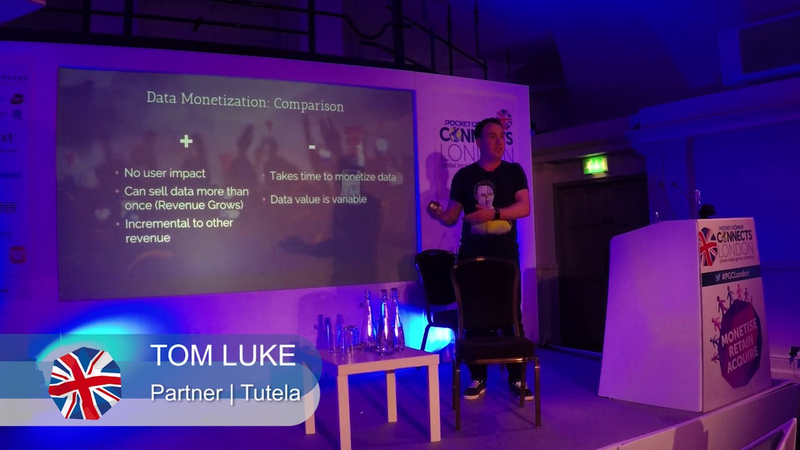
address etc and again we found that by a significant margin collection of anonymous usage statistics was actually the lowest friction point for users considering downloading an app or game so we know now that it's low friction and users are pretty happy with this as a way of monetizing or perhaps two to collect in the background it's important to understand the differences though date to monetization or anonymous data monetization in this case it's got some pretty big upside and some and some differences to other monetization models Lily on the plus side was absolutely no user impact in our case into Telus case we've done a lot of work on our on our SDK and our software libraries to make sure the file size is extremely small so it's less than 200 kilobytes the impact of the device is negligible so less than 1% drain on battery and cpu and so no
usually impact whatsoever another great benefit of data in asked in our case is you can sell the datum multiple times so it's not like adverts on a screen you can't put a limited number of adverts on a screen the screen is just not big enough what was basically we can sell it to you know effectively a limitless number of companies and just do to our revenue share model together we'll both be growing revenues on a continuous basis so it keeps growing and of course it's great because it's incremental to all the revenues as well even other types of data that you might be collecting and monetizing like tom's previous presentation you know you might be collecting data which might be more ways to the users this is in addition to those things it's also in addition to advertising and any page features that you may have in your apps some things to take note of data monetization involves collecting data product pricing it and then selling it and this period this can take several months of several several weeks or several months so it's not quite as instances other sources such as advertising it can take a little bit
longer before you go from integration 22 results into every news and the second point is the data is variable so typically will take data and will spend it sometime product rising it and then selling it to some organizations that can take several months and then several months later will sell the same data again and then again and they're going again so that means that the data will grove I'm as we as we monitor acted to more and more organizations so just take a bit about to tell her or a VC back company based in in Canada and London where a data tech company will all actually form the telecommunications industry so the games industry is still fairly new to us we've been in the telecoms industry for some time myself over 10 years iOS DK is currently aren't putting on more than 150 apps running on over 30 million devices at the moment I'm actually looking for more partners we're here today sponsoring with with a booth upstairs looking for more partners
who can who can join us in this opportunity the opportunity can be into the millions of dollars it really depends on the number of daily active users that you have more is more and what we were looking for is a partner to have location permissions because we need to know the location where the network quality is good and back we're looking for ideally partners that have got more than half a million daily active users that's enough not a hard limit but that's just that something that makes your data volumes more interesting or useful thurs and we're looking for people to move pretty quickly and we work on the basis of a revenue share model in cases where we have large partners we have course offer minimum guarantees as well so that's it that was my presentation thank you very much words done 106 and that please come and consult for us I'll take some questions fun [Applause]
yes we do yeah so just to answer that question in more detail well the question was do we collect data on the types of device to this year so we collect things like is that an iphone what version of iphone is it what's the screen size and what's the OS version these types of things and the reason wanna collect information is the telecoms companies want to know you know exact phone performing bachelor worse than different types of devices Philip Evers good and which I believe either yep more complete than the you may or may not be for me okay um I can get back to you on that yeah yeah I mean I guess typically the UK would have you know being a more developed market another markets it expect it to be kind of ahead of the curve in terms of things like that but yeah sure see we can help you
why should we integrate our tech or we pay you so it's as simple as that so we know we've actually raised a lot of VC money in the last few months just so we can pay more money to get more game developers on board so we want to do that and they get a good a good model for both sides we pay it both in terms of a monthly minimum guarantee but then also have a new show on top of that as well good question thank you good question and we get this question quite a lot and it unfortunately difficult question to answer because data monetization is quite different from you know advertising or just paid upgrades and things like that so when it comes to data monetization just to give you an example you know data form a single
device virtually has no value or it actually has no value stated from hundred devices have two on zero value but we actually take aggregate amount of data and turn them into products and the certain thresholds that we need to meet before we can make different types of products so you know for example me in the UK we require roughly fifty two hundred thousand daily active users to make our first tier of products but if it's 105 or hundred it makes it doesn't how much difference to it's an approximate threshold the best way to get a sense of you know how much damage is at work to developer well first one is we've actually got some tools on our website so let you do that so to tell about commons / partners putting your di use it i'll give you a sense of what you can earn but to just give you an example you know with roughly a million users in the US you'd expect to make you know between three and five hundred thousand dollars per year that doesn't necessarily apply to all countries different countries you've got different weightings and different values but it's a million in the u.s. is
worth roughly 300 factor five hundred thousand dollars does I help you okay I'll play you the exact size I'll get back to you on that it's this lesson long mega by the Android SDK is 200 kilobytes I'm the iOS SDK i believe is six hundred kilobytes so pretty small it's like going through a balancer okay thanks location yeah it captaining a company so we require we only require course location fine location is better so depending on how you input that I'm not actually sure on iOS whether that creates a prompt or not when you ask the coarse location you probably know the answer that better than I will but it depends on it on the app but it yes you write in some cases it will cause a prompt but depending whether you implement course are fine
and we actually did some I mean in the test thing that we've done you know we're in 150 apps now it will 330 million devices we've never had a complaint where someone's come back and say dark you know we've lost all of our users or they have no noticeable impact to the users [Music] you
Summary
Mobile game developers can generate incremental revenue by monetizing anonymous background data for the mobile signal testing industry, a sector currently valued at $6 billion and projected to reach $25 billion within five years. This model addresses the limitations of traditional advertising and paid-app strategies, which are constrained by screen real estate and low conversion rates. By integrating a lightweight software development kit (SDK), developers can contribute to a crowdsourced network performance map that provides telecommunications companies with critical insights into signal strength, latency, packet loss, and download speeds.
The methodology relies on collecting non-identifiable technical metrics—such as cell tower connectivity and device performance—without accessing personal identifiers like IP addresses, MAC addresses, or advertising IDs. This approach is designed to be low-friction for users, as the SDK is small (under 600 kilobytes) and has a negligible impact on battery life and CPU usage. Research conducted across the US and UK markets indicates that 41% of users prefer free apps that collect anonymous usage statistics over those supported by advertisements or paid features, identifying this as the least intrusive monetization method.
The business model operates on a revenue-share basis, often supplemented by minimum guarantees for partners with significant scale. While data monetization requires a lead time for productization and sales, it offers a scalable advantage: unlike ad inventory, which is limited by screen space, a single dataset can be sold repeatedly to multiple organizations. Ideal partners typically possess over 500,000 daily active users and location permissions to ensure data utility. For example, a developer with one million daily active users in the US market could potentially generate between $300,000 and $500,000 in annual revenue through this partnership.

























Comments